Looking to start your medical spa career with a provisional license? Here's a quick breakdown of the top 10 states for medical spa provisional licenses, ranked by ease of application, processing times, and supervision requirements. Provisional licenses allow medical professionals to work temporarily while awaiting full licensure, with varying rules and timelines across states.
Key Highlights:
- Texas: Offers a 270-day provisional license but requires sponsorship and practice in underserved areas.
- Florida: Streamlined through the Interstate Medical Licensure Compact (IMLC), with processing in as little as 19 days.
- Arizona: Allows provisional certificates with clear training requirements and flexible supervision for low-risk procedures.
- Illinois: Uses the CORE system for efficient online applications; strict rules on medical services delegation.
- Rhode Island: Requires medical spas to meet healthcare facility standards under new regulations.
- Tennessee: Centralized registry simplifies compliance; medical directors must oversee all cosmetic procedures.
- California: Strictest rules, requiring physician ownership and lengthy processing times (up to 8 months).
- Nevada: Provisional licenses for physicians and advanced estheticians; clear collaboration agreements required.
- Colorado: Fastest processing (under 30 days via IMLC); physician assistants can co-own spas.
- New York: Quick licensing (6–12 weeks); enforces 100% physician ownership and strict supervision.
Quick Tip: Each state has unique rules for ownership, supervision, and practitioner eligibility. Always check local regulations before applying.
Quick Comparison:
| State | Provisional License Duration | Processing Time | Supervision Requirements | Ownership Rules |
|---|---|---|---|---|
| Texas | Up to 270 days | 51 days | Sponsorship required | Physicians only |
| Florida | Limited license (IMLC) | 19 days (IMLC) | Written protocols for PAs/NPs | Non-physicians allowed |
| Arizona | Provisional certificate | 4 weeks | Tiered supervision | Physicians or NPs (51%) |
| Illinois | Temporary license | ~4 months | Strict delegation rules | Physicians/APRNs only |
| Rhode Island | Facility standards by 2026 | 30–60 days | Direct/indirect supervision | Physicians only |
| Tennessee | Registry required | 19 days (IMLC) | MD/DO oversight mandatory | Physicians only |
| California | No specific provisional license | Up to 8 months | On-site or accessible MD | Physicians only |
| Nevada | Training license | 3–4 months | Collaboration agreements | Physicians only |
| Colorado | Training license | Under 30 days (IMLC) | Accessible supervision | PAs can co-own (49%) |
| New York | Temporary license (6 months) | 6–12 weeks | Strict MD oversight | Physicians only |
Each state offers unique opportunities and challenges for medical spa practitioners. Understanding the licensing process and compliance requirements can help you plan your career path effectively.
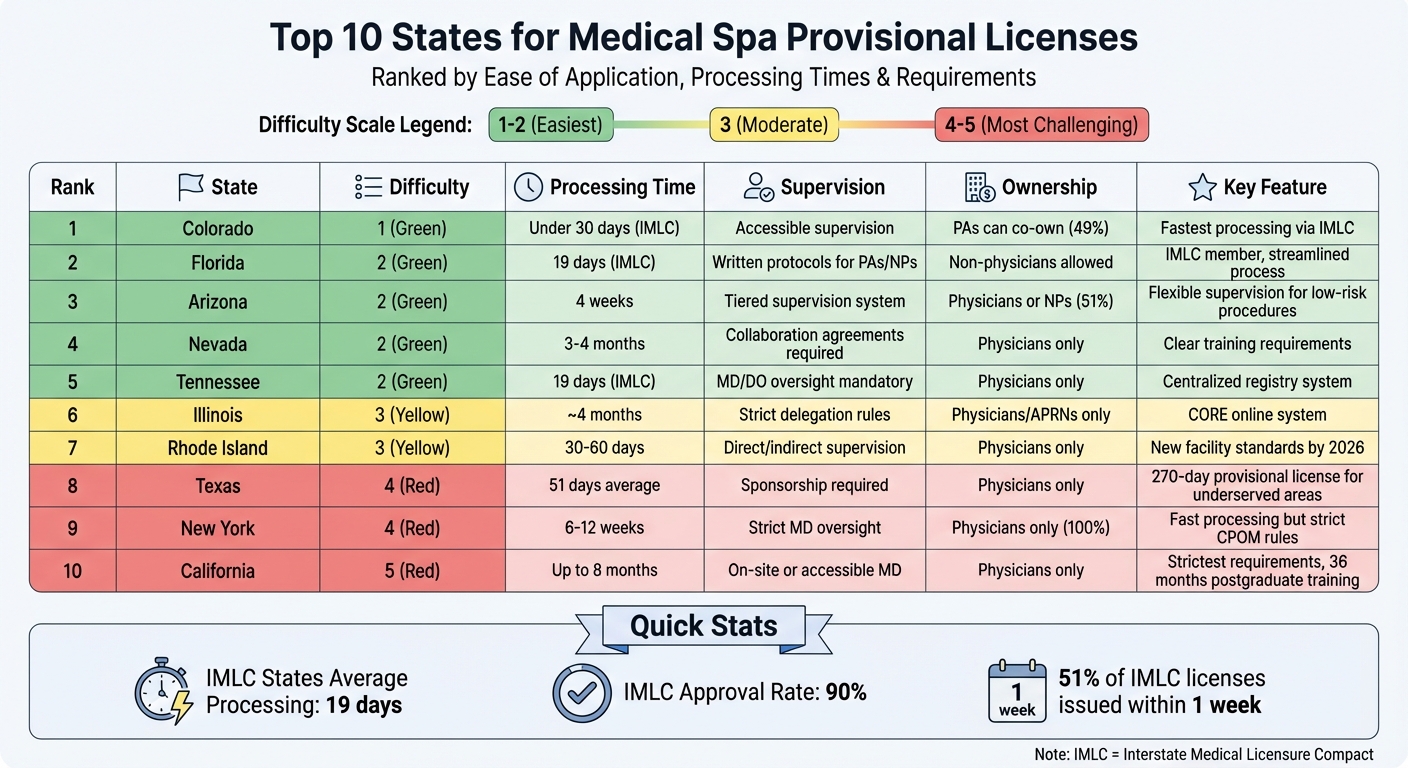
Top 10 States for Medical Spa Provisional Licenses: Processing Times and Requirements Comparison
1. Texas
Ease of Application Process
Texas simplifies the provisional license application process with its License Inquiry System of Texas (LIST). This online portal lets applicants track their application status, upload documents, and receive updates from the Board. Additionally, Texas accepts the Federation of State Medical Boards' Uniform Application, making it easier for out-of-state physicians to transfer their credentials.
Before applying, physicians need to ensure their intended practice location qualifies as a Medically Underserved Area (MUA) or Health Professional Shortage Area (HPSA). To verify this, applicants should contact the Texas Department of State Health Services at [email protected]. While the full medical license application can be completed online, the provisional license application (Form G) must be submitted by mail along with a check or money order for $107.00.
Processing Time
The Texas Medical Board typically processes physician licensure applications within an average of 51 days. Licenses are issued twice monthly, providing applicants with a clear timeline. A provisional license allows qualified out-of-state physicians to practice in Texas for up to 270 days while their full medical license application is under review. This extended timeframe ensures physicians can begin practicing without unnecessary delays.
Supervision Requirements
Provisional license holders need sponsorship from a Texas-licensed physician who will oversee their practice. However, in certain cases, a hardship waiver may exempt them from this requirement. For noninvasive cosmetic procedures, the supervising physician or physician assistant (PA) must either be physically present or immediately available for emergency consultation. They should also be able to provide emergency care if needed. This setup offers flexibility by allowing remote supervision, as long as emergency support is readily accessible.
Eligible Practitioner Roles
Physicians holding an active medical license in good standing from another state or Canadian province are eligible for a provisional license in Texas. Applicants must have already applied for a full Texas medical license and passed the Texas Medical Jurisprudence Examination. Additionally, all applicants are required to complete a criminal background check by submitting fingerprints through IdentoGo by IDEMIA.
2. Florida
Ease of Application Process
In 2024, Florida became the 40th state to join the Interstate Medical Licensure Compact (IMLC), making it easier for out-of-state physicians to apply for licensure through a faster process. To meet state requirements, applicants must complete electronic fingerprinting using FDLE-approved LiveScan services, ensuring the correct ORI number is used to route fingerprint data to the Board of Medicine. It's essential to include all necessary documents, such as diplomas and residency certificates, to avoid receiving a deficiency notice about 30 days after submission. Florida's Sunshine Law also makes most application information public record, except for specific financial and patient-related data. These steps contribute to a smoother and more efficient licensing experience.
Processing Time
Florida reviews initial license applications within 30 days. Completing the licensing process for a Limited License typically takes between two and six months, depending on how quickly any deficiencies are addressed.
Supervision Requirements
Florida has specific supervision rules for certain medical settings, particularly medical spas. Nurse practitioners and physician assistants must be supervised by a board-certified dermatologist or plastic surgeon. While the supervising physician doesn’t need to be physically present, all procedures must follow written protocols that are regularly reviewed. Each medical spa must also have a licensed physician serving as its medical director. Additionally, Limited License applicants who have been out of active practice for more than three years must complete six months of supervision under a board-approved physician.
Eligible Practitioner Roles
Florida offers a Limited License option for physicians licensed in any U.S. jurisdiction for at least 10 years, allowing them to practice in areas of critical medical need or provide non-compensated services. Recent graduates can also apply through the Graduate Assistant Physician pathway, which permits practice under restricted conditions. For compensated practice, fees include $300.00 for the application, $355.00 for the initial license, and a NICA fee of $250.00 or $5,000.00. However, fees are waived for non-compensated or retired practitioners.
3. Arizona
Ease of Application Process
Arizona simplifies the licensing process with its provisional certificate program. Applicants need to complete 40 hours of didactic training at an approved program to get started. This certification enables them to jump into hands-on training, which includes 24 hours for hair removal and an additional 24 hours plus 10 procedures for other cosmetic laser treatments.
Once an application is submitted, a licensing coordinator is assigned to assist. As an IMLC member, Arizona allows qualifying physicians to obtain licensure in less than 30 days, while medical spa applications are typically processed within 4 weeks. Applicants can track their progress through the Arizona Barbering and Cosmetology Board's online portal. These streamlined steps ensure a smooth transition into Arizona’s structured supervision protocols.
Supervision Requirements
Arizona uses a tiered supervision system tailored to the risk level of procedures. Fully certified laser technicians performing hair removal only require indirect supervision, which can be done through telecommunication. For other cosmetic laser services, direct supervision is mandatory, meaning a licensed health professional must be on-site during treatments.
Higher-risk Level III procedures, such as Botox or dermal fillers, demand close oversight by a medical director and can only be performed by licensed physicians, APRNs, or RNs. Every medical spa must have a medical director - either a licensed physician (MD/DO) or an APRN - who approves written protocols for all procedures offered. Additionally, all lasers, radiofrequency devices, and IPL equipment must be registered with the Arizona Department of Health Services (ADHS).
Eligible Practitioner Roles
Arizona pairs its streamlined licensing and supervision with clear practitioner eligibility rules. Under the state's Corporate Practice of Medicine doctrine, at least 51% of a medical spa's clinical practice must be owned by a licensed physician or qualified nurse practitioner. Only physicians, APRNs, and RNs are eligible to serve as injectors, while laser operators can include RNs, aestheticians, and Certified Laser Technologists (CLTs).
Non-medical entrepreneurs can participate through Management Services Organizations, but unlicensed owners must obtain a separate facility license from ADHS. For healthcare professionals licensed in other U.S. states or territories, Arizona also provides Temporary Licensure options, allowing them to practice while meeting state-specific requirements.
4. Illinois
Illinois has made strides in simplifying its licensing process, focusing on efficiency and clear regulatory oversight for medical professionals.
Ease of Application Process
Illinois introduced the CORE (Comprehensive Online Regulatory Environment) system on October 30, 2024, which serves as a centralized online portal for professional licensing applications, including those for medical spa practitioners. With CORE, applicants can submit their materials electronically and track the status of their applications in real time, whether they are under review, issued, or flagged for deficiencies.
For physicians, Illinois provides options such as the "Physician Temporary License" and "Physician Limited Temporary License." Applicants are responsible for addressing deficiency notices through the CORE system to avoid delays.
"Professional licenses will be issued once the Department reviews an application and confirms all required materials have been submitted and all requirements for licensure have been met." - IDFPR
Supervision Requirements
Illinois enforces a medical-focused model for procedures like Botox, dermal fillers, and laser hair removal, classifying them as medical services. A joint memo from the Illinois Department of Financial and Professional Regulation (IDFPR) and the Illinois Department of Public Health (IDPH), issued on December 2, 2024, mandates that these procedures be performed under proper professional supervision.
Medical spas in Illinois must adhere to strict licensing rules. They cannot combine medical services with cosmetology or esthetics under a single license. Additionally, licensed cosmetologists and estheticians are prohibited from performing any medical procedures, even if delegated by a physician.
Eligible Practitioner Roles
Ownership of medical spas is restricted to licensed physicians (MD/DO) and, in some cases, Advanced Practice Registered Nurses (APRNs), provided they operate under the appropriate Professional Corporation or Limited Liability Acts.
Practitioners such as Physician Assistants (PAs), Advanced Practice Nurses (APNs), Registered Nurses (RNs), and Licensed Practical Nurses (LPNs) must hold the necessary licenses to perform medical spa services. Furthermore, facilities offering only cosmetology or esthetics services are prohibited from using medical terminology in their business names, as this could mislead clients about the services they provide.
5. Rhode Island
Rhode Island has revamped its approach to medical spa regulation with the Medical Spas Safety Act (H 5351), enacted on June 30, 2025. This law now requires medical spas to operate under the licensing standards for healthcare facilities set by the Department of Health (DOH).
Ease of Application Process
Rhode Island simplifies the setup process for medical spas by exempting them from the certificate of need requirements. This exemption removes a significant administrative hurdle, making it easier for new facilities to open.
"The law exempts medical spas from Rhode Island's certificate of need requirements under the Determination of Need statute but otherwise brings them within the broader regulatory architecture applied to ambulatory care settings."
– Nixon Peabody LLP
The DOH must finalize all necessary regulations, including licensure and facility standards, by July 1, 2026. To stay updated, ensure your contact information with the DOH is accurate, as all official communications are sent via email. Be aware that incomplete physician applications will be withdrawn if not completed within one year.
These changes aim to simplify the establishment process while ensuring clear guidelines for oversight and compliance.
Supervision Requirements
Rhode Island separates supervision into two categories: direct supervision (on-site) and indirect supervision (off-site but immediately available). Both types are allowed depending on the procedure. However, procedures involving ablative lasers or energy devices are strictly regulated - they must be performed by a physician, physician assistant, or certified nurse practitioner and cannot be delegated.
Eligible Practitioner Roles
Ownership of a medical spa in Rhode Island is restricted to licensed physicians. Non-physicians, including physician assistants, nurse practitioners, registered nurses, and estheticians, are prohibited from owning these facilities. Each spa must appoint a medical director, who must either be a physician or a certified nurse practitioner with specialized training in cosmetic medical procedures. Additionally, cosmetic procedures can only be performed by physicians, physician assistants, or advanced practice registered nurses, with delegation allowed only within their professional scope of practice.
6. Tennessee
Since January 1, 2016, Tennessee has operated a centralized online registry that simplifies the registration process for medical spas. This system helps medical directors and supervising physicians manage oversight efficiently.
Ease of Application Process
Registering a medical spa in Tennessee is a straightforward process. Medical directors or supervising physicians need to complete Form PH-4289 and submit it to their respective licensing board. Clear definitions provided by the state help avoid confusion during the application process.
For physicians licensed in other states participating in the Interstate Medical Licensure Compact (IMLC), Tennessee offers an expedited pathway to obtain a license. Additionally, practitioners can handle renewals and updates through a user-friendly online Licensure Renewal System. The initial fee for an Aesthetician license is $60, with a renewal fee of $60 every two years.
Once the application is approved, the state enforces strict oversight to ensure compliance with its regulations.
Supervision Requirements
Every medical spa in Tennessee must have a licensed MD or DO with an active in-state practice serving as the medical director. The director's name and board certification status must be displayed both on-site and in all advertising materials. This physician is legally accountable for all cosmetic medical services performed at the facility.
If the medical director is not board-certified, this must be clearly disclosed on the practice's signage and marketing. While Physician Assistants and Nurse Practitioners are permitted to perform cosmetic procedures, they must work under the supervision of a licensed physician.
Eligible Practitioner Roles
Aestheticians in Tennessee are required to complete 750 hours of instruction and pass both written and practical exams with a minimum score of 70%. The medical director must be a licensed Medical Doctor (MD) or Osteopathic Physician (DO) with an active Tennessee license. Operating a facility without proper registration is considered "unprofessional conduct" and may result in disciplinary action.
sbb-itb-02f5876
7. California
California stands out as the largest medical spa market in the United States. With nearly 2,900 businesses operating in the state, California accounts for 11.5% of all registered med spas nationwide. However, the state also enforces some of the strictest regulations in the country when it comes to medical practice. These rules significantly influence both provisional and full licensure processes, making California a unique and highly regulated environment for medical spa operations.
Ease of Application Process
Obtaining medical licensure in California is widely regarded as a tough process, thanks to its lengthy timelines and extensive documentation requirements. The state enforces the Corporate Practice of Medicine (CPOM) doctrine, which mandates that only licensed physicians or a Professional Corporation (PC) with at least 51% physician ownership can own a medical spa. While non-physicians cannot own the clinical side, they are allowed to manage business operations through a Management Services Organization (MSO). Additionally, any physician planning to operate under a business name like "Radiant Med Spa" must secure a Fictitious Name Permit (FNP) from the Medical Board of California. Applications can be denied or suspended if the applicant is listed as a delinquent taxpayer or has unpaid court-ordered child support obligations.
Processing Time
California's licensing process also includes specific training requirements and timelines. Physicians must obtain a Postgraduate Training License (PTL) within 180 days of starting a Board-approved residency program. Full licensure, however, requires 36 months of accredited postgraduate training. The Medical Board of California provides expedited processing for honorably discharged veterans and those intending to work in medically underserved areas.
"California medical licensing requirements often involve longer timelines and exhaustive documentation, especially for international medical graduates (IMGs)." - David Ivaniuk, MedicalLicensing.com
Supervision Requirements
California law requires physicians to provide "adequate supervision" for any delegated medical procedures. While supervising physicians don’t need to be physically present at all times, they must remain accessible to oversee nurses and physician assistants effectively. Physician Assistants (PAs) need formal supervision agreements, and Nurse Practitioners (NPs) must adhere to established protocols before performing procedures. For treatments involving prescriptions, such as Botox, a physician, PA, or NP must first conduct a "good-faith examination" of the patient. Additionally, medical records must be kept for at least seven years.
Eligible Practitioner Roles
In California, only licensed MDs, DOs, NPs, PAs, and RNs are authorized to perform medical procedures like Botox injections, laser treatments, and microneedling. Estheticians, however, are restricted to non-medical services such as facials, non-medical peels, and microdermabrasion. To confirm a practitioner's license, you can visit the Medical Board of California (www.mbc.ca.gov) or the Board of Registered Nursing (www.rn.ca.gov).
8. Nevada
Nevada has a structured licensing system tailored for both physicians and estheticians, offering clear pathways for provisional practice. Physicians can obtain a physician training license, allowing them to practice under supervision before earning full licensure. For estheticians in medical spas, the Advanced Esthetician license is the key credential for performing nonablative procedures.
Ease of Application Process
Nevada’s licensing process is thorough and comes with specific requirements. Physicians must complete three years of progressive postgraduate training to qualify for a medical license, placing Nevada among the more demanding states in this regard. For Advanced Estheticians, the fees include $70 for a two-year license or $140 for a four-year license, along with a $110 examination fee. Applicants must ensure their licensure certification is sent directly from the issuing agency to the Nevada Board - altered forms are not accepted, and certifications are valid for only six months. Additionally, all communications must include the sender’s name, email, phone number, and mailing address for identification purposes.
Processing Time
The licensing process in Nevada typically takes 3–4 months due to the extensive documentation and credential verification required. While Nevada is part of the Interstate Medical Licensure Compact (IMLC), which can speed up the process for those licensed in other member states, applicants should still anticipate delays. Ensuring all credentials and background checks are accurate and complete is essential to avoid setbacks.
Supervision Requirements
Nevada has strict supervision rules for medical spa procedures. Advanced Estheticians must operate under a written collaboration agreement with a supervising health care professional who must be immediately available during procedures. Signs confirming supervision must also be displayed. Importantly, registered nurse (RN) supervision does not meet Nevada’s legal standards for this role. The supervising professional is responsible for addressing any adverse events that may arise during treatments.
Eligible Practitioner Roles
Nevada outlines specific roles for physicians, APRNs, Advanced Estheticians, and Cosmetologists in medical spa settings. Procedures like Botox, fillers, and laser treatments are generally limited to physicians and APRNs. The state also offers a provisional instructor license in cosmetology and medical spa fields, valid for one year at a cost of $70. Under the Corporate Practice of Medicine (CPOM) doctrine, only licensed physicians can own medical spas, though non-physicians may share profits under defined agreements.
9. Colorado
Colorado is known for its efficient licensing process, making it one of the easiest states in the U.S. to obtain a medical license. The Colorado Medical Board processes hundreds of applications each year, with most licenses issued within 60 days once all materials are submitted. This streamlined system ensures that qualified professionals can enter medical spa roles quickly, enhancing access to services.
Ease of Application Process
Colorado uses the DPO Online Services system to handle all licensing applications. A helpful feature is the "bump period", which extends licenses issued within 120 days of the renewal period, saving applicants from paying extra fees. Applicants must also maintain professional liability insurance of at least $1,000,000 per incident and $3,000,000 annually to qualify for licensure.
Processing Time
For standard applications, processing typically takes 60–90 days if all documents are submitted on time. However, those applying through the Interstate Medical Licensure Compact (IMLC) may receive their licenses in under 30 days, further speeding up the process.
Eligible Practitioner Roles
Colorado offers a three-year Physician Training License for residents or fellows, which can be renewed once. Additionally, a Re-entry License is available for physicians, physician assistants, and anesthesiologist assistants who have not practiced in the last two years. These options allow practitioners to quickly begin offering treatments like Botox, fillers, and laser procedures in medical spas. Under the state's Corporate Practice of Medicine doctrine, medical spas must be physician-owned, though physician assistants are permitted to hold up to 49% ownership.
10. New York
New York is known for being one of the quickest states to issue medical licenses, with processing times ranging from 4 to 12 weeks. David Ivaniuk of MedicalLicensing.com highlights this efficiency, stating, "New York is one of the quickest states for obtaining a medical license. It does not require verification of employment, malpractice history, hospital privileges, or previous medical licenses".
Ease of Application Process
New York simplifies its licensure process with an online "Office of Professions" portal. This platform makes it easy for applicants to upload documents and schedule exams online. Unlike many other states, New York skips time-consuming verification steps, such as employment history or malpractice checks. For estheticians, the state offers a six-month temporary license for just $10. This option is available to individuals who have completed a 600-hour approved course but have not yet passed the state exams. The temporary license can be bundled with the initial application for a total fee of $50.
Processing Time
Physician applications typically take 6 to 12 weeks to process once all materials are submitted. In many cases, approvals are visible online before the physical license arrives. However, international medical graduates face additional steps, as they must provide a Federation Credentials Verification Service (FCVS) profile, which can extend the timeline. This streamlined process underscores New York's commitment to efficient licensure.
Supervision Requirements
New York maintains strict supervision rules. Remote medical directors who only sign paperwork are not allowed - physicians must actively prescribe treatments and review patient records. Registered Nurses and Physician Assistants are permitted to perform injections and other medical procedures, but only under direct supervision from a physician. Licensed estheticians are restricted to treatments that do not penetrate the skin or go beyond the epidermis.
Eligible Practitioner Roles
Under New York's Corporate Practice of Medicine doctrine, medical spas must be 100% physician-owned through a Professional Corporation or PLLC. Services can be provided by Nurse Practitioners, Physician Assistants, Registered Nurses, Licensed Practical Nurses, and licensed estheticians, as long as they operate under appropriate medical supervision.
State Comparison Table
The table below provides a snapshot of the top 10 states ranked by application difficulty, processing times, and licensing requirements. The difficulty scale ranges from 1 (easiest) to 5 (most challenging), offering a quick overview of the licensing landscape across states.
Colorado emerges as the easiest state for medical licensing, with the lowest difficulty rating and the fastest processing times. For states participating in the Interstate Medical Licensure Compact (IMLC) - like Arizona, Colorado, Florida, Illinois, Nevada, Tennessee, and Texas - licenses are processed in an average of 19 days. Impressively, 51% of these licenses are issued within a week, and the approval rate stands at 90%. These numbers align with the detailed state-specific profiles discussed earlier.
California, on the other hand, presents the most challenging licensing process. It requires up to 8 months for processing, enforces stringent Corporate Practice of Medicine (CPOM) rules, and mandates 36 months of postgraduate training for international medical graduates.
Here’s a summary of the key comparisons, highlighting the unique requirements and timelines for each state:
| State | Difficulty Rating (1-5) | Processing Time | Key Licensing Requirements |
|---|---|---|---|
| Colorado | 1 | Under 30 days (IMLC) | Expedited processing through the IMLC |
| Florida | 2 | ~19 days (IMLC) | - |
| Arizona | 2 | ~19 days (IMLC) | - |
| Nevada | 2 | 3–4 months (standard) | Requires 3 years of postgraduate training |
| Tennessee | 2 | ~19 days (IMLC) | Must register with the state Medical Spa Registry |
| Illinois | 3 | ~19 days (IMLC); up to 4 months (full) | IMG pathway requires 3 years of supervised practice |
| Rhode Island | 3 | 30–60 days | Federation Credentials Verification Service (FCVS) is required |
| Texas | 4 | 51 days average | Provisional licensing for physicians only; practice limited to MUA/HPSA (max 270 days) |
| New York | 4 | 6–12 weeks | Enforces strict CPOM, mandating 100% physician ownership |
| California | 5 | Up to 8 months | Enforces strict CPOM; international applicants must complete 36 months of accredited postgraduate training |
Both New York and California adhere to strict CPOM rules, requiring operations to be fully physician-owned through Professional Corporations or PLLCs. This significantly impacts the licensing process, especially for non-physician-owned entities or international applicants.
Conclusion
Each state has its own way of handling provisional licensing, offering options tailored to the needs of medical spa practitioners. For example, Florida, Arizona, and Colorado make provisional licensing more accessible. Florida and Arizona allow non-physicians to own medical spas, creating opportunities for broader ownership models. Colorado, on the other hand, permits Physician Assistants to own up to 49% of a medical spa. Texas stands out with its 270-day provisional practice option for physicians working in HPSA or MUA areas, though this requires sponsorship by a Texas-licensed physician. Meanwhile, Tennessee simplifies compliance with its mandatory Medical Spa Registry for facilities offering cosmetic medical services.
Given the complexity of these regulations, managing compliance and licensing requirements can be overwhelming. That’s where tools like Prospyr’s HIPAA-compliant platform come in. By integrating CRM and EMR systems, automating compliance tasks, and securely managing documentation, it helps practitioners keep track of credentialing records and renewal deadlines - key for staying on top of state-specific rules.
Before starting the provisional licensing process, ensure your practice location meets the necessary state criteria. For instance, in Texas, practitioners should contact the Department of State Health Services (DSHS) to confirm if their location qualifies as an MUA or HPSA.
FAQs
What are the key differences in provisional licensing rules for medical spas across states?
Provisional licensing rules for medical spas differ widely across states, particularly in areas like ownership requirements, scope of practice, and licensing procedures. For example, some states grant provisional licenses to physicians working in underserved areas, while others focus on defining who is qualified to perform certain procedures - distinguishing between licensed medical professionals and cosmetologists or aestheticians.
In Texas, applicants must meet strict criteria, such as passing exams and completing background checks. Tennessee, on the other hand, prioritizes having a medical director and proper registration before offering cosmetic medical services. Meanwhile, some states bypass provisional licenses altogether, requiring full licensure and adherence to local regulations from the start.
These differences highlight how each state tailors its rules to ensure the safe and legal operation of medical spas.
How does the Interstate Medical Licensure Compact (IMLC) impact provisional license processing times?
The Interstate Medical Licensure Compact (IMLC) simplifies the licensing process for medical professionals, offering a quicker way to secure licenses in participating states. This approach can cut down on the time it usually takes to process provisional licenses, allowing practitioners to start working much sooner.
By meeting the IMLC's eligibility criteria, applicants gain access to a streamlined application process. This reduces the usual paperwork and avoids many of the delays tied to traditional licensing methods.
Why is it so difficult to get a medical spa provisional license in California?
California stands out for having some of the strictest rules when it comes to medical spa provisional licenses. In this state, only licensed physicians or professional corporations owned by physicians are permitted to own and operate medical spas. This ensures that the person at the helm has the necessary medical expertise.
When it comes to treatments like those involving needles, lasers, or prescriptions, things get even stricter. These procedures require medical judgment, meaning non-physician practitioners can only perform them under close supervision.
The regulations don't stop there. They also cover staffing and operational standards, adding layers of complexity to compliance. While these rules are designed to prioritize patient safety, they can make the licensing process particularly challenging for newcomers to the industry.