
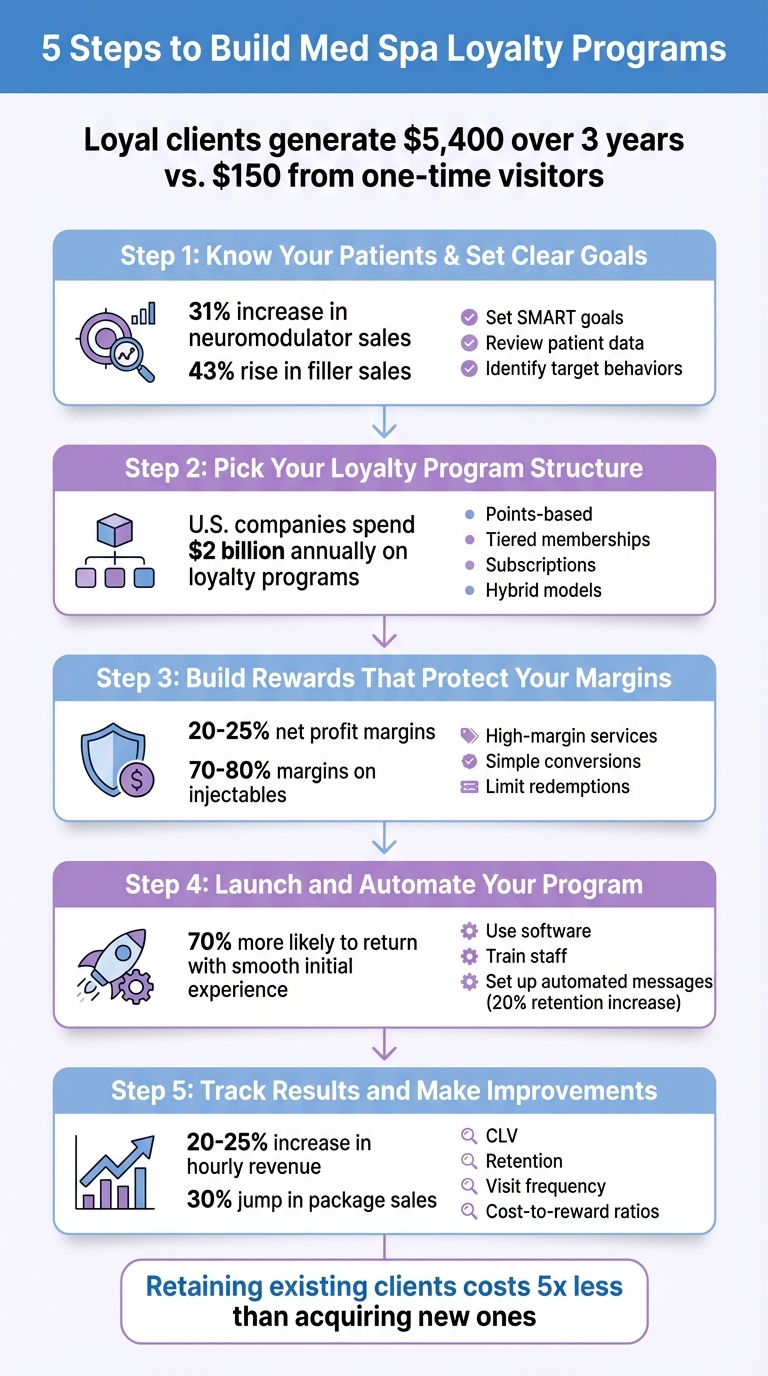
Med spas can boost revenue and retain clients by implementing loyalty programs. These programs reward repeat customers with perks like points, discounts, or memberships, encouraging them to return regularly and spend more. A loyal client can generate up to $5,400 over three years, compared to $150 from a one-time visitor. Here’s how to build a successful program:
- Understand your clients and set goals: Use patient data to identify behaviors to reward, like repeat visits or referrals, and align rewards with business objectives.
- Choose a program structure: Options include points systems, tiered memberships, subscriptions, or hybrid models.
- Design profitable rewards: Focus on high-margin services and set clear redemption rules to protect your bottom line.
- Automate and launch: Use software to manage points, payments, and communication while training staff to promote the program effectively.
- Track and refine: Monitor metrics like retention and spending, and adjust rewards based on performance.
Loyalty programs not only increase patient lifetime value but also create predictable revenue streams and reduce the cost of acquiring new clients. A clear, well-managed system ensures long-term growth and client satisfaction.
5 Steps to Build a Successful Med Spa Loyalty Program
Step 1: Know Your Patients and Set Clear Goals
Before starting a loyalty program, it's crucial to understand your patients and define your objectives. A program tailored for "Luxury Indulgers" who value VIP perks won't appeal to "Event-Driven Achievers" seeking quick results before an event like a wedding or reunion. To make your program effective, align rewards with patient behaviors and your business goals. Start by identifying your target outcomes and using patient data to guide your strategy.
Set Your Program Goals
Establish clear metrics to measure success. Are you looking to boost retention, increase the average spend per visit, or promote underutilized high-margin services? For example, single-location med spas might prioritize retention, while multi-location practices may need scalable, standardized programs. If your aim is to grow injectable sales, consider this: membership programs have led to a 31% increase in neuromodulator sales and a 43% rise in filler sales at aesthetic clinics. Set SMART goals, like increasing annual member spending by $1,100.
Review Patient Data
Dive into your practice management system for valuable insights. Analyze patient visit frequency, spending habits, and key financial metrics like revenue per treatment and monthly recurring revenue (MRR). This data can reveal trends in rebooking behaviors and spending patterns. Also, track conversion rates to see how many consultations turn into treatments. Practices using automated software for these analyses have reported a 20–25% increase in hourly revenue and a 30% jump in package sales.
"I'm always looking at my clinic in terms of growth. I'm aiming for 10, 20, 30% growth. It's important for me to access data that shows me how I'm doing." – Dr. Ahmed El Houssieny, Founder and Medical Director of Bank MediSpa
Identify Target Behaviors to Reward
Use data-driven insights to ensure your rewards encourage the right actions. Once you understand your patients and goals, decide which behaviors to incentivize. Focus on actions that align with your objectives - such as repeat visits, referrals, trying new services (like a Botox patient exploring skincare products), or even non-spending behaviors like writing reviews. For instance, if you have slow appointment slots on Tuesdays, offer double points for bookings on that day. This approach maximizes staff productivity without resorting to discounts. You can also reward underutilized services to encourage patients to try them.
Step 2: Pick Your Loyalty Program Structure
Once you’ve nailed down your goals and the behaviors you want to encourage, it’s time to choose a loyalty program structure that fits your med spa’s size and services. The right structure depends on whether your focus is driving frequent visits, rewarding high spenders, or promoting specific treatments. With U.S. companies pouring over $2 billion annually into loyalty programs, standing out means creating something that’s both simple and worthwhile. Start by comparing different models to find the one that aligns best with your practice’s objectives.
Compare Program Models
Different loyalty structures cater to unique business goals and patient preferences. Here’s a quick breakdown:
- Points-Based Systems: Perfect for rewarding every dollar spent. For example, patients earn 1 point for every $1 they spend and can redeem points for discounts or free services. It’s straightforward, works across all treatments, and is easy to scale.
- Tiered Memberships: Ideal for practices with a range of price points. Patients subscribe to tiers like Silver, Gold, or Platinum, each offering increasing benefits. For instance, a Silver tier at $99/month might include one signature facial and 10% off other treatments, while a Platinum tier at $249/month could offer a medical-grade peel and 20% off.
- Subscription Models: These charge a monthly fee for maintenance treatments like neurotoxins or facials. Subscriptions help patients spread out costs while ensuring regular visits.
- Paid or Fee-to-Join Programs: Patients pay an upfront fee (e.g., $150) and receive immediate perks like gift cards, consultations, or ongoing discounts (5–10%).
- Specialized Memberships: These focus on specific goals, like a "Tox Membership" or "Clear Skin Membership", targeting patients with niche needs rather than offering your full service menu.
- Treatment Packages or Punch Cards: Great for rewarding loyalty over time. For example, “Buy 5 Botox treatments, get 1 facial free”.
- Hybrid Models: Combine multiple elements, like awarding points for small actions (e.g., reviews or social media shares) while offering tiered rewards for higher spenders.
Here’s a quick comparison of the most common models:
| Program Model | Best For | Primary Benefit |
|---|---|---|
| Points-Based | High-frequency consumables | Easy to understand and scale |
| Tiered | High-value/VIP patients | Encourages higher spending for perks |
| Subscription | Maintenance treatments | Provides steady, recurring revenue |
| Paid/Fee-to-Join | Immediate cash flow | Builds commitment and delivers value |
| Specialized | Specific patient goals | Focuses on niche interests |
Once you’ve picked a structure, make sure your patients understand exactly how they’ll earn and redeem rewards. Simplicity is key to keeping the program profitable and user-friendly.
Create Earning and Redemption Rules
After choosing your model, set clear and simple rules so patients can easily grasp how the program works. For a points-based system, you might offer 1 point per $1 spent. To give a 10% reward, patients could redeem 500 points for a $50 discount. To protect your margins, consider offering branded merchandise as rewards - items with a $50 retail value might only cost you $25, effectively cutting your loyalty cost in half.
For tiered memberships, limit the options to 2–4 levels with increasing monthly fees and perks. For example, offer short-term commitments (3–6 months) to make it easier for patients to join. You can also reward non-purchase behaviors like writing reviews, referring friends, or following your social media pages. To fill slower appointment slots, try offering double points during those times. Automating the process with specialized software is a smart move, as it eliminates the hassle of tracking points manually or using physical cards.
"The clearer and more straightforward your program, the more eager your patients will be to invest in it. Overcomplicating it or offering too many options can cause 'analysis paralysis.'" – Sarah Eberle, Med Spa Marketing Expert, RepeatMD
Follow Medical Compliance Rules
When designing loyalty programs, med spas must follow local advertising and medical compliance laws. This includes adhering to regulations about marketing “free” medical procedures and ensuring referral incentives don’t violate anti-kickback laws. Before launching your program, review your state’s medical board guidelines and consult a healthcare attorney if necessary. Be transparent in your promotional materials, clearly outlining the terms and conditions of your program. Avoid language that could be seen as misleading or deceptive - compliance protects both your practice and your patients.
Step 3: Build Rewards That Protect Your Margins
With your loyalty program framework in place, the next step is designing rewards that maintain your profitability. Med spas typically operate on 20–25% net profit margins, so it’s essential to focus on high-margin services and set clear boundaries on redemptions to ensure your program generates net revenue.
Focus on High-Margin Services for Rewards
Rewarding customers with high-margin services is a smart way to protect your bottom line. Treatments like laser hair removal and RF microneedling, which rely on equipment requiring a one-time investment, are excellent options. Injectable treatments, such as Botox and fillers, are also highly profitable, often delivering 70–80% margins.
"Injectables have one of the highest ROIs in the aesthetic space. The materials... often yield margins of 70–80%." – AP Marketing, AestheticsPro
Other services like IV therapy and vitamin injections are standout choices for loyalty rewards. These treatments typically cost $25–$100 to prepare but are priced between $150 and $350 per session, offering substantial profit margins. Similarly, medical-grade skincare and retail products protect your margins while reinforcing your expertise. You can even bundle high-margin add-ons, such as exosome serums or B12 shots, as complimentary perks for loyalty members.
Avoid offering discounts on treatments that require expensive, single-use supplies, as these can quickly eat into your profits.
Simplify Points-to-Dollar Conversions
A straightforward points system makes your program easy to understand. For example, you can award 1 point for every $1 spent. To align with the common 10% reward benchmark, allow customers to redeem 500 points for a $50 discount.
To further reduce costs, consider offering branded merchandise or retail products as rewards. For instance, a product with a $50 retail value might only cost you $25, creating the perception of a 10% reward while keeping your actual cost closer to 5%.
"I recommend you offer merchandise as a reward because your cost will be $25, but the client will receive a value of $50. This practice allows you to decrease your loyalty cost to a five percent reward instead of 10 percent." – Dori Soukup, CEO and Founder, InSPAration Management
You can also use double-point promotions during slower hours to encourage bookings without resorting to price cuts. These strategies ensure you maintain profitability while keeping your rewards appealing.
Limit Reward Redemptions
To safeguard your margins, set clear limits on how rewards can be used. For example, you might cap per-visit redemptions at $100 or restrict free services to one per month. For membership programs, ensure the monthly fee at least covers the cost of the patient’s first service.
"A membership fee should pay for the patient's first service. For example, if your med spa offers a $600 same-day treatment when a patient makes a $99 payment, you're losing money right off the bat." – Skytale Group
For tiered memberships, design rewards that encourage higher spending without compromising profitability. For instance, a Silver tier at $99/month might include one $99 service and 10% off additional treatments, while a Platinum tier at $249/month could offer one $249 service and 20% off. This ensures patients who invest more in your program receive better benefits, while your margins remain intact across all tiers.
sbb-itb-02f5876
Step 4: Launch and Automate Your Program
Rolling out your loyalty program effectively means combining automation, well-trained staff, and smart messaging. This ensures your thoughtfully designed rewards system runs smoothly and delivers a seamless experience for your patients.
Use Software to Manage Your Program
Manually managing a loyalty program can be a headache. That’s why using an all-in-one HIPAA-compliant platform like Prospyr (https://prospyrmed.com) can make all the difference. With Prospyr, you can automate tasks like tracking points, processing payments, and updating member information. For example, when a patient completes a treatment, the platform automatically adjusts their points balance and sends them a confirmation message. Everything is handled in one centralized system, simplifying program management for your entire practice.
Here’s a compelling stat: patients are 70% more likely to return if their initial experience is smooth and stress-free. Automation not only supports efficiency but also enhances the overall patient experience.
Train Your Staff
While automation handles the technical side, your staff plays a crucial role in promoting the program. The front-desk team, in particular, should actively present the loyalty program as a valuable perk and guide patients through the enrollment process.
"It will be the front-line administrative staff that will help determine the success of the program, as they can advertise it and sign people up while they wait in the waiting room." – IAPAM
Make sure your team explains the program in simple, clear terms - how points are earned, redeemed, and the benefits of participating. If the explanation feels too long, refine the pitch to make it more concise. Giving your staff access to a digital interface can also help them show patients their accumulated savings in real time, reinforcing the program's value.
Set Up Automated Messages
Automated communication is key to keeping patients engaged and informed. By setting up email and SMS campaigns, you can notify patients when they earn rewards, hit milestones, or even during slower periods to encourage re-engagement. These automated messages can increase customer retention by 20%, while personalized campaigns can boost engagement by up to six times.
Platforms like Prospyr make it easy to create "set and forget" campaigns. For instance, you can send appointment reminders, update patients on their reward balances, or trigger re-engagement messages. If a patient reaches a reward milestone, an automated text can alert them to their available benefits. During slower times, you could run double-point promotions to fill appointment slots without resorting to discounts. This keeps your schedule full while protecting your bottom line.
Step 5: Track Results and Make Improvements
Once your program is live, keeping an eye on the numbers is crucial. Without tracking, you risk wasting both time and money.
Track Program Metrics
Pay attention to metrics like client retention, visit frequency, average spend, Client Lifetime Value (CLV), and cost-to-reward ratios to measure how well your program is working. CLV helps you understand the total revenue a patient generates throughout their relationship with your practice. At the same time, calculating your loyalty cost - the expense of rewards compared to the revenue they bring in - is essential. For example, offering branded items like robes or water bottles can lower loyalty costs to just 5% while delivering a perceived value of 10% to the client.
Adjust Rewards Based on Data
Use the data you collect to tweak your rewards strategy. For instance, if certain time slots are consistently slow, you could offer double points during those hours instead of relying on discounts. If high-margin services such as chemical peels aren’t performing well, consider making them redeemable through membership tiers. Review which rewards are being redeemed the most and phase out those that aren’t being used.
"The number one reason well-designed rewards programs work is value. Clients want to feel they are getting good value for their money and their loyalty." – AestheticsPro
If patients seem confused by your program rules, simplify them. Also, regularly remind members of the savings and perks they’ve earned. This not only reinforces the value of the program but also helps reduce cancellations.
Scale Your Program as You Grow
As your program evolves, aim for consistency across all locations. Tools like Prospyr (https://prospyrmed.com) can help you automate point tracking, manage memberships, and monitor performance metrics across multiple locations. This ensures every patient enjoys the same seamless experience, no matter where they go.
That said, don’t hesitate to adapt your offerings to local trends. For example, if one location has a higher demand for facials while another sees more interest in injectables, adjust your promotions to reflect those preferences. The key is to maintain a consistent core structure while allowing room for local flexibility. Over time, use your data to introduce new tiers, milestone bonuses, or surprise gifts at moments when patients are most likely to drop off.
Conclusion
Creating a thriving med spa loyalty program boils down to a few key elements: understanding your patients, selecting the right structure, safeguarding your margins, automating processes, and tracking performance. By focusing on these five steps, you can design a program that encourages growth and builds lasting patient relationships. Whether your goal is to fill slower appointment slots, highlight high-value services like chemical peels, or turn occasional clients into loyal, year-round patients, tailoring your program to your clinic's unique objectives ensures it delivers tangible benefits your patients will appreciate.
Shifting from one-time visits to a model built on consistent, relationship-based care is essential for long-term success. Loyal patients not only generate more revenue but are also far more cost-effective to retain - keeping an existing client costs up to five times less than acquiring a new one.
Simplicity is key. Overly complex rules can confuse patients and discourage participation. Whether you opt for a tiered membership program or a points-based system, the value of your program should be immediately clear to your patients.
Platforms like Prospyr (https://prospyrmed.com) streamline the entire process by handling rewards tracking, billing, membership management, and performance analytics - all within a HIPAA-compliant system. Automating these tasks not only boosts efficiency but also allows your staff to focus more on patient care. Plus, with data-driven insights, you can fine-tune your loyalty program to align with real patient behaviors.
Start with clear goals, design a program that protects your margins, and use automation to keep things running smoothly. The payoff? Predictable recurring revenue, increased patient lifetime value, and a practice that grows steadily without constantly needing to attract new clients. By following these steps, you’ll build a loyalty program that strengthens patient trust and drives sustainable growth for your practice.
FAQs
What are the benefits of having a loyalty program at a med spa?
A loyalty program can play a powerful role in keeping your med spa clients coming back and increasing your revenue. By offering rewards for repeat visits, you motivate clients to return more often, turning casual customers into devoted regulars. Here's a striking statistic: repeat customers typically spend 67% more than first-time visitors. Even better, boosting retention by just 5% can lead to profit increases ranging from 25% to 95%.
But the benefits don’t stop at the financials. A well-designed loyalty program enhances the client experience by offering perks that show appreciation and encourage them to explore new treatments. Plus, it gives your business a treasure trove of insights into client preferences, helping you create personalized marketing campaigns and custom offers that truly resonate. Tools like Prospyr make managing these programs a breeze, with features like automated payments and scheduling, ensuring your clients enjoy a smooth, hassle-free experience while reaping the rewards.
What are the best strategies for making med spa loyalty programs profitable?
To make your med spa loyalty program a financial success, start by setting clear revenue goals. Charge a membership fee that at least offsets the cost of initial services, ensuring you generate income right away. Combine this with tiered rewards that emphasize high-margin treatments like injectables or laser hair removal, while limiting discounts on services that rely heavily on consumable products. Membership plans priced between $50 and $300 per month, offering at least 10% savings, can motivate members to visit more often and spend more, creating a steady and predictable income stream.
Leverage data to retain clients and maximize profits. It’s far more cost-effective to keep an existing client than to acquire a new one, and loyal customers tend to spend more over time. Use strategies like seasonal promotions, referral bonuses, and personalized packages to keep clients engaged, while keeping discounts modest to safeguard your profit margins.
Lastly, simplify your program with automation tools. Platforms like Prospyr can handle billing, track member activity, and provide real-time insights into performance metrics. By combining thoughtful pricing, targeted promotions, and efficient management, your loyalty program can deliver consistent revenue growth and keep your clients happy.
How can I successfully create and manage a loyalty program for my med spa?
To create a thriving med spa loyalty program, start by crafting a structure that strikes the right balance between offering value to clients and maintaining profitability. Consider models like monthly memberships, points-based tiers, or service packages. Pricing should cover your costs without relying on steep discounts. For instance, monthly plans typically range from $50 to $300 and can include perks such as discounted treatments, priority booking, or access to exclusive events. Aim to offer clients at least 10% savings while keeping the program financially viable.
Leverage tools like Prospyr to simplify operations by automating tasks like payments, scheduling, and tracking member activity. Boost engagement by promoting your program with seasonal deals, referral bonuses, and personalized rewards tailored to clients’ treatment histories. Stay connected with members through regular email or SMS updates, highlighting benefits and special offers. Keep an eye on metrics like visit frequency, average spending, and retention rates to fine-tune your program, ensuring it delivers both happy clients and business growth.