
Properly classifying workers in your med spa is critical to avoid legal and financial risks. Misclassifications - such as labeling employees as independent contractors - can result in penalties, back taxes, and lawsuits. Here's what you need to know:
- Employees (W-2): You control their work schedule, provide tools, and offer benefits like paid time off. You must withhold taxes and comply with wage laws like overtime pay.
- Independent Contractors (1099): They work independently, set their own hours, and supply their own tools. They handle their own taxes and operate as separate businesses.
Misclassification risks include IRS audits, Department of Labor investigations, and state-specific penalties. For example, in California, fines for intentional misclassification can reach $25,000 per violation. Federal and state tests, such as the IRS Common Law Test and the ABC Test, help determine worker status.
Key Steps for Compliance:
- Document job duties and services for each role.
- Assess behavioral, financial, and relationship factors.
- Review state laws and supervision requirements.
- Use tools like Form SS-8 or the Voluntary Classification Settlement Program if unsure.
Missteps in classification can lead to severe consequences, so regular audits and clear documentation are essential. Platforms that centralize records and track roles can simplify compliance efforts.
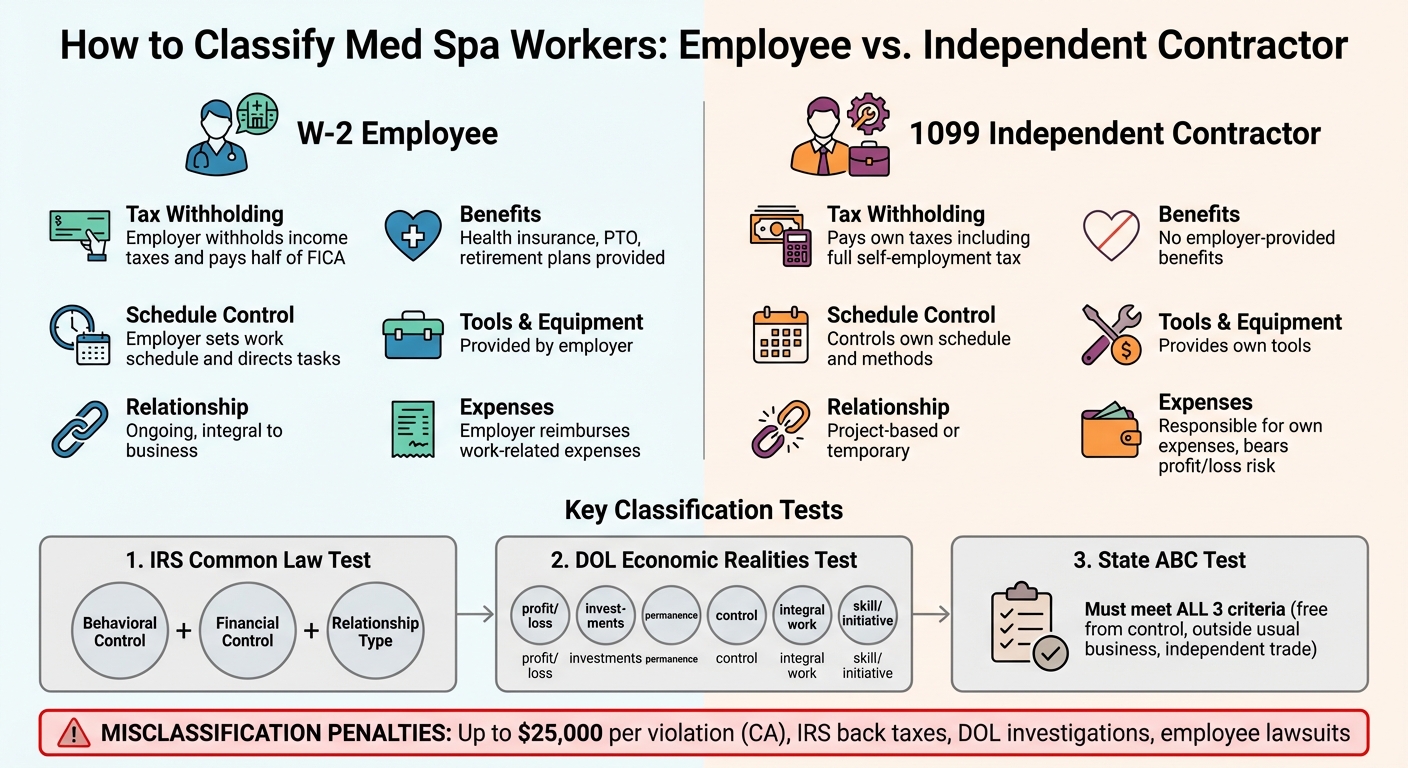
Employee vs Independent Contractor Classification Guide for Med Spas
Classification Tests You Need to Know
Federal and state authorities use various methods to determine whether your workers are employees or independent contractors. It's important to understand these frameworks because different tests can lead to different classifications. To ensure compliance, you’ll need to evaluate your workforce from multiple perspectives.
IRS Common Law Test
The IRS assesses worker classification based on three main factors: behavioral control, financial control, and the type of relationship between you and the worker.
- Behavioral control considers whether you dictate how, when, and where the work is done, including the tools used and the sequence of tasks. For instance, requiring specific training or procedures often signals an employer-employee relationship.
- Financial control looks at who manages the job's financial aspects. Do you reimburse expenses? Does the worker invest in their own equipment? Can they earn a profit or incur a loss?. Employees typically receive a steady wage, while independent contractors are often paid per project.
- The relationship of the parties examines factors like written contracts, benefits (e.g., insurance, vacation pay), and the duration of the relationship.
"An employee is generally considered anyone who performs services, if the business can control what will be done and how it will be done." - IRS
For med spas, a key consideration is whether the worker performs services that are central to your business. For example, nurses or estheticians providing your primary services are more likely classified as employees. On the other hand, professionals like doctors or dentists who serve a broader clientele are typically independent contractors under IRS guidelines. If you're unsure, you can file Form SS-8 to request an official determination from the IRS.
After reviewing the IRS test, it's essential to apply the DOL's broader economic realities test for additional compliance.
DOL Economic Realities Test
The Department of Labor (DOL) uses the "economic reality test" to determine if a worker is dependent on you (employee) or operates their own business (independent contractor). Starting March 11, 2024, the DOL evaluates six factors, considering all equally.
- Profit or loss potential: Does the worker make independent business decisions that affect their profit or loss, such as setting prices or hiring help?.
- Investments: Has the worker made significant investments, such as purchasing equipment or renting space? Using your supplies or facilities suggests employee status.
- Permanence: Ongoing or indefinite relationships point to employee status, while project-based work suggests contractor status.
- Control: Who decides schedules, pricing, and work processes? Note that control driven by medical regulations doesn’t automatically mean an employment relationship.
- Integral work: If the services provided are central to your business - like aesthetic treatments in a med spa - the worker is likely an employee.
- Skill and initiative: Does the worker use their expertise to operate an independent business? Simply being skilled (e.g., a nurse or esthetician) doesn’t automatically mean contractor status.
The DOL offers examples to clarify. Nurse A, who follows a set schedule, cannot work for competitors, and takes assignments from the facility, is classified as an employee. Meanwhile, Nurse B, who markets her own services, sets her prices, and works with multiple facilities, qualifies as an independent contractor.
Next, state-specific tests, like the ABC test, can provide even stricter guidelines.
State-Specific Classification Tests
Some states apply their own classification rules, which are often stricter than federal guidelines. States like California, New Jersey, Connecticut, and Massachusetts use the "ABC Test" for determining worker status in wage and hour cases. Under this test, workers are presumed employees unless all three criteria are met:
- (A) The worker is free from your control and direction while performing their work.
- (B) The work is performed outside your usual business activities. For med spas, this is a tough standard - nurses providing Botox or estheticians offering facials are performing core services.
- (C) The worker is engaged in an independently established trade or business of the same nature.
"The worker is presumed to be an employee for California wage order purposes unless the employer can affirmatively establish that all three of the following factors [the ABC test] exist." - Pietro Deserio, Associate, Proskauer Rose LLP
Factor B is particularly challenging for med spas. A nurse delivering Botox injections or an esthetician performing facials likely fails this criterion. On the other hand, someone handling unrelated tasks, like bookkeeping, could more easily qualify as a contractor.
California allows wage and hour claims to go back four years, and penalties for errors can reach $4,000 per employee. Since state and federal standards differ, conducting multi-test reviews is vital. For example, a worker might qualify as an independent contractor under the IRS test but still be considered an employee under a state’s ABC test. Legal precedents, such as California's Dynamex decision, can even apply retroactively, increasing liability for past misclassifications.
sbb-itb-02f5876
Employees vs. Independent Contractors: What's the Difference?
Understanding the difference between employees and independent contractors is crucial for correctly classifying workers. While legal guidelines provide a framework, the day-to-day operations of your med spa often reveal the nature of each working relationship.
Control Over Work and Schedule
One of the clearest distinctions lies in who controls the details of the work. If you set a nurse's schedule, assign specific treatment rooms, and require adherence to protocols - like those for administering Botox - you’re exercising behavioral control, which is typical of an employer. As the IRS explains:
"An employee is generally considered anyone who performs services, if the business can control what will be done and how it will be done".
Independent contractors, on the other hand, bring their own methods and expertise. For instance, a physician providing medical oversight as a contractor decides how to fulfill their duties and may work with multiple facilities as part of their independent practice. The key difference is how much control you have over the details of their daily work. While certain medical procedures require supervision, what matters is whether you dictate how tasks are performed.
Proper documentation is essential. For employees like RNs or NPs, you should have written protocols specifying who can perform certain medical services and under whose authority. For contractors, agreements should outline the desired results without micromanaging their methods. Avoid practices such as setting fixed hours, enforcing dress codes, or providing extensive training, as these can indicate an employer-employee relationship.
Financial Investment and Profit Opportunity
Financial arrangements are another key differentiator. Employees are paid regularly - whether hourly or salaried - and the med spa supplies the necessary tools, materials, and workspace while withholding taxes. Independent contractors, however, invoice for their services, cover their own expenses, and handle self-employment taxes. They often invest in their own equipment, marketing, and liability insurance, operating with the potential for profit or loss based on their business decisions.
It’s important to note that having specialized skills doesn’t automatically make someone a contractor. For example, a nurse who depends on your facility and schedule is likely an employee. As Weitz Morgan points out:
"Misclassifying an employee as an independent contractor can result in... unpaid payroll taxes, penalties, and interest".
To ensure proper classification, contractors should use their own tools, carry liability insurance, and operate independently. Regularly review your worker classifications using IRS and state-specific guidelines.
Relationship Duration and Benefits
The nature and duration of the working relationship also help determine classification. An ongoing, indefinite arrangement often points to an employee status, while project-based or short-term engagements typically suggest an independent contractor. Long-term, consistent work is a strong indicator of employment.
Providing benefits like health insurance, retirement plans, paid time off, or sick leave further reinforces employee status. The IRS highlights that:
"the substance of the relationship, not the label, governs the worker's status".
In other words, you can’t simply label someone as a contractor if they receive employee-like benefits, follow a set schedule, and are integrated into your core operations.
For roles central to your med spa business - like aesthetic treatments - the worker is more likely to be classified as an employee. Next, we’ll outline specific steps to help you classify your med spa workers correctly based on these distinctions.
How to Classify Your Med Spa Workers
Once you understand the differences between employees and independent contractors, follow these steps to properly classify your med spa workers.
Step 1: Document Job Duties and Services
Start by creating detailed job descriptions for every position in your med spa. For each role, outline specific responsibilities. For example, a Medical Aesthetics Nurse might handle Botox injections, laser treatments, patient consultations, and equipment sterilization. Meanwhile, a Spa Coordinator could focus on scheduling appointments, managing patient records, and administrative tasks.
Group the services each worker provides into categories. Medical services - like Botox, dermal fillers, and laser treatments - belong in one category, while non-medical services, such as facials, tanning, and manicures, belong in another. This distinction is important for tax purposes and workers' compensation classifications.
Document who provides the tools and equipment for each role. If your med spa supplies items like medical-grade lasers, injectables, and skincare products and requires workers to use them, this demonstrates behavioral control - a key factor in determining an employee relationship. As the IRS explains:
"What matters is that the business has the right to control the details of how the worker's services are performed".
Also, note which roles require professional licenses, such as Registered Nurse, Nurse Practitioner, or Licensed Esthetician, and whether supervision is needed for their duties. These job descriptions will help you assess the level of control involved in each role.
Step 2: Evaluate Behavioral, Financial, and Relationship Factors
Next, analyze each worker's role using the three main control factors:
- Behavioral control: Look at how much control you have over the worker's day-to-day activities. Do you set work schedules, assign treatment rooms, or provide ongoing training? For instance, if you regularly train workers on how to perform services, this strongly suggests an employee relationship.
- Financial control: Examine how the worker is paid and who covers business expenses. Employees typically receive regular wages (e.g., at least $684 per week for exempt status under the FLSA). Independent contractors, on the other hand, invoice for completed work, invest in their own tools, and bear the risk of profit or loss.
- Relationship factors: Consider the nature of the working relationship. Is it ongoing and indefinite? Do you offer benefits like health insurance, paid time off, or retirement plans? Is the worker's role central to your med spa's core business? For example, if an esthetician performs treatments that generate the majority of your revenue, the IRS is likely to classify them as an employee.
Keep in mind that even if you have a written contract labeling someone as an independent contractor, the actual working relationship is what determines their classification. Be sure to also review your state's specific laws to ensure compliance.
Step 3: Check State Scope of Practice and Supervision Requirements
State regulations can have a big impact on worker classification. If state law requires you to provide detailed oversight - such as requiring a medical director to supervise laser treatments or injectable procedures - you are exercising behavioral control, which leans toward employee classification.
Review your state's scope of practice laws for licensed professionals like nurses and estheticians. Some states may mandate specific training protocols or supervision levels, which affect the degree of control you must maintain. Misclassifying a worker because you failed to account for these requirements can lead to penalties, including liability for unpaid employment taxes, Social Security, Medicare, and unemployment taxes.
If you're still unsure about how to classify a worker, you can file Form SS-8 with the IRS to get an official determination for federal tax purposes. The IRS also offers the Voluntary Classification Settlement Program (VCSP), which allows businesses to reclassify workers as employees going forward while receiving partial relief from federal employment taxes.
Common Misclassification Mistakes in Med Spas
Misclassifying workers can lead to hefty fines and legal troubles. Recognizing where these errors commonly occur can help you steer clear of potential issues.
Workers Who Perform Medical and Non-Medical Services
One tricky area involves workers who handle both medical and non-medical tasks. For instance, someone might administer Botox injections (a medical procedure) while also offering facials or chemical peels (cosmetic services). The classification of such workers largely depends on the level of control your med spa has over their work.
If your med spa dictates their schedule, supplies the tools and products, and determines how both types of services should be carried out, it’s likely they should be classified as employees. The Department of Labor clarifies:
"A determination of whether a worker is an employee or independent contractor under the Act focuses on the economic realities of the worker's relationship... and whether the worker is either economically dependent on the potential employer for work or in business for themself".
Medical procedures typically include treatments like injectables, dermal fillers, deep micro-needling, and laser therapies. On the other hand, non-medical procedures cover surface-level treatments like exfoliation, microdermabrasion, and surface micro-needling. The real question isn’t just about the services they provide - it’s about whether they rely on your business for their livelihood or operate independently.
This issue often overlaps with challenges in classifying estheticians.
Estheticians and Non-Medical Services
Estheticians frequently get misclassified as independent contractors when they should be employees, especially if they perform services central to your med spa’s business. For example, if your spa specializes in facials and skincare, and an esthetician provides these services using your equipment, products, and treatment spaces according to a schedule you set, often managed through appointment booking software, they are almost certainly employees.
The Department of Labor emphasizes this point:
"This factor [Integral Part of Business] weighs in favor of the worker being an employee when the work they perform is critical, necessary, or central to the potential employer's principal business".
True independent contractors set their own rates, advertise their services, and use their own tools. Simply working extra hours at a fixed rate does not make an esthetician an independent contractor.
Nurses Performing Medical Procedures Under Supervision
Another common misstep is the classification of nurses performing medical procedures under physician supervision. Nurses administering treatments like Botox injections often fall under the "employee" category because state laws mandate physician oversight, which establishes behavioral control - a key indicator of employment status.
For example, in November 2018, a Texas nurse faced felony charges for practicing medicine without a license after performing Botox injections at a spa without the required physician supervision. This case underscores how critical it is to manage classification and supervision correctly.
Even if a nurse holds a professional license, that alone doesn’t make them an independent contractor. The IRS explains:
"What matters is that the business has the right to control the details of how the worker's services are performed".
If nurses are restricted from working elsewhere, don’t set their own prices, and don’t market their services independently, they are likely functioning as employees.
Penalties for Misclassification and How to Avoid Them
Fines, Back Taxes, and Legal Risks
Misclassifying workers in your med spa can lead to hefty fines, back taxes, and serious legal troubles. If the IRS or Department of Labor identifies misclassification, you could be responsible for covering both the employer and employee portions of taxes, including income, Social Security, Medicare, and unemployment taxes.
For instance, the IRS can impose a $50 fine for each missing Form W-2, charge up to 3% of wages, and require payment of 40% of unwithheld FICA taxes, along with the full matching FICA amount.
State penalties can be even tougher. In California, businesses face civil penalties ranging from $5,000 to $25,000 per violation if misclassification is deemed intentional. Additionally, if you misclassify a worker and fail to provide required meal or rest breaks, you’ll owe one extra hour of pay at the employee’s regular rate for every day the violation occurred.
Misclassified workers can also take legal action to recover unpaid minimum wages, overtime, and reimbursement for business expenses. If they win, you might end up covering their attorney's fees, court costs, and interest on unpaid wages. For med spas, such a finding could even be reported to state licensing boards, putting your business or professional license at risk.
A real-world example of these consequences occurred in November 2021, when Lime (known for its electric scooters) settled a California lawsuit for $8.5 million. The case revolved around the misclassification of "juicers", workers who recharged scooters. The court ruled this misclassification violated labor laws related to minimum wage, expense reimbursement, and accurate wage statements.
To avoid these penalties, consider taking proactive measures. The IRS Voluntary Classification Settlement Program (VCSP) offers businesses the chance to reclassify workers for future periods while receiving partial relief from federal employment taxes. Filing Form 8952 is required to participate. Conducting regular audits of job roles and worker relationships can also ensure compliance by using business analytics to track labor costs and staffing patterns. If you’re uncertain about a worker's classification, you or the worker can submit Form SS-8 to the IRS for a formal decision. Just keep in mind, this process can take six months or longer.
These risks highlight the importance of maintaining proper documentation and following both IRS and state-specific guidelines. To better understand the distinctions, see the comparison below between employees and independent contractors.
Employee (W-2) vs. Independent Contractor (1099) Comparison
Here’s a quick breakdown of the key differences between employees (W-2) and independent contractors (1099):
| Aspect | Employee (W-2) | Independent Contractor (1099) |
|---|---|---|
| Tax Withholding | Employer withholds income taxes and pays half of FICA | Responsible for paying their own taxes, including full self-employment tax |
| Benefits | Employer provides benefits like health insurance, PTO, and retirement plans | No employer-provided benefits |
| Schedule Control | Employer sets the work schedule and directs how tasks are performed | Controls their own schedule and methods |
| Tools & Equipment | Provided by the employer | Provided by the contractor |
| Long-Term Relationship | Typically ongoing and integral to the business | Usually project-based or temporary |
| Expense Reimbursement | Employer reimburses work-related expenses | Responsible for their own expenses and bears profit/loss risks |
Understanding these distinctions can help ensure compliance and protect your business from costly mistakes.
Using Practice Management Software for Compliance
To make the classification process smoother and more efficient, technology can play a big role. Tracking classifications manually is a challenging and time-consuming task. That’s where practice management software comes in - it centralizes documentation and tracking, helping your business stay ready for audits. These tools align perfectly with the classification steps discussed earlier.
Tracking Staff Roles with Practice Analytics
Practice analytics tools help you monitor worker responsibilities and management practices - both critical factors in proper classification. By tracking detailed work activities, these systems create a digital record of control. This can be a lifesaver during an audit, as the IRS closely examines behavioral control when determining worker status.
Role-based permissions are another important feature. They ensure that tasks are assigned appropriately - licensed nurses handle medical procedures, while estheticians focus on non-medical services. This not only ensures accurate classification but also helps meet state supervision requirements.
Prospyr’s practice analytics, for instance, provide real-time insights into staff performance and task completion. This makes it easier to confirm whether a worker’s duties align with their classification. Since roles and responsibilities can shift over time, regular reviews using practice analytics can catch potential misclassification issues before they lead to costly problems.
Managing Contracts and Documents
Keeping worker agreements well-organized is crucial for demonstrating proper classification. Practice management platforms are designed to store everything you need - contractor agreements, employee handbooks, job descriptions, and tax forms. Digital storage with time-stamped audit trails ensures you’re always prepared for an audit.
These platforms often include task management tools that track whether services are ongoing and integral to your business (which may indicate employee status) or project-based and temporary (suggesting contractor status). This documentation directly supports the "Relationship of the Parties" factor in IRS classification tests.
"A human resources information system (HRIS) can organize your records, track worker performance and projects, and ensure that all documentation is easily accessible in case of an audit." - Lattice
Task management features also automate key compliance tasks like contract renewals, license checks, and reminders. Starting in 2026, the 1099-NEC filing threshold will rise from $600 to $2,000, making software that automates tax form collection and filing even more valuable. Prospyr’s task management and document storage tools help you stay on top of these critical compliance activities without adding extra administrative work. By keeping everything organized and up-to-date, you can maintain compliance and reduce risk with less effort.
Conclusion
Getting employee classification right is about more than just following the rules - it’s a crucial step in protecting your med spa from costly audits and penalties. Missteps in this area can lead to IRS and DOL investigations, resulting in hefty back taxes, overtime pay, and retroactive benefits. Just look at FedEx: in 2015, they paid a massive $228 million settlement after misclassifying over 2,000 drivers as independent contractors. That case alone highlights how the risks can far outweigh any short-term savings.
To stay compliant, focus on the key factors: behavioral control, financial control, and the overall nature of your relationship with each worker. Keep thorough documentation of job duties, supervision levels, contracts, and tax forms. Regularly review and audit your classifications to ensure they align with IRS and DOL standards.
Technology can also be a game changer. Platforms like Prospyr simplify the process by centralizing documentation, tracking staff roles with analytics, and maintaining HIPAA-compliant records. With tools like task management and real-time analytics, you can stay on top of classifications without adding extra administrative headaches.
At the end of the day, these proactive steps don’t just keep you compliant - they safeguard your business’s financial health.
"Any perceived savings from misclassifying employees as contractors are far overshadowed by the associated risks." - Lattice
FAQs
What happens if med spa employees are incorrectly classified as independent contractors?
Misclassifying med spa employees as independent contractors can result in steep financial and legal troubles. Businesses might be required to cover back pay for unpaid wages, including overtime and minimum wage, along with penalties for unpaid payroll taxes. On top of that, failing to comply with unemployment insurance, workers' compensation, or employee benefit laws could lead to civil fines and other legal liabilities.
Getting employee classification right is crucial for staying within federal and state employment laws, safeguarding your business, and avoiding expensive mistakes. If you're uncertain about the rules, it's a smart move to consult with a legal or HR professional.
How can med spas properly classify employees and contractors to stay compliant?
To stay on the right side of the law, med spas need to carefully assess how they classify their workers, following both federal and state regulations. Start with the federal Fair Labor Standards Act (FLSA), which examines three main factors: how much control the spa has over the worker, the financial arrangement (like payment methods or who provides tools), and the nature of the relationship (such as contracts, benefits, or whether the work is essential to the business). For tax purposes, the IRS applies a similar approach, and if there’s any uncertainty, employers can file Form SS-8 to get clarification.
On the state level, many have stricter rules, like the ABC test, which med spa owners should review in addition to federal guidelines. A practical way to handle this is by documenting the specifics of each role, comparing them against both sets of criteria, and securely storing contracts and notes in a HIPAA-compliant system like Prospyr. If there’s any confusion, consulting a legal expert is a smart move to avoid the hefty penalties that can come with worker misclassification.
What are the steps to correctly classify med spa employees and contractors?
To properly classify med spa workers, start by crafting clear job descriptions that detail their responsibilities, required skills, reporting lines, and the degree of supervision involved. Next, assess each role using the IRS’s three key factors for classification:
- Behavioral control: Who dictates how tasks are performed?
- Financial control: Who handles expenses, provides tools, and bears financial risk?
- Relationship of the parties: Consider aspects like benefits, contracts, and overall employment expectations.
Be sure to document specific examples, such as work schedules, tools provided, or payment arrangements, and store this information securely for future reference.
Once you’ve gathered all the necessary details, decide whether the role fits better as an employee or independent contractor. If the worker is classified as an employee, they should be added to payroll with proper tax withholdings and benefits like workers' compensation. For independent contractors, ensure you have a written agreement in place and keep supporting documentation on file. Tools like Prospyr, an all-in-one practice management platform, can make this process easier by securely organizing job descriptions, classification records, and compliance documents in one centralized location.

