How to Benchmark KPIs for Aesthetic Clinics
Learn how to effectively benchmark KPIs in aesthetic clinics to improve client retention, revenue, and operational efficiency.

Tracking KPIs (Key Performance Indicators) is critical for the success of aesthetic clinics. It helps you measure performance, identify growth opportunities, and improve revenue, efficiency, and client satisfaction. By benchmarking against industry standards, you can spot areas for improvement and set actionable goals.
Key Metrics to Monitor:
- Client Lifetime Value (CLV): Revenue per client over their relationship with your clinic. Industry range: $2,500–$10,000+.
- Lead Conversion Rate: Percentage of leads that convert into paying clients. Industry average: 12.5%; top clinics: 55–75%.
- Treatment Room Utilization Rate: Efficiency of treatment room use. Aim for 80–85%.
- Client Retention Rate: Percentage of clients returning for services. Average: 30%; loyalty programs can boost it to 45%.
- Average Revenue Per Client (ARPC): Annual revenue generated per client. Benchmark: $1,500–$2,500.
- New-to-Returning Client Ratio: Healthy ratio is 30% new clients, 70% returning.
Steps to Benchmark KPIs:
- Collect Accurate Data: Use automated tools like Prospyr to centralize patient management, scheduling, and revenue tracking.
- Calculate KPIs: Use formulas for metrics like CLV, ARPC, and retention rates.
- Compare to Industry Standards: Identify strengths and gaps by measuring your performance against benchmarks.
- Set Goals: Target a 10–15% improvement in key metrics, focusing on areas with the most impact.
- Monitor Progress: Use real-time analytics to track changes and adjust strategies as needed.
Tools to Simplify KPI Tracking: Platforms like Prospyr integrate scheduling, CRM, and analytics, ensuring accurate data and reducing manual errors. Automated tools also provide real-time insights, helping you make data-driven decisions.
Why It Matters: Benchmarking KPIs allows you to improve lead conversion, retention, and revenue while identifying inefficiencies. Regular reviews and adjustments ensure continuous growth and better client experiences.
Important KPIs for Aesthetic Clinics
Core Metrics to Track
Understanding and tracking key performance indicators (KPIs) is essential for any aesthetic clinic aiming to grow and succeed. Let’s dive into some of the most important metrics to monitor and why they matter.
Client Lifetime Value (CLV) reflects the total revenue a client is expected to generate throughout their relationship with your clinic. This metric helps guide decisions on marketing investments and retention strategies. In the U.S. aesthetic industry, CLV typically ranges from $2,500 to over $10,000 per client.
Lead Conversion Rate shows how effectively your clinic turns potential leads into paying clients. It’s a direct measure of your marketing and sales efficiency. While the industry average is 12.5%, top-performing clinics report conversion rates between 55% and 75%.
Treatment Room Utilization Rate measures how efficiently your treatment rooms are generating revenue. Calculate this by dividing the hours your rooms are in use by the total available hours, then multiplying by 100. For example, if two treatment rooms are available for 80 hours a week but are booked for 64 hours, your utilization rate is 80%. Higher utilization rates mean less downtime and more revenue.
Client Retention Rate tracks the percentage of clients who return for additional services. On average, first-year retention rates hover around 30%, but clinics with loyalty programs can increase this by 10-15%.
Average Revenue Per Client (ARPC) measures how much revenue each client generates annually. This metric helps identify spending trends and opportunities to increase revenue through service upgrades or product recommendations. Industry benchmarks range from $1,500 to $2,500 per client annually.
New-to-Returning Client Ratio compares new clients to returning ones. A healthy balance is around 30% new clients and 70% returning clients, signaling that your clinic is successfully attracting new business while maintaining loyal customers.
By comparing these KPIs to industry standards, you can identify areas where your clinic excels and where there’s room for growth.
Industry Standards for KPIs
Here’s how your clinic’s performance might stack up against industry benchmarks:
| KPI | Industry Benchmark | What It Means |
|---|---|---|
| Client Lifetime Value (CLV) | $2,500 to $10,000+ | Revenue per client relationship |
| Lead Conversion Rate | 12.5% average, 55-75% for healthcare | Leads that convert into paying clients |
| Treatment Room Utilization | 80-85% during peak hours | Efficient use of treatment rooms |
| Client Retention Rate | 30% average, up to 45% with loyalty programs | Clients returning for future services |
| Average Revenue Per Client | $1,500 to $2,500 annually | Revenue generated per client each year |
| Retail to Service Revenue Ratio | 15% to 25% | Product sales compared to service revenue |
These benchmarks provide valuable insights, but your clinic’s location, target audience, and services will influence what’s realistic. Let’s explore how some of these metrics translate into actionable goals.
Client Retention Rate is heavily influenced by your retention strategies. While the average first-year retention rate is around 30%, clinics with structured loyalty programs can see rates climb to 45% or more. Increasing retention not only boosts revenue but also builds a loyal client base, which can lead to 15% higher annual revenue.
Treatment Room Utilization Rate is another critical metric. The goal should be 80-85% utilization during peak hours. Achieving this requires efficient scheduling and targeted marketing to fill appointment slots. Clinics that hit the 85% utilization mark often see a 20% increase in monthly revenue.
Retail to Service Revenue Ratio highlights the importance of product sales. For every $100 in service revenue, you should aim for $15 to $25 in retail product sales. This metric helps you assess whether you’re maximizing opportunities to boost revenue through complementary product offerings.
These benchmarks are a great starting point, but keep in mind that individual factors like your market, location, and services play a role in what’s achievable. The key is to measure consistently, set realistic goals, and focus on steady improvement over time.
How to Benchmark Your KPIs
How to Collect Data
Getting accurate data is a must when you're benchmarking KPIs - manual tracking often leads to gaps and errors. The solution? Use a centralized system that captures all your clinic's activities in one place. Platforms like Prospyr integrate everything from patient management to scheduling, payments, and even marketing data. This consolidation ensures that nothing slips through the cracks.
Automated tools like digital intake forms and lead capture systems can simplify the process. These tools send patient and lead information directly into your CRM, cutting out manual entry errors and improving overall accuracy. This setup not only streamlines data collection but also boosts your clinic's operational efficiency.
With real-time analytics, you can keep tabs on your clinic's performance as it happens. Instead of waiting until the end of the month to compile reports, integrated systems continuously track key metrics. This allows you to identify trends early, so you can address issues before they escalate.
When collecting data, make sure you cover all aspects of your operations - revenue streams, client interactions, and daily activities. Missing even small details can throw off critical metrics like Client Lifetime Value or Treatment Room Utilization.
How to Calculate KPIs
Once your data is clean and organized, calculating KPIs becomes a straightforward process. Here are some key formulas to keep in your toolkit:
-
Treatment Room Utilization Rate = (Total Hours Rooms Are Used ÷ Total Available Room Hours) × 100
This shows how effectively your treatment rooms are being used. -
Client Retention Rate = (Number of Returning Clients ÷ Total Number of Clients) × 100
For example, if you served 200 clients last year and 160 returned, your retention rate is 80%. -
Average Revenue Per Client (ARPC) = Total Revenue ÷ Number of Clients
If your clinic earned $500,000 from 250 clients, your ARPC is $2,000. -
Lead Conversion Rate = (Number of Converted Leads ÷ Total Number of Leads) × 100
If 400 inquiries resulted in 50 paying clients, your conversion rate is 12.5%. -
Client Lifetime Value (CLV) = Average Revenue Per Client × Average Client Lifespan
For instance, if your ARPC is $2,000 and clients typically stay for 3 years, your CLV is $6,000. -
Retail to Service Revenue Ratio = (Retail Revenue ÷ Service Revenue) × 100
If you earned $50,000 from product sales and $250,000 from services, your ratio is 20%.
Tracking these metrics regularly will help you monitor trends and identify areas for improvement. Once you've calculated your KPIs, the next step is to see how they stack up against industry standards.
How to Compare Against Standards
Comparing your metrics to industry benchmarks helps you understand how your clinic is performing and pinpoints areas for improvement.
Start by identifying your strengths. For instance, if your Client Retention Rate is 85% and the industry average is 80-90%, you're doing well, though there’s still room to aim higher.
Spot gaps where you're falling short. If your Lead Conversion Rate is 8%, but the industry average is 12.5%, it might indicate issues with your consultation process or marketing strategy. Addressing this gap could lead to significant revenue growth without increasing marketing spend.
Look for patterns across related metrics. For example, if your Lead Conversion Rate is high but your Treatment Room Utilization is low, the issue might not be marketing but scheduling inefficiencies.
Consider your clinic's specific situation. A clinic in a small town will likely have different metrics than one in a bustling city. The key is not just to meet benchmarks but to focus on consistent improvement over time.
Track your progress over time. If your Average Revenue Per Client has grown from $1,200 to $1,800 in two years, you’re on the right path, even if you haven’t yet hit the $2,000-$2,500 industry benchmark.
Once you've identified gaps, set clear goals to bridge them and improve your performance.
How to Set Achievable Goals
After comparing your metrics to benchmarks, it’s time to set specific, actionable goals. These goals should close the gap between your current performance and where you want to be.
- Target a 10–15% improvement in each KPI. For example, if your Client Retention Rate is 70%, aim for 77–80% over the next year.
- Focus on high-impact metrics. Improving your Lead Conversion Rate from 8% to 10% could have a bigger financial impact than fine-tuning smaller metrics. Retention-focused improvements often provide the best ROI since retaining a client costs far less than acquiring a new one.
- Set clear timelines and milestones. Instead of a vague goal like "improve Treatment Room Utilization", go for something concrete like "increase utilization from 75% to 80% by Q2." Break it down further: 76% in month one, 78% in month two, and 80% in month three.
- Align goals with your resources. If you're working on boosting your New-to-Returning Client Ratio, ensure your team and budget can handle the increased workload. Goals should challenge your team but remain realistic.
- Assign accountability. Designate team members to own specific KPIs. Regular check-ins will keep everyone focused and allow for adjustments along the way.
Reading about the problem? See how Prospyr solves it in one platform.
Book a DemoTools to Make KPI Tracking Easier
Why Automated Tools Help
Manually tracking KPIs with spreadsheets can seriously slow down your practice's efficiency. When you're juggling patient data, appointment schedules, and revenue numbers across multiple systems, mistakes are bound to happen. Over time, these errors can pile up, making it tough to rely on your benchmarks.
Automated tools take the hassle out of this process. They record data automatically, ensuring your KPIs stay accurate and up-to-date. For instance, when a patient books an appointment, fills out an intake form, or makes a payment, the information flows directly into your system - no manual input required.
The time savings alone make automation a game-changer. Instead of spending hours every week pulling reports from different sources, automated systems deliver detailed analytics instantly. This frees up your team to focus on patient care while you get the insights you need to make smarter business decisions.
| Feature | Manual Tracking (Spreadsheets) | Automated Tools (e.g., Prospyr) |
|---|---|---|
| Error Rate | High | Low |
| Time Investment | High | Low |
| Real-Time Insights | No | Yes |
| Integration with Other Tools | Limited | Extensive |
| Data Security (HIPAA) | Variable | Built-in |
| Scalability | Poor | Excellent |
Another big advantage of automated platforms is their ability to integrate across systems. Unlike manual methods, these tools connect your scheduling software, payment processors, and marketing platforms, creating a unified data ecosystem. This integration ensures that metrics like Client Lifetime Value and Lead Conversion Rate reflect the full picture of your business. Platforms like Prospyr take it a step further, offering seamless insights into your operations.
Prospyr: Complete Practice Management Platform
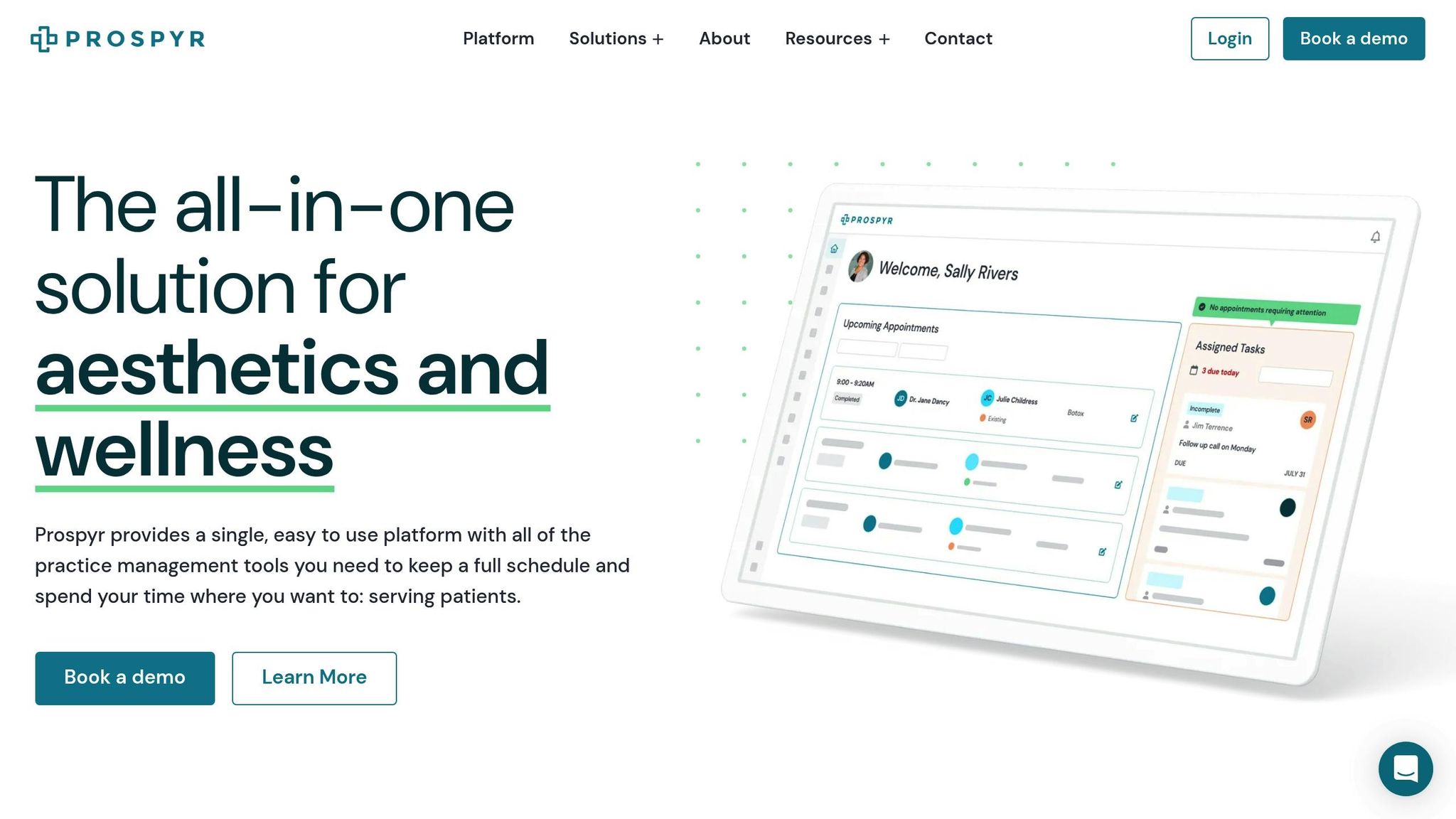
Prospyr builds on the power of automated data capture by integrating CRM, EMR, and marketing tools into one cohesive system. Dr. Daniel Lee, founder of New Life Cosmetic Surgery, is a great example of this in action. He replaced four separate software systems with Prospyr, highlighting its ability to streamline operations.
With Prospyr, all patient interactions - consultations, treatments, and follow-ups - are automatically recorded in a single system. This eliminates data silos and ensures your KPIs are calculated with complete accuracy.
The platform also simplifies patient workflows. Features like smart scheduling and digital intake forms make the process smoother while capturing key data points. For example, when a patient fills out a digital intake form, the information is automatically added to the system, reducing manual errors. This improves metrics like Treatment Room Utilization and New Patient Acquisition.
Prospyr’s lead capture tools are another standout feature. They automatically pull inquiries from your website, social media, and other marketing channels into your CRM. This ensures no potential client slips through the cracks, giving you more precise data for metrics like Lead Conversion Rate and marketing ROI.
Real-time analytics are a major plus. Instead of waiting until the end of the month to review your progress, you can monitor your KPIs daily and make adjustments on the fly. Dr. Saami Khalifian’s experience with SOM Aesthetics shows how effective this approach can be. Within just two months of opening, his clinic hit over $100,000 in monthly revenue and met its launch sales goals 21 times faster than expected - all thanks to Prospyr’s comprehensive platform.
Prospyr also simplifies managing recurring revenue streams with its membership management feature. Automated renewals and benefit tracking reduce administrative workload while ensuring consistent revenue recognition, which is critical for calculating metrics like Client Lifetime Value.
Regular Reviews and Updates
Setting up automated tools is just the beginning. Regular reviews are essential to maintaining strong operational performance. Focus these reviews on key metrics like Treatment Room Utilization and Client Retention Rate to identify trends early and make adjustments to staffing, scheduling, or service delivery as needed.
Quarterly reviews are particularly useful for analyzing long-term trends. Metrics such as Client Lifetime Value and Annual Revenue Growth take time to show meaningful patterns, so periodic analysis helps you refine your benchmarks.
During these reviews, compare your current performance against both industry standards and your clinic’s historical data. Even small improvements can signal progress, even if you haven’t yet reached your ultimate goals.
It’s also important to validate your data sources regularly. While automation reduces errors, periodic checks ensure your system is capturing everything accurately. Make sure calculations for metrics like Lead Conversion Rate and revenue include all lead sources and payment methods.
Finally, be ready to adjust your KPI targets based on what the data reveals about your clinic’s capacity and market conditions. Document any changes to your definitions or calculation methods to maintain consistency as your practice grows. This ensures your benchmarks remain relevant and actionable over time.
sbb-itb-02f5876
How to Use KPI Data for Improvement
Finding Problem Areas
The first step to making the most of your KPI data is identifying where your clinic might be falling short. Start by comparing your current metrics with industry standards. For instance, if your Treatment Room Utilization is below 80%, that’s a clear sign of missed revenue opportunities.
Look for patterns in your data that point to deeper issues. A Lead Conversion Rate under 12.5% could mean there are problems with your consultation process or pricing strategy. Similarly, if your Average Revenue Per Client is less than $1,500 annually, it may be time to focus on upselling services or improving client retention efforts.
Pay close attention to the ratio of new clients versus returning ones. Successful clinics typically see about 30% new clients and 70% returning clients. If your numbers lean too heavily toward new clients, it could signal retention challenges that need immediate attention. After all, acquiring new clients is more expensive than keeping existing ones.
Use practice analytics to track trends over time. For example, a steady decline in client retention or appointment bookings can highlight operational problems before they spiral out of control. Conduct monthly reviews to catch early warning signs, and use quarterly reviews to uncover longer-term trends that might not be immediately noticeable.
Prioritize problem areas based on how much they impact your revenue and how quickly they can be resolved. Focus first on issues tied to high-demand services or significant revenue drivers. For example, if your most popular treatment is underutilized due to scheduling inefficiencies, fixing that will likely have a bigger financial payoff than tweaking a less-used service. These insights will shape the strategic changes discussed in the next section.
Making Changes Based on Data
Once you’ve pinpointed problem areas, it’s time to take action. Start by addressing scheduling gaps to improve treatment room utilization. Offering incentives for appointments during off-peak hours can help fill those slower periods.
To boost client retention and lead conversion, refine your consultation process and implement targeted retention strategies. For example, create follow-up protocols for clients who haven’t scheduled in 90 days, and introduce loyalty programs that encourage repeat visits with perks like discounts or exclusive services. Train your team to handle common objections and use standardized consultation scripts to highlight what makes your clinic stand out.
Marketing tweaks can also have a big impact on your KPIs. If your new-to-returning client ratio shows too few new clients, adjust your digital marketing campaigns to target fresh demographics. Analyze which marketing channels bring in the best leads and shift your budget to focus on those.
Operational changes can address multiple KPIs at once. For instance, using digital intake forms can speed up appointment times, improve room utilization, and enhance the overall client experience. Similarly, automated appointment reminders can reduce no-shows while freeing up staff to focus on revenue-generating tasks.
Monitoring Progress
After implementing changes, consistent monitoring is key to understanding their impact. Set up real-time dashboards to track your most critical KPIs daily. This way, you can catch issues as they arise rather than waiting for monthly reports.
The benefits of effective monitoring are clear. For example, Dr. Daniel Lee of New Life Cosmetic Surgery shared how switching to a unified practice management platform led to dramatic results:
"We've seen a 50% increase in revenue and a 40% increase in appointments booked since switching away from using several different point solutions to running our practice on Prospyr."
Similarly, Dr. Saami Khalifian’s SOM Aesthetics achieved over $100,000 in monthly revenue within just two months of opening by closely tracking KPIs and making swift adjustments based on the data. Their ability to hit launch sales targets 21 times faster than planned underscores the power of staying data-driven.
Establish regular review cycles that align with your clinic’s needs. Weekly reviews work well for operational metrics like appointment booking rates, while monthly reviews are better suited for financial KPIs like revenue per client. Quarterly reviews are ideal for spotting long-term trends and guiding strategic decisions.
Make sure to document every change you implement and its corresponding results. Whether it’s a new scheduling procedure or a marketing campaign, track how it affects your KPIs. Over time, you’ll build a playbook of strategies that you can replicate or scale.
Keep in mind that not all changes will yield immediate results. Improvements in areas like client retention or lifetime value may take months to fully materialize. Set realistic timelines for each initiative and stick to your monitoring schedule, even if progress seems slow at first. Patience and consistency are key to long-term success.
Data Security and Compliance in KPI Management
Keeping Patient and Business Data Safe
When managing KPIs in your clinic, you're handling sensitive data - patient records, treatment histories, financial details, and business metrics. Protecting this information is critical. A single data breach could lead to costly fines, legal trouble, and lasting damage to your clinic's reputation.
One key measure is data encryption. Encrypting patient and business data during both storage and transmission ensures that, even if unauthorized individuals gain access, the information remains unreadable without the proper decryption keys.
Another important tool is role-based access controls. These controls ensure that employees only access the information necessary for their job roles. For instance, a front desk coordinator doesn’t need access to detailed financial KPIs, and the marketing team shouldn’t see sensitive patient records. Assigning permissions based on responsibilities strengthens overall security.
Regular staff training is equally vital. Your team should know how to recognize phishing attempts, create strong passwords, and handle sensitive data properly. Periodic training sessions help keep everyone informed about best practices and new security threats.
Additionally, routine audits play a critical role. By reviewing access logs regularly, you can identify and address potential security issues before they become serious problems.
The risks of weak data security go beyond financial penalties. Violations of laws like HIPAA can result in steep fines, lawsuits, and a loss of trust from patients. Implementing strong security practices not only protects your clinic but also reassures your patients that their information is in good hands.
Prospyr's HIPAA-Compliant Solutions
Prospyr offers a unified platform designed to simplify compliance and strengthen data security. Many aesthetic clinics face challenges when using multiple platforms for scheduling, patient records, marketing, and analytics. This fragmented setup makes it harder to maintain consistent security standards.
Prospyr solves this issue by consolidating all essential tools into a single, cloud-based, HIPAA-compliant platform. This approach ensures that patient management, business analytics, and marketing functions operate within a secure environment that meets stringent regulatory requirements.
"Know that your data is safe and accessible. Avoid HIPAA breaches. Protect yourself against malpractice claims. Prospyr's cloud-based, HIPAA compliant platform provides the data security."
The platform integrates CRM and EMR systems, bringing patient data and care strategies together under the same HIPAA-compliant protocols. Whether you’re tracking treatment room utilization or monitoring client retention, you can trust that your data meets compliance standards.
Prospyr’s email and SMS marketing tools are also HIPAA-compliant, so you can communicate with clients and nurture leads without compromising privacy.
The platform’s cloud-based design offers benefits that traditional on-premise systems can’t match. Automatic updates protect against emerging security threats, while redundant data storage guards against hardware failures or natural disasters. Plus, professional-grade security monitoring runs 24/7, providing a level of protection that most clinics would struggle to achieve on their own.
Building a Data-Driven Aesthetic Clinic
Turning your aesthetic clinic into a data-driven powerhouse starts with systematic KPI benchmarking and using those insights to make meaningful changes. The KPIs mentioned earlier serve as your roadmap for this transformation, helping you identify areas for improvement and measure progress effectively.
One of the biggest shifts you can make is moving from fragmented systems to a unified platform. Prospyr’s all-in-one platform simplifies clinic operations by combining patient management, business analytics, and marketing tools into a single system. This not only eliminates the hassle of juggling multiple platforms but also ensures HIPAA compliance. With its practice analytics feature, Prospyr offers real-time insights into your clinic’s financial and operational health, so you’re never left guessing about the state of your business.
For new clinics, the results can be game-changing. Take SOM Aesthetics, for example. By leveraging Prospyr, they hit their launch sales targets 21 times faster than anticipated.
"Prospyr has helped us launch SOM Aesthetics like a rocketship. Their powerful platform and helpful support have enabled us to exceed our financial targets while delivering an unmatched experience for our patients. Their constant innovation and clear commitment to the success of our practice make them awesome to work with."
Make daily KPI tracking part of your clinic’s routine. Automated tools can help you collect data continuously, allowing you to review metrics weekly and adjust your strategies based on the trends you observe. For instance, if your KPIs highlight issues like low treatment room utilization or declining client retention, you can implement targeted fixes and track their impact in real time.
FAQs
How can aesthetic clinics use KPI benchmarking to boost client retention and increase revenue?
KPI benchmarking is a valuable tool for aesthetic clinics to gauge their performance against industry standards and uncover areas that need attention. Begin by gathering precise data on essential metrics like client retention rates, revenue per client, and appointment conversion rates. Once you have this information, analyze it to identify patterns and see how your clinic stacks up against others in the field.
Use these insights to set specific, achievable goals. For instance, if your client retention rate falls below the average, you might focus on improving the patient experience. This could include personalized follow-ups or implementing loyalty programs to keep clients coming back. Platforms like Prospyr can make this process easier by offering analytics and actionable insights, allowing you to monitor progress and make informed decisions to drive your clinic's growth.
What challenges do aesthetic clinics face when tracking and analyzing KPIs, and how can they address them?
Aesthetic clinics often struggle with issues like uneven data collection, unclear benchmarks, and challenges in making sense of the data they gather. These problems can lead to misleading insights and slow down business growth.
To tackle these hurdles, clinics should implement standardized methods for collecting data. For example, digital tools can help track key metrics such as patient acquisition, retention rates, and revenue per treatment. By setting realistic, data-based goals and routinely evaluating performance against these benchmarks, clinics can spot trends and pinpoint areas needing improvement. Tools like Prospyr streamline this process by combining patient management, analytics, and automation in one platform, ensuring clinics have reliable data to guide their decisions and boost success.
How can automated tools like Prospyr improve KPI tracking for aesthetic clinics?
Automated tools like Prospyr make tracking key performance indicators (KPIs) in aesthetic clinics much easier and more efficient. By offering features like practice analytics, CRM/EMR integration, and AI-powered tools, Prospyr helps clinics gather and analyze data seamlessly.
With its ability to streamline workflows and provide real-time insights, clinics can track performance metrics more accurately, spot trends, and set achievable goals to fuel growth. This approach not only saves valuable time but also supports smarter decision-making, improving both clinic operations and patient care experiences.