
New York's SHIELD Act and the newly introduced Health Information Privacy Act (NY HIPA) are reshaping how aesthetic clinics handle patient data. These laws impose strict requirements for safeguarding sensitive information, breach reporting, and data processing. Non-compliance can lead to fines of up to $15,000 per violation or 20% of annual revenue from New York consumers. Key takeaways:
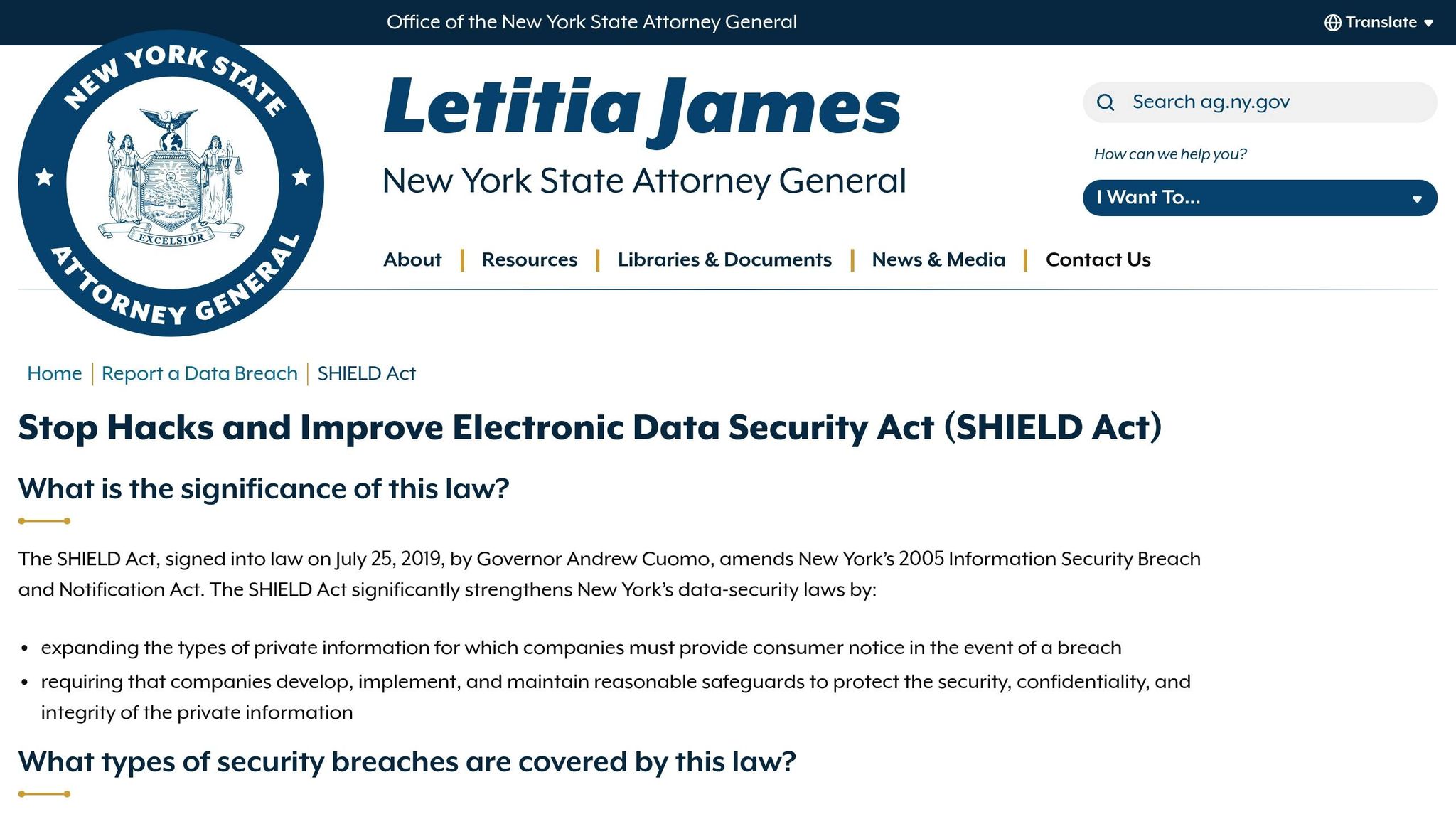
- SHIELD Act: Broadens the definition of "private information" (e.g., biometric data, online credentials) and mandates robust security measures. Even viewing data without permission is considered a breach.
- NY HIPA: Limits data processing to "strictly necessary" purposes and enforces a 24-hour waiting period before requesting authorization for optional uses like marketing.
- Fines: SHIELD Act violations can cost up to $250,000, while NY HIPA penalties are higher, targeting both individual violations and revenue percentages.
- Solutions: Clinics are adopting platforms like Prospyr, which automate compliance tasks like consent management, data retention, and breach reporting.
These laws demand precise workflows and robust tools to avoid steep penalties, making automated systems a practical choice for clinics navigating New York's privacy landscape.
Privacy Compliance Challenges for Aesthetic Clinics
Aesthetic clinics face a complex web of privacy regulations, needing to comply with federal HIPAA standards while navigating stricter New York laws. The SHIELD Act, for example, broadens the definition of "private information" far beyond HIPAA's Protected Health Information (PHI). It includes biometric data, like fingerprints and retina scans, as well as online credentials, such as usernames paired with passwords. This means technologies like facial recognition systems and patient portal access must now meet state-level security standards. Consequently, clinics must rethink their data security measures and access controls to align with these expanded definitions. Even the concept of what constitutes a security breach is redefined.
New York's interpretation of a "security breach" under the SHIELD Act further complicates compliance. Simply viewing patient data without proper authorization qualifies as a breach. For HIPAA-covered entities, this adds another layer of responsibility. Any breach reported to the U.S. Department of Health and Human Services must also be disclosed to the New York Attorney General - even if the compromised data doesn't meet SHIELD's definition of "private information".
Adding to these challenges is the upcoming rollout of NY HIPA in 2025, which introduces even stricter requirements. Clinics will have to adhere to a "24-hour rule", mandating a 24-hour waiting period after account creation before requesting consent for optional data processing. NY HIPA also limits the processing of health data to instances deemed "strictly necessary" for specific purposes. If not, clinics must obtain separate, detailed authorization. As McDermott Will & Emery explains, "NYHIPA intends to limit marketing and advertising without consumer authorization. However, the law is so broad that it is also likely to hamper the efforts of regulated entities to conduct general outreach".
Documentation requirements add yet another layer of administrative burden. If a clinic chooses not to notify patients about an inadvertent disclosure, it must document the "no harm" determination in writing and retain it for at least five years. For breaches affecting more than 500 New York residents, the clinic must submit a written "no likelihood of harm" determination to the Attorney General within 10 days to avoid standard notification obligations. Clinics must also publish data retention schedules and securely dispose of unnecessary information within 60 days.
The financial penalties for non-compliance are severe. Violating the SHIELD Act can result in fines of up to $5,000 per violation for failing to maintain reasonable safeguards, plus $20 per failed notification, capped at $250,000. NY HIPA violations are even more costly, with penalties reaching the greater of $15,000 per violation or 20% of revenue earned from New York consumers in the previous fiscal year. For busy aesthetic clinics, these fines could pose serious financial risks.
1. New York Privacy Laws (SHIELD Act)
Data Compliance Requirements
The SHIELD Act mandates that aesthetic clinics adopt administrative, technical, and physical measures to safeguard patient information. These measures must be proportionate to the clinic’s size, the sensitivity of the data, and the associated implementation costs. Compared to HIPAA, the SHIELD Act expands the scope of data protection requirements.
Clinics must also ensure that third-party vendors handling tasks like appointment scheduling, payment processing, or marketing comply with the SHIELD Act. If a vendor's security practices fall short, the clinic remains accountable. These regulations highlight the complexities of managing patient data, which we’ll delve into further.
Patient Data Handling
In addition to the SHIELD Act, the New York Health Information Privacy Act (NY HIPA) extends regulations to include a broader spectrum of health-related data. Effective January 2025, NY HIPA introduces "regulated health information", which goes beyond traditional medical records to encompass wellness habits, purchase histories, location data, and even inferred health conditions. HIPAA-covered entities are exempt only when processing HIPAA-protected health information (PHI).
NY HIPA enforces a "strictly necessary" standard, meaning clinics can only process health data if it is essential for delivering a requested service, protecting vital interests, or adhering to legal obligations. For any other type of data processing, clinics must obtain separate, explicit patient authorization. Notably, this authorization cannot be requested within the first 24 hours of account creation. On top of these data handling rules, marketing activities face even stricter regulations.
Marketing and Communication Rules
Under NY HIPA, marketing practices involving patient health information are tightly regulated. Clinics cannot collect, use, or share such information for marketing purposes without obtaining a separate authorization document. These authorizations are valid for one year, and patients must be allowed to approve or decline each specific processing activity individually.
Additionally, clinics must wait at least 24 hours before requesting marketing authorization. As The Business Council in New York pointed out:
"A consumer/patient should not be told they have to wait 24-hours before being able to access telehealth mental health counseling services, but that will be the result under this legislation".
Patient portals must clearly display all authorized processing activities and provide a "one-click" option for patients to withdraw their consent easily. Clinics are expressly prohibited from penalizing patients who refuse to grant marketing authorization, ensuring that services are not denied or downgraded based on their decision.
2. Prospyr Practice Management Platform

Data Compliance Requirements
Prospyr operates on a HIPAA-compliant infrastructure designed to meet New York's SHIELD Act technical safeguards. By centralizing patient records with advanced encryption, the platform meets the state's administrative, technical, and physical security requirements. This is especially crucial given the regulatory landscape - Manhattan med spas have faced fines averaging $75,000 and even license suspensions. To address these challenges, Prospyr ensures meticulous documentation of orders, supervision protocols, and the involvement of responsible medical personnel.
The platform also aligns with New York's March 2025 Energy Device Classification ruling, which requires all treatments involving energy-based devices to begin and end with a medical assessment conducted by a licensed MD, PA, or NP. Prospyr's integrated CRM and EMR systems simplify this process, storing detailed medical intake data such as medical history, current medications, allergies, and contraindications. This level of documentation is critical, especially in light of a recent investigation revealing that all 15 med spas audited in New York City were performing medical procedures without proper licensing.
Patient Data Handling
Prospyr takes patient data management to the next level by ensuring compliance with New York's strict data processing standards. The platform's digital intake forms and patient portal are designed to meet the "strictly necessary" standard under NY HIPA. It retains records for the mandated 5 to 7 years and supports HIPAA's "accounting of disclosures" requirement for up to six years. To safeguard sensitive health information, Prospyr employs role-based access controls, ensuring only authorized personnel have access to modify or view patient data.
Marketing and Communication Rules
Prospyr also strengthens compliance in patient communications. Its email and SMS tools include built-in consent management features that align with New York's privacy regulations. Patients are given clear opt-in and opt-out options, ensuring all communications remain within regulatory boundaries.
Operational Efficiency
By combining scheduling, payments, and patient communications into one HIPAA-compliant system, Prospyr simplifies compliance with New York's stringent regulations. Its task management and practice analytics tools allow clinics to track compliance metrics in real time. This unified approach streamlines operations, removing the need for multiple third-party vendors and reducing risks tied to external security practices.
sbb-itb-02f5876
Advantages and Disadvantages
Manual vs Automated Compliance for NY Aesthetic Clinics
Clinics navigating New York privacy compliance face a choice: stick with manual processes or adopt an automated platform. The stakes are high - violations of NY HIPA can result in penalties of $15,000 per violation or 20% of revenue generated from New York consumers in the previous fiscal year. For instance, a Manhattan med spa recently paid $75,000 for inadequate documentation, while a Westchester County med spa faced permanent closure and fines exceeding $50,000 due to systemic non-compliance.
Manual compliance methods come with inherent challenges. They are prone to errors, especially under stringent requirements like the 60-day data disposal rule and the one-click revocation mandate. Jennifer J. Hennessy, Partner at Foley & Lardner LLP, highlights the operational strain:
"NYHIPA will pose significant financial and operational hurdles to digital health companies... The 24-hour moratorium on requesting authorization will effectively create a barrier to activities that improve the patient experience".
These manual processes often fall short in ensuring timely compliance, making clinics vulnerable to penalties.
On the other hand, automated platforms like Prospyr streamline compliance by embedding regulatory safeguards into daily workflows. For example, Prospyr automatically enforces the 24-hour authorization rule, tracks data retention schedules, and offers patients instant revocation controls via a secure portal. Christine Moundas, Partner at Ropes & Gray LLP, explains the complexity of NY HIPA's requirements:
"NY HIPA's authorization requirements starkly differ from the opt-in consent requirements provided in other state consumer data privacy laws. Clicking a simple 'I accept' button after reading a privacy policy would not be sufficient".
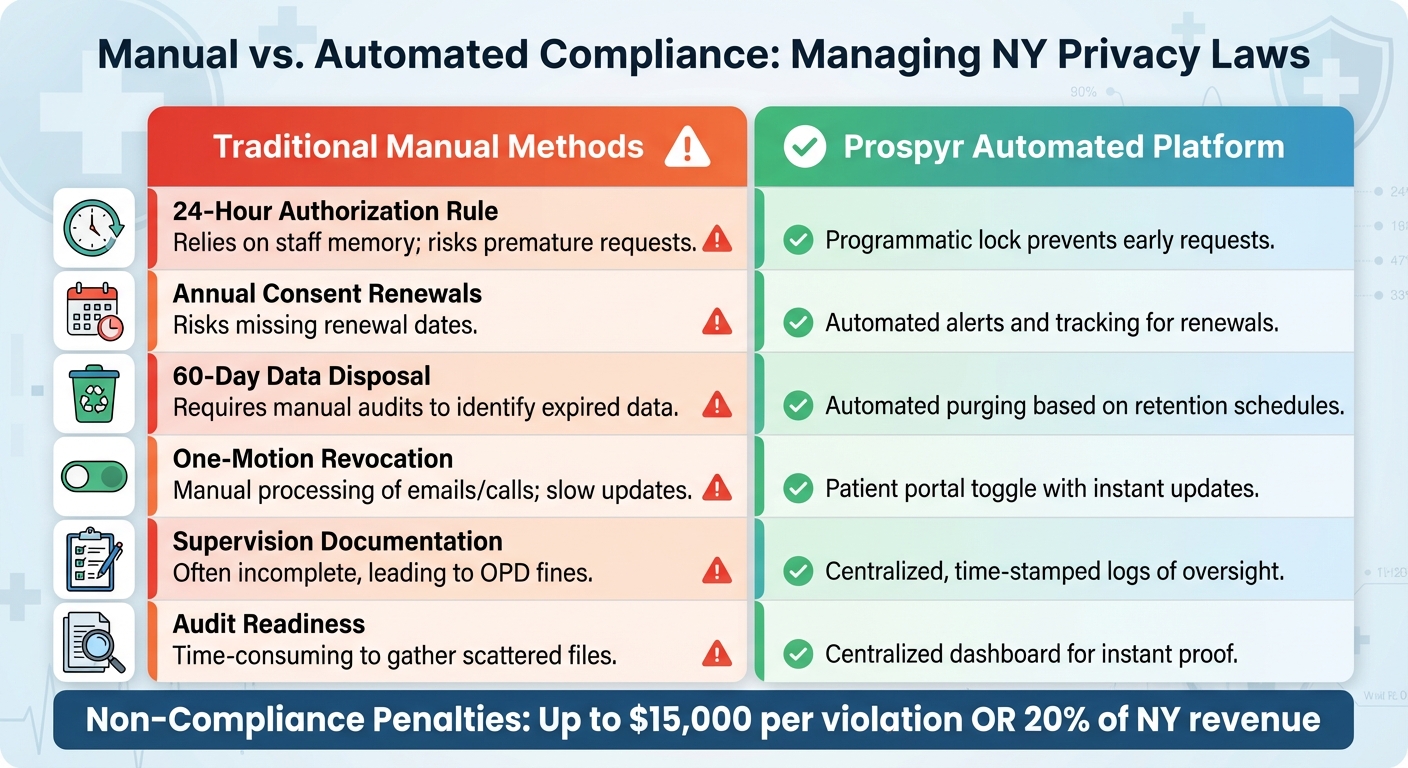
To better understand the benefits of automation, here’s a comparison of how Prospyr addresses common compliance challenges:
| Compliance Aspect | Traditional Compliance Methods | Prospyr Automated Platform |
|---|---|---|
| 24-Hour Authorization Rule | Relies on staff memory; risks premature requests | Programmatic lock prevents early requests |
| Annual Consent Renewals | Risks missing renewal dates | Automated alerts and tracking for renewals |
| 60-Day Data Disposal | Requires manual audits to identify expired data | Automated purging based on retention schedules |
| One-Motion Revocation | Manual processing of emails/calls; slow updates | Patient portal toggle with instant updates |
| Supervision Documentation | Often incomplete, leading to OPD fines | Centralized, time-stamped logs of oversight |
| Audit Readiness | Time-consuming to gather scattered files | Centralized dashboard for instant proof |
Conclusion
New York's privacy laws present tough operational challenges for aesthetic clinics. The SHIELD Act requires robust security measures and detailed breach protocols, while the New York Health Information Privacy Act (NY HIPA) introduces strict workflows for collecting and using patient data. For instance, clinics must adhere to a 24-hour waiting period before requesting consent and ensure data is securely disposed of within 60 days. These requirements demand precise tracking, which can be difficult to manage with manual processes.
The financial risks are just as daunting. Non-compliance can lead to fines of up to $15,000 per violation or 20% of revenue generated from New York consumers. Even small lapses in compliance can result in hefty penalties, and these rules apply to clinics of all sizes - no exceptions for smaller practices.
Practice management platforms like Prospyr offer a lifeline by embedding compliance into their systems. Prospyr’s HIPAA-compliant tools automate key requirements, such as the 24-hour authorization delay, consent renewals, seamless patient portal management for revocations, and secure data disposal within 60 days. These features, discussed earlier, help clinics stay compliant without the burden of manual tracking.
For aesthetic clinics in New York, choosing between manual processes and automated systems isn’t just a matter of convenience - it’s a necessity in navigating a regulatory landscape with high stakes. As Ropes & Gray LLP aptly put it, "Clicking a simple 'I accept' button after reading a privacy policy would not be sufficient for compliance."
FAQs
How do the SHIELD Act and NY HIPA affect aesthetic clinics differently?
The SHIELD Act and the New York Health Information Privacy Act (NY HIPA) each bring unique requirements for aesthetic clinics, especially when it comes to handling sensitive data.
The SHIELD Act is a broad data security law that applies to any business managing private information of New York residents. This includes details like Social Security numbers, biometric data, or login credentials. Under this law, clinics must put in place reasonable safeguards to protect data and report any breaches without delay.
On the other hand, NY HIPA focuses specifically on health-related information. This includes data connected to an individual’s physical or mental health, payment records, or even location. It applies to all entities managing such information - big or small - without exceptions for revenue or size. NY HIPA has stricter requirements, such as obtaining written consent before using or selling data and limiting its processing to only what is absolutely necessary for the service requested. Moreover, it demands tighter agreements with third parties handling health data, similar to the Business Associate Agreements required under HIPAA.
For aesthetic clinics, understanding and adhering to these laws is essential to maintain compliance and safeguard patient privacy.
How can aesthetic clinics navigate potential delays in data processing under New York's privacy laws?
Currently, New York's Health Information Privacy Act (HIPA) does not specify a mandatory 24-hour waiting period for data processing. Instead, aesthetic clinics should prioritize meeting broader privacy standards, such as protecting patient information and maintaining systems that comply with HIPAA regulations.
Using a comprehensive practice management platform - one that combines scheduling, digital intake forms, and secure communication - can make managing patient data more efficient while adhering to privacy laws. Beyond compliance, this approach improves operational workflows and creates a smoother, more positive experience for patients.
What financial risks could aesthetic clinics face if they don't comply with New York's privacy laws?
Failing to follow New York's privacy laws can hit aesthetic clinics hard in the wallet. We're talking civil penalties, statutory fines for each violation, and the potential for sky-high costs tied to lawsuits or fixing the damage. On top of that, ignoring breach notification rules can pile on even more financial strain and hurt a clinic's reputation.
For clinics handling sensitive health and wellness data, staying updated on regulations and enforcing strong data protection measures isn't just smart - it's a must to avoid these expensive pitfalls.