
Need a temporary medical license? Here's what you need to know. A temporary medical license allows physicians to practice under specific conditions while awaiting permanent licensure. These licenses are often tied to training programs, relocations, or short-term needs, and come with restrictions like supervision or limited practice settings.
Key Steps:
- Determine License Type: Options include provisional, locum tenens, training permits, or telemedicine licenses.
- Check Eligibility: Requirements vary by state but often include an MD/DO degree, training verification, and exam completion (e.g., USMLE Steps 1-3).
- Gather Documents: Common needs include ID, transcripts, training records, ECFMG certification (for IMGs), and background checks.
- Meet Deadlines: Start 90-180 days before your intended start date; delays in verifications can slow approvals.
- Pay Fees: Costs range from $25 to $710 depending on the state.
Pro Tip: Use tools like Prospyr for task management and document storage to stay organized. Missing paperwork or deadlines can lead to delays, so preparation is key.
Want more details? Read on for a complete breakdown of the process, state-specific requirements, and tips to ensure compliance.
Before You Apply
Jumping into the application process without preparation can lead to unnecessary delays, rejections, or even missed start dates. Taking the time to prepare ensures you meet state requirements, understand expectations, and have all the necessary materials ready to go.
Identify Your License Type and Scope
Temporary medical licenses come in various forms, such as locum tenens licenses for short-term coverage, provisional permits while waiting for full licensure, emergency permits for public health crises, short-term training or visiting faculty permits, and telemedicine or limited practice permits [8, 11]. Each type has specific rules regarding duration, settings, and supervision. For example, locum tenens and provisional licenses typically allow practice for 30 to 365 days, while emergency permits are usually tied to declared health emergencies and may require volunteer work.
Before diving into forms, pinpoint where and how you’ll be practicing. Is it in a specific state, facility, or through telehealth? Licensure is often state-specific and tied to a particular site or employer. Knowing why you need a temporary license - whether to cover for another clinician, join a training program, or bridge the gap while awaiting permanent licensure - will help you choose the right permit. Also, determine how long you plan to use the temporary license and what supervision is required, such as a named supervising physician or a sponsoring institution's written support.
For clinics expanding their services, temporary licenses allow new physicians to start working while their permanent licenses are processed. However, be aware that some permits may limit independent billing or restrict certain high-risk procedures outside the sponsoring institution.
Review Education and Training Requirements
Most state medical boards require applicants to hold an MD or DO degree from an accredited or board-approved institution. Graduates from the U.S. or Canada usually need 1–3 years of ACGME-accredited postgraduate training. International medical graduates (IMGs) often face additional steps, including completing 2–3 years of residency training and verification processes.
If you're an IMG seeking a short-term permit, your degree must typically come from a board-approved school. You’ll likely practice under a preceptorship or short-term residency at an accredited U.S. institution. Many states also require proof of legal authorization to live and work in the U.S., such as an H1B, J1, O1, TN visa, permanent residency, or an employment authorization card.
Gather essential documents like your medical diploma, official transcripts, and training certificates. IMGs applying for short-term permits may also need a commitment letter from the U.S. institution outlining the supervising physician, your role, and the service dates.
Verify Exam and Certification Status
Alongside education, your exam and certification records must meet state standards. Most states require passing all USMLE Steps 1–3 (or equivalent exams) within a set timeframe, often 7 to 10 years from the first passed Step, with limits on the number of attempts (usually 3 or 4 per Step). IMGs usually need a valid ECFMG certificate and proof of passing the required exams.
Request official exam transcripts directly from USMLE, COMLEX, or ECFMG, and ensure your attempt count and timelines align with state regulations. Common issues include exceeding the allowed number of attempts, missing the exam sequence deadline, or lapses in certification. If it’s been over 10 years since your last exam, you might need to provide additional proof of competency or board certification. For example, Illinois requires applicants who haven’t practiced or trained in the past five years to show professional capacity, which could involve remedial education or extra testing. In complex cases, consulting a licensure specialist or legal advisor can help ensure compliance.
Set Application Deadlines
The licensing process can take anywhere from several weeks to several months, depending on the need for external verifications and the completeness of your application. For temporary licenses, start preparing 90 to 180 days before your intended start date. This is especially important if you’ve trained or practiced in multiple states or countries, are an IMG requiring extra verifications, or need documents from several institutions.
Plan for about 2–4 weeks to gather your materials, 4–8 weeks for verifications and board reviews, and another 2–4 weeks to address potential issues. Don’t forget internal processes like hospital credentialing and payer enrollment, which often require an active license.
Assign tasks to streamline the process. A credentialing coordinator can handle transcripts and training verifications, an administrative lead can manage identity and immigration documents, and you’ll be responsible for completing forms and providing exam history.
Using a digital platform like Prospyr can simplify this process. Prospyr allows you to create tailored checklists for each state and license type, set deadlines, and assign tasks. Its secure, HIPAA-compliant document storage makes it easy to keep and access key documents - like IDs, diplomas, and exam score reports - across multiple applications. Automated reminders via email or SMS ensure deadlines are met, while centralized tracking gives you a clear overview of your progress.
Required Documents
Once you've determined your license type and confirmed your eligibility, the next step is gathering the necessary paperwork. Having all your documents ready upfront can save you a lot of time and prevent delays.
Personal Information and ID
Start by ensuring all your personal information and identification documents are accurate and up to date. You'll need to complete your state's official application form, usually available online. This form will ask for details like your full legal name, date and place of birth, Social Security number, and current mailing address. For instance, Illinois requires applicants to provide their full licensure history, personal background, and disclose any legal or disciplinary matters.
To verify your identity, submit a government-issued photo ID, such as a driver’s license or passport. If your legal name has changed since medical school or obtaining prior licenses, include supporting documentation like a marriage certificate, divorce decree, or court order.
Some states may also ask for additional proof of residency. Be sure to review your state medical board’s website, as requirements can vary widely.
Education and Training Records
Your educational background is a key part of the application process. Start by submitting an official undergraduate transcript that verifies completion of at least two academic years at an accredited institution. The transcript must include the institution's official seal and signature.
For medical education, provide an official transcript showing your degree conferral and graduation date. If an official transcript is unavailable, attach a copy of your diploma. Contact your medical school early to avoid delays in obtaining these documents.
- For current U.S. medical school graduates: Submit the ED-MED form (Certification of Graduation), certified by your medical school and dated within 45 days of graduation. Do not submit this form earlier than 45 days before your graduation date.
- For international medical graduates: Submit the ED-NON form (Certification of Education Non-LCME Accredited Medical College), signed by your medical school’s Dean and sealed with the institution’s official stamp. This should also include proof of completed core clinical clerkships in areas like internal medicine, OB/GYN, pediatrics, psychiatry, and surgery. If your medical degree required an internship or social service for completion, include documentation of satisfactory completion.
If applying for a temporary license, you'll also need the CA-MED form (Certificate of Acceptance for Specialty/Residency Program). This must be completed by your program’s Director and sealed by your graduate medical education (GME) office to confirm acceptance into an accredited program. Any documents not in English must include a notarized English translation.
Once your education records are in order, you can move on to documenting your licensure and professional history.
License and Work History
If you’ve held a license in another state or country, you’ll need to request official licensure verifications. This often means obtaining a Certificate of Licensure from each medical board where you’ve been licensed.
Additionally, include a detailed work history covering the last five years. If you’ve been out of practice or training for more than five years, you may need to provide evidence of professional activity, such as completing 150 CME hours of AMA PRA Category 1 Credit.
With these records in place, the next step is verifying your background and legal standing.
Background Checks
Applicants must meet high ethical standards, which involves disclosing any legal or disciplinary issues. This includes any actions that could be grounds for discipline under the Medical Practice Act.
Complete fingerprinting and criminal background checks as required by your state. For example, Maryland mandates criminal background checks by law.
Be transparent about any past legal matters, including criminal convictions, malpractice claims, or disciplinary actions by medical boards. Failing to disclose this information accurately can result in application denial or even legal consequences.
Practice Site and Supervision Documents
For temporary licenses, you’ll need to provide details about your practice site and supervising physician. This includes information about your postgraduate training program, such as the program name, specialty, start date, and duration. If any details change, notify your state board immediately to update your documentation.
Fees and Additional Costs
Application fees vary depending on the state and license type. For example:
- Illinois: $230 for a temporary medical license
- Ohio: $130 for a training certificate application
- Virginia: $25 for a temporary license and $302 for an initial medical license
Be sure to budget for extra costs like transcript requests, ECFMG certification fees for international graduates, fingerprinting, background checks, and license verification fees from previous jurisdictions.
To streamline this process, consider using Prospyr's document management system. It allows you to securely store all your essential documents - like transcripts, diplomas, and ID copies - in one HIPAA-compliant location. This makes it easier to access and share files when applying to multiple states or updating your information. Plus, the platform’s task management tools help you track what’s completed and what’s still pending, so you don’t miss any critical steps.
Submission and After Approval
Once you've gathered all your documents and completed the necessary forms, it's time to submit your application. This step requires close attention to detail and consistent follow-up to ensure everything goes smoothly.
Final Review Before Submission
Before hitting "submit", take the time to carefully review all forms and documents. Double-check that names are spelled correctly, dates align across all paperwork, and every required field is filled out.
Make sure all supporting documents, notarizations, and signatures meet the specific requirements of your state. Some states have strict formatting rules for notarized forms, so compare your documents against your state board's guidelines to avoid issues.
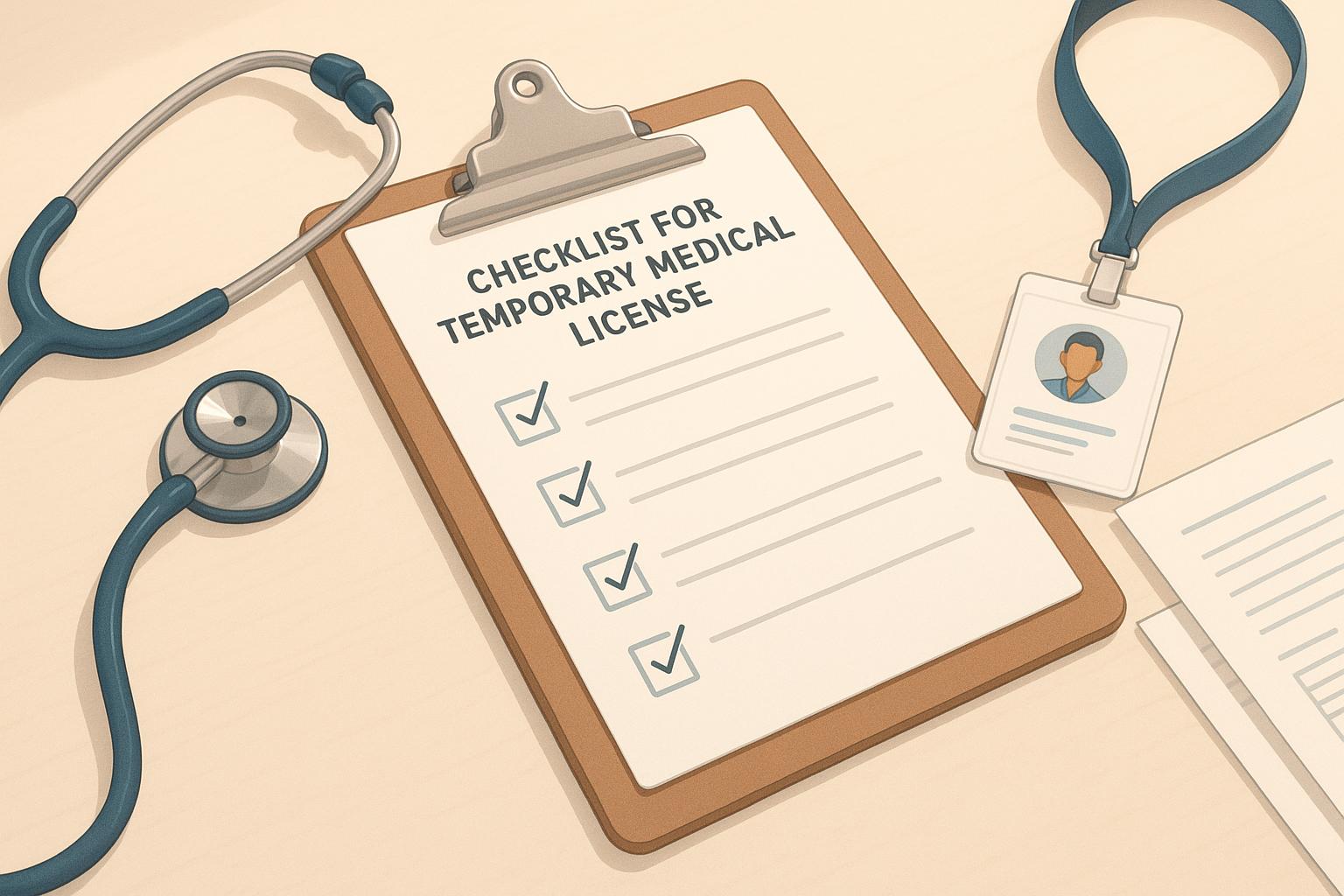
Confirm the application fee for your state and ensure you're using an approved payment method. To keep things organized, create a checklist based on your state medical board's requirements and go through it item by item. This helps catch any missing details. Additionally, verify the submission process - some states require online portals, certified mail, or other specific methods. Check these details with your state board before sending your application.
Keep copies of everything you submit, both digitally and physically. These records may come in handy for future licensing applications, audits, or credential verifications. Once the application is submitted, shift your focus to tracking its progress.
Monitor Your Application Status
Stay proactive by regularly checking in with your state board. Keep track of your submission date and any confirmation numbers - they’ll be crucial for follow-ups.
Processing times can vary widely depending on the state and the completeness of your application. For instance, Florida's 27-page application requires detailed documentation on identity, residence, education, employment history, health history, and criminal history, which can influence how long processing takes.
If you don’t hear back within the expected timeframe, set reminders to follow up. Keep detailed records of all communication with the board, including emails, phone calls, and dates of contact. Log any pending background checks or credential verifications.
Respond promptly to any requests for additional information or clarification. Delays in replying can significantly slow down the process and may even jeopardize your application. State boards typically expect responses within 10-15 business days, so act quickly when contacted.
To stay organized during this period, tools like Prospyr's task management system can be a lifesaver. Use it to track submission deadlines, monitor your application's progress, and schedule follow-ups. This system ensures you don’t miss important deadlines or requests. Once your application is approved, focus on keeping your practice records and obligations up to date.
Maintain Compliance After Approval
After your license is approved, verify all the details immediately. Check that your name, license number, scope of practice, and any restrictions or conditions are accurate.
Update your practice records right away and notify your team about your licensure status and any limitations. Prospyr's all-in-one CRM and EMR system can simplify this process by centralizing your updated temporary medical license information, ensuring patient data and internal documentation remain current.
Adhere to any license restrictions or conditions. These may include regional limitations or specific practice constraints. For example, temporary physician licenses in Illinois are issued for one, two, or three years, depending on the length of the accredited training program as determined by the Accreditation Council for Graduate Medical Education (ACGME).
Ensure your malpractice insurance meets your state’s requirements and is active before you start practicing. Keep it in effect throughout your license period. Submit any required reports or updates about your practice activities on time, ensuring all information is accurate.
Set reminders for license expiration and reporting deadlines. Prospyr’s task management features can help you stay on top of these obligations, avoiding lapses that could disrupt your practice.
Stay up to date on continuing medical education (CME) requirements. Some states may require specific training, and if you’ve been out of practice for more than five years, you might need to complete 150 CME hours of AMA PRA Category 1 Credit.
Maintain open communication with your state medical board. Notify them immediately if there are any changes to your practice, such as supervision arrangements or scope of practice. Being proactive helps prevent compliance issues and shows your dedication to following regulations. If you encounter challenges or have questions about license restrictions, address them with the board right away rather than waiting for an audit or inquiry.
Finally, keep a well-organized record of all correspondence with the board, including emails and letters. These records serve as a safeguard if any questions arise about your compliance history. Having this documentation on hand can save you time and stress down the line.
sbb-itb-02f5876
State-Specific Requirements
Every state medical board has its own set of rules for licensure. Knowing these differences and where to find reliable information can save you a lot of time and prevent frustrating delays during the application process.
Find Your State Board Requirements
First, identify the state where you plan to practice and locate its official medical or osteopathic board. Make sure to use trustworthy sources - look for websites ending in .gov or other official domains. Once you're on the correct site, head to the licensure section to find the specific license category you need. This could include options like "MD/DO Temporary Licensure", "Restricted Temporary License", "Physician in Training", or "Resident/Fellow Temporary License."
Download all the instructions and forms directly from the board’s website. These documents outline exactly what’s required, including state-specific forms that may not exist elsewhere. Keep in mind that each state has its own naming conventions and formatting rules, so don’t assume forms from one state will work in another.
Pay close attention to postgraduate training requirements. Some states require just one year of ACGME-accredited training, while others may mandate three years or even the completion of an entire residency program before issuing a temporary license. Exam rules also vary widely. For example, some states limit USMLE or COMLEX attempts to three per Step or Level, while others allow up to six. Additionally, time limits to complete the entire exam sequence differ - many states enforce a seven-year window, but some extend it to ten years or impose no limit at all.
Background checks are another area where states differ. Some require fingerprinting via LiveScan, others use FBI-based checks, and photo requirements can range from electronic submissions to physical prints taken within the last 60 days. Always confirm these details with your state board before starting the process.
If you’re thinking about applying through the Interstate Medical Licensure Compact (IMLC), make sure you meet the eligibility criteria. The compact simplifies licensure for physicians who meet certain standards, such as having no disciplinary actions or criminal convictions. If you qualify, follow the compact’s state-specific pathways to speed up your application. For a broader overview, check out the Federation of State Medical Boards’ resource, State Specific Requirements for Initial Medical Licensure. It provides a helpful summary of exam limits, training minimums, and other key rules across all states.
Once you understand your state’s requirements, tailor your application to match your applicant type.
Adjust for Applicant Type
The documents you’ll need depend on whether you’re a U.S. medical graduate, an international medical graduate (IMG), a trainee, or an independent practitioner. Each category has different eligibility requirements and paperwork, so customize your checklist accordingly.
- U.S. graduates: Typically, you’ll need proof of an LCME or COCA-accredited degree, official transcripts, and school-certification forms. Postgraduate training requirements usually range from one to three years, depending on the state. Exam completion windows may also be shorter for U.S. graduates compared to other applicants.
- International medical graduates (IMGs): IMGs often face additional requirements. Most states require ECFMG certification, international education verification, and proof that core clerkships meet state standards. Some boards may also ask for Fifth Pathway forms or other supplementary documentation. Training thresholds for IMGs are often stricter. For example, while a U.S. graduate might need just one year of ACGME-accredited training, IMGs may need two or three years in the same state. Some states explicitly require three years of training for IMGs, even when domestic graduates need less.
- Trainees: Residents and fellows typically apply for restricted or training-linked temporary licenses. These often require program acceptance and board-specific forms signed by program directors. Scope of practice and supervision ratios are usually outlined by state or institutional policies. Certain states, like New York, don’t require physicians in ACGME-approved postgraduate training programs to hold a license or limited permit to work within that program - an important detail that can save trainees unnecessary paperwork.
- Independent practitioners: You’ll need to document prior licenses, board certifications (if applicable), hospital privileges, malpractice coverage, and a detailed practice history. If you’ve been out of practice for more than five years, expect to provide continuing medical education (CME) records. Some states also require activity verification forms to account for gaps in your work history. For example, New York offers licensure by endorsement for certain foreign-licensed physicians with at least five years of professional experience, three years of acceptable postgraduate training, and specific exam and certification criteria.
By tailoring your checklist to your applicant type, you’ll ensure that your application process is both efficient and compliant.
Standardize Across Multiple Locations
If you’re applying for temporary licenses in multiple states, separating core tasks from state-specific ones can make the process much smoother. Core tasks - like gathering identity documents, updating your CV, compiling exam score histories, and preparing malpractice narratives - can be standardized and reused across all applications. State-specific tasks, such as unique forms or training requirements, can then be added as needed.
Create master templates for each license type with placeholders for state-specific details. This ensures consistency while allowing you to easily adapt the template for different boards.
For organizations managing multiple clinic locations, using a practice management platform like Prospyr can simplify the process even further. Prospyr allows administrators to create a centralized document library with state-tagged forms and reusable checklist templates. These templates can auto-assign tasks based on clinic location, ensuring that front-office teams in different states follow a consistent structure while pulling the correct forms for their jurisdiction. Prospyr’s task management and analytics features also help you track progress and identify bottlenecks, such as delays in background checks or verifications.
Align your internal checklists with the strictest state’s requirements for your applicant type. For example, if one state requires three years of ACGME-accredited training for IMGs and another requires only two, build your checklist around the three-year requirement. This approach minimizes rework when expanding to new locations and ensures you’re always prepared for the most demanding boards.
When dealing with prior license verifications, treat each jurisdiction as a separate task. Many boards require official confirmation from every state where you’ve held a license, often using their own forms. These requests can take weeks or even months, so start early. Keep a detailed table tracking each license, the verification method, fees, and submission and confirmation dates. This will help you stay on top of outstanding verifications and avoid unnecessary delays in securing your temporary licensure.
Conclusion
Securing a temporary license isn’t just about completing forms - it’s about careful planning, attention to detail, and staying ahead of deadlines. Start early to give yourself enough time for tasks like requesting transcripts, coordinating ECFMG verifications, completing background checks, and gathering state-specific forms. Missing paperwork or incomplete responses are common reasons applications get delayed, so working methodically through your checklist can save you from unnecessary headaches.
Precision is key. Even small gaps in work history, unexplained breaks in training, or missing exam verifications can stall your application. These delays can be costly, especially if your license is tied to urgent needs like locum tenens work, event-based roles, or starting a new position. To avoid setbacks, provide complete and truthful answers, document everything thoroughly, and keep copies of all submissions to ensure the process moves smoothly.
Once your license is approved, ongoing management is just as important. Temporary licenses often have short validity periods - some as brief as 270 days - so it’s crucial to monitor expiration dates and renewal deadlines. Set calendar reminders 60–90 days before expirations to stay on top of these requirements. Make sure to comply with supervision terms and promptly report any disciplinary actions or malpractice events to maintain your standing.
For clinics managing multiple providers, centralized digital tools can simplify compliance. Platforms like Prospyr help streamline the process by organizing documentation, tracking deadlines, and sending automated reminders. Administrators can use these tools to create standardized checklists, assign tasks based on location, and monitor license statuses in real-time through dashboards. This ensures no detail gets overlooked, reducing the risk of disruptions to patient care.
Think of your checklist as a living document. Update it with lessons learned from each application, adapt to changes in state regulations, and refine it as your practice grows. By staying organized and proactive, you can minimize compliance risks, keep your temporary licenses current, and focus on what matters most - providing excellent care to your patients.
FAQs
What types of temporary medical licenses are available, and how can I choose the right one?
Temporary medical licenses come in different forms, depending on the state and the specific area of medicine. These licenses often cover situations like residency training, locum tenens positions, or short-term assignments at a particular facility or event. The type of license you'll need depends on your intended purpose, the state's requirements, and your qualifications.
To make the right choice, start by reviewing the state medical board's guidelines for the location where you plan to work. Pay close attention to required documents and application deadlines - staying organized is key to avoiding delays. If juggling multiple responsibilities feels overwhelming, tools like Prospyr can simplify the process by helping you manage documentation and scheduling efficiently.
What documents do international medical graduates (IMGs) need for a temporary medical license application?
International medical graduates (IMGs) must typically gather several important documents when applying for a temporary medical license in the United States. These documents often include:
- Medical education credentials, such as a diploma or degree certificate.
- Licensure verification from the medical board in your home country.
- Official transcripts from your medical school.
- Proof of U.S. residency or training, if applicable.
- Valid identification, like a passport or a government-issued ID.
- English language proficiency test scores, if required by the state licensing board.
Since requirements differ from state to state, it’s crucial to review the specific guidelines of the medical board where you plan to apply. Submitting accurate and complete documents on time is essential to prevent any delays in the licensing process.
What steps can I take to stay on track and avoid delays when applying for a temporary medical license?
To make sure your temporary medical license application goes through without a hitch, having a clear plan is key. Begin by gathering all the necessary paperwork, including proof of your education, professional certifications, and valid identification. Keep in mind that requirements can differ depending on your state or licensing board, so double-check their specific guidelines.
It’s also a good idea to set up a timeline to keep track of deadlines and submission dates. Submitting your application early can give you a buffer in case there are any unexpected delays. If juggling deadlines and paperwork feels overwhelming, tools like Prospyr can help simplify the process by organizing administrative tasks and keeping you on track. Staying ahead of the game and keeping everything in order will make the entire process much smoother.