
Med spas often struggle with cash flow due to delayed payments, high equipment costs, and commission-based staff pay. Tracking Accounts Receivable (AR) KPIs is critical to avoid financial strain and ensure steady revenue.
Key Takeaways:
- Delayed Payments Hurt Cash Flow: Invoices over 90 days old have only a 50% collection rate, dropping to 10% after 120 days.
- Critical KPIs to Monitor:
- Days in Accounts Receivable (DRO): Should stay under 40 days.
- Net Collection Rate (NCR): Target 96–99% for efficiency.
- Denial Rate: Keep below 5% to minimize revenue loss.
- AR Over 120 Days: Should be less than 10% of total AR.
- Administrative Challenges: Poor AR management wastes staff time on chasing payments instead of patient care.
- Growth Impact: Tied-up cash limits investments in equipment, staffing, and marketing.
Solution: Use tools like Prospyr to automate AR tracking, reduce errors, and improve collections. Real-time dashboards and alerts can help you stay on top of KPIs, ensuring financial health and freeing up resources for growth.
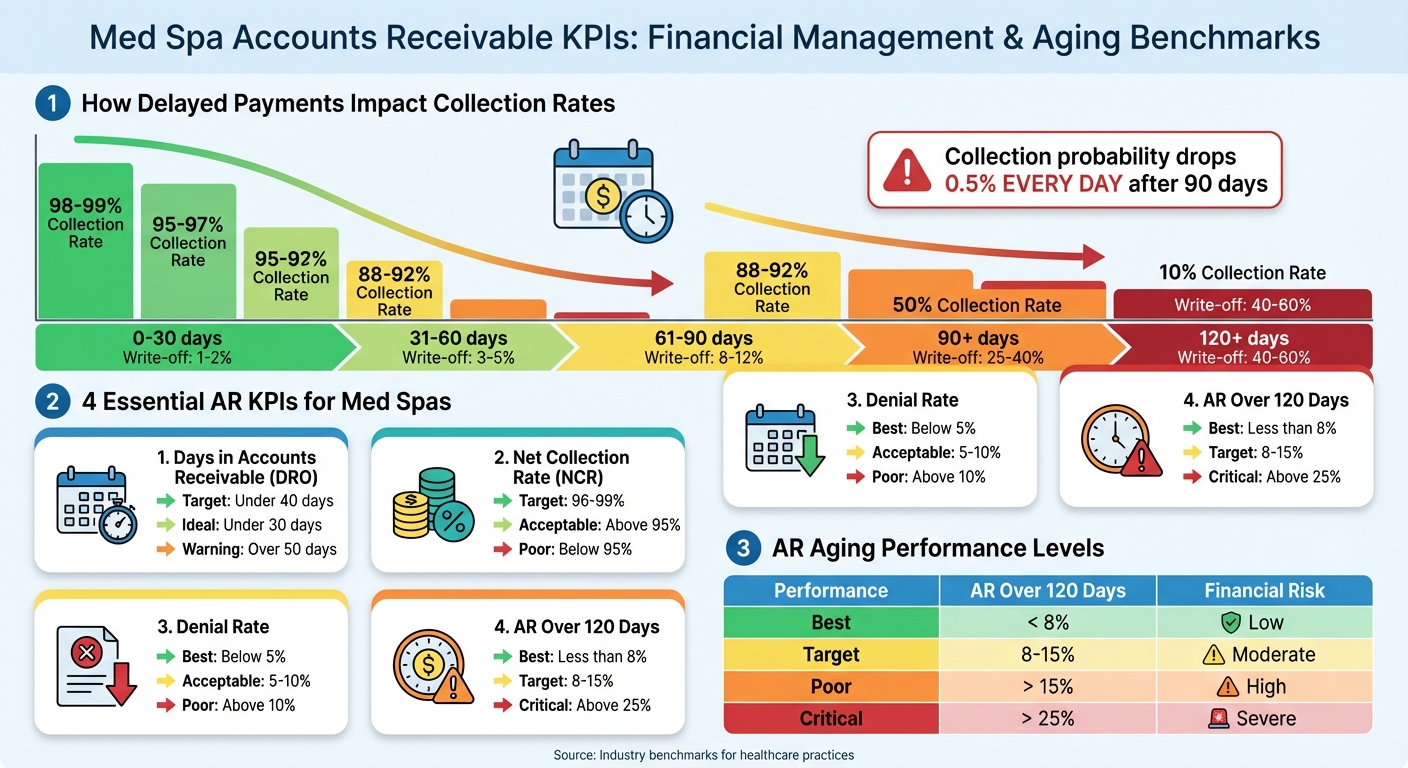
Med Spa Accounts Receivable KPIs and Collection Rates by Aging Period
How Poor Accounts Receivable Management Hurts Your Bottom Line
Struggling to manage accounts receivable (AR) efficiently can lead to immediate cash flow problems. Even if your med spa is busy booking treatments and selling products, delayed payments can leave you short on operating capital. Tracking key performance indicators (KPIs) effectively can help stabilize your finances and keep operations running smoothly.
Here’s the reality: collection rates for accounts over 90 days old can plummet to just 50%. And it gets worse - write-off rates leap from 15–25% at the 90-day mark to a staggering 40–60% once invoices are over 120 days past due. Every overdue dollar ties up resources that could otherwise cover payroll, replenish inventory, or fund new equipment.
"Every day an invoice goes unpaid is a day your business might struggle to cover operating costs."
- Ryan Grundy, Sage
The U.S. Department of Commerce reports that the chance of collecting on delinquent accounts drops by 0.5% for every single day past the 90-day threshold. For med spas operating on tight margins, this slow erosion of revenue can mean the difference between growing and simply staying afloat.
Delayed Payments and Aging Receivables
If your AR cycle stretches to 45 days, it means you’re footing the bill for about three pay periods before receiving the income generated by your team. For healthcare practices, maintaining an AR cycle of 30 to 40 days is key to financial health . Beyond 120 days, the odds of collecting unpaid invoices drop dramatically - practices typically recover only 10 cents for every dollar owed at this stage.
In a well-run practice, receivables over 90 days should make up 18–22% of total AR, with the median for receivables over 120 days around 13.54%. If your numbers are higher, you’re losing money that could otherwise fuel growth.
| Aging Period | Typical Write-off Rate | Probability of Collection |
|---|---|---|
| 0–30 days | 1–2% | Very High |
| 31–60 days | 3–5% | High |
| 61–90 days | 8–12% | Moderate |
| 90+ days | 25–40% | Low (approx. 50%) |
| 120+ days | 40–60% | Very Low (<30%) |
Even small errors - like incorrect addresses or missing purchase orders - can delay payments by an average of 21 days. These mistakes push receivables into aging categories where the likelihood of collection drops significantly.
Increased Administrative Burden
Beyond cash flow issues, poor AR management also drains your team’s time and energy. Without clear AR tracking, staff waste hours chasing payments instead of focusing on patient care or revenue-generating tasks.
High denial rates add to the problem, requiring more staff to recover money that’s already been earned. Instead of scheduling treatments or improving the patient experience, your team ends up resolving disputes, fixing data entry errors, and resubmitting claims that weren’t accurate the first time .
"You want a system that is very accurate and gets as much of the money into the practice as quickly as possible."
- David Norris, MD, MBA, Author of The Financially Intelligent Physician
Inefficient AR processes also drive up the “cost of collections,” which includes staff time, postage, and software expenses, cutting directly into profits . A healthy practice should aim for an adjusted collection rate above 95%, with denial rates staying under 10%. Falling short of these benchmarks means administrative inefficiencies are eating into your bottom line.
Limited Growth Opportunities
When cash is tied up in unpaid receivables, it’s hard to invest in new equipment, expand your space, or ramp up marketing efforts. For 90% of healthcare providers, rising costs are already outpacing revenue growth. In this environment, every dollar counts. Top-performing practices keep their bad-debt ratio under 5% of total service revenue.
On the flip side, a poorly managed AR process creates a timing mismatch - practices pay staff and overhead every 14 days but wait 45 days or longer to collect revenue for services. This gap leaves little room for strategic investments, stifling growth.
"The most important function of the A/R process is to get that claim out right the first time."
- Margo Williams, MHA, CMPE, American College of Physicians
A bad debt-to-sales ratio below 15% is considered healthy, while anything above 25% signals serious financial trouble. Similarly, accounts receivable older than 90 days should make up less than 10% of total AR. Exceeding these benchmarks means potential growth capital is lost to write-offs and collection costs, slowing your med spa’s progress.
Next, we’ll explore the key AR KPIs that can help tackle these cash flow, administrative, and growth challenges.
Key Accounts Receivable KPIs Every Med Spa Should Track
Keeping tabs on these four KPIs can reshape how you manage accounts receivable (AR), giving you a clear picture of your med spa's financial standing and any potential challenges. Let's break down how Days in Accounts Receivable (DRO) sets the pace for your revenue cycle.
Days in Accounts Receivable (DRO)
DRO calculates how long it takes, on average, to collect payments. To find this number, divide your total accounts receivable (including credit balances) by your average daily charges. Using charges from the past 90 days helps smooth out seasonal fluctuations. For most medical practices, a DRO between 30 and 40 days is considered manageable, with anything under 30 days being ideal. If your DRO climbs beyond 50 days, it's a clear signal to evaluate your collection processes.
To get an accurate DRO, always use service dates instead of posting dates and subtract credit balances.
"Without a doubt, the best overall indicator of billing performance is days in receivable outstanding (DRO). DRO tells you how long money sits in accounts receivable."
Net Collection Rate (NCR)
The Net Collection Rate (NCR), also called the adjusted collection rate, measures how much of your collectible revenue you actually collect. The formula is straightforward: (Payments - Credits) ÷ (Charges - Contractual Adjustments). This accounts for payer fee schedules, offering a realistic view of your collection efficiency. High-performing practices typically maintain an NCR between 96% and 99%, while anything below 95% suggests room for improvement.
It's crucial to separate contractual adjustments from non-contractual ones, as mixing them can obscure revenue losses.
"Net collection rate (NCR) shows how much of the allowed amount you actually collect... NCR reflects real reimbursement."
- Tebra
While NCR gives an overall view of collection success, other metrics like denial rates and first pass resolution rates help pinpoint specific issues with claim submissions.
Denial Rate and First Pass Resolution Rate
The denial rate tracks the percentage of claims rejected by insurance payers. Calculate it by dividing the total dollar amount of denied claims by the total submitted claims. Industry averages for denial rates range from 5% to 10%, but leading practices aim for rates below 5%. High denial rates often point to issues like eligibility verification errors, coding mistakes, or incomplete documentation - all of which slow down revenue collection and increase administrative strain.
The First Pass Resolution Rate measures how many claims are paid on the first submission. Top-performing organizations often hit a 95% rate. Identifying and fixing errors before submission can significantly boost cash flow by reducing denials.
"A high clean claim rate indicates that the practice is submitting accurate and complete claims, which can help expedite the payment process."
- Andie Tena, Assistant Vice President, Practice Management Services, CAP
Tracking these rates by payer can help you identify problematic insurance carriers, allowing for targeted improvements.
Percentage of AR Over 120 Days
This metric highlights the portion of receivables that are at risk of becoming uncollectible. To calculate it, divide AR older than 120 days by total AR. The goal is to keep this percentage below 10%, with top practices maintaining it under 8%. If this figure exceeds 15%, it's a sign of poor performance, and anything over 25% indicates serious financial trouble.
"Good overall days in A/R can also mask elevated amounts in older receivables, and therefore it is important to use the 'A/R greater than 120 days' benchmark."
Even if your overall DRO looks healthy, a high percentage of aged receivables can signal deeper issues. For instance, a 40-day average DRO might still hide the fact that 20% of your AR is over 120 days old. Common culprits include outdated workflows, front-desk errors, delays in finalizing clinical notes, or poor communication with payers.
| Performance Level | AR Over 120 Days | Financial Risk |
|---|---|---|
| Best | < 8% | Low |
| Target | 8–15% | Moderate |
| Poor | > 15% | High |
| Critical | > 25% | Severe |
To avoid skewed data, classify patient payment plans separately in your aging reports. Set up automated alerts if AR over 120 days exceeds 20%, so management can take quick action. For accounts older than 120 days, consider outsourcing to specialized collection agencies. This allows your internal team to focus on newer, more recoverable accounts.
How Tracking AR KPIs Improves Med Spa Financial Health
Keeping a close eye on Accounts Receivable (AR) KPIs can be a game changer for med spas. Regular monitoring helps identify weak spots in your revenue cycle before they spiral into cash flow problems. In fact, the difference between med spas that track KPIs and those that don't often shows up in their working capital, staff productivity, and ability to fund growth initiatives.
Faster Cash Conversion
Tracking KPIs in real time can significantly speed up the process of turning your services into cash. For example, keeping an eye on Days Sales Outstanding (DSO) every day allows you to spot payment delays early. A DSO under 45 days is generally seen as healthy across industries, but many med spas outperform this benchmark by using automated payment reminders and offering early payment discounts.
Another key metric, the Collections Effectiveness Index (CEI), measures how much of your AR you’re actually collecting. A CEI between 80% and 90% indicates good performance, while practices hitting 95% or higher show excellent collection efficiency. Tools like automated reminders sent near due dates can lower Average Days Delinquent (ADD). Additionally, visual dashboards with drill-down features allow you to monitor AR health daily and address any bottlenecks as soon as they appear. Metrics like the Accounts Receivable Turnover ratio also reveal how well credit sales are being converted into cash, ensuring you maintain solid working capital.
Better Business Decisions
AR data isn’t just about cash flow - it’s a tool for making smarter business decisions. By tracking your adjusted collection rate on a monthly basis, you can more accurately forecast cash flow, which is critical for planning big moves like buying equipment, hiring staff, or launching new services. Similarly, the bad debt-to-sales ratio helps assess the effectiveness of your credit policies. A ratio below 15% is considered healthy, while anything over 25% signals potential trouble and poor credit control.
Monitoring high-risk accounts can also guide you in tightening credit terms or focusing your marketing on more reliable patient segments. Segmenting AR data by payer, age bucket, or denial reason provides a clear view of where revenue is leaking. This level of detail ensures you don’t grow beyond what your administrative systems can handle, helping you know when it’s time to invest in automation or additional staff. Plus, it sets the foundation for reducing claim denials and cutting down payment delays.
Fewer Claim Denials and Payment Delays
Better AR visibility doesn’t just improve cash flow - it also enhances billing accuracy. Proactively tracking KPIs helps catch billing errors before they turn into claim denials. For instance, monitoring revised invoices can highlight manual entry mistakes, while switching to automated invoicing ensures greater accuracy from the start.
Tracking how long it takes to resolve disputes can reveal unclear billing terms or service quality issues that need immediate attention. Using reason codes alongside disputed or short-paid invoices can pinpoint whether the problem lies in invoicing errors, service issues, or even customer stalling tactics. A customer portal that allows patients to raise claims with reason codes can speed up dispute resolution and reduce Deduction Days Outstanding (DDO).
It’s critical to act fast - every day a claim sits in the 90+ day bucket reduces its recovery chances by 1%. Early intervention is key to safeguarding your revenue and maintaining financial stability.
sbb-itb-02f5876
Using Prospyr to Track and Manage AR KPIs

Managing AR KPIs manually can be a tedious and error-prone process. Prospyr takes the hassle out of this by automating the workflow. By syncing directly with your invoicing and accounting systems, it eliminates the need for manual data entry and ensures your KPIs are always current.
Automated AR Monitoring and Alerts
Prospyr's practice analytics bridge the gap between patient interactions and collections, keeping tabs on key metrics like Days Receivable Outstanding (DRO) and Net Collection Rate (NCR). You can set custom alert thresholds to get notified when metrics drift into risky territory - for instance, if DRO exceeds 50 days or if more than 20% of accounts receivable are over 120 days old. These alerts give you a chance to act quickly, addressing payment delays before they disrupt cash flow.
HIPAA-Compliant Payment Processing
Payment processing is simpler and safer with Prospyr. The platform supports both virtual and in-person transactions while adhering to HIPAA standards for security. This makes it easier for patients to pay on time, improving collection rates without adding extra work for your team. Plus, the payment data feeds directly into real-time KPI dashboards, keeping everything streamlined.
Dashboards for KPI Visualization
Prospyr's dashboards make sense of your AR data by turning it into clear, actionable visuals. Instead of digging through spreadsheets, you get an at-a-glance view of outstanding balances, broken down into aging categories like Current, 30–60 days, 60–90 days, and Over 90 days. These visual tools help you quickly identify trends and pinpoint issues, such as payer delays or inconsistencies in collections. With this information, you can make smarter decisions about credit policies, staffing, and where to allocate resources for growth.
Conclusion
Keeping a close eye on AR KPIs is key to protecting your med spa's cash flow and driving growth. Metrics like Days in Accounts Receivable, Net Collection Rate, and Denial Rate give you the insights needed to quickly turn credit sales into cash, ease your team's administrative workload, and stop revenue from slipping away unnoticed.
When these metrics aren’t consistently tracked, delayed payments and aging receivables can quietly chip away at your working capital. The difference between a thriving med spa and one that struggles often lies in the ability to spot red flags early - like a denial rate climbing past 10% or receivables lingering beyond 120 days - and act strategically to improve revenue cycle performance.
To tackle these financial challenges effectively, automation is the way forward. Prospyr streamlines AR monitoring, offers HIPAA-compliant payment processing, and delivers real-time KPI dashboards. Instead of manually sifting through data, you'll get instant alerts when metrics signal trouble and clear visuals to guide your next steps. This automation allows your team to focus on patient care and revenue-generating tasks instead of chasing overdue payments.
The med spa industry is embracing a data-driven approach, where steady cash flow and operational efficiency set successful practices apart. Incorporating automated AR tracking into your financial strategy not only reduces risk but also strengthens your competitive position. By prioritizing AR KPIs and using tools like Prospyr to simplify the process, you’ll set your med spa up for long-term growth and success.
FAQs
What are the best ways for med spas to reduce accounts receivable days and improve cash flow?
Med spas can take steps to cut down on accounts receivable (AR) days and boost cash flow by focusing on a few practical strategies:
- Automate invoicing and payment reminders: This ensures clients are promptly notified about their balances, helping reduce delays in payments.
- Leverage AI-powered tools: These tools can identify overdue accounts and streamline follow-up processes, making collections quicker and more efficient.
- Set clear payment terms: Policies like offering discounts for early payments or charging penalties for late ones can motivate clients to pay on time.
By putting these strategies into action, med spas can reduce their Days Sales Outstanding (DSO), improve cash flow, and create more stable financial operations.
How can med spas simplify and automate accounts receivable tracking?
Automating accounts receivable (AR) tracking can be a game changer for med spas. It cuts down on tedious manual tasks, gives a clearer picture of cash flow, and helps payments roll in faster. Platforms like Prospyr make this even easier with features like AR dashboards, automated invoice creation, and built-in payment processing. These tools let clinics handle outstanding balances effortlessly as part of their regular workflow.
With these systems in place, med spas can simplify their operations, reduce overdue payments, and dedicate more time to delivering top-notch patient care. Monitoring AR metrics becomes a proactive effort, keeping finances on track and setting the stage for long-term success.
Why is it important to minimize claim denials in med spa operations?
Minimizing claim denials plays a key role in keeping cash flow steady and cutting down on avoidable expenses. A denied claim doesn’t just interrupt revenue - it also demands extra staff time to fix, with an average rework cost of $25.20 per claim. On top of that, some denials are completely unrecoverable, underscoring the importance of tackling them head-on.
By maintaining low denial rates, med spas can safeguard their income, strengthen their financial stability, and keep daily operations running smoothly.