Checklist for Arizona Med Spa Insurance Compliance
Arizona med spa compliance guide: required insurance, licensing, device registration, HIPAA/cyber coverage, and record-keeping essentials.


Checklist for Arizona Med Spa Insurance Compliance
Running a med spa in Arizona means following strict insurance and regulatory rules. Here's what you need to know:
- Professional Liability Insurance: You need coverage of $1M per claim and $3M aggregate to protect against treatment-related claims.
- General Liability Insurance: Covers injuries or property damage at your facility (not treatment-related).
- Workers' Compensation Insurance: Required if you have at least one W-2 employee.
- Cyber Liability Insurance: Protects sensitive patient data from breaches and HIPAA violations.
- Licensing and Credentialing: Ensure all staff have proper Arizona licenses and comply with supervision rules.
- Equipment Registration: Register lasers and other devices with the Arizona Department of Health Services.
Why this matters: Non-compliance can lead to fines, license suspension, or personal liability. Maintain updated insurance documents, track renewal dates, and review policies annually to avoid gaps in coverage. Tools like Prospyr can help with document management and reminders.
Proper planning and documentation ensure your med spa stays compliant and protected.
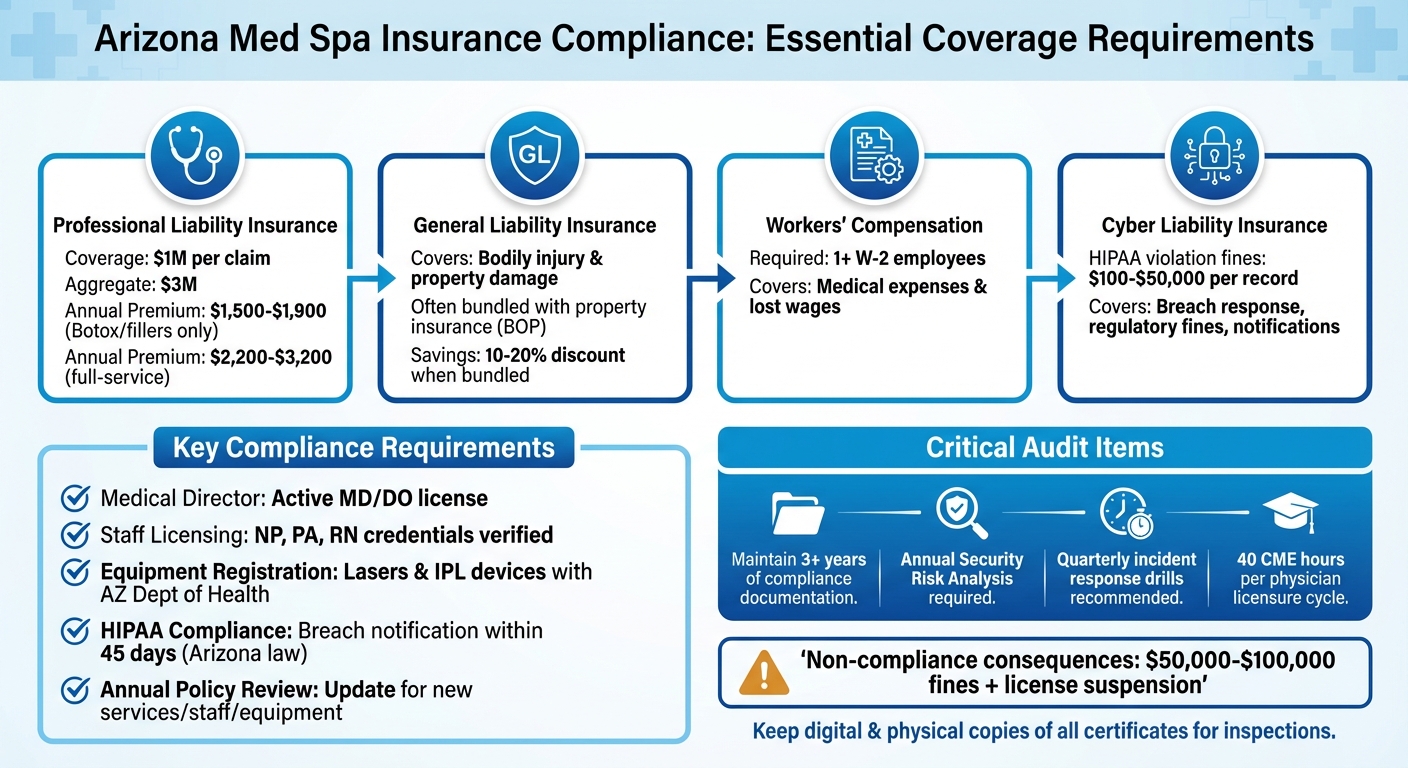
Arizona Med Spa Insurance Requirements and Coverage Limits
Required Insurance Policies for Arizona Med Spas
Operating a med spa in Arizona requires specific insurance policies to stay compliant with state laws and protect against financial risks. Below are the key insurance types every med spa should consider.
Professional Liability Insurance
Professional liability insurance, often called malpractice insurance, is essential for covering claims related to negligence, errors, or dissatisfaction with treatments. The typical coverage limits are $1,000,000 per claim and $3,000,000 aggregate, offering a safety net against potential legal issues.
"If you inject a patient without liability coverage in place, you're personally liable." - CarePro Insurance
Make sure your policy includes all services your med spa offers, such as microneedling, GLP-1 weight loss medications, and laser treatments. Keep in mind that many standard malpractice policies exclude aesthetic procedures unless explicitly added to the policy. For reference, annual premiums generally range from $1,500–$1,900 for practices offering only Botox and fillers, while full-service med spas may pay between $2,200–$3,200.
General Liability Insurance
In addition to professional coverage, general liability insurance protects your facility from third-party claims for bodily injuries or property damage occurring on your premises. This type of insurance is often a requirement from landlords when signing a commercial lease.
It’s important to note that general liability does not cover claims related to treatments. Many insurers offer a Business Owner's Policy (BOP) that bundles general liability with property insurance, often providing a discount of 10–20% on premiums.
Workers' Compensation Insurance
Arizona law mandates workers' compensation insurance for businesses with at least one W-2 employee. This policy covers medical expenses and lost wages for employees injured on the job. Independent contractors are excluded unless you add a specific endorsement. Even employing a single receptionist as a W-2 worker requires this insurance to avoid fines, penalties, or personal liability.
Cyber Liability Insurance
With the increasing reliance on digital tools, med spas must prioritize protecting sensitive patient data. From medical histories to payment details, med spas are prime targets for cyberattacks, including ransomware and data breaches. Cyber liability insurance helps cover costs associated with HIPAA violations, breach notifications, and legal fees.
For example, HIPAA violations can lead to fines ranging from $100 to $50,000 per record. This insurance is particularly important if your med spa uses online booking systems, digital intake forms, or cloud-based management software. Coverage typically includes breach response expenses, regulatory fines, and patient notification costs, ensuring your business is prepared for potential digital threats.
sbb-itb-02f5876
Professional Liability Insurance Compliance Checklist
This checklist is designed to help ensure your professional liability insurance aligns with Arizona's requirements and keeps you prepared for audits.
Verify Coverage Meets Arizona Standards
First, confirm that your policy adheres to Arizona's mandated limits: $1,000,000 per claim and $3,000,000 aggregate. Make sure all the treatments you offer - such as Botox, dermal fillers, laser treatments, microneedling, and IV therapy - are explicitly listed in the policy.
Your coverage should also extend to all licensed staff, including Medical Directors, Nurse Practitioners, Physician Assistants, and Registered Nurses. Arizona law (A.R.S. §32-3233) requires physician-approved protocols and supervision for medical devices that impact living tissue. Your policy should clearly reflect these supervisory requirements. To stay audit-ready, maintain a delegation matrix that outlines which procedures each staff member is authorized to perform and their required supervision levels.
Lastly, ensure you have immediate access to proof of coverage to meet compliance standards.
Maintain Copies of Insurance Certificates
Keep your insurance certificates up to date and store them securely in both digital and physical formats for easy access during inspections[8,15]. To simplify this process, consider using a practice management tool like Prospyr, which allows you to securely upload and manage these documents.
Review Your Policy Every Year
Once you’ve verified your coverage and organized your records, make it a habit to review your policy annually. Schedule this review with a medical aesthetics advisor before your renewal date to spot any potential gaps in coverage. If you introduce new services, hire additional staff, or invest in new devices - such as RF microneedling or weight loss injections - update your policy immediately to avoid claim denials[4,5].
Use a compliance calendar to track renewal dates and ensure your coverage never lapses. Being proactive about these updates can save you from unexpected issues down the road.
Reading about the problem? See how Prospyr solves it in one platform.
Book a DemoHIPAA Compliance and Data Protection Insurance Checklist
Protecting patient data goes beyond adhering to federal HIPAA regulations - Arizona has its own specific rules to follow. Your cyber liability insurance should address both federal and state requirements, ensuring your coverage aligns with Arizona's unique legal landscape.
In addition to liability coverage, implementing strong cybersecurity practices is essential to safeguard sensitive data and maintain compliance. Here's a breakdown of the critical steps to protect your med spa's data.
Ensure Cyber Liability Coverage Includes PHI Protection
Your cyber liability policy must cover Protected Health Information (PHI) under HIPAA and Personally Identifiable Information (PII) as defined by Arizona law. This includes details like patient names, treatment records, insurance IDs, and biometric data. Make sure your policy provides:
- First-party coverage: Covers breach-related costs, such as patient notifications, credit monitoring, and forensic investigations.
- Third-party coverage: Protects against lawsuits and regulatory fines, including penalties from the HHS Office for Civil Rights (OCR) and Arizona Consumer Fraud Act violations.
Insurers are tightening requirements, often mandating safeguards like multi-factor authentication (MFA) and AES-256 encryption for electronic PHI. If you're using a HIPAA-compliant platform like Prospyr, these protections may already be in place, potentially reducing your insurance premiums.
Implement Proper Breach Notification Procedures
Arizona law requires faster action than federal regulations. Affected residents must be notified within 45 days of discovering a breach, compared to the federal 60-day rule.
"Arizona data breach notification law states that consumers should be notified no later than 45 days after the breach is discovered. So organizations that handle the PHI of Arizona residents must ensure that those residents are notified in the shorter 45 day timeframe."
- Monica McCormack, Compliancy Group
For breaches affecting over 500 individuals, notify the HHS Secretary and major media outlets. If more than 1,000 Arizona residents are impacted, you must also inform the Arizona Attorney General's Office and leading consumer reporting agencies. Additionally, ensure all vendors - like EHR systems or billing companies - sign Business Associate Agreements (BAAs) committing them to report security incidents immediately. Some insurers even require BAAs as a condition for coverage.
Regularly Audit Cybersecurity Measures
Conducting regular audits is vital to identifying vulnerabilities and staying compliant. At a minimum, include the following activities:
- Annual Security Risk Analysis (SRA): Pinpoints weaknesses in systems handling electronic PHI.
- Vulnerability Scanning (every six months): Identifies potential security gaps.
- Penetration Testing (annually): Tests the strength of your defenses.
- Audit Log Reviews (every 12 months): Tracks who accessed patient data.
In 2024, the OCR penalized smaller healthcare providers with 22 enforcement actions, totaling nearly $12.8 million. This highlights the growing scrutiny on smaller practices. To prepare, run quarterly tabletop exercises to test your breach response plan with your team. Keep your asset inventory, network maps, and vendor audits updated annually to ensure compliance.
| Audit Activity | Frequency | Requirement Level |
|---|---|---|
| Security Risk Analysis (SRA) | Annual or after major changes | Required |
| Vulnerability Scanning | Every 6 months | Required |
| Penetration Testing | Annual | Required |
| Audit Log Review | Every 12 months | Required |
| Incident Response Drills | Quarterly | Recommended Best Practice |
| Staff HIPAA Training | Annual | Required |
| BAA/Vendor Review | Annual | Required |
Licensing and Credentialing Compliance Checklist
Arizona has strict regulations for med spas, covering both the qualifications of individuals performing medical aesthetic procedures and the structure of the facility itself. Neglecting to properly verify credentials can lead to hefty fines between $50,000 and $100,000, along with potential license suspension. Here’s a breakdown of what you need to do to stay compliant.
Verify Medical Director Licensure
Every med spa in Arizona must have a medical director with an active, unrestricted MD or DO license in good standing. In certain cases, a Nurse Practitioner with Full Practice Authority may also qualify. Licenses can be verified through the Arizona Medical Board website.
"Every medical spa must appoint an Arizona-licensed MD or DO in good standing as the medical director. The director must actively oversee delegation, supervision, chart reviews, and quality assurance." - Medical Director Co.
If your medical director prescribes controlled substances, they must have a valid DEA registration and be enrolled in Arizona's Controlled Substances Prescription Monitoring Program. Physicians are also required to complete 40 hours of CME credits per licensure cycle, with an additional 3 hours focused on opioid-related topics for those holding a DEA license. Since license renewals can take 60 to 90 days, it’s essential to plan ahead.
Once the medical director’s credentials are in order, ensure that all other practitioners meet their specific licensing requirements.
Confirm Practitioner Credentials
Each team member performing treatments must hold the appropriate Arizona license for their role. Here’s what to check:
- Nurse Practitioners: Verify their credentials through the Arizona State Board of Nursing or Nursys to confirm Full Practice Authority if they’re practicing independently.
- Physician Assistants: Confirm they have a current Delegation or Collaboration Agreement on file with the Arizona Regulatory Board of Physician Assistants. Under Arizona HB 2043, PAs with at least 8,000 practice hours can collaborate without direct supervision.
- Registered Nurses: Must operate under the orders of a physician or Nurse Practitioner and stay within the scope of the Arizona Nurse Practice Act.
- Laser Technicians: Ensure they hold a valid certificate from the Arizona Department of Health Services.
- Estheticians and Medical Assistants: They are not permitted to perform medical procedures like injections, laser treatments, or microneedling beyond a depth of 0.3mm, even under supervision.
Create a Scope Matrix to map out which clinical services each provider is authorized to perform, along with supervision requirements and training renewal dates, often managed through digital intake systems. Use a renewal tracker with alerts set at 30, 60, and 90 days for licenses, DEA registrations, Controlled Substances Prescription Monitoring Program enrollments, and supervision agreements to avoid missing deadlines.
Maintain Facility Registration
In addition to staff credentials, your facility must comply with Arizona’s stringent registration requirements.
If your med spa is owned by individuals without medical licenses, you’ll need to secure a facility license from the Arizona Department of Health Services. Also, make sure all lasers, radiofrequency devices, and IPL equipment are registered with the department. Keep entity formation documents (such as PC or PLLC) readily available to comply with Arizona's Corporate Practice of Medicine rules, which mandate that licensed physicians retain control over all clinical decisions.
Maintain a Delegation Index that includes agreements for Nurse Practitioners and Physician Assistants, and organize a Laser Binder with operator certifications, safety officer designations, and maintenance logs. Both should be reviewed with your medical director twice a year.
Equipment Registration and Safety Compliance Checklist
For med spas in Arizona, ensuring equipment safety is just as critical as maintaining proper insurance and licensing. Any medical laser or Intense Pulsed Light (IPL) device classified as a Class II surgical device under 21 CFR 801.109 must be registered with the Arizona Department of Health Services.
Register Lasers and Other Devices
When registering devices, include details like the device class, type, manufacturer, model number, and the on-site address. You’ll also need to identify your prescribing health professional (usually your Medical Director) and designate a trained Laser Safety Officer (LSO). For facilities using Class 3b or Class 4 lasers across different disciplines or practitioners, Arizona mandates the formation of a Laser Safety Committee to oversee activities and approve operating procedures.
These higher-class lasers must have safety mechanisms, such as a guard on the switch to prevent accidental exposure. Additionally, a radiation measurement system with an error margin within 20% should be in place. Display all valid laser technician certificates in a visible public area and confirm that certification fees are up-to-date. Once registration is complete, focus on maintaining compliance through regular upkeep and inspections.
Maintain Maintenance and Inspection Records
Lasers should be calibrated according to the manufacturer’s specifications, with intervals tracked using a maintenance calendar. Your Medical Director must review, sign, and date all written procedure protocols annually. They are also required to observe each laser technician performing procedures at least every six months.
Keep all compliance documentation and technician records on-site for at least three years, even after an employee’s departure. When lasers are not in use, secure them by setting the on/off switch to "off" and removing the physical key unless a certified professional is present. With these precautions in place, you’ll also need to prepare for emergencies.
Develop Emergency Plans
Create a written emergency care plan for times when the Medical Director is unavailable. This plan should address laser safety incidents, bloodborne pathogen exposures, and adverse events like burns or vascular occlusions.
"A crash cart and emergency medications (e.g., epinephrine, diphenhydramine, IV fluids) must be available onsite." - Medical Director Co.
Include clear first aid steps, escalation points (like when to call 911), and notification protocols for your Medical Director and professional liability insurer. After any safety incident, conduct a root cause analysis and update your Standard Operating Procedures to prevent similar issues in the future. Monthly safety walk-rounds are a good practice - inspect emergency kit seals, ensure eyewash stations are accessible, and check equipment cords for wear.
Insurance Documentation and Record-Keeping Checklist
Keeping thorough and organized insurance documentation is critical for staying compliant and audit-ready. Beyond just being organized, proper records can protect you during audits and claims investigations. In Arizona, med spas are required to maintain audit-ready files that demonstrate consistent oversight and compliance. Without a solid system, you could face coverage gaps, fines, or challenges defending against claims.
Organize Insurance Policies and Certificates
Keep all current and expired Certificates of Insurance (COIs) in a single, permanent file. The Arizona Department of Administration advises that "All certificates, whether they have expired or not should be kept by the agency as part of the permanent contract file". Alongside COIs, include other essential documents like entity formation records, delegation agreements, licenses, DEA registrations, and CSPMP logs.
When filing new certificates, double-check that the "State and state agency" are listed as additional insureds and that a 60-day notice of cancellation is included. Verify details like the agent's name, policy period, and liability limits to ensure accuracy. Once centralized, clearly label renewal deadlines to stay ahead of expirations.
Track Renewal Dates
Set reminders well in advance of expiration dates - at least 60 days prior - to allow enough time for renewal processing. At the 60-day mark, request renewal COIs from your insurance agents to avoid any gaps in coverage. In Arizona, insurance producer licenses need to be renewed every four years by the last day of the licensee's birth month. This process requires 48 credit hours of continuing education, including 6 hours focused on ethics. The renewal fee is $120, but missing the deadline adds a $100 late penalty to the standard fee.
For professional and facility-related licenses, it's best to start the renewal process 90 days before the expiration date to avoid lapses. Staying on top of these timelines ensures you’re always prepared and compliant.
Document Incident Reports
Maintain a detailed log of all adverse events, claims, and insurer responses. According to Medical Director Co., "Arizona Medical Board inspectors expect documentation proving ongoing physician oversight and compliance" through Quality Assurance (QA) records like chart reviews, QA meeting notes, and competency logs. For injectable procedures, track dosage and lot numbers for every treatment to address any potential adverse events.
Additionally, keep procedure-specific informed consent forms and clinical protocols with your insurance documents to show your commitment to risk management. Regularly schedule QA meetings and document any corrective actions taken - these records demonstrate that you’re actively managing risks and maintaining professional standards.
To simplify compliance management, tools like Prospyr can help centralize insurance records and automate renewal reminders, saving you time and minimizing errors.
Conclusion
Meeting Arizona's med spa insurance requirements goes beyond ticking boxes - it’s about creating a solid strategy that protects both your business and your patients. Key steps include ensuring your entity structure adheres to the 51% ownership rule (requiring a licensed physician or qualified nurse practitioner to hold the majority share) and keeping detailed records like quality assurance logs and device registrations. These actions help shield your practice from potential penalties, such as cease-and-desist orders, fines, or even license revocation. The Arizona Medical Board also emphasizes the importance of maintaining documentation like physician oversight records, delegation agreements, and competency logs, which are essential for minimizing risks and maintaining compliance.
Keep all critical documents - such as insurance certificates, professional licenses, DEA registrations, and Controlled Substances Prescription Monitoring Program logs - in one organized, easily accessible location. Use tools like automated renewal reminders to avoid lapses in coverage. Additionally, document adverse events, chart reviews, and QA meetings to showcase your commitment to compliance and effective risk management.
FAQs
Do I need both professional and general liability coverage?
Having both professional liability insurance and general liability insurance is a smart move for med spa owners. These two types of coverage work together to protect your business from different kinds of risks.
- Professional liability insurance focuses on claims tied to the services you provide. For example, if a client experiences complications from a treatment like laser therapy or injections, this policy helps cover legal and financial responsibilities.
- General liability insurance steps in for other risks, such as accidents on your property. Think of situations like a client slipping on a wet floor or accidental property damage during a procedure.
By combining these policies, you’re better equipped to handle the diverse challenges that come with running a med spa. It’s about ensuring that both your treatments and your business environment are covered.
What treatments must be listed on my professional liability policy?
Including treatments like microneedling, dermaplaning, and chemical peels in your professional liability policy is essential. These aesthetic procedures, while popular, come with certain risks, such as malpractice or negligence claims. Explicitly covering these treatments in your policy ensures your med spa is safeguarded against potential legal and financial challenges.
What records should I keep to be audit-ready in Arizona?
To remain prepared for audits in Arizona, it's essential to keep specific records organized and accessible. These include:
- Patient treatment records: This covers consent forms, medical histories, and any other related documentation.
- Medical oversight documentation: Details about supervising physicians and their roles should be included.
- Business and licensing documents: Ensure all business licenses and related paperwork are up to date.
- Insurance policies: Maintain records of all relevant insurance coverage.
- Compliance procedures: Document staff training, safety protocols, and other compliance-related activities.
- HIPAA-compliant data retention: Store patient data securely and follow retention guidelines to meet privacy laws.
Proper storage and careful attention to retention timelines are crucial to staying aligned with Arizona's regulations and audit requirements.