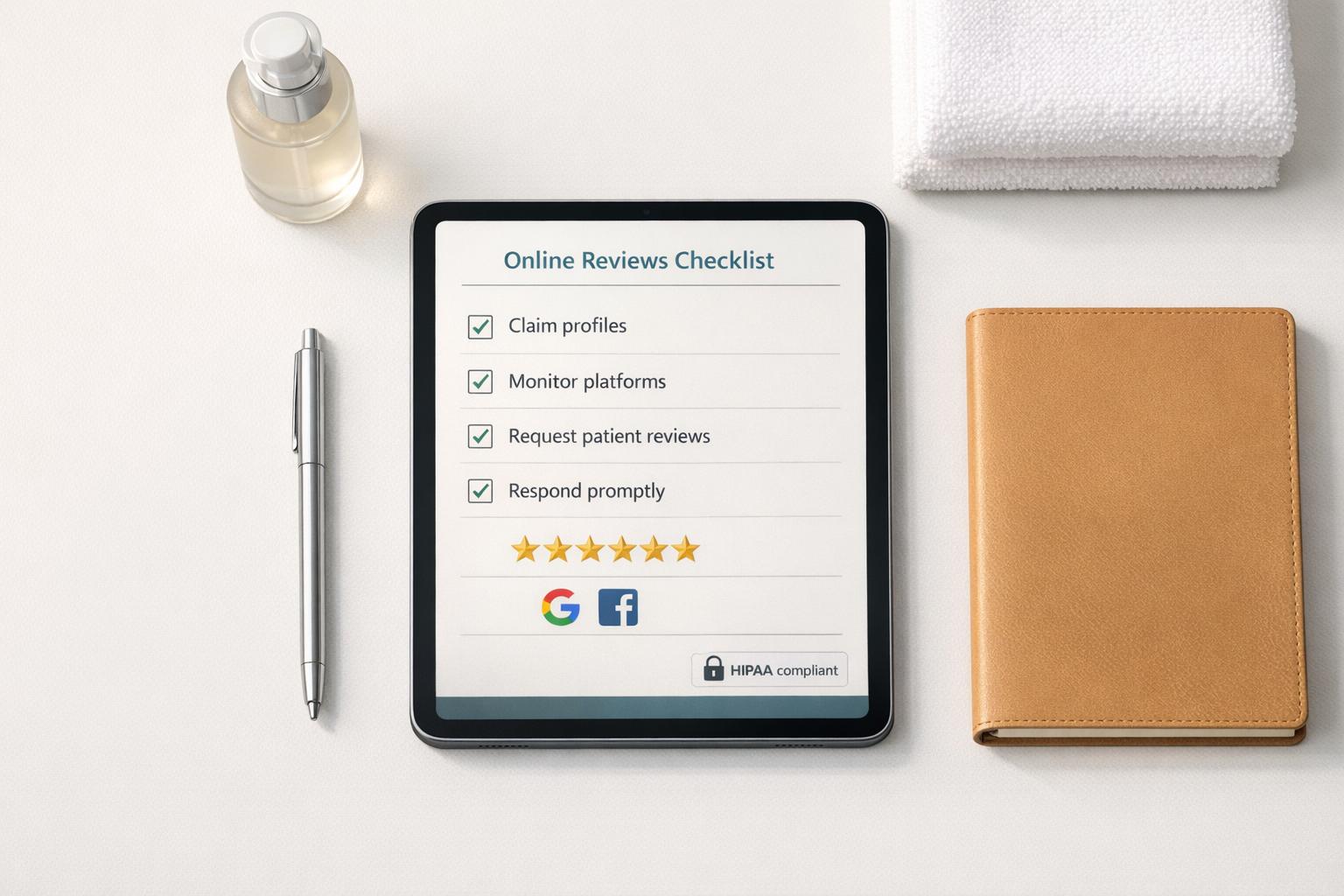

Your clinic's online reviews can make or break your reputation.
Potential patients often decide whether to book an appointment based on your ratings and feedback. Here’s why managing online reviews is critical and how to do it effectively:
- Reviews Influence Decisions: 73% of patients read reviews before booking, and 83% avoid clinics rated below 4 stars.
- Financial Impact: A one-star rating increase can boost revenue by 5–9%.
- Visibility Matters: Active review management improves your ranking on Google’s Local Map Pack.
This guide covers:
- Setting up a review management system (roles, HIPAA compliance, securing profiles).
- Monitoring and responding to reviews daily.
- Encouraging patient feedback at the right time.
- Using reviews to improve operations and patient care.
Start managing your reviews now to attract more patients, strengthen your reputation, and improve clinic performance.

Online Review Management Checklist for Aesthetic Clinics
Setting Up a Review Management System
To manage reviews effectively, you'll need a structured system that defines roles, ensures HIPAA compliance, and secures your online presence. This approach helps maintain consistency and professionalism in handling feedback.
Define Roles and Responsibilities
A lack of clear accountability can derail review management efforts. Assign specific team members, such as a front desk representative or social media manager, to handle daily monitoring and respond to initial reviews. For more sensitive or complex issues, escalate them to the practice manager. Meanwhile, the clinic owner or director should handle high-stakes situations requiring final approval.
Establish escalation paths and use standardized templates to prevent emotionally charged responses. For example, recurring or serious complaints should go to the practice manager, while legal concerns - like threats of lawsuits or claims of clinical harm - must be referred to legal or compliance counsel. Incorporating these steps into a Standard Operating Procedure (SOP) ensures responses remain consistent and follow proper governance protocols.
"Reputation management is no longer a marketing exercise alone. It is a licensure-sensitive communication strategy that requires governance before automation." - DocuHealth
Create HIPAA-Compliant Response Guidelines
Responding to reviews without violating HIPAA regulations can be tricky. Even if a reviewer identifies themselves as a patient, confirming their status publicly could disclose Protected Health Information (PHI). Avoid mentioning any details about treatments, appointments, diagnoses, or billing in your responses.
Instead, develop a library of pre-approved, neutral templates. For instance, use phrases like, "Thank you for sharing your feedback", instead of referencing specific care details. Always encourage reviewers to continue the conversation privately - through a phone call or a secure patient portal. A 2022 case highlights the risks: a dental practice was fined $50,000 by the OCR for revealing anecdotal details about a patient visit in a public response.
If your clinic uses AI or third-party tools to draft responses, make sure you have a signed Business Associate Agreement (BAA) in place. Additionally, ensure that a human reviews and approves all responses before they are published.
Claim and Secure Online Profiles
Managing reviews starts with controlling your online presence. Begin by claiming your Google Business Profile to enhance local search visibility. Afterward, focus on platforms that align with your patient demographics. For example, U.S.-based aesthetic clinics should prioritize RealSelf for procedure-specific reviews, Yelp for urban markets, and Healthgrades for feedback from credentialed providers.
Once you've claimed your profiles, secure them with role-based access to prevent issues tied to individual accounts. On platforms like Healthgrades and Vitals, verify that your medical director and nurse practitioners are listed accurately to bolster clinical credibility. The American Med Spa Association (AmSpa) advises checking reviews weekly and responding to all feedback within 24 to 48 hours.
An integrated platform like Prospyr can make these tasks easier by centralizing review management while ensuring HIPAA compliance and secure access to your profiles.
Daily and Weekly Review Monitoring Checklist
Once your system is set up, sticking to a structured routine for review monitoring is crucial to maintaining a solid online reputation. With profiles claimed and roles assigned, you need a regular schedule to stay on top of incoming reviews. Skipping this can lead to neglected feedback, which can harm your credibility.
Monitor Key Review Platforms
Google Business Profile should be your top priority. Check it daily because it directly impacts your local search rankings and visibility in the Map Pack. Platforms like RealSelf and Yelp also require daily attention, as they play a big role in how potential patients evaluate procedures and compare providers.
Other platforms, like Facebook, Healthgrades, and Vitals, can be reviewed weekly. While they’re important for building social proof and showcasing medical expertise, they typically receive fewer reviews than Google. Here's a suggested schedule:
| Platform | Check Frequency | Primary Reason |
|---|---|---|
| Google Business Profile | Daily | Local SEO and Map Pack visibility |
| RealSelf | Daily | Procedure-specific research |
| Yelp | Daily | Discovery in urban markets |
| Weekly | Social proof and peer recommendations | |
| Healthgrades / Vitals | Weekly | Medical director and practitioner credibility |
Once you’ve reviewed these platforms, it’s time to track metrics to spot trends and evaluate your performance.
Track Review Metrics
Monitoring reviews isn’t just about reading feedback; it’s about spotting patterns. Each week, document your average star rating across platforms and note how many new reviews you’ve received. Ideally, aim for 8–15 new reviews per month with a rating that stays between 4.5 and 4.8 stars. If you're getting fewer than 4 reviews per month, it’s a sign to revisit your process for encouraging reviews.
Look for recurring themes in the feedback. For instance, if multiple reviews mention long wait times or issues with the front desk, those are areas you can address. As Sunny Patel from Wolfable explains:
"Reviews, read systematically, are a low-cost patient experience audit."
Every quarter, dive deeper into your reviews. Check what percentage focus on specific treatments versus general experiences. This can reveal gaps in how you communicate with patients or guide them through their care journey.
Timely responses, which we’ll cover next, are the final piece of effective review management.
Respond to Reviews on Time
Make it a habit to acknowledge new reviews within 24–48 hours. Negative reviews, especially those involving safety concerns, require even faster action - respond to these within 12 hours. A delayed response can give the impression that you’re not paying attention, and studies show that 88% of consumers prefer businesses that respond to both positive and negative feedback.
To stay on top of this, set up real-time alerts so you don’t have to rely on manual checks. Assign a team member to handle responses by the end of each day, using pre-approved templates to ensure consistency and HIPAA compliance. Tools like Prospyr’s review management software can help centralize these alerts and streamline your response process across all platforms. This level of responsiveness strengthens your reputation and supports a reliable review management strategy for your clinic’s success.
How to Generate More Patient Reviews
Once you’ve set up review monitoring, the next step is actively encouraging patients to leave reviews. By asking at the right time and using the right methods, you can turn patient satisfaction into meaningful feedback.
Identify the Right Moments to Ask for Reviews
Timing is everything when it comes to requesting reviews. The key is to align your ask with moments when patients are most satisfied. For example:
- Injectables (like Botox or fillers): Wait 5–7 days after treatment. This allows time for any swelling to subside and for results to fully appear.
- Facials: Ask within 24–48 hours while the skin is still glowing from the treatment.
- Body treatments: Request feedback within 24 hours to capture patients while their experience is fresh.
- General aesthetic services: The first 24 hours post-appointment are ideal, as satisfaction tends to peak during this time.
| Treatment Type | Best Time to Ask | Why |
|---|---|---|
| Injectables (Botox, fillers) | 5–7 days post-treatment | Results are clear once swelling subsides |
| Facials | 24–48 hours post-treatment | Captures the post-treatment glow |
| Body treatments | Within 24 hours | Experience is fresh and satisfaction is high |
| General aesthetic services | Within 24 hours | Highest satisfaction window |
A personal ask, such as the provider mentioning it at the end of the appointment, can be highly effective. This human touch often performs better than automated messages alone. To make the process even easier, you can place QR codes at the front desk, allowing patients to leave reviews in under a minute.
For those moments when you can’t ask in person, automation can ensure no opportunity is missed.
Automate Review Requests
While personal requests are impactful, they aren’t always scalable. Automating the process ensures every patient gets a follow-up. SMS is particularly effective, boasting an open rate of 98%, compared to email’s 20–28%. The timing of these messages is also crucial - requests sent within one hour of an appointment see a 35% higher response rate than those sent 24 hours later.
Tools like Prospyr's review management system can help streamline this process. These tools can automatically send SMS or email requests once an appointment is marked complete. They often include a direct link to your Google Business Profile and consolidate incoming reviews into a single, easy-to-manage dashboard.
It’s also important to keep messages HIPAA-compliant by using neutral language such as “Thank you for your visit” and avoiding any mention of specific treatments or clinical details. Additionally, to prevent request fatigue, configure your system to avoid sending review requests to returning patients more than once every 6–12 months.
Route Feedback Based on Patient Sentiment
Adding a private feedback step before directing patients to public review platforms can help manage patient sentiment effectively. Start by asking patients how they feel about their results. For instance:
- Patients who score 9–10 on a quick Net Promoter Score (NPS) survey can be directed to platforms like Google or RealSelf.
- Patients who score 6 or below can be routed to a private internal feedback form, giving your team a chance to address concerns directly.
This approach not only helps resolve issues quietly but also ensures that only satisfied patients post public reviews.
"A client who writes a positive review is also psychologically committing to the practice, making them more likely to rebook." - Brian Boesen, Founder of Regulr
Clinics that adopt structured workflows for reviews typically generate 15–50 reviews per month, compared to just 2–5 reviews from sporadic manual requests. And remember, offering incentives like discounts or gifts in exchange for reviews is against FTC guidelines. Keeping the process honest ensures long-term credibility and success.
sbb-itb-02f5876
How to Respond to Reviews: A Step-by-Step Checklist
Once you've streamlined the process of collecting reviews, the next step is equally important: crafting thoughtful and compliant responses. How you reply to reviews can significantly impact how your practice is perceived. In fact, businesses that respond to reviews consistently are seen as 1.7 times more trustworthy, and 88% of consumers prefer businesses that engage with both positive and negative feedback. The challenge lies in knowing exactly how to respond to each type of review while avoiding potential pitfalls.
Responding to Positive Reviews
Positive reviews are an opportunity to reinforce your practice's values and build stronger connections. Aim to respond within 24–48 hours. Start by thanking the reviewer by name and referencing general aspects of their feedback, such as "friendly staff" or "welcoming environment." However, steer clear of confirming patient relationships or mentioning any specific treatments - this could violate HIPAA guidelines. For example, instead of saying, "We're thrilled your Botox results turned out great!" opt for something neutral like, "We're happy to hear you had such a positive experience with our team."
"Thank you for taking the time to share your experience. We are glad to hear that your visit was a positive one. Our team works hard to provide compassionate, high-quality care, and feedback like yours is incredibly meaningful." - StarReplies Team
Wrap up your response with a warm, general invitation, such as "We look forward to continuing to serve our community." Avoid phrases like "See you at your next appointment", as this could imply an ongoing patient relationship, posing a compliance risk.
Responding to Neutral or Mixed Reviews
Neutral or mixed reviews might highlight specific areas for improvement, making them valuable for operational insights. When responding, acknowledge the positive aspects of the review first, then address the concerns with an open invitation to discuss them further. Always include a direct contact method, like a manager's name, phone number, or email, instead of using vague terms like "contact us." For example, if someone leaves a 3-star review without any details, you could respond by asking what could have made their experience a 5-star one.
Document recurring issues, such as long wait times or billing confusion, and make these topics part of your team's regular discussions. This not only helps improve your operations but also shows prospective patients that you're committed to addressing feedback.
"The goal of every response is not to win an argument or to thank someone for their praise. The goal is to demonstrate to the next ten prospective patients reading that review that your clinic is attentive, professional, and genuinely invested in patient experience." - Sunny Patel, Wolfable
Responding to Negative Reviews
Negative reviews require a prompt and professional approach. A single negative review left unaddressed can deter 22% of potential patients, but a well-crafted response has the potential to win back 51% of dissatisfied individuals. Address safety-related concerns within 2–4 hours, and respond to all other negative feedback within 24 hours.
Here’s a quick guide to handling common negative review scenarios:
| Scenario | What NOT to Do | Professional Approach |
|---|---|---|
| Results concern | Argue or disclose clinical details | Acknowledge the concern with empathy and invite the reviewer to discuss privately. |
| "Botched" claim | Admit fault or apologize for specific outcomes | Express regret for their experience and offer immediate private follow-up. |
| Fake review | Respond angrily or ignore | State that no record of the visit exists and provide contact info for verification. |
| Pricing complaint | Debate or justify costs | Highlight your commitment to high-quality, FDA-approved products and safety. |
Never admit liability or reference specific treatments publicly. If you suspect a review is fraudulent - such as one with generic language or no record of the visit - report it through the platform's official system instead of engaging directly. Research shows that about 10.7% of Google reviews are likely fake, so this step is essential.
"The person reading your reply isn't an angry patient. It is the next 100 patients. They want to see that you are kind and professional." - Sunny Patel, Wolfable
To maintain consistency and compliance, create a library of HIPAA-safe response templates that your team can personalize as needed. Tools like Prospyr (https://prospyrmed.com) can help centralize and automate your responses while ensuring HIPAA compliance.
Using Reviews to Improve Clinic Operations
Analyze Review Trends
Reviews can shine a light on patterns that are worth paying attention to. Set aside 30 minutes each week to dig into these trends - whether it’s recurring complaints about long wait times, consistent praise for a specific provider, or a drop in ratings after a scheduling change. The goal here isn’t just to track metrics (that’s covered elsewhere) but to connect these patterns to actionable changes. For example, identify which parts of the patient experience generate the most feedback and determine whether the sentiment points to a broader issue. AI-powered tools can help summarize themes and produce sentiment reports, making it easier to spot and address problems before they escalate. These insights can directly guide improvements in staff training and operational workflows.
Use Feedback in Staff Training
Anonymous review insights can be a valuable addition to team meetings, helping you address service gaps without singling anyone out.
- Wait times and front-desk experience: If reviews mention long waits or a lack of friendliness at the front desk, it’s time to review scheduling protocols and consider additional customer service training for your administrative staff.
- Concerns about clinical results: Negative feedback about treatment outcomes should trigger a deeper review, along with communication coaching for the clinical team.
- Positive feedback about specific providers: Highlight these reviews as examples of best practices during team development sessions.
Tracking feedback at the provider level is especially useful. When a review mentions a team member by name, it’s an opportunity for growth - whether it’s recognizing high performers who can share their methods or supporting those who need targeted coaching.
By centralizing review data, your team can focus on making meaningful, targeted improvements.
Use Technology to Centralize Review Data
Managing reviews manually across multiple platforms takes time. A centralized platform simplifies this process by gathering all review data in one place, making it easier to monitor trends, respond quickly, and connect reviews to clinic metrics like patient retention and referrals. Tools like Prospyr (https://prospyrmed.com) are designed for this purpose. Prospyr’s review management tools integrate seamlessly with practice analytics, showing you how your online reputation aligns with real-world outcomes - not just star ratings.
As one expert puts it: "Your online reputation is more important than ever in today's digital age. It can influence patient decisions and shape your brand image." A HIPAA-compliant dashboard streamlines the process, saving time and enabling faster action. Clinics that use review management strategically often see a 25–40% boost in new patient volume. That’s a compelling reason to treat review management as an essential part of your business strategy.
Conclusion: Building a Consistent Review Management Process
Managing online reviews isn’t something you can set and forget - it’s a continuous effort that has a direct impact on how many new patients choose your clinic. Consider this: 93% of patients check online reviews before deciding on a provider. Even more striking, just one negative review left unchecked can drive away 22% of potential patients. With so much on the line, a solid strategy is non-negotiable.
The checklist outlined in this article provides a step-by-step approach to building a reliable review management system. It starts with setting up HIPAA-compliant response guidelines and claiming your profiles, moves into daily monitoring and generating reviews at the right time, and ends with using patient feedback to improve your clinic’s operations. Each step supports the next, creating a seamless process. When done consistently, this approach strengthens your reputation, boosts your Local SEO rankings, and ensures a steady stream of new patients.
"Positive or negative, every review is an opportunity to demonstrate your dedication to patient care." - Prospyr
The clinics that stand out aren’t always the ones with the most advanced clinical skills - they’re the ones with better systems in place. As Katy Piper of Pabau explains: "The gap between a three-star practice and a five-star competitor is rarely about clinical skill. It is almost always about med spa reputation management workflows." A well-structured and consistent process is what transforms a reactive clinic into one that thrives on its reputation.
Prospyr simplifies this process by offering tools like review monitoring, automated requests, sentiment-based routing, and practice analytics. This means your team can spend less time navigating platforms and more time focused on patient care. Start with the checklist, make it a habit, and let the right tools lighten the load.
FAQs
How can we reply to reviews without violating HIPAA?
When replying to reviews, it’s crucial to steer clear of confirming whether the reviewer is a patient or mentioning any sensitive health information. This includes details about treatments, diagnoses, billing, or even specific provider names. Instead, use neutral and professional language to acknowledge their feedback. Encourage them to reach out to your office privately, either by phone or email, for further assistance. Make sure your team is well-trained in HIPAA-compliant practices and adheres to consistent policies to safeguard patient privacy at all times.
What should we do when we get a fake or malicious review?
If you come across a fake or malicious review, report it to the platform right away to safeguard your online reputation. When crafting a public response, it's crucial to remain HIPAA-compliant. Avoid confirming whether the reviewer is a patient or sharing any clinical information. A neutral and professional reply might look like this: "We value genuine feedback. If you’ve never been to our practice, please reach out to us directly so we can better understand and address your concerns."
What’s the best way to ask patients for more reviews?
To gather more reviews, set up a consistent and automated process that prioritizes timing and convenience. For cosmetic treatments, it's best to request reviews 3–7 days after the results become noticeable. For routine visits, aim to ask within 24–48 hours.
Begin by making an in-person request during checkout, then follow up with an automated SMS or email that includes a direct link for leaving a review. SMS generally yields better results. Highlighting how reviews can assist others in making informed decisions can also encourage more responses.