

High costs push patients away. Over half of people delay health or wellness care due to out-of-pocket expenses, and 38% switch providers after negative billing experiences. Practices lose not just revenue but long-term relationships. The solution? Flexible payments.
Key takeaways from the article:
- 53% of patients delay care due to costs; 63% can’t pay more than $750 upfront.
- Flexible payment options like installment loans, recurring plans, or revolving credit lines make treatments more accessible.
- Memberships turn large expenses into predictable monthly payments, increasing loyalty and adherence to treatment plans.
- Integrated payment systems simplify billing, reduce errors, and improve patient satisfaction.
- Positive billing experiences drive retention: 58% of patients return after a good experience, while 38% leave after a bad one.
Offering diverse payment methods and using tools like Prospyr to manage billing can help practices retain patients, reduce financial stress, and improve overall satisfaction.
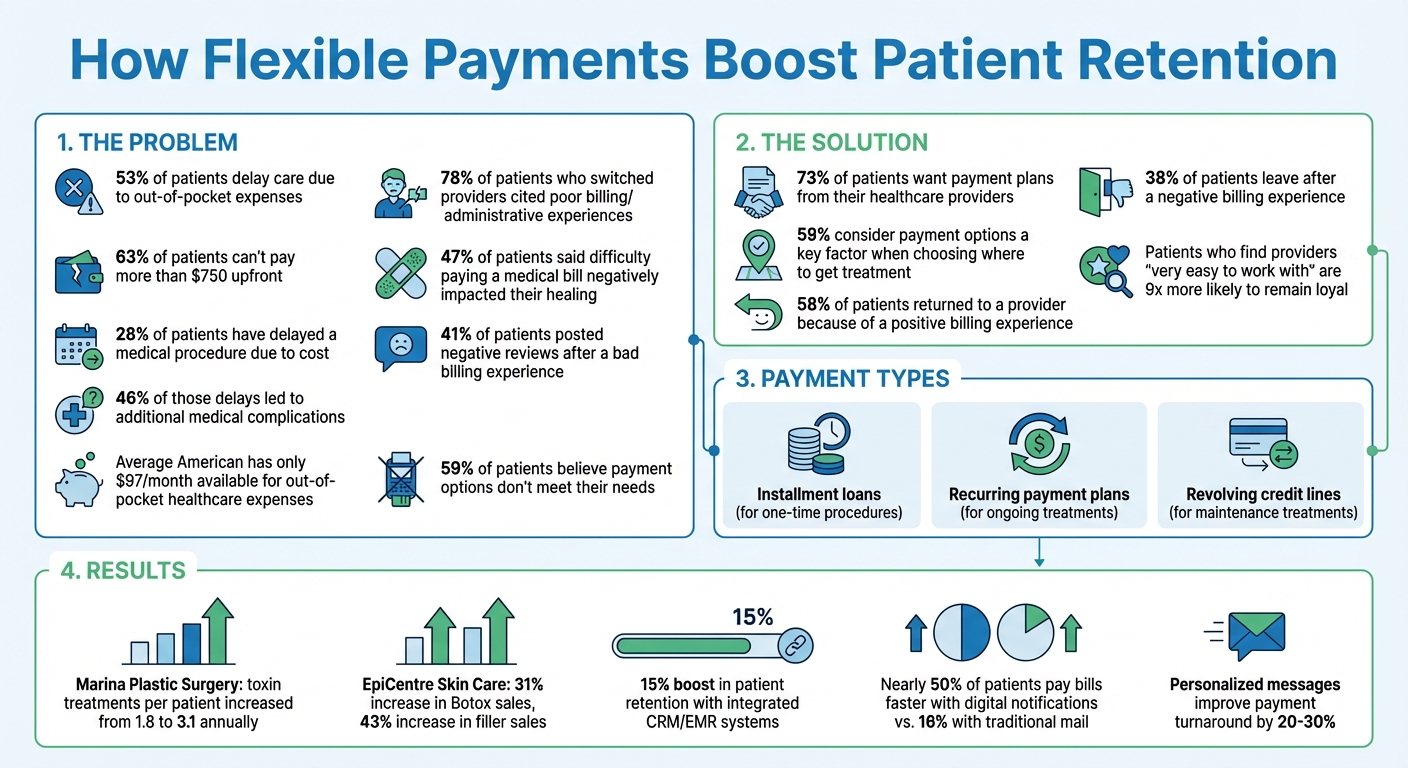
How Flexible Payment Options Impact Patient Retention Statistics
The Problem: Financial Barriers Prevent Patient Loyalty
High Upfront Costs Prevent Treatment Commitment
Aesthetic and wellness treatments often come with price tags that exceed what many patients can afford upfront. When treatments cost thousands of dollars, plenty of patients simply don’t move forward. In fact, 28% of patients have delayed a medical procedure due to cost, and 46% of those delays led to additional medical complications.
The average American has just $97 per month available for out-of-pocket healthcare expenses. Practices that require full payment upfront for expensive treatments unintentionally exclude a large portion of potential patients. It’s not that patients don’t value their health and wellness - they’re just limited by what their budgets allow.
This financial strain doesn’t just block new patients; it disrupts ongoing care. Patients who start a treatment plan but can’t afford to complete it are left with unfinished results. This not only impacts their outcomes but also diminishes their view of the practice’s overall value. Add inflexible payment systems to the mix, and the problem becomes even more pronounced.
Rigid Payment Systems Lead to Lost Patients
When practices stick to “pay in full” policies, they risk losing patients to competitors. Beyond the financial burden, rigid payment systems create unnecessary administrative headaches. 78% of patients who switched providers cited poor "navigation experiences", including billing and administrative challenges. Confusing invoices, limited payment options, and frustrating interactions with billing staff leave patients feeling overwhelmed and stuck. Nearly half (47%) of patients said difficulty paying a medical bill negatively impacted their healing or well-being.
The fallout doesn’t stop there. 41% of patients have posted negative reviews after a bad billing experience. In a field where reputation and referrals are key to growth, inflexible payment systems can seriously damage a practice’s ability to attract new patients. Even more concerning, 59% of patients believe the payment options offered by their providers don’t meet their needs. Addressing these shortcomings isn’t just a nice-to-have - it’s a critical step toward building patient loyalty and trust.
Flexible Payment Options Solve Financial Barriers
Turn hefty upfront costs into manageable payments. Flexible payment options help patients align treatment costs with their monthly budgets, eliminating one of the biggest hurdles that stop them from starting or completing their care. Let’s dive into how these payment methods can make a difference.
Types of Flexible Payment Methods
One size doesn’t fit all when it comes to payments. Different patients have different needs, and practices can offer solutions tailored to those needs:
- Installment loans work best for one-time procedures like laser treatments or body contouring. These loans allow patients to make fixed, predictable payments over time.
- Recurring payment plans are ideal for ongoing treatments, such as monthly facials or IV therapy sessions, where patients pay a set amount at regular intervals.
- Revolving credit lines, like health and wellness credit cards, let patients borrow and repay as needed without reapplying. These are perfect for recurring maintenance treatments or new procedures, encouraging repeat visits and long-term care continuity.
Practices can choose between managing payments in-house or partnering with third-party financing providers. In-house plans give practices control over terms and interest rates, helping to build trust directly with patients. However, they also come with added administrative responsibilities and the risk of handling collections. On the other hand, third-party financing shifts the risk to an external lender while ensuring practices receive payment quickly - often within two business days - though this convenience typically comes with a merchant fee.
These payment options don’t just ease financial stress - they also create opportunities for stronger, long-term connections with patients.
How Flexible Payments Improve Retention
The numbers speak volumes: 58% of patients have returned to a provider because of a positive billing experience. When patients can afford to complete their treatment plans, they’re more likely to see better results, feel satisfied, and stay loyal. Flexible payment options turn one-time visits into lasting relationships. In fact, 73% of patients want payment plans from their healthcare providers, and 59% consider payment options a key factor when choosing where to get treatment.
Reducing financial friction keeps patients coming back. Patients who describe their providers as "very easy to work with" are nine times more likely to remain loyal compared to those who find their providers difficult. Flexible payment solutions address cost concerns and build trust - critical factors, especially when 53% of people delay care due to out-of-pocket expenses. These options remove barriers, making it easier for patients to prioritize their health and stick with their providers.
Memberships and Subscriptions Build Long-Term Loyalty
Memberships Provide Predictable Value for Patients
Memberships transform hefty, one-time expenses into manageable monthly payments. This setup makes premium aesthetic treatments feel more within reach for patients. After all, 68% of aesthetic patients identify cost as the primary hurdle to sticking with their treatment plans.
With memberships, patients are more likely to stick to recommended treatment schedules - like getting neurotoxin injections every 3–4 months - ensuring consistent care throughout the year. For example, Marina Plastic Surgery saw a jump in average annual toxin treatments per patient from 1.8 to 3.1 after adopting a subscription model, which significantly boosted revenue. Similarly, at EpiCentre Skin Care and Laser Center in Dallas, Dr. A. Jay Burns reported a 31% increase in Botox sales and a 43% rise in filler sales thanks to their subscription approach.
"For our practices, noncompliance leads to unhappy, undertreated patients, so they may write negative reviews. In addition to that, we lose revenue."
Offering perks like discounts, priority appointments, and complimentary treatments strengthens patient loyalty even further. These benefits, paired with flexible payment options, encourage patients to stay engaged with their care plans. Beyond improving adherence, this model also integrates effortlessly with automated systems, reducing administrative headaches.
Automate Membership Management with Prospyr

To truly maximize the benefits of memberships, automation is key. Handling memberships manually can overwhelm staff, but Prospyr’s tools take care of the heavy lifting - managing billing cycles, recurring payments, and credit card charges - so your team can focus on delivering excellent patient care.
Prospyr simplifies renewals, payment tracking, and appointment reminders, ensuring patients stay on schedule without billing hiccups. This reduces missed treatments and late payments, which are common pain points. And since patients who find their providers "very easy to work with" are nine times more likely to stay loyal, Prospyr’s automation directly supports retention. By integrating membership management with its broader practice tools, Prospyr provides a seamless experience. It connects membership data with your CRM and scheduling systems, offering a complete, HIPAA-compliant view of each patient’s treatment history and payment details - all in one place.
sbb-itb-02f5876
Integrated Payment Systems Improve Patient Experience
Payment Integration Enables Personalized Communication
Integrated payment systems simplify the patient experience by connecting CRM, scheduling, and communication tools. This integration eliminates the hassle of staff toggling between systems, helping to reduce checkout mistakes and speeding up the entire process. But beyond efficiency, it opens the door to personalized, proactive communication - something patients genuinely value.
For example, integrated systems make it easy to send automated text or email reminders with secure payment links. Nearly half of patients pay their medical bills faster when they receive digital notifications, compared to just 16% who respond more quickly to traditional mail. The secret lies in crafting thoughtful, personalized messages. Including the patient’s name and using polite, supportive language can improve payment turnaround times by 20–30%. These seamless interactions also set the stage for proactive financial discussions, helping to alleviate patient concerns about costs.
Integration also makes upfront financial conversations feel more natural. Take the example of Erica McDade, a treatment coordinator at Seven Hills Dentistry in Dallas, GA. In June 2025, she used an iPad integrated with Open Dental to perform CareCredit prequalifications. The process took just two minutes, and 6 out of 10 patients were approved through the integrated app. Because the system provided pre-approval details before the patient’s visit, staff could discuss payment options during appointment confirmation calls. This approach made cost conversations smoother and less uncomfortable for everyone involved.
Prospyr's Unified Payment and Practice Management
Prospyr takes these benefits further by combining payment processing with core practice management features, enhancing the overall patient experience. Prospyr integrates payment processing, patient records, scheduling, and communication into a single, HIPAA-compliant platform. With this unified system, staff can access a patient’s complete history - including clinical notes, appointment schedules, membership details, and payment records - all in one place. Plus, the platform automates payment entries directly into the daily ledger. Practices with integrated CRM and EMR systems have seen a 15% boost in patient retention rates. It’s easy to understand why: when everything works together, patients encounter fewer billing surprises and less administrative hassle.
Miranda Duel, office manager at Homestead Animal Hospital in Mechanicville, NY, shared her experience of switching to an integrated system in June 2025. She explained how it replaced manual credit card terminals, eliminating human errors by automatically recording payments into the practice software ledger.
With 58% of patients saying they return to a provider after a positive billing experience, and 38% leaving due to negative ones, getting these details right isn’t just about convenience - it’s a key factor in building patient loyalty.
Track the Results of Flexible Payment Options
Use Payment Data to Understand Patient Behavior
Keep an eye on payment data to evaluate how well flexible payment options are working. Start by calculating your Patient Retention Rate using this formula:
[(Total patients at the end of the period – New patients gained during the period) / Total number of patients at the beginning of the period] x 100.
Review this quarterly to identify trends. If retention improves after introducing installment plans or memberships, it’s a good sign you’re meeting patient needs.
In addition to retention, track your TOS (Time of Service) collections for copayments and patient balances. This metric reveals whether patients are paying upfront or require more flexible options. For example, the percentage of patient-due balances collected at TOS rose from 14.76% in 2019 to 39% in 2022, highlighting a shift toward upfront payment engagement. If your TOS collections are low, it might mean your payment options need rethinking.
Days in Accounts Receivable (A/R) is another key metric to monitor. It shows how quickly patients are paying their bills. High-performing practices typically clear most A/R within 30 days. If you’re seeing accounts linger in the 120+ day range, it may be time to reassess whether your payment plans are manageable for patients. For example, in 2024, UCHealth used Experian Health's Patient Financial Clearance tool to screen patients for financial assistance, leading to $26 million in charity care write-offs while maintaining steady revenue. Similarly, Luminis Health used Coverage Discovery to uncover an average of $240,000 in billable coverage monthly that would otherwise have been written off as self-pay.
These metrics provide a clear picture of how flexible payment options influence patient behavior and practice stability.
Flexible Payments Support Practice Growth
Flexible payment options do more than retain patients - they drive sustainable growth by increasing treatment acceptance rates. Monitor how often patients accept treatment plans and track revolving credit usage. Revolving credit lines are especially helpful because patients can return for additional treatments without needing to reapply.
"If providers want to see new patients choose their practice, they should consider prioritizing financial conversations as part of care discussions." - Claude Royster, MGMA
Billing experiences matter. Positive payment interactions encourage patients to return, while negative ones can lead to patient loss. When flexible payment options are paired with tools like Prospyr, you gain real-time insights into payment trends, membership renewals, and patient lifetime value - all in one place. These tools allow practices to refine payment strategies and strengthen patient relationships. By analyzing this data, you can make smarter decisions about expanding payment options and enhancing the overall patient experience.
Conclusion
Offering flexible payment options plays a key role in improving patient engagement and encouraging commitment to care. By introducing installment plans, memberships, and transparent pricing, healthcare practices can help remove financial stress and create an environment where patients feel supported. Studies indicate that positive billing experiences can significantly enhance patient retention.
Technology solutions like Prospyr simplify payment processing while integrating seamlessly with CRM, scheduling, and communication systems. This reduces errors, lightens administrative workloads, and ensures a smooth, HIPAA-compliant experience. By linking payment data directly to patient records and appointment systems, practices can shift the focus back to patient care rather than billing headaches.
Whether it’s installment plans for one-time treatments or memberships for ongoing care, offering diverse payment options increases patient satisfaction and operational efficiency. Features like automated reminders and clear upfront cost discussions build trust and encourage timely payments. Combining financial flexibility with streamlined technology allows practices to elevate the patient experience at every stage of care.
FAQs
How can flexible payment options help improve patient satisfaction and loyalty?
Offering flexible payment options - like installment plans, memberships, or online financing - can make aesthetic and wellness treatments more manageable for patients. By spreading costs into predictable monthly payments, clinics can help ease financial worries and create a more straightforward and reassuring care experience.
Research highlights that convenient payment methods significantly impact patient loyalty. Patients are more likely to stick with providers who offer simple, tailored payment solutions. By eliminating financial hurdles and simplifying the payment process, clinics can build trust, enhance satisfaction, and encourage repeat visits.
With tools such as Prospyr, clinics can seamlessly incorporate flexible payment options into their systems. This not only simplifies workflows but also reduces the chances of cost-related drop-offs, helping to maintain strong, long-term relationships with patients.
What flexible payment options can healthcare practices offer to improve patient retention?
Offering a variety of payment options can make healthcare more approachable and encourage stronger patient relationships. Some popular choices include installment plans, which let patients spread out treatment costs over time, and membership or subscription programs that provide services for a set monthly fee. Practices can also create custom payment plans to fit individual needs and offer digital payment solutions, like online portals or mobile wallets, for quick and contactless transactions.
When patients have the flexibility to choose payment methods that work for their budget, it can ease financial worries and lead to a better overall experience. Tools like Prospyr simplify the process for aesthetics and wellness clinics, helping them manage these options while boosting patient satisfaction and loyalty.
How do flexible payment systems improve the patient experience and loyalty?
Flexible payment systems simplify the checkout process and make it more patient-friendly. By incorporating features like financing options, online payment portals, and point-of-service card processing directly into a practice’s management software, clinics can reduce errors, speed up transactions, and cut down on front desk wait times. Patients value having clear cost estimates and the flexibility to choose payment methods - whether it’s credit cards, debit cards, or installment plans - giving them a greater sense of control over their care.
With an all-in-one platform like Prospyr, these tools are integrated into the same system that manages appointments, records, and memberships. Patients can effortlessly enroll in memberships, set up recurring payments, or apply for financing, all within a single portal. This seamless approach not only enhances convenience and affordability but also frees up staff to focus more on patient care, improving satisfaction and building long-term loyalty.