

Certified providers in aesthetic medicine outperform their uncertified peers in revenue, client trust, and service offerings. Here's why certifications are a game-changer:
- Close skill gaps: Certifications equip practitioners with advanced training, enabling them to safely perform high-revenue treatments like neurotoxin injections, laser therapies, and combination protocols.
- Boost revenue: Certified professionals command higher prices, expand service offerings, and increase patient retention. For example, adding laser treatments can raise annual practice income from $150,000 to $400,000 or more.
- Build client trust: Patients prefer certified providers, with 84% more likely to return to practices prioritizing safety and professionalism. Retaining clients is 8x cheaper than acquiring new ones.
- Stay competitive: Certifications differentiate providers in a booming $11.8 billion industry, where expertise and credentials attract discerning clients.
- Learn business essentials: Certification programs teach critical skills like pricing, patient retention strategies, and legal compliance, helping practices scale profitably.
Certification not only enhances clinical skills but also strengthens patient relationships and improves business outcomes with advanced practice analytics. In a competitive market, it’s the key to sustainable growth.

Key Benefits of Aesthetic Medicine Certification: Revenue Growth and Client Trust Statistics
How Skill Gaps Affect Practice Growth
Skill gaps in aesthetic practices can directly hinder revenue growth and limit market potential. Without specialized certifications, practitioners miss opportunities to tap into the industry's rapid expansion and address the changing needs of patients. Closing these gaps through certification is crucial for offering diverse services and fostering long-term client loyalty.
Limited Treatment Options Without Certifications
Practitioners who lack advanced certifications are often restricted to basic services, while competitors with specialized training dominate high-revenue treatments. For instance, without expertise in facial anatomy and musculature, practitioners are unable to safely perform advanced procedures like neurotoxin injections for migraines or "gummy smiles". Similarly, certifications in energy-based devices are necessary to provide laser treatments, including photo facials, microdermabrasion, and tattoo removal.
This lack of training translates to missed financial opportunities. While aesthetic nurse practitioners earn an average of $96,536 annually, those with specialized certifications can see their earnings soar to $150,000–$250,000 or more, thanks to commissions. For example, programs like the National Esthetician Certification require 1,200 hours of training, ensuring practitioners gain the expertise needed for skin sciences and laser procedures. As the Aesthetic Academy of Advanced Medical Sciences explains:
"Aesthetic medicine is the only specialty that... requires practitioners to learn to assess facial anatomy using the Golden Ratio - a mathematical formula for understanding and creating ideal proportions."
Beyond financial growth, skill gaps limit a practice's ability to address emerging trends. For instance, practitioners without advanced training cannot manage facial volume loss caused by GLP-1 medications (patients lose an average of 7% of midfacial volume for every 22 pounds lost) or cater to younger patients seeking "prejuvenation" treatments. Additionally, certifications in combination therapies, such as RF microneedling paired with PLLA, allow practices to offer cutting-edge protocols that deliver better results and justify higher pricing. Without these skills, practices risk falling behind competitors and losing patient trust.
Client Trust Issues Without Credentials
The absence of proper certifications doesn’t just limit services - it also undermines patient confidence. Patients are far more likely to trust injectors who can provide proof of formal training and certifications. As the American Academy of Cosmetic Medicine highlights:
"Patients feel safer choosing trained injectors."
Certifications also signal a practitioner’s commitment to high standards of care and safety. For example, the Certified Aesthetic Provider™ (CAP) designation demonstrates a dedication to professionalism that goes beyond simply following industry trends. This trust becomes even more critical when only 7% of aesthetic patients would consider stopping treatments during a recession. Retaining this loyal client base depends heavily on maintaining credibility.
The financial stakes are high. Acquiring a new patient costs eight times more than retaining an existing one, and 80% of a practice’s revenue often comes from its top 20% of patients. Without standardized training, practitioners risk delivering inconsistent results, which can harm a clinic’s reputation and make patient retention difficult. Missing data on skin reactions or allergies due to improper digital intake protocols further increases clinical risks and delays treatments, eroding patient confidence. Ultimately, a lack of certifications impacts both the ability to offer advanced treatments and the trust needed to sustain a thriving practice, making professional training a cornerstone of growth.
sbb-itb-02f5876
How Certifications Increase Revenue
Certifications don't just address skill gaps - they also open doors to increased revenue. By obtaining certifications, practitioners can offer specialized treatments at premium prices, driving significant financial growth. For example, a practice centered solely on injectables can bring in between $75,000 and $150,000 annually. Add lasers and facial rejuvenation services, and that number can climb to $200,000–$400,000 or more. Expanding into multiple treatment categories creates opportunities for even greater revenue.
Certified practitioners can also boost the average lifetime treatment value, which often exceeds $15,000, by offering a variety of premium services. A patient coming in for Botox might later opt for laser treatments to improve skin texture or regular chemical peels for maintenance - services that require proper certifications to perform safely and legally.
Higher Prices for Specialized Treatments
Advanced certifications allow practitioners to command higher prices for specialized treatments by showcasing their expertise. For instance, while basic Botox treatments range from $300 to $600 per session, body contouring sessions can cost $1,000 to $4,000, and laser hair removal packages typically fall between $1,500 and $5,000. These higher prices reflect both the complexity of the procedures and the significant investment in training and equipment. For example, laser systems alone can cost anywhere from $30,000 to $150,000.
Certifications also enable practitioners to tap into emerging trends. A growing market involves patients on GLP-1 medications, which often lead to noticeable facial volume loss - about 7% for every 22 pounds lost. Certified professionals can offer advanced volume restoration services to meet this demand, creating new revenue streams. This ability to provide high-value treatments not only increases income but also strengthens your practice's reputation for excellence.
More Services Mean More Revenue
Adding certified services expands a practice's offerings, creating multiple income streams that significantly enhance overall earnings. Many successful practices rely on three core areas: injectables for steady, recurring revenue; lasers and body contouring for differentiation and premium pricing; and facial rejuvenation for patient engagement and maintenance. Each category plays a distinct role in driving profitability.
A phased approach often works best. Starting with injectables requires minimal upfront costs and helps build a patient base. Adding facial rejuvenation services, such as chemical peels priced between $150 and $500 per session, within 3–6 months creates regular patient touchpoints. With capital in place, investing in laser equipment within 12–18 months allows practices to stand out from competitors who only offer injectables. Retail skincare sales, which can contribute about 20% of total medical spa revenue, provide an additional passive income stream to complement active treatment earnings. Together, these diversified services highlight the value of certifications and lay the groundwork for long-term growth.
How Certifications Build Client Trust
Certifications create a foundation of trust that keeps clients coming back. Displaying credentials signals to clients that their provider has undergone proper training and stays updated with industry standards. This assurance strengthens relationships, builds loyalty, and ultimately leads to better business results. It’s a trust that reflects in both treatment outcomes and long-term client retention.
Better Treatment Results with Formal Training
Certified practitioners achieve better results because their training is grounded in rigorous, evidence-based practices. Unlike providers who might rely on marketing claims, certified professionals make decisions based on solid clinical data. Take neurotoxins, for example. Certified providers can reference clinical studies showing responder rates ranging from 10.6% for letibotulinumtoxinA to 65.2% for incobotulinumtoxinA at day 120. This knowledge allows them to select the most suitable product for each patient’s unique needs.
The results speak for themselves. A multicenter study on PLLA (Poly-L-Lactic Acid) treatments revealed that 65-72% of patients experienced treatment success at six months, with ultrasound imaging confirming actual new collagen formation. Elizabeth Diaz, Aesthetic Injector and Nurse Practitioner at Blossom Beautifully Medical Aesthetics & Wellness, highlights the importance of training:
"The right credentials and training in an aesthetic provider do more than ensure safety; they guarantee that you are under the care of someone who understands the art and science of beauty enhancements".
Certified practitioners also excel in setting realistic expectations during consultations. By using detailed data and clear communication, they help patients understand what to expect, reducing the risk of disappointment. This approach not only improves satisfaction but also contributes to sustained revenue growth, aligning with the broader goals of any practice.
Client Retention and Referrals from Certified Practitioners
Trust is the cornerstone of loyalty. Confident clients are more likely to return for future treatments and recommend their provider to others. In a crowded market with endless choices, certifications often become the deciding factor for many patients.
The financial benefits are clear. With the average cost of acquiring a new aesthetic patient sitting around $132, retaining clients through trust is far more economical than constantly chasing new ones. The loyalty of aesthetic clients is also noteworthy - only 7% of patients say they would stop treatments entirely during a recession. This demonstrates the resilience of trust-based relationships built by certified practitioners.
Better results from certified expertise lead to repeat visits and word-of-mouth referrals, creating a cycle of growth. By combining professional training with consistent follow-ups and open communication, practices can foster the kind of long-term relationships that not only generate referrals but also ensure steady financial success.
Standing Out in a Competitive Market
The aesthetics industry brought in $11.8 billion in global revenue in 2022, making it a highly competitive field where practices vie for the same pool of clients. Certifications now play a key role in helping you grow your aesthetic practice by building trust and showcasing superior clinical outcomes. As cosmetic procedures become more accessible and widely accepted, certifications serve as a critical factor influencing patient choices in a crowded marketplace.
Using Credentials to Differentiate Your Practice
Certifications go beyond basic licensure and act as a strong signal of expertise. In a market saturated with providers, credentials validate your skills and set you apart from those who meet only entry-level state requirements.
Take the Certified Aesthetic Nurse Specialist (CANS) credential, for example. Earning this certification requires 1,000 practice hours in core specialties within the past two years, a minimum of two years of nursing experience, and a recommendation from a physician. Achieving this demonstrates a dedication to professional excellence that goes beyond the basics.
Specialized certifications also expand the range of treatments you can offer. Training in areas like laser therapy or chemical peels enables you to provide services that competitors without these qualifications simply can't. This not only differentiates your practice but also helps you attract clients seeking advanced, specialized care.
Attracting Clients Who Value Expertise
Modern clients are drawn to providers who prioritize evidence-based care over flashy marketing. With the average cost of acquiring a new patient sitting at $132, certifications help you appeal to discerning clients who are willing to pay premium rates for proven expertise and safety.
Affiliations with professional organizations such as the American Association of Aesthetic Medicine and Surgery (AAAMS) or the International Society of Plastic and Aesthetic Nurses (ISPAN) further enhance your reputation. These memberships not only keep you informed about industry trends but also signal your commitment to staying at the forefront of the field. Moreover, advanced certifications can open doors to exclusive opportunities like high-end clinic partnerships, speaking events, and teaching roles - positions that establish you as a leader in the industry rather than just another provider.
Business Skills Learned Through Certification Programs
Certifications don’t just sharpen clinical skills - they also teach the essential business strategies needed to run a successful practice. Many healthcare practitioners enter the field without a solid foundation in business management, which can make scaling and sustaining a profitable practice challenging. For instance, while the U.S. medspa market is expected to grow from around 1,600 locations in 2010 to over 13,000 clinics by 2026, only a small percentage of these businesses manage to surpass $3 million in annual revenue. Most medical spas generate between $1.8 million and $2.2 million annually, highlighting the gap between clinical expertise and financial success. Certification programs address this gap by teaching operational and strategic skills that directly impact profitability.
Business and Marketing Training for Growth
One of the key lessons from certification programs is viewing marketing as a revenue driver rather than just an expense. Practitioners learn financial management basics, such as pricing services effectively to balance transparency with profitability and using financial dashboards to monitor Key Performance Indicators (KPIs) in real time. Since staffing typically accounts for 35% to 45% of total revenue, these programs also focus on hiring strategies, compensation models, and retention techniques to safeguard one of the largest investments in any practice.
Patient retention is another critical area. Certification programs emphasize strategies like membership models and high-value retention plans, recognizing that 80% of an aesthetic practice’s revenue often comes from the top 20% of its patients. With the lifetime treatment value of a single patient frequently exceeding $15,000, mastering retention strategies can significantly boost revenue.
"Health care practitioners... may hold the necessary license and clinical training to start their own practices without further assistance, but they often do not have the business education to start their own practices without further assistance." - American Med Spa Association
These business skills are complemented by training in legal and compliance areas, which are just as crucial for long-term success.
Legal and Compliance Training
Legal missteps in aesthetic medicine are often accidental but can be incredibly costly, leading to fines, lawsuits, or even the loss of a medical license. For instance, 17 states enacted new laws in 2025 regulating who can work in medical spas and the supervision required. Certification programs equip practitioners with a "legal playbook" to navigate these complexities, covering topics like Management Services Organization (MSO) structuring, Corporate Practice of Medicine (CPOM) laws, and Medical Director agreements.
Practitioners also learn which treatments qualify as medical procedures and which licensed professionals - whether MDs, NPs, PAs, RNs, or estheticians - are legally allowed to perform them based on state-specific laws. Informed consent is another critical area, with training on crafting treatment-specific forms where patients initial key risks, rather than relying on generic documents. These measures help protect practices from regulatory fines, lawsuits, and board investigations while ensuring medical tasks are delegated appropriately and within legal boundaries.
How Technology Supports Certified Practices
Running a successful practice means balancing efficient operations with excellent client care, and the right technology can make that much easier. In 2020, the non-surgical aesthetic market brought in $6.6 billion, highlighting the demand for practices that combine certified expertise with effective tools. Practice management platforms play a key role here, helping certified practitioners cut down on scheduling errors, reduce wait times, and let staff focus more on patients rather than paperwork. This efficiency creates opportunities for offering advanced treatments and delivering better overall care.
Managing Operations with Prospyr
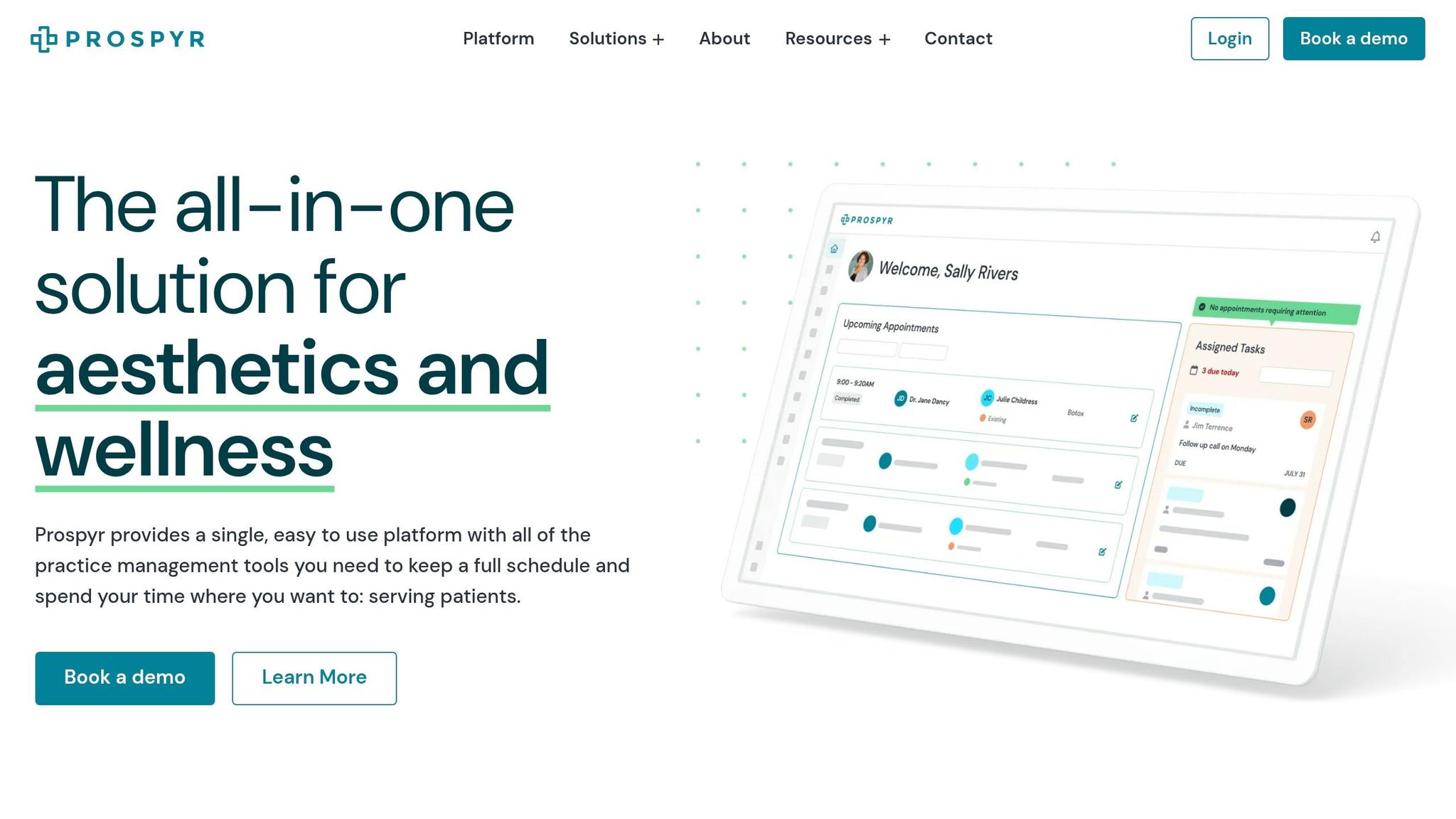
Prospyr simplifies practice management by bringing all essential business functions into a single, HIPAA-compliant platform. Certified practitioners can use it to manage patient records with integrated CRM/EMR systems, track treatment histories for procedures like dermal fillers or non-surgical rhinoplasty, and monitor revenue trends through real-time analytics. For instance, New Life Cosmetic Surgery, led by Dr. Daniel Lee, transitioned from using four separate software systems to Prospyr's all-in-one solution. This switch led to a 50% revenue increase and a 40% rise in appointment bookings.
Prospyr's AI-driven scheduling tools ensure practitioners make the most of their availability while reducing no-shows. Additionally, automated task management handles follow-ups for post-treatment care, maintaining compliance and improving care delivery.
"We've seen a 50% increase in revenue and a 40% increase in appointments booked since switching away from using several different point solutions to running our practice on Prospyr."
- Dr. Daniel Lee, Founder, New Life Cosmetic Surgery
While operational streamlining is a game-changer, improving how practices interact with clients is just as essential for growth.
Improving Client Interactions with Prospyr
Certified practitioners earn trust through their expertise, but technology can amplify that trust by enhancing patient experiences. Features like automated email and SMS reminders, combined with post-care instructions, help keep clients engaged, boosting satisfaction and retention rates by 25–35%. Digital intake forms further streamline the process by gathering health histories securely before appointments, saving 15–20 minutes per patient during consultations.
SOM Aesthetics, founded by Dr. Saami Khalifian and Dr. Jess Shisler, used Prospyr's CRM tools to drive pre-launch efforts and pre-bookings, earning $40,000 in revenue within their first two days. They also took advantage of automated membership renewals, lead capture from social media, and review management tools to showcase their certified results.
"Prospyr has helped us launch SOM Aesthetics like a rocketship. Their powerful platform and helpful support have enabled us to exceed our financial targets while delivering an unmatched experience for our patients."
- Dr. Saami Khalifian, Founder and CEO, SOM Aesthetics
Conclusion
Certifications play a key role in growing a practice by equipping providers with the clinical expertise to deliver in-demand treatments safely, the business acumen to manage operations effectively, and the credentials that immediately establish trust with clients. These certifications not only boost revenue but also set your practice apart. Clients are more likely to choose providers with advanced qualifications, like the Certified Aesthetic Provider™, who emphasize safety and professionalism over cost-cutting alternatives.
To achieve these benefits, incorporating technology is crucial. Tools like Prospyr streamline patient management and automate follow-ups, allowing practitioners to focus on delivering quality care. Features like real-time analytics, smooth patient onboarding, and automated retention reminders ensure certified practices run efficiently and maximize their potential.
Combining certifications with smart operational tools gives your practice a competitive edge. Certified practices can broaden their services, introduce membership programs for steady income, and make informed decisions using data-driven insights. This approach helps your practice stand out, operate smoothly, and foster strong client relationships that lead to referrals and repeat visits.
FAQs
Which certification should I get first?
To begin your journey in aesthetic medicine, it's crucial to obtain a certification that prioritizes safety, skill, and adherence to regulations. Look for programs that focus on essential techniques like Botox and dermal fillers while emphasizing patient safety and ethical practices. Select a certification that matches your current expertise, complies with local laws, and aligns with the procedures you aim to offer. This will help you establish a solid and compliant base for your practice.
How fast will certification pay off?
Certification can yield results in a short time - sometimes just a few months. It enhances the credibility of your practice, draws in more patients, and can lead to higher revenue. According to various reports, many practitioners see a return on their investment within the first year, making certification a smart move for growing your aesthetic practice.
What tools help certified clinics retain patients?
Certified clinics can keep patients coming back by using tools like practice management platforms, such as Prospyr. These platforms make it easier to manage automated communication, send personalized follow-ups, and run loyalty programs - all of which can improve rebooking rates and encourage repeat visits. Features like appointment reminders, post-treatment check-ins, and tracking retention metrics (like satisfaction rates and client lifetime value) allow clinics to fine-tune their strategies. Prospyr streamlines these tasks with automation, membership management tools, and actionable insights, helping clinics strengthen patient loyalty and grow their practice.