
If I want more med spa bookings, I’d start with Google reviews and SMS follow-up first, then Instagram, and use TikTok last.
Here’s the short version: Google reviews help me win local search clicks, SMS helps me get more reviews and rebook past clients, Instagram helps turn interest into consults, and TikTok helps more people find the brand. That order matches how close each channel is to a booking.
A few numbers make the point fast:
- 84% of consumers trust brands more with UGC
- 87% say before-and-after photos matter
- 83% of patients say Google Reviews affect provider choice
- 75% won’t book a provider below 4.0 stars
- SMS open rates often hit 95%–98%
So if I had a small team and had to pick the best channels first, I’d do this:
- Google Reviews for search trust and local clicks
- SMS follow-up to ask for reviews and prompt rebooking
- Instagram to show results, testimonials, and tagged client posts
- TikTok for reach, education, and early-stage interest
What this article covers:
- Which channel is closest to the booking decision
- Where before-and-after content works best
- Which platform takes the most staff time
- Where moderation and consent matter most
- How to choose the right mix based on team size
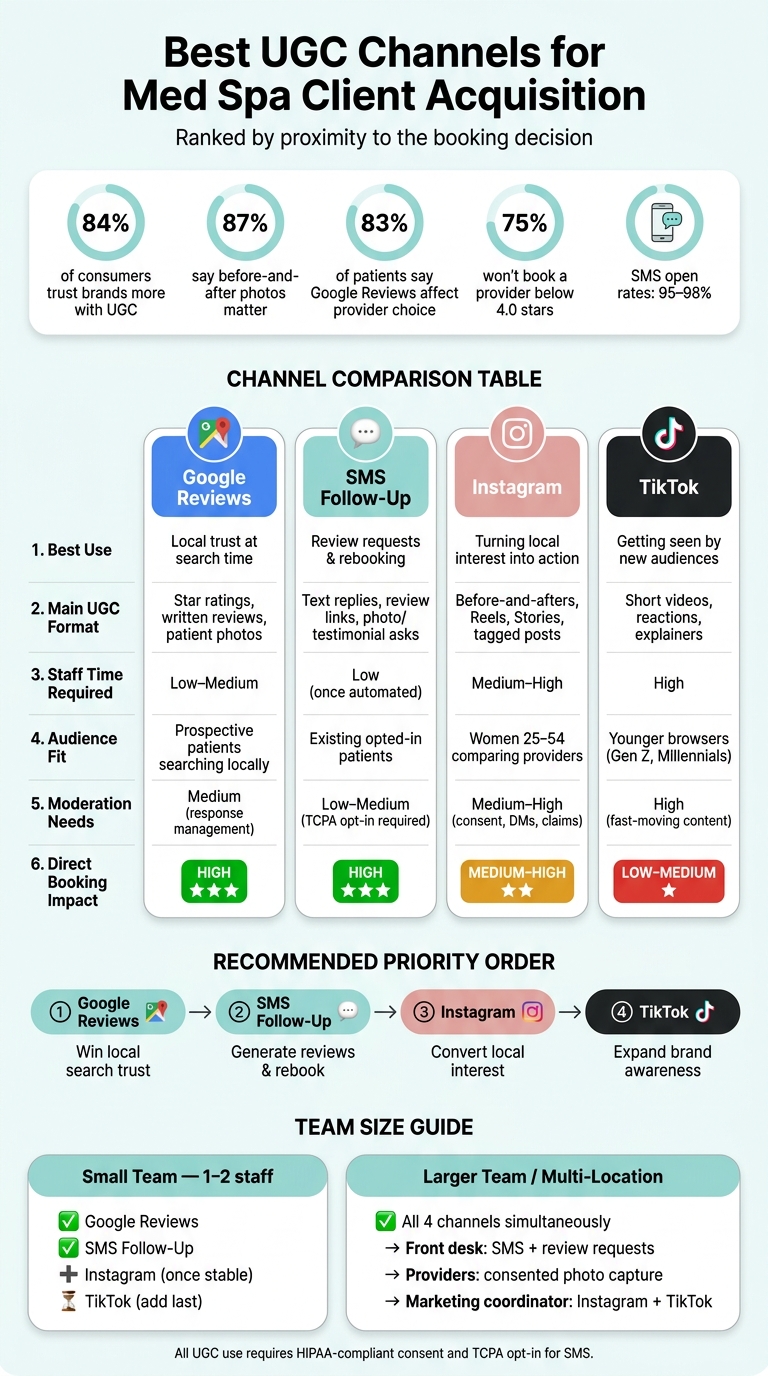
Best UGC Channels for Med Spa Bookings: Side-by-Side Comparison
Quick Comparison
| Channel | Best use | Main UGC format | Staff time | Direct booking impact |
|---|---|---|---|---|
| Google Reviews | Local trust at search time | Star ratings, written reviews, patient photos | Low to medium | High |
| SMS follow-up | Review requests and rebooking | Text replies, review links, photo/testimonial asks | Low once set up | High |
| Turning local interest into action | Before-and-afters, Reels, Stories, tagged posts | Medium to high | Medium to high | |
| TikTok | Getting seen by new audiences | Short videos, reactions, explainers | High | Low to medium |
Bottom line: if I want the shortest path to more consults, I’d put my time into the channels that sit closest to the decision to book. Then I’d add visual channels to support discovery and proof.
sbb-itb-02f5876
Instagram vs. TikTok for Visual UGC
Instagram and TikTok can both work for visual UGC. But they tend to do different jobs.
TikTok gets you seen. Instagram gets people to book.
That’s the simplest way to look at it. For most med spas, visual UGC pulls its weight in two places: discovery on TikTok and conversion on Instagram.
| Dimension | TikTok | |
|---|---|---|
| Audience fit | Strong with women 25–54; aligns with core med spa buyers. | Skews younger (Gen Z, younger Millennials); strong for preventative and entry-level treatments. |
| UGC format | Polished before-and-afters, Reels, Stories, tagged client posts | Raw short-form video: walkthroughs, reactions, staff clips, trend-based content |
| Effort level | Moderate: consistent posts and Stories | High: frequent posting and trend testing |
| Moderation needs | Medium: DM triage, comment replies, spam filtering | High: rapid comment streams, misinformation correction, off-topic replies |
| Booking impact | Strong: stronger follower-to-booking conversion, built-in booking surfaces. | Indirect: drives discovery; bookings typically happen later via Instagram, Google, or the website. |
Instagram: Local Reach and Higher Booking Intent
About 50% of U.S. adults use Instagram, and its largest age group, 25–34, accounts for about 31.7% of users. That lines up closely with the people most likely to book injectables, skin treatments, and body services.
On Instagram, UGC tends to work best when it looks polished but still feels personal. Reels and tagged client posts usually get the most engagement. When a client shares their results and tags your clinic, that post does more than fill a feed. It shows local proof to friends, family, and followers who may already live nearby and trust that person. That kind of social proof can do a lot of heavy lifting.
A simple setup works well here:
- Repost tagged client content to Stories with a booking link
- Save top examples in Highlights by treatment
- Make it easy for prospects to scan results fast
Consent matters just as much as content. Use separate written marketing authorization for any identifiable client content, and don’t tuck it into treatment paperwork. Digital intake forms with channel-specific checkboxes make this easier to track. After consent is in place, staff should check mentions and tags every day, reply fast, and steer DMs toward a booking link or consultation form.
That part matters because Instagram DMs from local followers convert at a meaningfully higher rate than TikTok interactions. So the inbox shouldn’t be treated like casual chatter. It’s much closer to a warm-lead queue.
When someone is already weighing options and comparing providers, Instagram is usually the stronger closer.
TikTok: Broad Awareness and Informal Treatment Content
TikTok tends to win on reach and interaction. Engagement rates for beauty and aesthetics content often land around 2.5–4.5%, compared with 1.2–2.0% for Instagram Reels. Those numbers are strong. But attention and appointments aren’t the same thing.
What tends to work on TikTok is less polished and more direct. Think of a 45-second Botox walkthrough, a provider answering a common question straight to camera, or a client reacting right after treatment. That style works because it lowers the barrier. People see the room, hear the explanation, and get a feel for what the visit is like. For someone who’s curious but nervous, that can make a procedure feel less intimidating.
The downside is workload. TikTok asks for more volume, more testing, and more attention to what’s moving at the moment. A post can take off fast, and so can the comments. That brings more off-topic replies, more bad advice, and more misinformation. If your team posts on TikTok, moderation can’t be an afterthought.
The same HIPAA consent rules apply here too. Any identifiable client video needs signed marketing authorization before it’s posted.
So while TikTok is strong for getting your clinic in front of new people, Instagram usually does more of the booking work after that. TikTok introduces the clinic. Instagram helps turn that interest into action.
For trust at the decision stage, the next comparison is Google reviews versus text follow-up.
Google Reviews vs. Text Message Follow-Up for Trust and Conversion
Instagram and TikTok do the visual heavy lifting for UGC. Google reviews and text follow-up do something else: they build trust right when a person is close to booking. Google reviews help finish the search decision. Text follow-up helps generate those reviews in the first place. Most prospective patients check Google reviews before they reach out. Then, after a visit, text follow-up can help bring in reviews and nudge patients to book again.
So the key issue is simple: which channel turns interest into trust and bookings?
| Dimension | Google Reviews | Text Message Follow-Up |
|---|---|---|
| Audience fit | Prospective patients searching "med spa near me" or specific treatments | Existing patients who have already visited and opted in to texts |
| Content type | Public star ratings, written reviews, patient photos | Direct links, short testimonials, consented photo requests, rebooking nudges |
| Effort level | Moderate: requires active monitoring and timely responses | Low once automated; triggered by appointment completion |
| Moderation needs | High: public-facing, requires professional responses to negative feedback | Low: private, opt-in communication with lower moderation needs |
| Booking impact | Strong for new client acquisition; drives clicks and consultation requests from local search | Strong for repeat visits; direct links reduce friction for rebooking |
Google Reviews: Search Visibility and Social Proof
Google reviews help med spas show up in Maps results and win more clicks from local search. A few things matter here: review volume, star rating, how recent the reviews are, and the keywords patients use in the review text. Review signals account for about 15% of Local Pack ranking weight.
The trust factor is hard to ignore. About 83% of patients say Google Reviews influence provider choice, and 75% won't book a provider rated below 4.0 stars. Even a shift from 3 stars to 5 stars can increase clicks from local search by about 25%. In a busy metro market, that's not a small swing.
Fresh reviews tell Google and potential patients that the practice is active and dependable. Replying to reviews adds to that signal. Responding to 80% or more of reviews is tied to a 10%–20% ranking lift, and every 25% increase in response rate can improve conversion by about 4.1%.
There’s one rule you can’t bend: HIPAA still applies in public replies. Never confirm treatment details or share protected health information, even in response to a glowing review. Thank the patient, acknowledge the feedback, and keep the reply broad.
If Google reviews show the outcome, SMS is often what gets that outcome from happy patients.
Text Message Follow-Up: A Direct Way to Generate More UGC
SMS is one of the fastest ways to get more Google reviews from satisfied patients. Text messages often see open rates of 95–98%, while email sits closer to 20%. Timing matters too. Sending the review request within 1–3 hours of the appointment tends to work well.
A short thank-you text with a direct link to your Google review page makes the ask easy. Add a plain prompt like "Share what service you had and how you felt during your visit", and you’re more likely to get detailed reviews instead of one-line comments. That matters because reviews that mention treatments can help with local search relevance.
Text follow-up can do more than collect reviews. It can also gather other forms of UGC. For example:
- A patient can reply with a short testimonial
- A patient can share a photo of their results
- With written consent for use and placement, those replies can become marketing assets
For patients who don’t want to post in public, even a one- or two-sentence text reply can still work well on your website or in email campaigns.
Compliance matters here, and there’s no shortcut around it. Marketing texts, including review requests and rebooking offers, should go only to patients who gave explicit opt-in under TCPA guidelines. Every message should also include a clear unsubscribe option. Standard SMS apps do not meet HIPAA rules, so clinics should use a secure, dedicated platform that signs a Business Associate Agreement and keeps message content limited to general references rather than specific treatment details.
Running review requests and SMS follow-up in one system - like Prospyr - can make the process much easier to keep going. It also helps tie review generation directly to booking and follow-up workflows.
The Best Channel Mix for a U.S. Med Spa
Once you know what each channel does, the next step is picking the mix your team can handle and that leads to bookings the fastest. In most U.S. med spas, each channel plays a different role in the path to booking: Google reviews and SMS catch people with strong intent, Instagram helps turn local interest into action, and TikTok gets you in front of more people.
Here’s the side-by-side view:
| Channel | Audience Fit | UGC Type | Effort Level | Moderation Needs | Booking Impact |
|---|---|---|---|---|---|
| Local patients comparing providers | Before/afters, Reels, Stories, testimonials | Moderate–High | Moderate–High (consent, claims, DMs) | Medium–High: strong visual proof drives local conversions | |
| TikTok | Younger browsers discovering treatments | Short educational videos, informal treatment explainers | High | High (fast-moving content needs review) | Low–Medium: strong for awareness; bookings often come via Google or Instagram after discovery |
| Google Reviews | People ready to choose a provider | Star ratings, written reviews, patient photos | Low–Moderate | Medium (response management, review triage) | High: directly influences which clinic gets clicked and called |
| SMS Follow-Up | Existing patients who opted in | Review requests, rebooking prompts, photo/testimonial asks | Low once automated | Low–Medium (TCPA opt-in, opt-out required) | High: drives more reviews, repeat visits, and direct rebookings |
That table leads to a practical question: which channels can your team run well every week?
Choosing Channels Based on Team Size and Goals
For a small team - maybe an owner and one or two staff members - the most workable place to start is Google reviews and SMS follow-up. Both can be partly automated, and both tie closely to bookings. After those are in good shape, a steady Instagram posting rhythm gives future patients the visual proof they often want before they contact you.
TikTok makes sense later, not first. Add it when someone on the team can keep up with weekly short-form video without letting everything else slip.
Pew Research found that 50% of U.S. adults use Instagram compared with 37% for TikTok. That bigger user base makes Instagram the simpler starting point for many med spas that want a steady flow of local proof.
Bigger clinics or multi-location groups with a dedicated marketing coordinator can run all four channels at the same time. But even then, the work needs clear owners. A setup like this tends to work well:
- Front desk handles review requests and SMS triggers
- Providers capture consented photos during visits
- A marketing coordinator manages Instagram and TikTok calendars, video editing, and comment monitoring
That’s usually the point where a connected workflow platform starts to make sense.
Using Prospyr to Connect UGC, Follow-Up, and Booking Workflows
After you choose the mix, the workflow matters just as much as the content itself. Prospyr can connect UGC collection, follow-up, and booking in one workflow. With CRM/EMR-connected follow-up, clinics can send messages based on actual visit records - for example, a review request 24 hours after treatment, a check-in one week later, and a rebooking reminder timed to that patient’s treatment cycle.
Prospyr also gives teams social media management tools to plan and schedule Instagram content in one place, while its review management features help staff monitor and respond to Google reviews. Booking links in SMS and social profiles can send patients straight to online scheduling. Its analytics show which channels lead to consults.
Conclusion: Start With the Channels Closest to Booking
After looking at audience fit, content format, effort, moderation, and booking impact, the order is pretty simple: TikTok builds awareness, Instagram turns local interest into action, Google reviews help close trust gaps, and SMS follow-up helps turn happy clients into reviews and repeat bookings.
For most U.S. med spas, Google reviews and SMS follow-up should come first because they’re closest to the actual booking decision. Together, they help improve visibility and trust without adding much manual work.
Once that trust is there, Instagram is the next step. It’s the best channel for showing results and giving people the visual proof they want to see. Before-and-after posts, Reels, and client testimonials tend to do that job well.
If you still need more reach, bring in TikTok after the booking channels are steady. In other words, add TikTok last, once Google reviews, SMS, and Instagram are all running with consistency.
Start with the channel closest to booking.
FAQs
Which UGC channel should I start with first?
Start with Google reviews. They help build the baseline trust you need to win new clients, especially since many patients check reviews before they choose a provider.
Once you have that base in place, focus on Instagram. It’s a strong channel for visibility because it lets you show visual stories, share before-and-after transformations, and give people a better feel for your work.
If it fits your setup, Prospyr can help you manage reviews, social content, and HIPAA-compliant consent in one place.
How often should I ask clients for Google reviews by text?
For the best results, send a Google review request by text the same day as the patient’s appointment. That timing matters. The visit is still fresh in their mind, so they’re more likely to follow through.
If same-day outreach doesn’t happen, send the request within 1 to 3 days after treatment.
Before you do any of this, make sure you have written consent for text-based review requests during intake. If you use Prospyr, its built-in communication tools can help automate these requests.
Do I need written consent to post before-and-after photos?
Yes. You need explicit written consent before posting patient before-and-after photos on social media or using them in marketing.
Here’s why: these images count as PHI under HIPAA. That means a standard treatment consent form isn’t enough.
The authorization should be separate from routine care paperwork, and it should clearly spell out:
- where the photos will appear
- whether the patient agrees to each platform or channel
- that the patient can opt in or opt out by platform
You also need to store that consent securely. And if a patient revokes consent, take the images down right away.