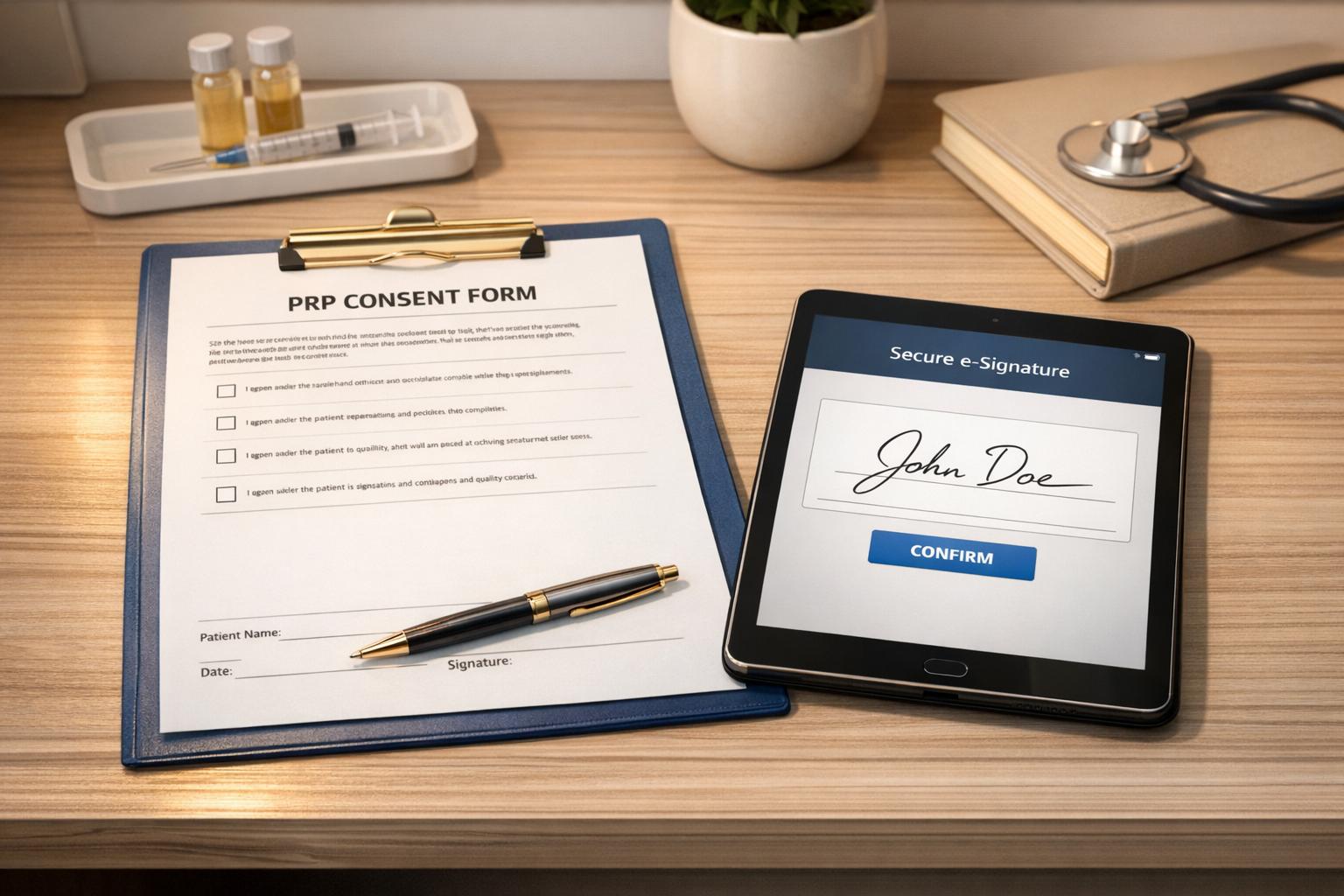

Ensuring your PRP consent process is legally sound is critical for protecting your clinic and patients. Here's what you need to know:
- Key Elements of PRP Consent Forms: Include patient identification, medical history, treatment details, risks, and alternative options. Ensure the form outlines the procedure (blood draw, centrifugation, injection) and FDA status of PRP use.
- Risk Disclosure: Highlight potential complications like injection site pain, infection, allergic reactions, and variability in results.
- Signatures and Legal Requirements: Obtain signatures from the patient (or legal representative), provider, and, if required, a witness. Ensure all parties understand the procedure and risks before signing.
- Compliance Standards: Follow FDA and HIPAA guidelines for storage, retention, and patient access to consent forms. Avoid exculpatory language that waives patient rights.
- Digital Consent Tools: Use HIPAA-compliant platforms to streamline consent management with encryption, secure storage, and e-signatures.
This checklist ensures your PRP consent process meets legal and ethical standards while safeguarding your practice.

PRP Consent Form Compliance Checklist: Essential Requirements
Required Elements in a PRP Consent Form
A PRP consent form is more than just paperwork - it's a critical document that outlines patient information, explains the procedure, and discloses risks. To meet legal standards, it must include essential details that protect both the patient and the clinic. Missing any of these components compromises the form's validity and could lead to legal complications.
Patient Information and Medical History
Start with the basics: the patient’s full name, age, and contact details. This ensures accurate record-keeping and identification. The form should also include a section for medical history to screen for any contraindications, such as blood disorders or active infections.
Make sure the purpose of the treatment is clearly stated. Whether the PRP procedure is for medical reasons (like injury recovery or pain management) or cosmetic applications (like skin rejuvenation or hair restoration), it needs to be spelled out. Additionally, the form should include a statement confirming that the patient has reviewed the document and discussed any concerns with their physician.
Once patient details are covered, the next step is to explain the procedure and any alternative treatments.
Treatment Details and Alternative Options
The consent form must provide a clear explanation of the PRP process, which typically involves:
- Drawing blood (phlebotomy)
- Using a centrifuge with a separator gel to concentrate platelets
- Injecting the processed plasma into the treatment area
Because PRP treatments use the patient’s own blood by-products, they are considered autologous. However, it’s important to note the FDA status: while some components, like centrifuge tubes, may be FDA-cleared, the procedure itself is often performed off-label for both musculoskeletal and cosmetic uses.
Aftercare instructions should also be included. For example, patients may be advised to avoid applying ice or heat to the injection site for 72 hours and to refrain from alcohol for 48 hours. The form should also list alternative options to ensure informed consent. These alternatives might include no treatment, surgical procedures, medications (such as neurotoxins or dermal fillers), physical therapy, laser treatments, or chemical peels. If a mid-level provider, such as an RN or NP, is involved under supervision, this must be clearly documented.
Finally, the form should provide a thorough disclosure of risks and side effects.
Risks and Side Effects Disclosure
To comply with legal requirements, the consent form must outline all potential risks associated with the treatment. Patients should understand that results are not guaranteed and typically last between 18 and 24 months, with individual outcomes varying. Including relevant procedure codes, such as CPT code 0232T, is also recommended.
Below is a summary of the risks that must be disclosed:
| Risk Category | Specific Disclosures Required |
|---|---|
| Injection Site | Pain, bruising, swelling, bleeding, and risk of infection |
| Systemic/Allergic | Allergic reactions to anticoagulants or centrifuge separator gels |
| Expectations | Variability of results, temporary effects (18–24 months), and possible need for multiple sessions |
| Procedural | Risks related to phlebotomy (e.g., fainting, hematoma) and the injection process |
Signatures and Authorization Requirements
To ensure legal validity, a PRP consent form must include proper signatures. These signatures confirm that the patient fully understood the procedure, voluntarily agreed to it, and that the provider adequately explained the associated risks and alternatives. Missing or incorrect signatures can leave clinics vulnerable to legal challenges.
"A signature on a form is evidence that the patient has given consent, but is not proof of valid consent. If a patient is rushed into signing a form, on the basis of too little information, the consent may not be valid, despite the signature."
It’s essential to identify who needs to sign, the order in which signatures should be obtained, and the timing of the process. These requirements depend on factors like the patient’s age, mental capacity, and the specific circumstances of the procedure. Below is a breakdown of the key roles and their responsibilities in securing proper authorization.
Patient and Guardian Signatures
The patient’s signature must be voluntary and reflect full understanding and competency.
For minors under 18, a parent or guardian with legal authority must sign the form. It’s crucial to confirm that the individual signing has the legal right to make medical decisions for the child. However, in some states, individuals aged 16 and 17 may be allowed to self-consent.
If an adult patient lacks mental capacity, a legally authorized representative (LAR) or surrogate must sign on their behalf. The signing process should follow a specific order: the patient or their representative signs and dates the form first, followed by the provider.
Provider and Witness Signatures
After the patient or their representative has signed, the provider and, when necessary, an impartial witness must also sign the form. The healthcare professional performing the procedure - or the individual who explained the risks and benefits - must sign and date the document. This step confirms that the consent process was conducted appropriately and that the patient had the chance to ask any questions.
"Essential elements of the consent process include signatures from the patient and the physician, while having a witness sign the form is suggested though not mandated by law."
- Satvik N Pai et al., Cureus
Witness signatures aren’t always legally required but can provide additional protection. A witness is mandatory in certain cases, such as when the patient is illiterate, blind, or physically unable to sign. The witness should be an impartial adult who is not part of the treatment team and, ideally, not a family member. For patients who don’t speak English, it’s important to document the translator’s details and secure their endorsement to confirm that the patient understood the information.
If the consent form is signed in advance, it must be reconfirmed on the day of the procedure. Any changes to the form after signing must be initialed and dated by both the patient and the provider.
| Signature Type | Required By | Purpose |
|---|---|---|
| Patient / LAR | Patient or Legal Representative | Confirms voluntary agreement and understanding of risks and benefits. |
| Provider / Physician | Performing Clinician | Verifies that the procedure, risks, and alternatives were explained. |
| Witness | Impartial Third Party | Ensures the consent process for vulnerable or incapacitated patients. |
| Translator | Interpreter | Confirms accurate communication in the patient’s native language. |
Compliance and Legal Protection Standards
These standards emphasize the importance of a thorough consent process. Adhering to compliance rules not only shields your practice from legal risks but also strengthens patient confidence. Federal and state regulations outline what must be included in consent forms, how they should be stored, and how long they need to be kept. Failing to meet these requirements can lead to severe repercussions, including civil lawsuits and federal investigations.
State and Regulatory Requirements
Under FDA 21 CFR Part 1271, Platelet-Rich Plasma (PRP) is classified as a Human Cell, Tissue, or Cellular and Tissue-Based Product (HCT/P). It must meet specific criteria: minimal manipulation, homologous use, and no combination with other substances except water or crystalloids. To comply, your consent forms must clearly state the intended homologous use.
Federal law, specifically 21 CFR 50.25, mandates that consent forms include critical details such as risks, benefits, alternative treatments, confidentiality measures, and a statement affirming that participation is voluntary. If your state requires additional disclosures, those must also be included.
"The informed consent requirements in this policy are not intended to preempt any applicable Federal, state, or local laws... that require additional information to be disclosed in order for informed consent to be legally effective." - Code of Federal Regulations § 431.116
One key rule: do not include exculpatory language in your consent forms. This means patients cannot be asked to waive their right to sue for negligence or to release your practice from liability. Such clauses violate 45 CFR 46.116 and could invalidate the entire consent process.
"No informed consent may include any exculpatory language through which the subject or the legally authorized representative is made to waive or appear to waive any of the subject's legal rights, or releases or appears to release the investigator, the sponsor, the institution, or its agents from liability for negligence." - 45 CFR 46.116
To ensure compliance, consult legal counsel familiar with your state’s medical board standards and consumer protection laws. Regulations differ significantly across states, so what works in California might not meet the requirements in Texas or Florida.
Once you’ve clarified these regulatory details, the next step is to focus on meticulous documentation and secure record retention.
Documentation and Record Retention
Proper documentation is essential to meet regulatory standards. Every consent form must be signed, dated, and, when necessary, witnessed before any procedure begins. The signature date must reflect the actual time consent was obtained - it cannot be backdated or added later.
Patients must receive a copy of their signed consent form immediately. This is a federal requirement under FDA regulations.
"Informed consent involves providing a prospective subject... with adequate information to allow for an informed decision about participation... prior to enrollment." - U.S. Food and Drug Administration
Storing these forms securely is equally critical. Whether you use physical files or digital platforms, storage must comply with HIPAA regulations. For digital systems, ensure they are HIPAA-compliant and that you have a Business Associate Agreement (BAA) with the vendor.
Retention periods for medical records vary by state but typically range from 5 to 10 years after the last patient interaction. Some states, like Colorado, have specific rules - for instance, Rule 21.170.1.A outlines clear retention standards for medical documentation. If your PRP practice is involved in FDA-regulated clinical investigations, you’ll need to follow stricter federal record-keeping requirements under 21 CFR parts 50 and 56.
HIPAA violations carry hefty penalties, with fines ranging from $100 to $50,000 per incident, depending on the severity. Breaches affecting 500 or more individuals must be reported to the HHS Office for Civil Rights within 60 days of discovery.
To minimize risks, appoint Privacy and Security Officers, provide annual staff training, and regularly audit how consent forms are managed and stored. Keep in mind that informed consent isn’t a one-time event - it’s an ongoing process throughout the course of treatment.
sbb-itb-02f5876
Using Digital Tools for Consent Management
Digital consent forms have transformed the way organizations handle compliance by automating the collection, storage, and retrieval of Protected Health Information (PHI). They also help minimize risks associated with unauthorized access.
HIPAA-Compliant Digital Consent Forms
For a digital consent platform to meet HIPAA standards, it must include several critical features. First, PHI must be encrypted both during transmission (TLS 1.2 or higher) and while stored (AES-256). Additionally, strict access controls like multi-factor authentication (MFA) and role-based permissions are essential. Automated audit trails should track who accessed each form, what actions were taken, and the exact timestamps of those activities.
It's equally important that the vendor signs a Business Associate Agreement (BAA) to ensure compliance. The platform should also accommodate the 15-day patient access rule, which took effect in 2026, reducing the response time for patient data requests from 30 days to 15.
Prospyr’s digital intake forms check all these boxes. The platform ensures HIPAA compliance with encrypted storage and robust access controls. It also automatically generates detailed audit trails and provides patients with electronic copies of their signed consent forms. To enhance security and maintain legal standards, the platform incorporates reliable e-signature protocols.
E-Signature Security and Legal Validity
To ensure digital signatures are legally valid, they must comply with the E-Sign Act and 21 CFR Part 11. This includes linking each signature to its corresponding record to prevent tampering. Identity verification is another key element, which can be achieved through government ID checks, security questions, or biometric authentication.
"In order to be considered equivalent to full handwritten signatures, electronic signatures must comply with all applicable requirements under 21 CFR part 11." - U.S. Department of Health and Human Services (HHS)
Digital platforms should also log the exact timestamp when consent is provided. Prospyr’s e-signature system goes a step further by including timestamp verification and identity authentication, ensuring that every signature adheres to legal requirements. It uses digital signatures and checksums to protect the integrity of signed documents, preventing any alterations after completion.
Given that nearly 50% of online traffic now comes from smartphones, mobile accessibility is crucial. Prospyr’s mobile-friendly consent forms allow patients to review and sign documents on any device, making the process far more efficient than traditional paper forms, which can take over 20 minutes to complete.
Summary and Complete Checklist
This checklist pulls together all the critical components discussed earlier to ensure your PRP consent form is thorough and compliant.
A well-prepared PRP consent form not only protects your clinic legally but also ensures patients make informed decisions. It should include:
- Patient identification: Full name, date of birth, and contact details.
- Treatment process description: A straightforward explanation of the procedure, covering steps like phlebotomy, centrifugation, and treatment areas.
- Risk disclosure: Clear information about potential risks, such as infection, bruising, allergic reactions, and other complications.
- Alternative options: Mention other treatments like surgical procedures, dermal fillers, neurotoxin injections, or even the choice to decline treatment.
The form must also include three signatures - from the patient (or their legal representative), the provider, and a witness - along with corresponding dates. It's important to confirm that the patient had the chance to ask questions and received answers before signing. To ensure compliance with state and local laws, have an attorney review your consent form template.
Using digital consent platforms like Prospyr can simplify this process. These HIPAA-compliant tools automate record-keeping, provide secure storage with encryption, and create audit trails. Plus, they allow patients to receive electronic copies of their signed forms, ensuring all checklist requirements are met.
Every consent form should also include:
- Patient demographics and medical history.
- Procedure details and contraindications.
- Risk disclosures and alternative treatment options.
- Post-procedure instructions, such as avoiding ice or heat for 72 hours and alcohol for 48 hours.
Keep the original signed form in the patient's medical record and provide a copy for their personal files. Leveraging digital tools like Prospyr can help maintain these standards while making the consent process more efficient and secure.
FAQs
What happens if key elements are missing from a PRP consent form?
If a PRP consent form is missing key components, it might be considered invalid. This could expose your practice to malpractice claims and regulatory penalties, including HIPAA fines that can range anywhere from $137 to $1,500,000 per violation.
To safeguard your practice, make sure your consent forms meet all legal and regulatory requirements. They should clearly explain the procedure, outline any potential risks, and ensure patients provide informed consent. Leveraging tools like digital intake forms can simplify this process and help ensure compliance is consistently maintained.
How do digital consent tools improve compliance with PRP therapy consent requirements?
Digital consent tools make compliance easier and more efficient by enabling patients to complete and sign PRP consent forms online. These platforms ensure that all necessary disclosures are included, while also providing secure, time-stamped records. Additionally, they use an encrypted, HIPAA-compliant storage system to safeguard sensitive information. By minimizing paperwork errors and automating documentation, these tools help clinics adhere to legal and regulatory requirements with less hassle.
What information should be included in the risk disclosure section of a PRP consent form?
The risk disclosure part of a PRP consent form needs to clearly explain the potential risks and complications tied to the treatment. These could include side effects like infection, pain, swelling, bruising, or allergic reactions. It should also mention less common but more serious risks, such as nerve damage or unexpected results.
The wording should be simple and easy for patients to grasp, while still being thorough. Including a section where patients can jot down questions or ask for clarification is a great way to ensure they fully understand the risks before moving forward. Always refer to legal and regulatory requirements to make sure the form complies with local standards.