Coding for Cosmetic vs. Medical Procedures
How coding, documentation, and correct ICD/CPT use decide if a procedure is covered or denied as cosmetic.
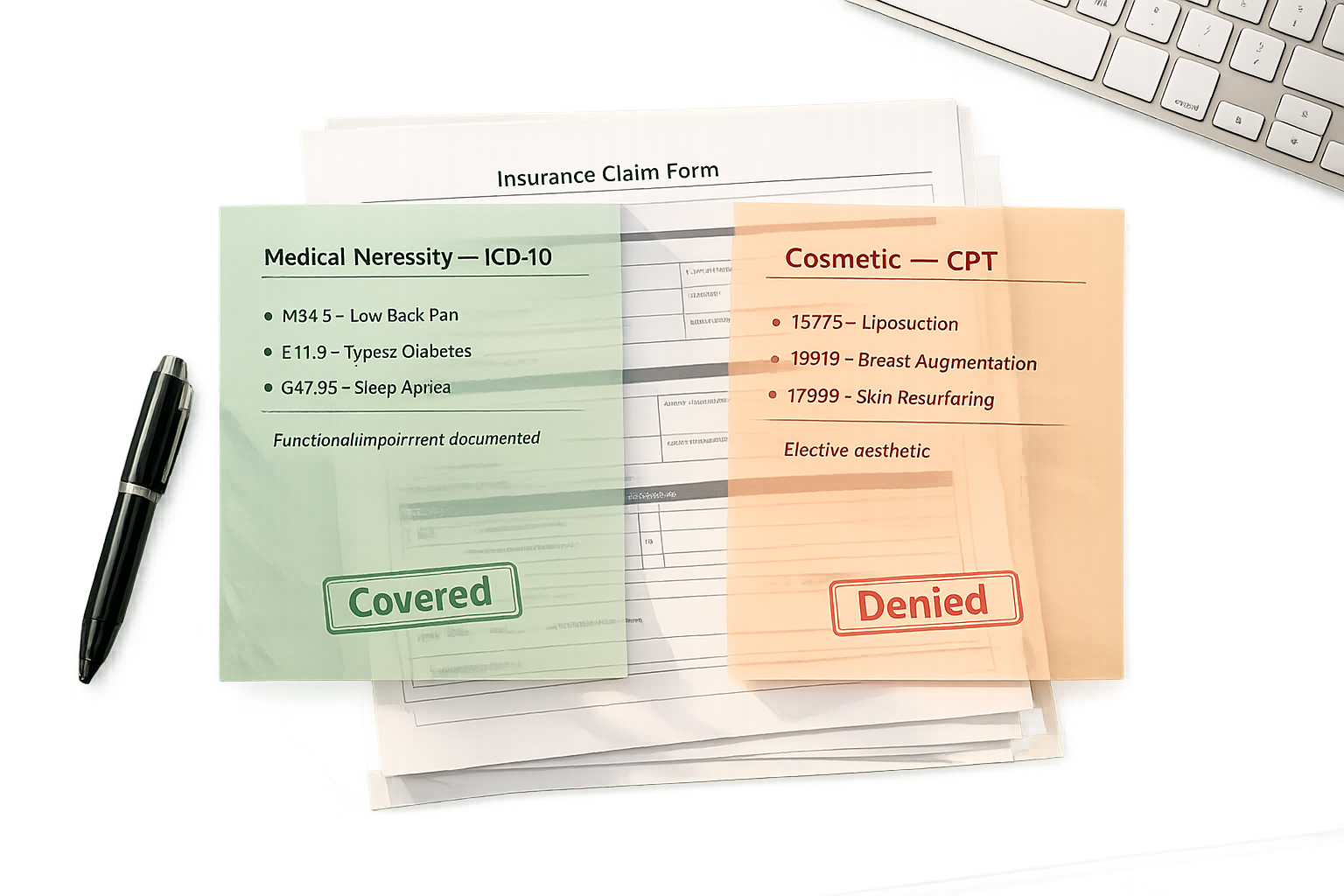

Coding for Cosmetic vs. Medical Procedures
Accurate coding determines whether a procedure is covered by insurance or denied as cosmetic. Here's what you need to know:
- Cosmetic procedures: Enhance appearance only, typically not covered by insurance. Example: rhinoplasty for reshaping a normal nose.
- Medically necessary procedures: Address functional impairments, often covered if proper documentation supports the claim. Example: nasal surgery for breathing issues.
- Documentation matters: Insurers rely on diagnosis codes, clinical notes, and proof of necessity to classify procedures. Errors in coding or modifiers cause 25%-35% of denials.
- Key codes: Cosmetic procedures use ICD-10 code Z41.1, while medically necessary procedures require precise CPT and ICD codes supported by detailed records.
- Financial consent: Patients must sign agreements (e.g., ABN for Medicare) for non-covered services to avoid disputes.
Using the right codes, clear documentation, and tools like automated templates can minimize errors and ensure smoother claims processing.
Defining Cosmetic and Medical Procedures
Understanding how payers differentiate between cosmetic and medically necessary procedures is essential for accurate coding. These distinctions can be tricky, and the definitions that matter most are those set by the payers.
How Payers Define Cosmetic Procedures
Cosmetic procedures are defined by payers as those performed on normally functioning body parts solely to enhance appearance, without addressing any functional impairments. Essentially, if the body part works within a typical range, any surgery to alter its appearance is classified as cosmetic.
"Surgery performed to improve on 'natural' appearance or performed purely for the purpose of enhancing one's normal appearance is not considered reasonable and necessary." - Noridian Healthcare Solutions
For example, a rhinoplasty performed to refine the shape of a structurally normal nose is considered cosmetic. Even if a patient feels deeply dissatisfied with their appearance, personal preference does not influence the classification.
How Payers Define Medically Necessary Procedures
A procedure is deemed medically necessary when it addresses a documented functional impairment and is expected to improve the condition. Coverage typically applies when the impairment results from factors like disease, trauma, injury, infection, burns, congenital defects, or prior medical treatments such as surgery or radiation.
"Reconstructive surgery is performed to restore bodily function or to correct a deformity resulting from disease, injury, trauma, birth defects, congenital anomalies, infections, burns or previous medical treatment, such as surgery or radiation therapy." - Noridian Healthcare Solutions
The classification of a procedure can shift depending on the clinical context. For instance, a panniculectomy performed for aesthetic reasons is cosmetic, but if the patient suffers from chronic pain, difficulty walking, or recurring dermatitis or ulcers, it may be classified as reconstructive. Similarly, nasal surgery could be considered cosmetic if it enhances appearance, but medically necessary if it corrects a documented breathing problem.
These payer definitions are closely tied to federal and regional regulatory policies, which guide coverage and coding decisions.
Regulatory Sources That Shape Coverage and Coding
Federal regulations, such as Section 1862(a)(7)(A) of the Social Security Act, and guidelines from the Centers for Medicare & Medicaid Services (CMS) establish the criteria for services deemed "reasonable and necessary". CMS provides National Coverage Determinations (NCDs) for nationwide coverage rules, while Medicare Administrative Contractors (MACs) issue Local Coverage Determinations (LCDs) to define medical necessity criteria within specific regions.
Notably, the required CPT, HCPCS, and ICD-10-CM codes for claims are now often included in Billing and Coding Articles rather than the LCD documents themselves. For commercial payers, policies like those from Anthem follow similar principles, requiring documentation of functional impairment and evidence that the procedure will address it.
The Medicare Coverage Database (MCD) is a helpful tool for navigating these requirements. By searching for CPT/HCPCS codes and state-specific details, you can locate the relevant billing and coding articles for any procedure.
sbb-itb-02f5876
Coding Cosmetic Procedures: Documentation and Compliance
When it comes to cosmetic procedures, the line between what's covered as a medical necessity and what's considered non-covered lies entirely in how it's documented. This includes the diagnosis code chosen, the clinical note's wording, and proof of functional impairment. Let’s break down the key elements of documentation and coding, including the importance of precise measurements and clinical justification.
CPT and HCPCS Codes for Cosmetic Services
Cosmetic and medically necessary procedures often share the same CPT codes, which makes accurate documentation absolutely critical. Take lesion removal codes, for example, which fall within the 11300–11471 range. These codes apply to both situations, but the difference lies in the clinical rationale provided in the claim.
One common mistake is coding based only on the lesion's diameter. However, the correct CPT code for excisions depends on the excised diameter - calculated as the widest part of the lesion plus the narrowest surgical margin on both sides. This seemingly small detail causes significant errors, with dermatology practices reporting a 12–18% error rate in lesion excision coding. To avoid this, clinicians should consistently document both the excised diameter and surgical margins in their operative notes.
Using Diagnosis Codes for Cosmetic Procedures
The diagnosis code you assign plays a pivotal role in determining whether a claim is covered or denied. For purely cosmetic procedures, the correct ICD-10-CM code is Z41.1 (encounter for cosmetic surgery), which signals to the payer that the service is non-covered.
"It is not appropriate to bill Medicare for services that are not covered … as if they are covered." - CMS Guidelines
Misusing a medical necessity code for a cosmetic service can lead to allegations of billing fraud. On the flip side, incorrectly classifying a medically necessary procedure as cosmetic often results in automatic denials. To avoid these issues, it's crucial to cross-check ICD-10 codes with the clinical notes for every procedure that could be considered cosmetic before submitting the claim.
Accurate coding isn’t just about compliance - it’s also about ensuring patients fully understand their financial obligations.
Financial Consent and Compliance Requirements
For Medicare patients, an Advance Beneficiary Notice (ABN) is mandatory when providing a service that Medicare is expected to deny as non-covered. This document informs patients beforehand that they’ll bear the cost, and it must be signed before performing the procedure.
For self-pay cosmetic patients, a signed financial responsibility waiver should be part of your standard process. Collect payments in full upfront via payment links to avoid billing errors and reduce the risk of disputes later. If a patient insists on submitting a claim, use the -GY modifier (indicating a statutorily excluded service) alongside the Z41.1 code. This ensures the denial is processed transparently.
To maintain compliance, consider conducting quarterly audits of cosmetic procedure charts. This helps catch any self-pay procedures that may have been mistakenly submitted to insurance.
Reading about the problem? See how Prospyr solves it in one platform.
Book a DemoCoding Medically Necessary Procedures: Standards and Practices
Proper reimbursement for medically necessary procedures hinges on a clinical record that clearly justifies the need for the service.
How to Establish Medical Necessity
Medical necessity, as defined by payers, refers to services that are "reasonable and required" for diagnosing or treating an illness or injury. However, having a valid CPT code and a matching diagnosis code is not enough on its own.
"The most expensive mistake is assuming the code set alone proves necessity. It does not. A clean CPT and a valid diagnosis can still fail if the record does not show severity, risk, functional impact, and the clinical decision path." - Safwan Azeem, Medical Billing and Coding Specialist
Each claim must include a clear, specific rationale tied to the service provided. This involves documenting the chief complaint, objective findings, functional impairments, and any history of conservative treatments through digital intake tools that were attempted but failed. Vague or incomplete documentation can lead to claim denials or downcoding.
The level of detail required for these procedures is far more stringent than for cosmetic ones, where the emphasis is primarily on appearance rather than clinical justification.
CPT Codes for Medically Necessary Procedures
Some CPT codes overlap between cosmetic and medically necessary procedures, but the difference comes down to the documentation. For medically necessary procedures, the focus is on proving functional impairment and the failure of prior treatments.
For example, benign excision codes (11400–11446) require documentation of symptoms like pain, inflammation, or functional impact. Malignant excision codes (11600–11646), on the other hand, require a confirmed histologic diagnosis of malignancy from pathology. Billing these codes without proper documentation would violate compliance rules.
Other procedures, such as functional rhinoplasty (CPT 30465), must include evidence of nasal airway obstruction, while panniculectomy (CPT 15830) requires proof of recurrent infections, skin breakdown, or failed conservative treatments. Proper use of modifiers is also essential. For instance, Modifier 25 should only be applied when an E&M service addresses a separate clinical issue unrelated to the procedure. Overuse of Modifier 25 - especially in more than 30–40% of procedure claims - can draw payer audits.
Documentation Requirements for Medically Necessary Procedures
Thorough documentation is the cornerstone of claims for medically necessary procedures. Records should include a detailed symptom history (with duration), objective exam findings, functional limitations, a history of conservative management (including what was tried, for how long, and why it was ineffective), and a clear connection between the diagnosis and the procedure.
For excision procedures, include precise measurements and margins as required. For biologic authorizations, numeric severity scores from validated tools like PASI (Psoriasis Area and Severity Index) or EASI (Eczema Area and Severity Index) carry more weight with payers than descriptive narratives.
Here’s a quick summary of required documentation for different procedures:
| Procedure Type | Essential Documentation |
|---|---|
| General Procedures | Chief complaint, functional impact, and immediate need |
| Lesion Excision | Excised diameter (lesion + margins), anatomical site, and pathology |
| Conservative Management | Prior treatments tried, duration, and reasons for failure |
| Biologics | Severity scores (PASI, BSA, etc.) and failure of systemic therapies |
| Modifier 25 | Distinct history, exam, and MDM for a separate clinical problem |
| Mohs Surgery | Pathology confirming cancer, lesion location, and stage-based notes |
Accurate and detailed records ensure claims are supported and reduce the risk of denials or audits. Consistently meeting these standards is crucial for successful reimbursement.
Handling Dual-Purpose and Borderline Cases
When it comes to procedures that straddle the line between cosmetic and medically necessary, the importance of thorough documentation can't be overstated. Some cases challenge clear classification, as their categorization depends heavily on the patient's clinical needs and the supporting medical records. Proper documentation is critical for ensuring accurate coding, particularly in these nuanced scenarios.
Common Dual-Purpose Procedures
Take the example of panniculectomy versus abdominoplasty. If a patient experiences recurrent infections or chronic skin issues due to an overhanging pannus, a panniculectomy (CPT 15830) may qualify as medically necessary. On the other hand, abdominoplasty (CPT 15847) is typically regarded as cosmetic and isn't coded separately when performed as part of another procedure.
"Panniculectomy billed for cosmetic purposes will not be deemed medically necessary." - CMS
Rhinoplasty offers another example. To distinguish between cosmetic and functional purposes, detailed documentation is essential. Functional rhinoplasty (CPT 30465) or septorhinoplasty (CPT 30420) might be covered if medical necessity is clearly documented. However, cosmetic rhinoplasty remains a self-pay service unless specific functional impairments are addressed.
Coding Combined Cosmetic and Medical Procedures
When a procedure includes both reconstructive and cosmetic components, it's crucial to bill them separately. For the medically necessary portion, use the appropriate CPT code and ensure the documentation supports the claim. For the cosmetic portion, secure a financial agreement with the patient before the procedure.
Modifiers play a key role in these situations. For instance:
- Modifier 59: Indicates that two procedures performed on the same day are distinct, such as a biopsy and an excision at separate sites.
- Modifier 22: Used for increased procedural complexity, like dealing with extensive scarring from previous trauma.
Using modifiers correctly is essential to avoid audits and ensure compliance.
Avoiding Upcoding and Misclassification Errors
"This boundary is drawn entirely by documentation. The diagnosis code, the clinical note language, and the documented medical necessity determine whether a payer covers the service or denies it as cosmetic." - Qualigenix
One of the most common mistakes is applying a medical necessity ICD-10 code to a procedure performed primarily for cosmetic reasons. Any mismatch between the documented intent and the assigned ICD-10 code can lead to billing fraud. It's the billing team's responsibility to confirm that the ICD-10 code aligns with the documented medical necessity.
Insurers are increasingly relying on AI-driven claim-review systems to spot inconsistencies in documentation, especially for high-cost plastic surgery and dermatology claims. Practice owners can monitor these trends using advanced billing analytics to identify patterns in denials. A single denied claim for reconstructive surgery can delay reimbursement by $8,000 to $15,000 or more. To avoid such setbacks, consult your Medicare Administrative Contractor (MAC) for local coding guidelines and check the Medicare Coverage Database (MCD) for the latest code-specific requirements.
Using Technology to Improve Coding Accuracy and Compliance
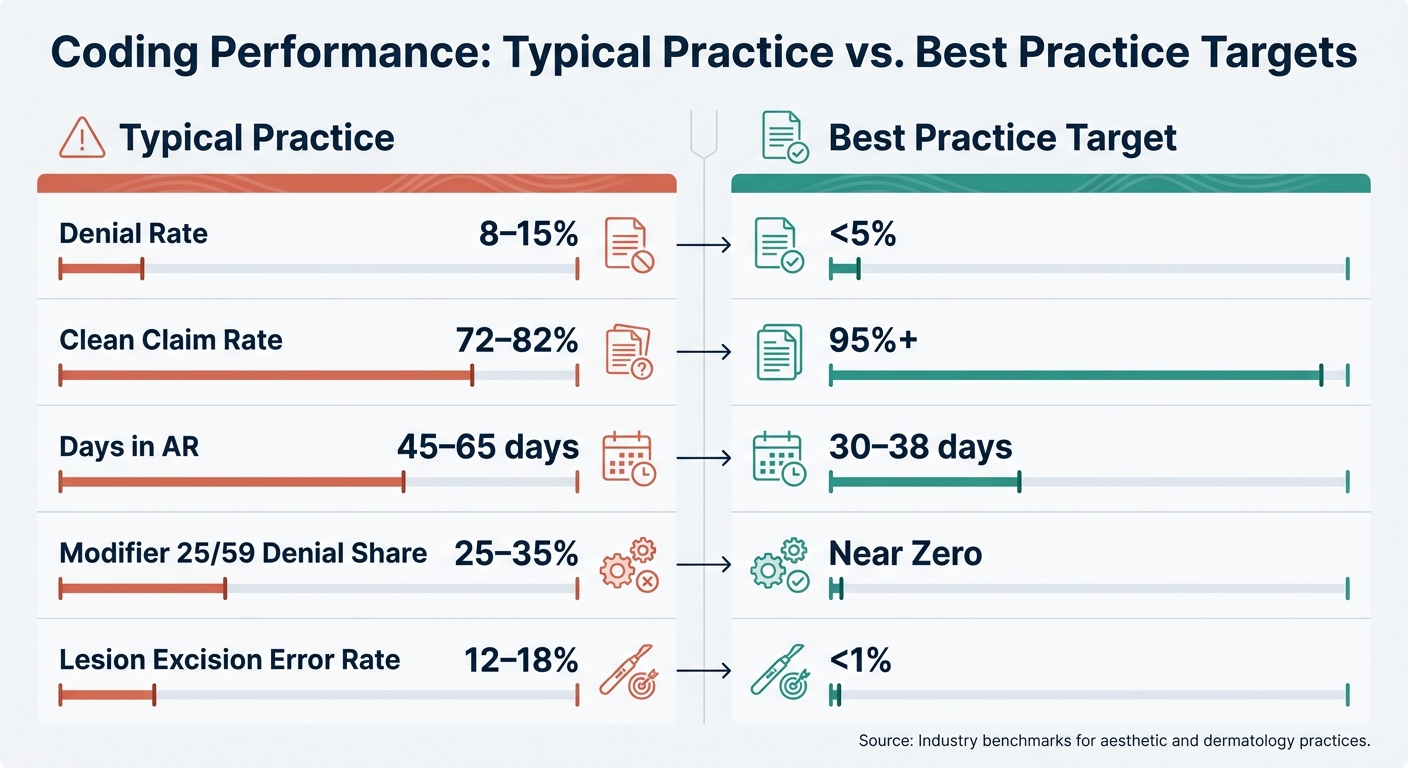
Cosmetic vs. Medical Procedure Coding: Key Differences & Performance Benchmarks
Improving Coding Workflows with Practice Management Tools
Technology-driven workflows are a game-changer for ensuring consistent and accurate coding standards. Manual coding, especially in practices managing both cosmetic and medically necessary procedures, often leads to errors. Dermatology coding expert Jenni Wheeler highlights the root of the issue:
"The issue is not lack of knowledge. It is lack of process. Practices often rely on individual expertise instead of systems."
Relying solely on individual expertise can amplify mistakes. On the other hand, standardized digital templates guide clinicians to document all the necessary details insurers require - like the widest lesion dimension, surgical margins, and total excised diameter - before coding. These templates directly address the high error rates previously noted in lesion excision coding.
Additionally, automated pre-claim review protocols help reduce modifier-related denials, particularly for Modifier 25 and Modifier 59, by reducing the reliance on manual checks. This automation lays the groundwork for integrated solutions like Prospyr, which take coding accuracy to the next level.
How Prospyr Supports Coding and Documentation
Technology like Prospyr builds on these streamlined workflows to further refine documentation accuracy. Designed specifically for aesthetic and wellness practices, Prospyr offers tools that align with the unique demands of hybrid workflows. For example, its customizable smart note templates include a medical necessity checklist for reimbursable procedures while also simplifying documentation for self-pay services. This dual functionality reduces the risk of accidentally assigning a cosmetic ICD-10 code to a reimbursable medical procedure.
Prospyr also includes image markup tools that allow providers to annotate clinical photos directly in the patient’s chart. This creates a visual record that not only supports medical necessity but also tracks cosmetic outcomes. With features like automatic data integration across CRM/EMR systems and AI-powered note creation and transcription, Prospyr helps reduce manual errors and documentation burdens, ensuring providers can capture complete and accurate records with less effort.
Internal Audits and Keeping Up with Policy Changes
Regular internal audits are non-negotiable for maintaining compliance. Payer policies evolve, CPT codes are updated annually, and Medicare Administrative Contractors frequently revise local coverage determinations with little warning. Monthly internal audits - such as cross-checking ICD-10 codes against clinical notes for high-risk procedures like cyst removals or skin tag treatments - help practices catch small errors before they snowball into larger issues.
The gap between average and high-performing practices is clear:
| Metric | Typical Practice | Best Practice Target |
|---|---|---|
| Denial Rate | 8–15% | <5% |
| Clean Claim Rate | 72–82% | 95%+ |
| Days in AR | 45–65 days | 30–38 days |
| Modifier 25/59 Denial Share | 25–35% | Near zero |
| Lesion Excision Error Rate | 12–18% | <1% |
Prospyr’s analytics simplify this process by automating multi-chart reviews, making it easier to cross-reference diagnosis codes with clinical notes on a large scale. This systematic approach helps practices achieve a 95% first-pass acceptance rate, eliminating the need to chase denials weeks down the line.
Conclusion: Key Takeaways for Coding Cosmetic vs. Medical Procedures
Accurate documentation is the cornerstone of distinguishing between cosmetic and medically necessary procedures. Using clear language, detailed measurements, and separate billing systems ensures smoother claims processing and helps avoid audit complications. Incorporating advanced tools can further enhance these practices.
Payer policies and guidelines are constantly evolving. Practices that fail to adapt often face denial rates far exceeding the target of less than 5% seen in top-performing environments. To close that gap, consistent and precise documentation, backed by effective systems, is essential.
Technology is a game-changer when it comes to coding accuracy. Tools that offer standardized templates, automated pre-claim reviews, and real-time analytics - such as those integrated into platforms like Prospyr - help reduce manual errors and mitigate the risk of misclassification. Advanced practice management systems streamline processes, making documentation more efficient and reliable.
In a landscape of shifting policies and standards, aligning workflows with the right technology is critical. Routing cosmetic charges to self-pay while ensuring medical claims are backed by thorough documentation improves overall accuracy. Success in coding requires both robust processes and in-depth knowledge. Regularly reviewing workflows and leveraging technology can catch errors that manual efforts might overlook.
FAQs
What documentation proves a procedure is medically necessary?
To establish medical necessity, clinical documentation must clearly outline the patient’s condition and justify the need for the procedure. This includes detailing the disease, functional impairments, previous treatments, and their outcomes. It's also essential that the records align with ICD-10-CM codes and explain how the procedure will enhance or restore the patient’s function.
Prospyr streamlines this process with its AI-powered tools for note creation and transcription, helping ensure documentation is both thorough and compliant.
When should I use ICD-10 code Z41.1 for cosmetic surgery?
ICD-10 code Z41.1 should be used when a procedure is performed solely for cosmetic purposes and not due to medical necessity. Since Medicare usually does not cover cosmetic procedures, submitting claims is generally unnecessary unless the patient specifically requests it.
If you need to submit a claim to receive an official non-covered denial, include the -GY modifier. This modifier indicates that the service is statutorily excluded from Medicare coverage. Additionally, report the encounter using Z41.1 to accurately describe the nature of the service provided.
How do I bill cases with both cosmetic and medically necessary work?
For procedures that have both a medical and a cosmetic component, it's important to separate billing clearly. Insurance will only cover the medically necessary portion, while the cosmetic part must be billed directly to the patient.
To ensure everything is properly handled, make sure operative notes clearly differentiate between the medical and cosmetic aspects of the procedure. Also, secure written pre-authorization for any reconstructive work. Provide patients with detailed, itemized invoices that outline cosmetic costs, deductibles, and any out-of-pocket expenses related to the medical portion.