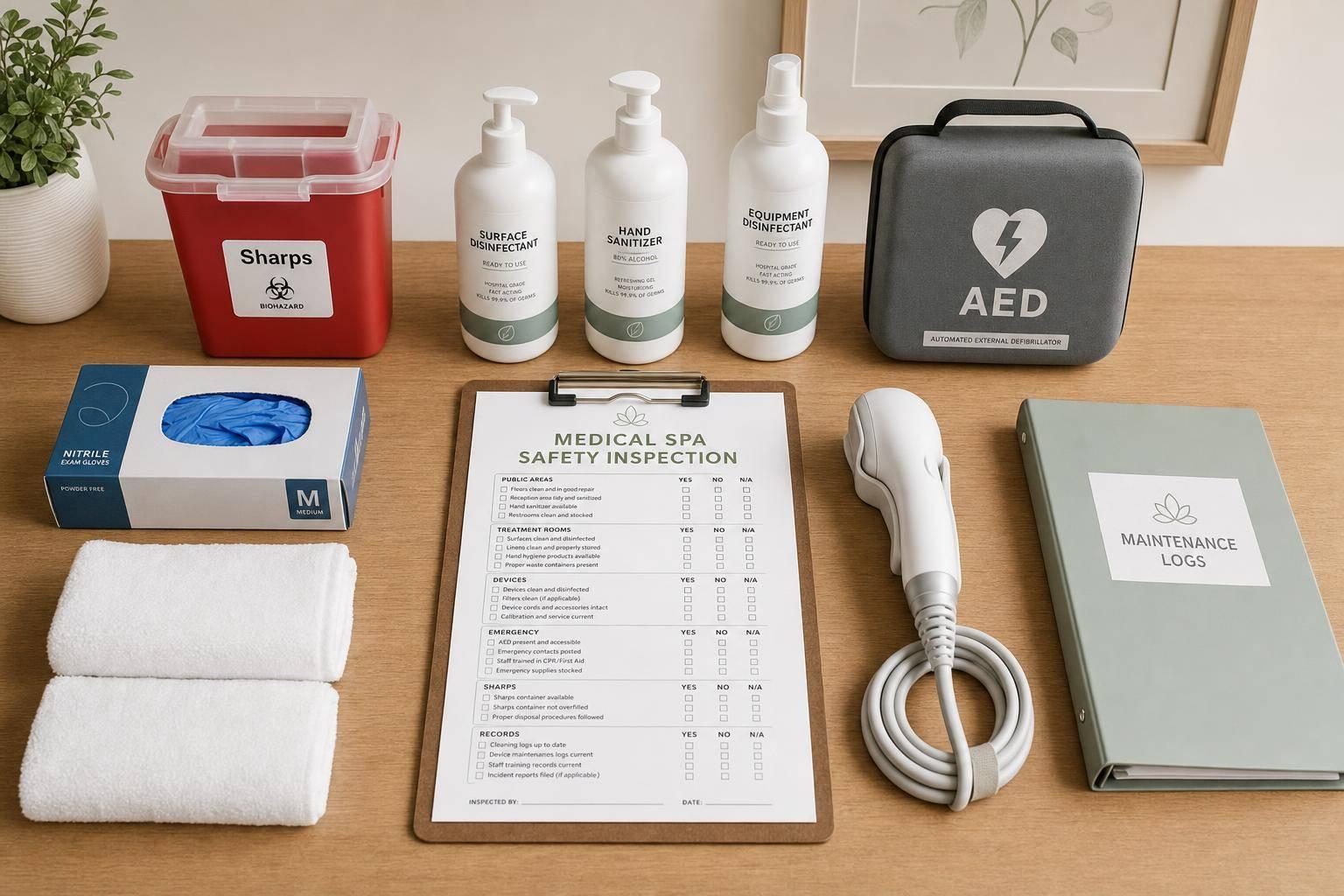

Filing accurate insurance claims for aesthetic clinics ensures steady cash flow and avoids costly rejections. Here's the essence of an effective claims process:
- Verify Insurance Coverage: Confirm active policies and understand payer requirements upfront to prevent denials.
- Organize Documentation: Collect complete patient records, including medical history, consent forms, and insurance details.
- Use Correct Medical Coding: Ensure all procedures and diagnoses are coded accurately to avoid rejections.
- Submit Claims Electronically: File claims digitally for faster processing and maintain thorough records.
- Track and Follow Up: Monitor claim statuses regularly to resolve issues quickly and reduce delays.
Avoid common errors like incomplete documentation, outdated codes, and modifier mistakes. Using automated tools and centralized practice management systems can simplify the process, reduce denials, and improve reimbursement timelines.
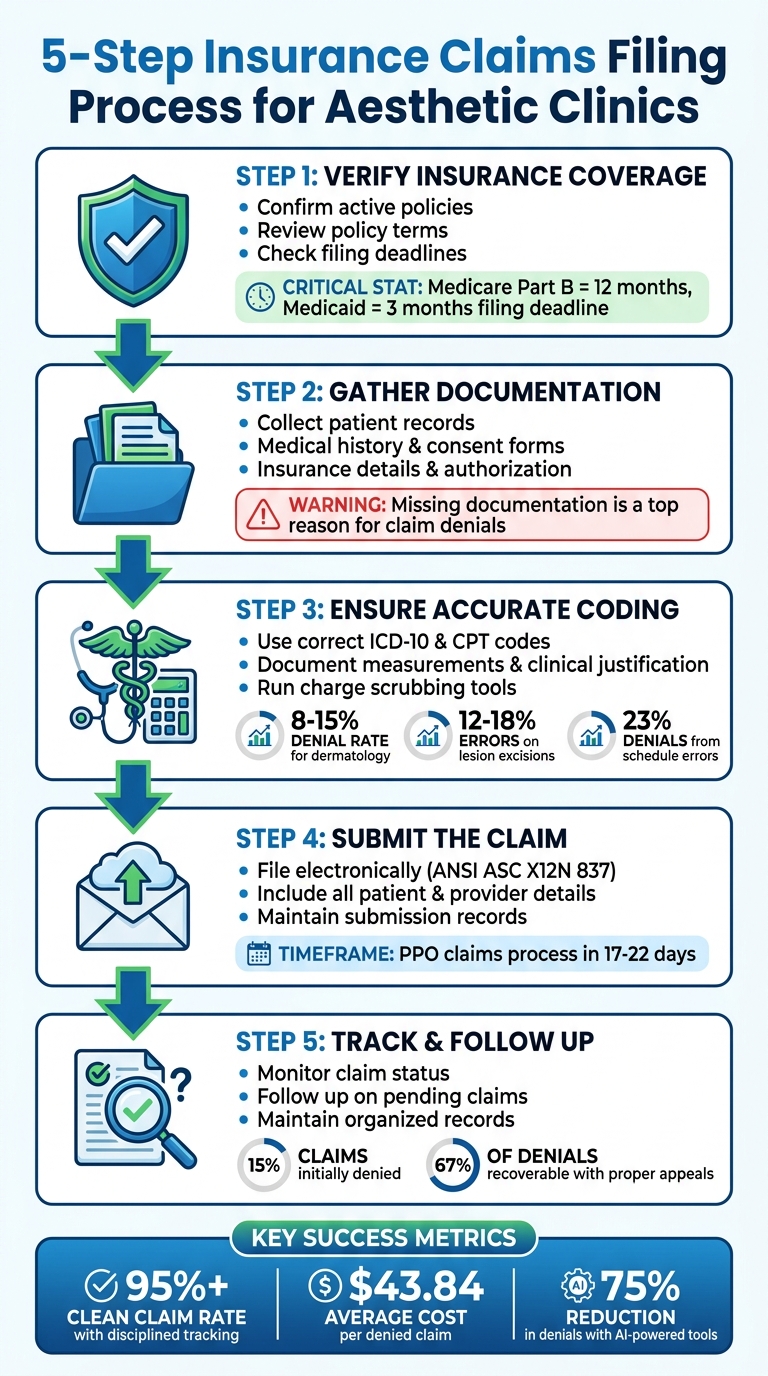
5-Step Insurance Claims Filing Process for Aesthetic Clinics
Step 1: Verify Insurance Coverage and Policy Requirements
Before submitting any claim, it's crucial to confirm the patient’s active insurance coverage for the date of service. As Team Flex of Flex Dental explains:
Insurance verification is arguably the single most important step in preventing claim denials.
Taking this step early helps avoid wasting time on claims that might be rejected due to expired policies or incorrect details. After confirming coverage, review the policy terms carefully to ensure compliance with the insurer’s requirements.
Failing to meet insurer deadlines can disrupt the revenue cycle. Many commercial payers enforce timely filing limits, typically ranging from 90 to 365 days. Claims submitted after these deadlines are often denied and cannot be corrected through regular appeals, resulting in lost revenue.
Review Policy Terms
Check the insurer’s current medical policies to determine how a procedure is categorized - whether it’s considered cosmetic, reconstructive, or medically necessary. These classifications directly impact coverage eligibility. It’s also essential to review the insurer’s "Services That Require Precertification" list to confirm whether prior authorization is needed, as this is a common reason for claim denials.
For procedures like cosmetic treatments, ensure that documentation—such as clinical notes, photographs, or medical necessity justifications—meets the insurer’s standards, often managed through digital intake tools, the insurer’s standards. If your clinic provides injectable treatments, refer to the "Medical Specialty Drug Policies" to verify coverage for the specific drugs used. Additionally, always download the latest claim forms from the insurer’s "Forms Index" to avoid delays caused by outdated paperwork.
Understand Insurer Requirements
A thorough understanding of insurer protocols and deadlines is essential to prevent claim denials.
Each payer has specific submission rules. For example, Medicare Part B claims must be filed within 12 months of the service date, while Medicaid claims generally need to be submitted within 3 months, though this varies by state. If a patient has multiple insurance plans, use the National Association of Insurance Commissioners (NAIC) Coordination of Benefits (COB) rules to determine the primary payer.
Additionally, verifying details like deductibles, co-insurance, and annual maximums before treatment allows you to provide accurate out-of-pocket estimates. This proactive approach minimizes billing disputes down the line.
sbb-itb-02f5876
Step 2: Gather and Organize Required Documentation
Getting all your paperwork in order is a crucial part of filing a successful claim. As ClaimBack explains, "Missing documentation is not just an administrative inconvenience - it is a legitimate and frequently used basis for insurers to delay decisions, request additional information indefinitely, or deny claims on grounds that the loss cannot be verified". Essentially, the better organized and complete your records are, the stronger your case will be. In fact, incomplete documentation is one of the main reasons insurers delay or outright deny claims.
Required Patient Records
Start by collecting the key patient records that provide a full medical picture and establish the legitimacy of the treatment. This includes:
- A detailed medical history
- Findings from physical examinations
- Signed informed consent forms outlining the procedure's risks and anticipated outcomes
Additionally, you’ll need a government-issued ID and proof of the relationship between the claimant and the insured party. For claims involving aesthetic procedures, you must also include evidence of the practitioner's qualifications, such as an NVQ Level 3 certification, at least 12 months of experience, or other relevant credentials.
Next, gather all necessary insurance-related documents. This includes the full policy wording, the policy schedule (showing coverage periods and insured amounts), and proof of premium payments, which can be demonstrated through receipts or bank statements. If the procedure required prior approval, be sure to include the original authorization request, the insurer’s response, and a letter of medical necessity from the physician addressing the insurer's clinical criteria.
Once these records are in place, you can move on to compiling treatment and incident details.
Incident and Treatment Documentation
When documenting treatment, include the attending physician’s statement, as well as hospital admission and discharge summaries. These should contain ICD diagnosis codes to meet insurer requirements. For billing, provide original itemized invoices that list each service and charge - summary bills won’t suffice. Prescription receipts and reports from lab tests or imaging studies, complete with specialist interpretations, are also necessary.
If complications or adverse events occurred, timestamped photographic evidence is especially important. Take and include photographs immediately after the incident to document the situation clearly. For procedures with cosmetic aspects but functional purposes, pre-operative and post-operative photos can serve as objective proof. Always ensure you have patient consent before taking or storing any photographs, and keep a detailed log of dates, conversations with insurer representatives, and discussion points.
Step 3: Ensure Accurate Medical Coding
Once you've gathered all the necessary documentation, the next step is to ensure that every procedure and diagnosis is coded correctly. Marcus D. Holloway, Senior RCM Strategist at Qualigenix Healthcare, emphasizes the complexity of dermatology billing:
Dermatology billing is among the most technically demanding in outpatient medicine. A single patient visit can produce an E&M service, a biopsy, a shave removal, and a lesion excision - all on the same claim.
For dermatology and skin care practices, denial rates typically range between 8% and 15%, with coding errors for lesion excisions alone making up 12% to 18% of all procedure claims.
Use Correct Diagnostic and Procedural Codes
Accurate coding hinges on understanding the technique used and the measurements recorded during the procedure. For example, when coding excisions, it's critical to document the widest dimension of the lesion along with the narrowest margin. This information is used to calculate the excised diameter, which determines the correct CPT code. Simply noting "1 cm lesion removed" without specifying the margins can result in payers assigning the lowest reimbursement tier.
Avoid vague language in documentation. Replace phrases like "patient desires removal" with clear clinical justifications such as "irritated by clothing", "bleeds with shaving", or "suspicious features." As the Qualigenix Editorial Team points out:
The boundary is drawn entirely by documentation. The diagnosis code, the clinical note language, and the documented medical necessity determine whether a payer covers the service or denies it as cosmetic.
To minimize denials, your ICD-10 code should reflect symptoms such as pain, inflammation, bleeding, or functional impairment. Additionally, before submitting claims, use automated tools to catch any lingering errors.
Use Charge Scrubbing Tools
Charge scrubbing tools are invaluable for identifying errors before claims are submitted. These tools can flag common issues like incomplete patient information, incorrect diagnosis codes, or improper use of modifiers. Considering that healthcare providers face a rejection rate of one out of every seven claims, and the industry processes over 200 million claim denials daily, pre-submission checks are critical.
Automated systems also compare your billed charges to contracted fee schedules, helping to prevent mismatches. Fee schedule errors alone account for about 23% of contractual denials. Catching these problems early allows you to correct them immediately, avoiding the average cost of $43.84 to resolve each denied claim later.
Step 4: Submit the Claim
After confirming the coding is accurate, it's time to submit the claim to the insurance payer. Timely submission not only speeds up reimbursement but also helps keep your records organized and ready for follow-up.
Choose Electronic Submission
Filing claims electronically is the standard approach. According to HIPAA regulations (45 CFR Part 162), covered entities are required to use the ANSI ASC X12N 837 transaction set - specifically, the 837P format for professional claims. Medicare also mandates electronic submissions for providers with 10 or more full-time employees.
Before submitting, ensure your billing system is set to "Insurance" to generate the claim. Include all necessary details such as the patient's name, date of birth, gender, contact information, and payer/member IDs. Your NPI and Tax ID must also be listed. For group practices, the rendering provider's individual NPI is typically entered in Box 24j of the CMS-1500 form, while the organization's NPI goes in Box 33.
Always bill the full appointment fee, as insurers will adjust payments to match your contracted rate. Many practice management systems offer batch submission features, enabling you to file claims for multiple clients at once. This can save time and reduce administrative workload.
With accurate documentation and coding in place, electronic submission simplifies the reimbursement process and ensures claims move through the system efficiently. After submission, maintain detailed records and track progress with analytics and address any issues promptly.
Maintain Submission Records
It's essential to keep digital copies of every submitted CMS-1500 form and related documentation as part of your clinic's permanent records. These records serve as a vital audit trail in case you need to challenge a denial or respond to a payer's inquiry. Use the 276/277 transaction sets to track claim statuses and the 835 transaction for Electronic Remittance Advice (ERA), which provides a detailed breakdown of payments, adjustments, and denials, along with reason codes.
Be mindful of filing deadlines, which vary by payer. For Medicare Part B professional claims, the deadline is 12 months from the date of service. Commercial payers, on the other hand, may have deadlines ranging from 90 to 365 days. Missing these deadlines can lead to denials that are often irreversible through standard appeals. To avoid this, maintain a thorough digital audit trail with submission timestamps to contest any denials related to "timely filing".
Step 5: Track, Follow Up, and Maintain Records
Once you've submitted insurance claims, it’s important to actively monitor their progress to avoid potential revenue losses. On average, most claims are processed within 30 days, with PPO claims typically taking 17–22 days to complete. However, around 15% of claims are initially denied, which highlights the importance of regular follow-ups to keep cash flow steady.
Here’s how you can effectively track and manage your claims.
Monitor Claim Status
Use your practice management software to keep tabs on claims in real time. For instance, platforms like Prospyr feature dashboards that not only display claim statuses but also send alerts when updates occur. Integrated systems connected to clearinghouses can show whether claims are marked as "Received", "Pending", or "Denied" directly on your dashboard. Additionally, enrolling in Electronic Remittance Advice (ERA) can provide automated updates for claims, including notifications for "Paid" or "Denied" statuses.
To stay proactive, set follow-up triggers for claims stuck in limbo:
- If a claim remains "Received" or "Accepted" for over 30 days without resolution, contact the payer.
- For claims labeled as "Pending" or requiring additional information, reach out after a week to investigate the delay.
- Claims needing more information should be addressed within 10 business days, while unresolved claims should be followed up on after 30 days.
Maintain Organized Records
Strong record-keeping is essential for effective follow-ups. Save digital copies of all CMS-1500 forms alongside their clearinghouse and claim numbers to maintain a thorough audit trail. If you need to delete or correct a claim, ensure you download and store a copy in the patient’s profile first for future reference. Update accounts receivable by recording payments and contractual write-offs as soon as you receive the Explanation of Benefits (EOB).
Organize denied claims into categories - such as registration errors, authorization problems, coding mistakes, or disputes over medical necessity. This approach helps you identify recurring issues rather than treating each denial as an isolated event. Practices with disciplined tracking and follow-up systems often achieve first-pass clean claim rates of over 95%, while inconsistent processes tend to result in rates closer to 80%. Running monthly denial reports can help pinpoint patterns and guide improvements to your processes, reducing the need for repeated individual appeals.
Documentation and Compliance Best Practices
Accurate record-keeping is only the starting point for managing aesthetic procedure claims. Strong documentation and compliance practices are essential to avoid claim rejections and regulatory troubles. Insurers often scrutinize claims for aesthetic treatments, so it’s crucial to clearly differentiate between cosmetic procedures and those deemed medically necessary. Proper documentation not only speeds up claim approvals but also minimizes liabilities during audits, strengthening your clinic’s overall risk management approach. Always ensure compliance checks are tailored to the specific procedure involved. Here’s how to maintain high standards for consent and secure documentation.
Consent and Documentation Standards
For every treatment, use consent forms specifically designed for that procedure. Generic forms won’t meet insurer requirements for treatments like neuromodulators, dermal fillers, or laser therapies. These forms should include electronic timestamps and secure digital signatures to create a reliable audit trail. Also, consult your insurer’s "Services That Require Precertification" list before scheduling treatments. Many aesthetic procedures require prior approval, and skipping this step can lead to automatic claim denials.
When documenting patient interactions, stick to objective, fact-based language. Avoid using speculative phrases like "I think" or "maybe." Be specific and precise, especially when documenting symptoms or any issues a patient reports after a procedure. As insurance dispute specialists at Gary Martin Hays & Associates emphasize:
What you say can be used against you, and even a small slip-up could cost you thousands of dollars in compensation.
Insurance adjusters are trained to find ways to delay, reduce, or deny claims, so every word in your records carries weight.
Secure Digital Storage
Protecting your clinic’s patient records requires storage practices that align with HIPAA standards. Use encrypted, HIPAA-compliant platforms to secure patient data both at rest and in transit. These systems should include unique user IDs, automatic log-off features, and multi-factor authentication for staff logins. Clinical photography, which is often critical for verifying aesthetic treatments, must be captured and stored within a HIPAA-compliant application - not on personal devices or consumer cloud platforms.
To enhance security, implement role-based access control, ensuring staff can only access information relevant to their responsibilities. Establish Business Associate Agreements with any third-party vendors handling patient data, such as cloud storage providers or email services. Regularly audit access logs to track who has viewed, modified, or exported sensitive information, maintaining a complete record of all interactions. Platforms like Prospyr offer integrated HIPAA-compliant storage and access control, helping you meet both clinical and regulatory requirements effectively.
Common Filing Errors to Avoid
Filing errors can throw a wrench into even the most organized claims submission process. Dermatology and aesthetic practices, in particular, face an uphill battle, with an average denial rate of 14% - nearly triple the industry average of 5%. A significant chunk of these denials - 40% - stems from disputes over cosmetic versus medical necessity, while 22% are due to incorrect modifier usage. For mid-sized practices, these errors can mean annual revenue losses ranging from $100,000 to $300,000. Fortunately, there’s a silver lining: 67% of denied claims can be recovered with proper appeals and supporting documentation. Let’s break down the most common pitfalls to avoid.
Incomplete Documentation
Missing or incomplete records are among the leading reasons claims get denied. Something as simple as forgetting a patient or subscriber's medical release signature can render a claim invalid. To avoid this, ensure all required documentation is included, such as consent forms, objective severity scores (like BSA, PASI, or DLQI), timestamped photographs, and lab results - especially for prior authorizations.
For treatments like Botox, laser procedures, or chemical peels, documenting failed conservative therapies over 3–6 months is critical. Including objective severity scales can help establish medical necessity. Without this evidence, insurers may classify these procedures as cosmetic. AJ Friesl, Founder of Muni Health, explains:
Dermatology claims are denied more than most specialties because procedures regularly fall near the line between cosmetic and medically necessary.
Real-time clinical photos with a scale reference (like a ruler) are another must. These timestamped images provide crucial visual proof of disease severity and functional impairment, which insurers often scrutinize to determine if a procedure was genuinely medically necessary.
With documentation in check, let’s move on to common coding mistakes that can trip you up.
Coding Errors
Incorrect medical coding is a frequent culprit behind claim denials and processing delays. One common mistake is failing to document the full excised diameter of a lesion, including margins. Instead of relying on pathology report measurements, which can be inaccurate due to specimen shrinkage in formalin, always record clinical measurements before excision.
Another common error involves using outdated or deleted codes. For example, relying on the old skin biopsy codes (11100/11101) will result in automatic rejections.
Modifier mishaps are another major issue. Incorrect use of Modifier 25 and Modifier 59 accounts for 22% of denials. To avoid this, use the more specific X-modifiers when appropriate:
- XS (Separate Structure): For procedures performed on different anatomic sites.
- XE (Separate Encounter): For procedures done during different sessions on the same day.
When billing with Modifier 25, it’s crucial to document the evaluation and management (E/M) note separately from the procedure note to prove it was a "separately identifiable" service.
Every denied claim costs an average of $43.84 to resolve. Investing in code auditing tools and staff training can save both time and money. For uncertain excisions, waiting for the pathology report before billing can also help prevent claim corrections. By steering clear of these coding errors, you can ensure your claims are processed smoothly and efficiently.
Using Practice Management Tools for Claims Filing
Efficient claims processing is the backbone of managing risks and ensuring predictable revenue. Integrated practice management platforms simplify this process by centralizing key functions like patient records, billing, and documentation. This eliminates the need for juggling multiple tools, reduces manual data entry, and minimizes claim errors, all while ensuring accurate documentation.
Integrated Documentation Management
Prospyr's CRM/EMR integration acts as a centralized hub for all patient-related information, including demographics, provider details, service codes, and treatment notes. By housing everything in one system, it eliminates the need for manual data transfers, which significantly reduces errors. The platform also includes an AI-powered coding engine that suggests CPT codes based on documented services, aligning billing with documentation and reducing the likelihood of mistakes. This is especially beneficial for aesthetic clinics, where distinguishing between cosmetic and medically necessary procedures can be tricky.
Another standout feature is real-time verification of insurance coverage during patient intake. This provides instant updates on coverage details, such as deductibles, co-pays, and session limits, before treatment begins. It helps avoid situations where services are rendered only to find out later that the patient’s policy was inactive or didn’t cover the procedure. Additionally, AI-powered prior authorization tools automate up to 80% of the process, speeding up approvals and reducing denials by as much as 75%.
Once documentation is streamlined, automated workflows take over to ensure compliance and accelerate claim processing.
Automated Workflows for Compliance
With centralized data management in place, automated workflows help ensure that all submissions meet payer requirements. Prospyr’s automated tools make sure all necessary forms and documentation are complete before treatment begins, lowering the risk of incomplete submissions. The platform’s billing rule engines stay updated with changing payer-specific regulations, so your clinic stays compliant without the need for constant manual oversight. Integrated scrubbing tools check NPI and ICD-10 codes for accuracy, while real-time claim tracking quickly flags any delays or errors.
Conclusion
Filing insurance claims successfully hinges on a few key practices: verifying coverage ahead of time, keeping detailed and accurate records, and using the correct codes. Each step - whether it's confirming eligibility or monitoring the progress of claims - plays a role in minimizing denials and speeding up reimbursements. Aesthetic clinics that follow these steps experience fewer rejections and faster payment cycles.
The rise of AI-native practice management platforms has brought new levels of efficiency and compliance. Platforms like Prospyr consolidate everything - patient demographics, CPT codes, and more - into one centralized system. With tools like real-time eligibility checks and automated prior authorization workflows, clinics can secure approvals up to a week before appointments.
AI-powered billing systems have made a big impact, reducing claim denials by 75% and automating 80% of workflows. Clinics using these platforms report impressive results, including a 90% increase in patient engagement and a 70% reduction in check-in times. These benefits highlight the importance of verifying coverage, maintaining proper documentation, coding accurately, submitting claims on time, and tracking them closely.
By incorporating these strategies, clinics can avoid common filing errors and ensure their revenue cycle stays on track. Review your codes, document every session with SOAP notes, and switch to electronic submissions to simplify the process. These small yet effective changes can make a significant difference in keeping operations smooth.
Streamlining the claims process isn’t just about avoiding errors - it’s about building an automated system that allows your team to focus more on what truly matters: patient care. Implement these methods to transform your approach and free up more time for your patients.
FAQs
What documentation best proves medical necessity for an aesthetic procedure?
When it comes to proving medical necessity for an aesthetic procedure, having the right documentation is key. This includes keeping accurate and thorough records like:
- Digital consent forms: These confirm the patient’s understanding and agreement to the procedure.
- Pre-treatment photos: Visual evidence that supports the need for the procedure.
- Detailed treatment notes: Clear explanations of the medical reasoning behind the procedure.
These records not only provide a solid medical rationale but also help ensure compliance with regulations and reduce the chances of claim denials. Tools like digital intake forms can make the process smoother and provide additional support for your claims.
What are the most common coding or modifier mistakes that trigger denials?
Mistakes in medical coding can happen often and come in various forms. Some of the most frequent errors include:
- Incorrect use of modifiers: For example, using Modifier -50 incorrectly for bilateral procedures.
- Missing or improper documentation: Failing to provide adequate or accurate documentation to support the codes used.
- Coding errors: This can include billing multiple codes for the same procedure site or exceeding dosage limits, which can lead to claim denials.
- Failure to link CPT codes to the correct ICD-10 diagnosis codes: This disconnect can cause issues with insurance claims.
- Improper code bundling: Combining or separating codes incorrectly can result in inaccurate billing.
To help avoid these pitfalls, tools like Prospyr can be incredibly useful. They streamline documentation and automate the process of pairing codes, reducing the likelihood of errors and saving time for medical professionals.
How soon should my clinic follow up if a claim is still pending or unpaid?
Your clinic needs to stay on top of pending or unpaid claims by following up within 30 to 60 days after submission or the anticipated payment date. Insurers often have strict timeframes for claim submissions - commercial insurers typically allow 90 to 180 days, while Medicare provides up to 12 months. Regular follow-ups not only help avoid unnecessary delays but also ensure claims are handled properly, reducing the chances of denials and cash flow disruptions.