Florida Medical Licensing for Aesthetic Practices
Key Florida rules for aesthetic practices: physician oversight, APRN/PA protocols, cosmetology limits, med spa clinic licensing, renewals, and CE.

Florida Medical Licensing for Aesthetic Practices
In Florida, running an aesthetic practice means following strict licensing and compliance rules to ensure safety and professionalism. Here's what you need to know:
- Physicians: Must have an active MD/DO license and serve as Medical Directors for aesthetic services. Supervision rules apply for APRNs and PAs.
- APRNs and PAs: Require written protocols with supervising physicians for delegated medical procedures.
- Cosmetologists and Estheticians: Can perform non-medical treatments like facials and waxing but are prohibited from advanced procedures like injections or laser treatments.
- Med Spa Owners: Non-physicians can own med spas but may need a Health Care Clinic License, depending on the ownership structure.
- Renewals: Licenses must be renewed every two years, with specific continuing education requirements for all professionals.
Staying compliant involves meeting education, insurance, and reporting obligations. Tools like Prospyr can help manage deadlines, records, and legal updates to keep your practice running smoothly.
Florida Aesthetic Practice Licensing Requirements by Provider Type
Licensing Requirements for Medical Professionals
Physician Licensing and Delegation Requirements
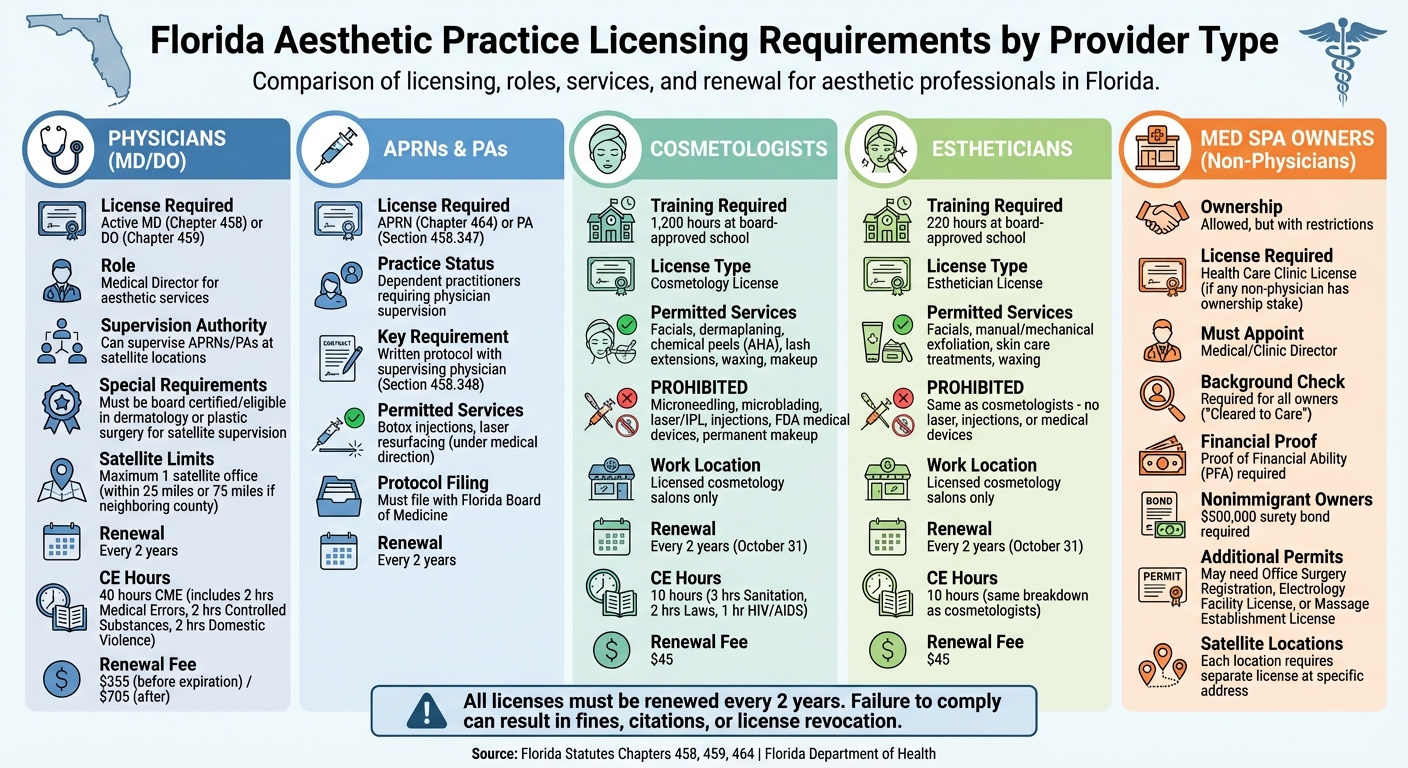
In Florida, physicians must hold an active, unrestricted MD license (Chapter 458) or DO license (Chapter 459) to perform aesthetic procedures. Additionally, a licensed physician must act as the Medical Director to supervise all medical treatments.
For physicians supervising APRNs or PAs at satellite locations focused on aesthetic or dermatologic services, specific rules apply. The supervising physician must be board certified or board eligible in dermatology or plastic surgery. These satellite offices must be within 25 miles of the primary practice or in a neighboring county, with a maximum distance of 75 miles between locations. Physicians can oversee only one satellite aesthetic office in addition to their primary practice.
To maintain safety standards, med spas are required to display a current schedule showing the supervising physician's physical presence and operational hours for times when they are not onsite. Physicians must also report the addresses of all non-primary practice locations where they supervise APRNs or PAs to the Florida Board of Medicine. Delegated procedures like Botox injections or laser resurfacing must be performed by licensed professionals (RN, APRN, or PA) under the physician's medical direction.
APRNs and PAs: Practice Scope and Supervision Requirements
In Florida, Physician Assistants (PAs) and Advanced Practice Registered Nurses (APRNs) operate under distinct regulatory frameworks. PAs are classified as "dependent" practitioners under Florida Statute Section 458.347, requiring physician supervision to perform medical services. APRNs, governed by Chapter 464, must establish a formal supervisory relationship with a physician through a written protocol to perform medical acts.
Both PAs and APRNs in aesthetic practices must have a written protocol that defines their supervisory relationship, standing orders, and delegated medical acts under Section 458.348. Physicians supervising PAs or APRNs are required to file this protocol with the Florida Board of Medicine. Moreover, the physician's expertise must align with the aesthetic procedures being delegated, as outlined in Section 458.3312.
| Feature | Physician Assistant (PA) | Advanced Practice Registered Nurse (APRN) |
|---|---|---|
| Primary Statute | Florida Statute Section 458.347 | Florida Statute Chapter 464 / 458.348 |
| Supervision Basis | Dependent practitioner under physician supervision | Independent nursing license; medical acts via physician protocol |
| Regulatory Board | Florida Board of Medicine | Florida Board of Nursing (with medical acts overseen by Board of Medicine) |
| Protocol Requirement | Required under Section 458.348 | Required under Section 458.348 |
Licensing Requirements for Non-Medical Providers
Cosmetologists and Estheticians: Permitted Services
In Florida, the rules for non-medical providers clearly separate aesthetic services from medical procedures. Cosmetologists must complete 1,200 training hours, while estheticians need 220 hours at a board-approved school. Both professionals are allowed to perform treatments focused on improving the appearance of the face, scalp, and body, but only within licensed cosmetology salons.
Their permitted services include:
- Facials
- Manual and mechanical exfoliation (like dermaplaning)
- Chemical peels using alpha hydroxy acids
- Lash extensions and lifts (limited to gel-based ammonium thioglycolate)
- Waxing
- Makeup application
- Skin care treatments
However, Florida law clearly outlines what they cannot do. According to the Florida Administrative Code:
"Bodily intrusion includes but is not limited to skin perforation by any means, including the application of permanent makeup, the use of laser and intense pulsed light (IPL) treatments, ultrasound and high intensity focused ultrasound (HIFU) treatments, radiation, plasma pen, Hyaluron pen, injections, and FDA approved medical devices, all of which are beyond the scope of a cosmetology license."
This means services like microneedling, microblading, laser treatments, injections, and any procedures involving FDA-approved medical devices are strictly prohibited for cosmetologists and estheticians. Providers looking to perform more advanced treatments must pursue additional training and registration. Some providers also integrate telehealth for initial consultations to streamline the patient intake process.
Specialists and Technicians: Licensing and Compliance
Florida requires specific licensing for specialists and technicians offering advanced aesthetic services. For example, a Full Specialist registration combines facial and nail specialties and needs 400 hours of training. These professionals are also required to complete 10 hours of continuing education every two years. This includes:
- 1 hour of HIV/AIDS education
- 3 hours on sanitation and sterilization
- 2 hours covering Florida laws and regulations
For treatments like electrolysis, microblading, or permanent makeup, providers must obtain a license through the Florida Department of Health instead of the Board of Cosmetology. After completing their education and passing exams, applicants may work under the supervision of a licensed specialist while waiting for their full license - provided they work within a licensed salon.
Licenses are renewed every two years for a $45 fee, with expiration dates grouped by odd or even years.
Reading about the problem? See how Prospyr solves it in one platform.
Book a DemoBusiness Licensing and Compliance for Med Spa Owners
Med Spa Ownership Requirements in Florida
In Florida, non-physicians can own a med spa, but the rules are strict. If your business is entirely owned by licensed health care practitioners, like MDs or DOs, you might not need a Health Care Clinic License from the Agency for Health Care Administration (AHCA). However, if any non-physician - whether a partner, investor, or corporate entity - has an ownership stake, the med spa must secure this license.
Licensed clinics are required to appoint a Medical or Clinic Director to oversee medical operations. The application process includes submitting Proof of Financial Ability (PFA), which shows you can manage the clinic's operations. Additionally, all owners and controlling parties must pass background checks as part of Florida’s "Cleared to Care" initiative. For out-of-state entities, a Florida-registered agent must be designated for service of process. Nonimmigrant owners are also required to provide a surety bond of at least $500,000.
Depending on the services you offer, additional permits from the Department of Health may be necessary. For example, performing Level II or III surgical procedures requires an Office Surgery Registration. Offering electrolysis services means obtaining an Electrology Facility License, while providing massage therapy services necessitates a Massage Establishment License. Starting in 2024, Florida’s participation in the Interstate Medical Licensure Compact could simplify the licensing process for out-of-state physicians looking to practice in the state.
Licensing for Satellite Locations and Mobile Services
If you’re planning to expand your med spa, each new location must comply with Florida’s location-specific licensing rules. Facility licenses in Florida are tied to a specific physical address, meaning every satellite location requires its own license. This process includes a separate application, a completed field inspection, and the appointment of a Designated Establishment Manager. Operating without these steps is considered unlicensed activity and may lead to fines, citations, or even criminal charges.
Your insurance must also reflect the new address to ensure proper liability coverage for personal injury and bodily harm. Additionally, all business partners, officers, and LLC members must complete electronic fingerprinting and background checks through an approved Livescan provider. If your business operates under a "Doing Business As" (D/B/A) name, ensure it’s registered with the Florida Division of Corporations before applying for the license.
Mobile services, such as pop-up Botox bars or in-home treatments, must comply with state medical regulations. This includes oversight by licensed medical professionals and maintaining HIPAA-compliant records.
| Fee Type | Cost |
|---|---|
| New Massage Establishment License | $255 |
| Change of Location | $125 |
| License Renewal (Before Expiration) | $105 |
| License Renewal (After Expiration) | $180 |
These fees highlight the importance of staying on top of licensing requirements. If a license isn’t renewed within six months of becoming delinquent, it will be marked as "Null & Void", requiring you to start the application process from scratch for that location. Always confirm all licenses are in place before serving clients to avoid unnecessary disruptions.
sbb-itb-02f5876
License Renewal and Continuing Education Requirements
License Renewal Schedules and Fees
In Florida, license renewal schedules are divided into two groups. For Medical Doctors (MDs), Group 1 licenses expire on January 31 of even-numbered years (e.g., 2026), while Group 2 licenses expire on January 31 of odd-numbered years (e.g., 2027). Cosmetologists, estheticians, and nail specialists follow a similar pattern, but their licenses expire on October 31 - Group 1 in odd-numbered years and Group 2 in even-numbered years.
The renewal window opens 90 days before your license expires. For MDs, renewing an active license before the expiration date costs $355.00. However, if you renew after the deadline, the fee jumps to $705.00. Cosmetology professionals pay a standard renewal fee of $45.00. If an MD license has been delinquent for more than two renewal cycles, passing the Special Purpose Examination (SPEX) is required to reactivate it.
| MD Renewal Status | Before Expiration | After Expiration | 120-Day Delinquent |
|---|---|---|---|
| Active to Active | $355.00 | $705.00 | $1,060.00 |
| Inactive to Inactive | $125.00 | $475.00 | $600.00 |
| Active to Inactive | $475.00 | $925.00 | $950.00 |
Electronic fingerprinting is valid for five years. If your fingerprints expire before renewal, you’ll need to pay a $43.25 retention fee instead of getting a new scan, which typically costs $60–$90. Be sure to check your fingerprint status in the Clearinghouse system before the deadline.
Staying on top of renewals goes hand in hand with meeting continuing education requirements to maintain professional standards.
Continuing Education Requirements for Aesthetic Providers
Medical Doctors are required to complete 40 hours of Continuing Medical Education (CME) every two years. This includes 2 hours on Prevention of Medical Errors, 2 hours on Prescribing Controlled Substances (for DEA-registered doctors), and 2 hours on Domestic Violence every third renewal cycle. First-time renewals include an additional 1-hour HIV/AIDS training, with the remaining hours coming from AMA Category I courses.
Cosmetologists and estheticians must complete 10 hours of continuing education per renewal cycle. These hours cover specific topics such as:
- 3 hours: Sanitation and Sterilization
- 2 hours: Florida Laws and Rules
- 1 hour: HIV/AIDS
- 1 hour: Chemical Makeup
- 1 hour: Environmental Issues
- 0.5 hours: OSHA
- 0.5 hours: Workers' Compensation
- 1 hour: Elective
Starting July 1, 2024, professionals who have held an active license for at least 10 years without any disciplinary action will be exempt from continuing education requirements.
All courses should be tracked using CE Broker, which reports directly to the Department of Health. Online cosmetology continuing education courses typically cost between $16.95 and $22.95 and require a passing score of at least 75%. For Medical Doctors, CME hours cannot roll over to the next cycle, so careful planning is essential. Physicians can also earn up to 5 hours of risk management credit by providing pro bono services.
Managing Compliance with Prospyr
How Prospyr Helps with Licensing Compliance
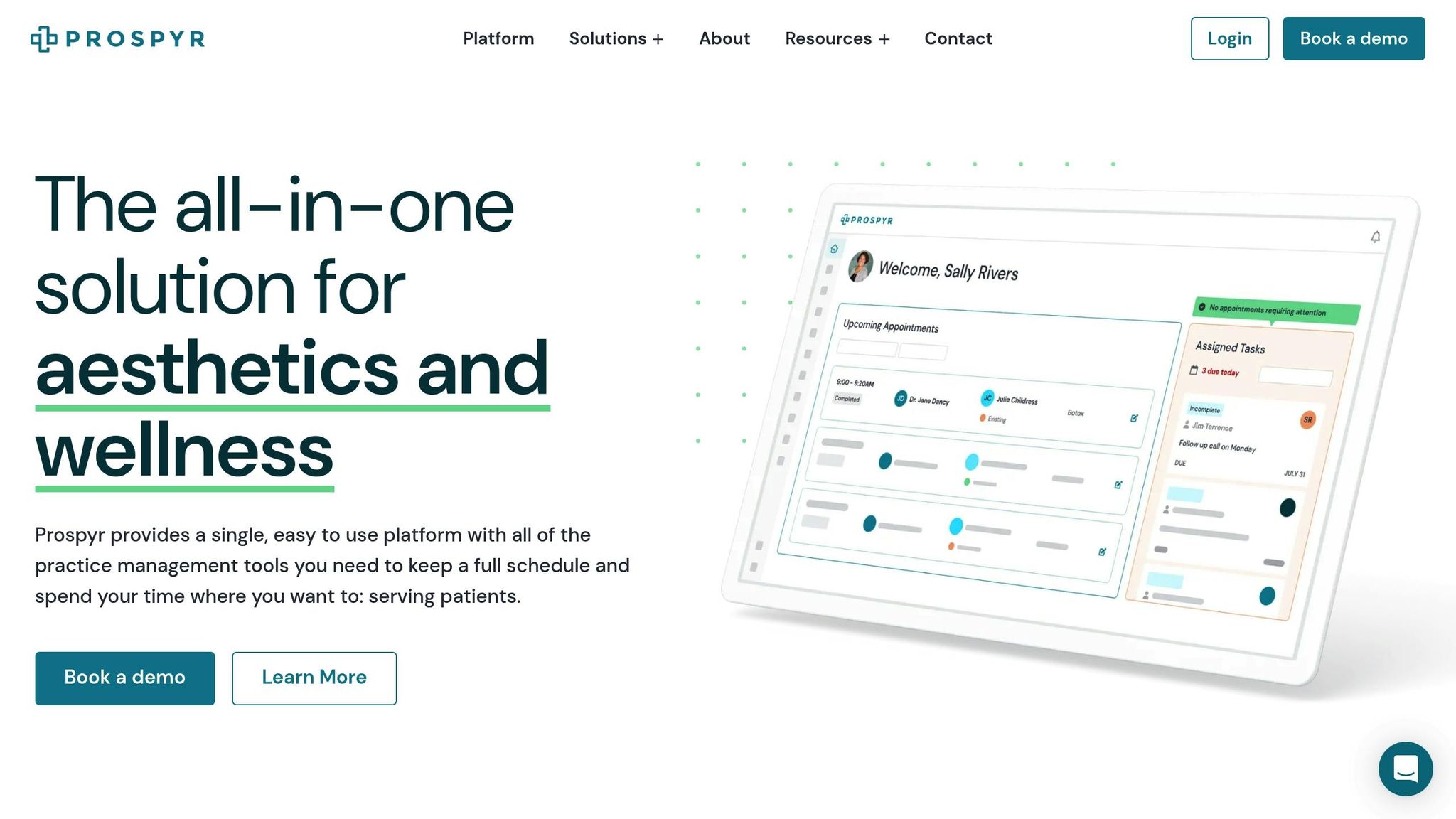
Florida has strict rules for license renewals and background checks, including a new Level 2 background screening requirement that kicks in at the first renewal after July 1, 2025. Prospyr simplifies this process by keeping track of renewal deadlines for MDs, PAs, and estheticians. It also digitally stores continuing education certificates, making it easier to ensure licenses remain active and meet Florida’s documentation standards. Prospyr doesn’t stop there - it alerts you to overpayments immediately and keeps digital records of protocols and supervision requirements, all in line with state regulations.
Another big change is coming on January 1, 2026, when Florida law (SB 1808) will require practices to refund patient overpayments within 30 days. Prospyr’s financial tracking system makes meeting this deadline effortless, so you won’t have to rely on messy manual spreadsheets. Plus, its HIPAA-compliant EMR replaces paper charts and secures patient data, ensuring you’re ready for audits by the Florida Board of Medicine. These features work seamlessly with the broader practice management tools mentioned earlier in the article.
Running Your Practice More Efficiently with Prospyr
Prospyr isn’t just about compliance - it’s also designed to make your practice run more smoothly every day. With tools like smart scheduling, AI-powered note creation, and real-time booking, it helps optimize your workflow and manage operations across multiple locations, whether they’re satellite offices or mobile setups.
For mobile or satellite practices, Prospyr’s cloud-based system ensures patient consent forms and treatment records are updated instantly. Its iOS app even supports Tap to Pay, allowing secure payments during house calls. On top of that, practice analytics give you real-time insights into revenue, appointment trends, and provider productivity. The membership management feature automates renewals and recurring billing, cutting down on admin tasks and helping you build steady, predictable monthly income.
Conclusion
Operating an aesthetic practice in Florida demands strict adherence to the state's regulations, which cover everything from physician oversight and APRN supervision to esthetician registrations and clinic permits.
"The Florida Department of Health is responsible for the regulation of health practitioners for the preservation of the health, safety, and welfare of the public".
Failing to meet key requirements - such as completing background screenings - can lead to serious consequences like disciplinary action, denied applications, or even license revocation. Compliance isn't just a formality; it safeguards your license and ensures your business stays operational. For instance, nonimmigrant alien owners must meet the $500,000 surety bond requirement and demonstrate proof of financial capability.
To simplify compliance, tools like Prospyr can be invaluable. They help automate tasks like tracking license renewals, digitizing continuing education records, and maintaining HIPAA-compliant patient documentation. Leveraging Florida's e-licensing system for faster applications, routinely verifying practitioner licenses through Florida Health Source, and conducting quarterly audits of patient records and protocols are practical steps to keep your practice aligned with state standards.
FAQs
What are the supervision rules for APRNs and PAs in Florida's aesthetic practices?
In Florida, Advanced Practice Registered Nurses (APRNs) and Physician Assistants (PAs) working in aesthetic practices are required to have a formal supervisory relationship with a licensed physician. The supervising physician must submit a written notice to the appropriate board within 30 days of establishing this relationship. This notice must outline details such as the physician’s information, the practice’s location, and the number of APRNs or PAs under their supervision.
APRNs can qualify for autonomous practice if they meet certain criteria. These include holding an active Florida APRN license, completing 3,000 clinical hours under a physician’s supervision within the last five years, and finishing graduate-level coursework in differential diagnosis and pharmacology. Once these requirements are fulfilled, APRNs may provide aesthetic services independently, although the original supervisory notice remains on file.
For PAs, the supervisory rules are similar. They are permitted to perform aesthetic procedures only under a physician’s standing orders or protocol. This protocol must also be reported to the board within 30 days. The supervising physician is responsible for defining the PA’s scope of practice and ensuring they comply with Florida’s regulations.
Can a non-physician own a med spa in Florida, and what are the licensing requirements?
Yes, non-physicians can own a med spa in Florida, but they are not allowed to oversee or influence any medical services. A licensed physician must act as the medical director, and all medical procedures must be carried out by licensed professionals.
In addition, med spas typically need to register as a Health Care Clinic with the Agency for Health Care Administration. This process often requires securing a $500,000 surety bond, maintaining liability and malpractice insurance, and adhering to strict HIPAA regulations. Meeting these requirements is crucial to operate within the law and ensure a high standard of care for patients.
What happens if I don’t renew my Florida medical license on time?
If you miss the deadline to renew your Florida medical license, it will be classified as delinquent status, and you'll incur a delinquent fee. If the license stays delinquent through the end of the licensure cycle, it will become null and void, effectively ending your legal ability to practice medicine in Florida. This situation could also result in disciplinary actions. To steer clear of these issues, ensure you renew your license on time.
Free PDF guide + worksheets
Build your Florida opening file.
Get the state highlights, linked official sources, service-by-service licensing worksheet, ownership questions and opening checklist in one printable guide.
- ✓ State-specific decisions and next steps
- ✓ Credential and supervision worksheet
- ✓ A place to track approvals, owners and renewals