
Want to improve your email marketing? Start by analyzing your competitors. Here's how clinics can refine their strategies:
- Identify Competitors: Use tools like SEMrush or Google searches to find direct (same services, same audience) and indirect competitors (overlapping services, different audience).
- Subscribe to Competitor Emails: Sign up for their newsletters, lead magnets, or booking processes to gather insights.
- Key Metrics to Watch:
- Open Rate: Average for healthcare is 23.7%.
- Click-Through Rate (CTR): Aim for at least 3.0%.
- Unsubscribe Rate: Keep below 0.3%.
- Analyze Content & Design:
- Subject lines: Shorter ones perform better.
- Mobile Optimization: Over 60% of users open emails on phones.
- Personalization: Does their content reflect user behavior or preferences?
- Use Tools for Analysis: Platforms like SendView and MailCharts provide deeper insights into email strategies, automation, and performance.
Finding Competitors and Their Email Strategies
To analyze what your competitors are doing with email marketing, you first need to identify who they are and how to access their campaigns. Fortunately, this process is simpler than you might think. Once you’ve laid this groundwork, you can dig deeper into their tactics and approach to email list building.
How to Identify Direct and Indirect Competitors
Start by distinguishing between direct and indirect competitors. Direct competitors are businesses offering the same services to the same audience. For instance, two local med spas providing Botox and laser hair removal fall into this category. Indirect competitors, on the other hand, might offer overlapping services but cater to a slightly different niche - like a general wellness center compared to a specialized aesthetics clinic.
To pinpoint competitors, try Google searches with phrases like "best med spa in [Your City]" or "alternatives to [Your Clinic Name]". Tools such as SEMrush, SpyFu, or Ahrefs can also help by showing which clinics are bidding on valuable keywords like "microneedling for acne scars near me". Social media platforms, particularly Instagram, Facebook, and TikTok, are another goldmine for identifying businesses engaging with your target audience.
"Competitive analysis reveals what's working in your local market, where your competitors might fall short, and how you can create a unique value proposition that sets your business apart." – Ryan Pullano, Founder, Med Spa Marketing Portal
For insights into paid strategies, check the Meta Ad Library and Google’s Ads Transparency Center to see which competitors are running sponsored content. Additionally, reading reviews on Google and Yelp can highlight customer feedback on communication and follow-up - areas that could reveal opportunities for improving your email marketing.
Building a Competitor Email List
Once you’ve identified your competitors, the next step is to capture their email campaigns. Start by subscribing to their newsletters via website pop-ups, landing pages, or embedded forms. To stay organized, use a dedicated email address, like a Gmail alias (e.g., [email protected]).
To uncover automated email sequences, try triggering behavioral emails. For example, start a booking process on a competitor’s site but don’t complete it - this often activates cart abandonment emails. Similarly, sign up for their lead magnets, such as treatment guides, skin quizzes, or discount codes, to access nurture campaigns. Joining through multiple entry points, like lead forms or webinar sign-ups, can also reveal how they segment and manage leads.
For finding specific email addresses linked to competitor domains, tools like Hunter.io can be helpful. If you’re looking for deeper insights, platforms like SendView, MailCharts, and Owletter can automate email collection and provide technical details you can’t get from a regular inbox. These tools make it easier to analyze competitor strategies. For example, SendView offers a 10-day free trial, while MailCharts has a free tier that gives access to a database of over 30,000 brands.
"Subscribing to your competitors' emails isn't enough... Inboxes aren't designed to let you analyze the contents. They're only designed to help you read them." – Gregg Blanchard, SendView
Key Metrics to Analyze in Competitor Emails
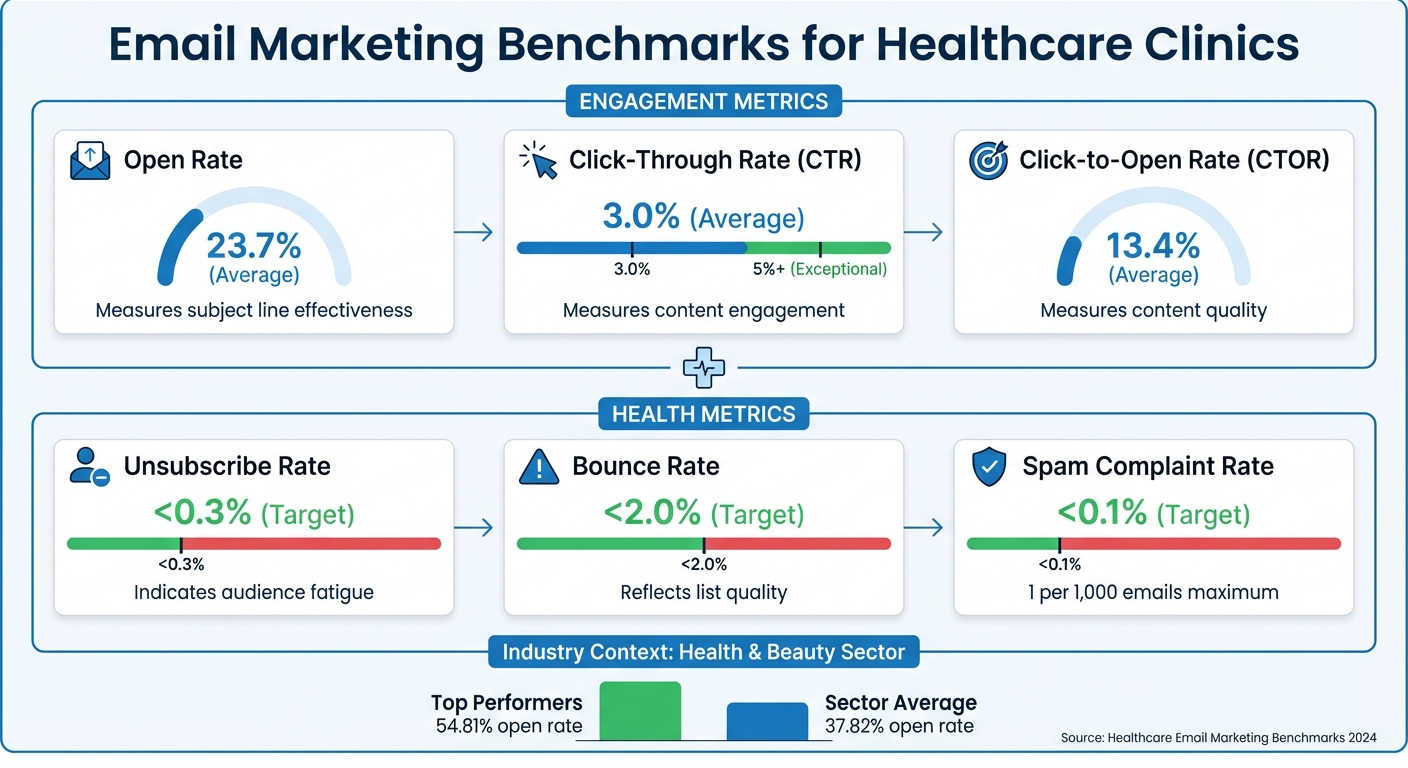
Email Marketing Benchmarks for Healthcare and Aesthetic Clinics
Once you've gathered competitor emails, the next step is identifying key metrics to evaluate. While you can't access their internal analytics dashboards, you can rely on proxy metrics and industry benchmarks to gauge performance and uncover opportunities.
Email Engagement Metrics
Open rate tracks how many recipients open an email and often reflects the effectiveness of the subject line and sender name. For healthcare and aesthetic clinics, the average open rate is 23.7%. However, with Apple's Mail Privacy Protection automatically pre-fetching images, open rates have become less reliable. If competitors are using personalized subject lines or sender names, they're likely working to maximize this metric.
Click-through rate (CTR) measures the percentage of recipients clicking on a link within the email. In healthcare, the average CTR is 3.0%, with anything above 5% being exceptional. This metric reflects how engaging the content and call-to-action (CTA) are. A related metric, click-to-open rate (CTOR), compares clicks to opens and averages 13.4% for clinics. CTOR is particularly valuable because it focuses on content quality rather than just the subject line - essentially, it answers whether the email delivered on its initial promise.
Unsubscribe rate should stay under 0.3% for healthcare providers. A sudden increase in unsubscribes might indicate overly frequent emails or irrelevant content. Similarly, spam complaint rates should remain below 0.1% (1 complaint per 1,000 emails) to protect sender reputation. While these metrics aren't directly visible, you can gauge deliverability by monitoring how often competitors' emails land in your spam folder or by checking their authentication records (SPF/DKIM).
| Metric | Healthcare Benchmark | What It Indicates |
|---|---|---|
| Open Rate | 23.7% | Appeal of subject line and sender name |
| Click-Through Rate (CTR) | 3.0% | Engagement with the offer |
| Click-to-Open Rate (CTOR) | 13.4% | Relevance and quality of content |
| Unsubscribe Rate | 0.3% | Audience fatigue or poor targeting |
| Bounce Rate | < 2.0% | List quality and sender reputation |
Beyond engagement, conversion and retention metrics shed light on overall campaign success.
Conversion and Retention Metrics
Conversion rate measures how many recipients take a desired action, such as booking a consultation or buying a skincare package. While competitors' exact conversion rates aren't visible, you can analyze their email-to-landing-page journey. Does the messaging flow seamlessly from the subject line to the CTA and landing page? Are they using urgency tactics like countdown timers or limited-time offers? These strategies often signal a focus on immediate conversions.
For retention, observe how competitors structure their automated sequences. Are they sending welcome emails to new subscribers? How quickly do they follow up after someone downloads a treatment guide? For example, in 2025, a SaaS company analyzed five competitors' email sequences and found a 32% difference in subject-line length. By aligning their send times with competitors' Tuesday-morning schedules, they doubled their reply rate from 5.8% to 11.9%. Similarly, Ryan Austin, Director of Email Marketing at Bluetent, incorporated reservation data into campaigns, achieving a 75% open rate for web subscriptions and generating over $50,000 in additional revenue.
"Campaign Monitor is extremely innovative and perfectly aligned with our goals. It gives us both ready-made templates and the freedom to code our own - fully integrated with our reservation data." – Ryan Austin, Director of Email Marketing, Bluetent
Also, take note of how competitors re-engage inactive patients with win-back campaigns. Email lists naturally shrink by 22.5% to 28% each year, so successfully reactivating dormant subscribers gives clinics a major edge. Look for patterns in these emails - are they offering exclusive discounts to lapsed patients? Providing educational content to regain trust? Mapping these strategies can reveal gaps in your own patient lifecycle approach.
Analyzing Competitor Email Content and Design
When it comes to competitive analysis, diving into the content and design of competitor emails can uncover practical ideas to improve your clinic’s campaigns. By examining how competitors structure their emails, you can learn how they grab attention, maintain brand identity, and encourage action across devices - bolstering the strategies discussed earlier.
Subject Lines and Send Times
Subject lines play a huge role in email performance. A study of over 91 billion subject lines revealed that shorter ones (under 25 characters) tend to get the most opens in campaign emails, while medium-length ones (25–35 characters) perform better for triggered emails. As you review competitor subject lines, ask yourself: Do they use personalization (like first names or treatment names)? Do they tap into psychological triggers like urgency or curiosity? Do they run A/B tests to refine their approach? These are signs of a well-optimized strategy.
Interestingly, emojis are falling out of favor. Emails without emojis now often outperform those with them, especially in triggered campaigns. Similarly, promotional subject lines with the "Interestingly, emojis are falling out of favor. Emails without emojis now often outperform those with them, especially in triggered campaigns [26]. Similarly, promotional subject lines with the "$" symbol tend to drive better results than those with "%" [26]. Preheaders also matter - a concise preheader under 30 characters can boost opens, while slightly longer ones (30–50 characters) are better for driving conversions [26][27].quot; symbol tend to drive better results than those with "%". Preheaders also matter - a concise preheader under 30 characters can boost opens, while slightly longer ones (30–50 characters) are better for driving conversions.
"A subject line has a single job: Getting as many subscribers as possible to open your email." – Jacob Hansen, Attentive
Avoid using misleading prefixes like "RE:" or "FWD:". These tactics are not only flagged by spam filters but can also harm your sender reputation. After analyzing subject lines, take a closer look at how segmentation and design enhance overall performance.
Content Personalization and Segmentation
To see how competitors tailor their emails, sign up for their communications through different entry points - whether it’s a newsletter, a lead magnet, or a webinar registration. Pay attention to whether the content changes based on how you signed up. For example, do follow-up emails reflect your specific signup path? Testing these sequences can reveal how well competitors personalize their outreach.
Some clinics take this further by using dynamic content tied to browsing behavior or purchase history. For instance, you might notice emails referencing treatments you’ve viewed or suggesting services that align with your profile. On the flip side, weak segmentation shows up when clinics send irrelevant offers, like "new patient" discounts to long-term subscribers, or fail to recognize past appointment history. To keep track of a competitor’s full email strategy without clogging your inbox, consider using a dedicated "shadow" email address.
Design and Mobile Optimization
Great email content is only as effective as its design - and with over 60% of emails being opened on mobile devices, responsive design is non-negotiable. Test competitor emails on various devices to see if they adapt well to smaller screens. Single-column layouts generally perform better on mobile compared to multi-column designs, which can break or appear cluttered.
Look closely at call-to-action (CTA) buttons. Are they easy to tap on mobile? Do they pop with high-contrast colors? These details can make a big difference for mobile users. Also, check if competitors are using engaging elements like GIFs, videos, or embedded polls to boost interaction. With dark mode becoming more popular, it’s worth verifying if their designs remain readable in this setting.
Lastly, evaluate how seamlessly the email design flows into the landing page. A consistent visual style and messaging between the two can make or break the user experience. When the transition feels disjointed, it often signals missed opportunities to convert.
sbb-itb-02f5876
Tools and Platforms for Email Analysis
To stay ahead, it’s essential to use specialized tools that go beyond the capabilities of standard email clients. These tools can uncover technical details like which email service provider (ESP) competitors rely on or whether their emails meet spam filter standards.
Email Analysis Tools
Tracking tools make it easy to monitor multiple competitors at once. SendView, for instance, uses unique tracking addresses to analyze over 3 million emails. It uncovers trends, ESP usage, spam scores, and SPF/DKIM authentication details. Pricing starts at $69/month for tracking up to 10 companies and scales to $169/month for 50 companies.
"I love the tools SendView has built. It's so nice to not have my personal inbox blow up and be able to easily identify email sending trends from the companies I care about." – Chase Dimond, email marketing expert
Another option, Owletter, captures and screenshots emails from specific websites automatically. It also includes keyword alerts to notify you when competitors mention certain treatments or promotions. Plans start at $29/month for tracking 10 websites. Meanwhile, MailCharts offers access to a searchable database of over 30,000 brands, allowing you to explore historical campaigns and automated sequences without needing to subscribe manually.
For those on a tighter budget, you can create a custom tracking system using Zapier's email parser to extract data from competitor emails, ChatGPT to identify patterns, and tools like Looker to visualize trends. If you simply want to identify an ESP quickly, ESP Finder offers a free plan that analyzes forwarded emails to determine the platform being used.
One crucial tip: avoid using personal email accounts for this type of analysis. They lack the necessary metadata for deeper insights.
With these tools, you can gather detailed competitor insights to fine-tune your email marketing strategy.
How Prospyr Can Improve Your Email Strategy
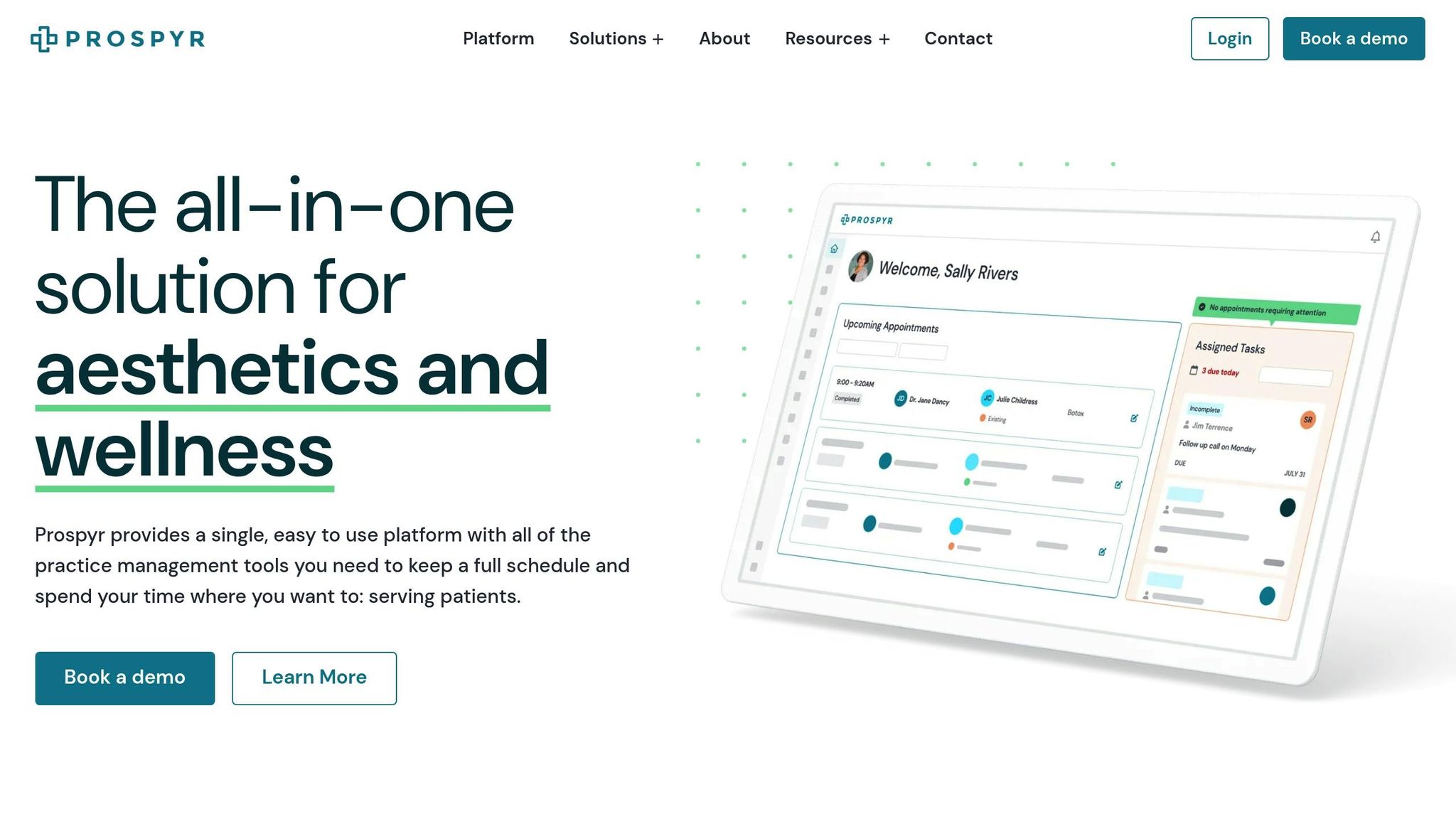
Prospyr's marketing automation tools make it easier to implement HIPAA-compliant email and SMS campaigns that align with proven industry tactics. Whether you’re setting up welcome sequences for new patients, follow-ups after treatments, or reminders for incomplete bookings, Prospyr helps you replicate and improve upon successful strategies.
By leveraging the metrics and trends uncovered through competitor analysis, Prospyr enables you to craft campaigns designed for better engagement and conversions. Its segmentation features allow you to personalize messages based on patient behavior, treatment history, or how they signed up. For example, if competitors send one-size-fits-all promotions, Prospyr lets you go a step further. You can send Botox offers to patients who've previously booked injectables or skincare packages to those interested in facials.
Prospyr’s practice analytics also let you measure your send times, open rates, and conversions against the data you’ve gathered on competitors. This way, you can continuously refine your approach based on what’s working in your market.
Applying Insights to Your Email Marketing
Benchmarking Your Performance
Once you've gathered competitor data, it's time to create a comparison framework to evaluate where your clinic stands. Break down key metrics into categories like timing, engagement, content balance, technical health, and automation. For example, if competitors favor specific send times, try testing alternative schedules to improve your email visibility. You can also experiment with subject line length or even add emojis to see what resonates most with your audience.
In the health and beauty sector, the average open rate is 37.82%, while top performers hit 54.81%. If your clinic's numbers fall short, take a closer look at how top competitors craft their subject lines or time their emails. Use these insights to align your email strategy with industry benchmarks and boost engagement.
| Metric Category | What to Benchmark | Actionable Insight |
|---|---|---|
| Timing | Day of week and time of day | Find the best send times for your audience. |
| Engagement | Subject line length and emoji usage | Test similar styles to see if they improve open rates. |
| Content | Educational vs. Promotional ratio | Balance health tips with offers for services. |
| Technical | ESP used and Spam Score | Match or exceed tech standards for better deliverability. |
| Automation | Number of emails in a "Welcome" series | Refine onboarding sequences for new patients. |
Pay attention to technical details like spam scores and authentication protocols (SPF, DKIM, DMARC) to ensure your emails consistently land in inboxes. Here's an interesting stat: 39% of brands don't A/B test their emails. This means testing competitor-inspired tactics can give you a leg up almost immediately.
Once you've established benchmarks, you can start applying these insights to refine your approach.
Implementing New Strategies
After comparing your performance, use a SWOT analysis to dig deeper into your findings. This will help you pinpoint competitor strengths to emulate, weaknesses to avoid, opportunities they’re missing, and any threats they might pose to your clinic. For instance, if competitors rely on generic calls-to-action (CTAs) like "Learn More", you can stand out by using personalized promotions - such as Botox discounts for patients with a history of injectables or customized skincare packages for those interested in facials.
Automation is another area where you can shine. Set up sequences like welcome emails, abandoned booking reminders, and post-appointment follow-ups. These flows can convert 4x more recipients than standard email blasts. Dive into competitor automation to analyze their cadence and content, then tailor your sequences to your audience.
Don’t overlook the importance of CTAs and landing pages. If competitors’ emails lead to clunky, non-mobile-friendly booking pages, make sure your conversion path is smooth and responsive. With 62% of users opening emails on mobile devices, a mobile-friendly design is no longer optional. Use clear, action-driven CTAs like "Confirm Your Appointment" to encourage immediate responses.
However, avoid copying competitor tactics outright. Validate each strategy with A/B testing to see how it performs with your audience. Start with a manageable cadence - one to two emails per month - to avoid overwhelming your subscribers. If competitors are overloading inboxes with irrelevant content, refine your segmentation to ensure patients only receive emails that align with their treatment interests or medical history. This approach keeps your messaging relevant and builds trust with your audience.
Conclusion
Competitor email marketing analysis can reveal overlooked opportunities that help your clinic stand out. Darren Blumenfeld from InboxAlly says it best: "Blind spots are a gift - an open invitation to do better than your competition. Address what others overlook, and your brand could be the one to set the next standard". When you notice competitors relying on generic CTAs or neglecting mobile optimization, you’ve found areas where you can excel.
The key is turning those insights into action. Use a SWOT analysis to evaluate strengths and weaknesses, and test your strategies with A/B testing. Pay attention to technical details, like spam scores and authentication protocols, to ensure your emails actually reach your audience.
Once you’ve gathered these insights, simplifying your workflow becomes crucial. For aesthetic clinics juggling patient care and marketing, tools like Prospyr offer HIPAA-compliant automation for tasks like segmentation, trigger-based sequences, and mobile optimization. You can easily set up automated flows for welcoming new patients, reminding them about abandoned bookings, or following up after treatments.
Prospyr’s integrated analytics allow you to track performance and quickly adopt successful strategies. While the competitive landscape will always shift, your approach doesn’t have to be overwhelming. Regularly monitor 3–5 direct competitors, experiment with tactics tailored to your patient base, and rely on automation to handle repetitive tasks. By combining strategic insights with tools built specifically for aesthetic clinics, you can focus less on analysis and more on building meaningful connections with patients who need your services. Staying vigilant and refining your approach will keep your clinic ahead in a constantly changing market.
FAQs
Is subscribing to competitor emails legal?
Yes, subscribing to competitor emails is legal in the U.S., provided those emails adhere to the CAN-SPAM Act. This law requires things like accurate header details, clear labeling as advertisements, and the inclusion of a valid physical address. When analyzing competitor emails, it’s important to ensure they meet these regulations to avoid any compliance issues.
How can I estimate competitor email performance without their data?
To get a sense of how your competitors' email campaigns perform without having direct access to their data, start by subscribing to their email lists. This lets you monitor key elements like how often they send emails, the type of content they share, and the timing of their campaigns.
You can also use tools designed to analyze email campaigns. These tools can reveal patterns such as their content strategies, spam scores, and even their sending schedules. While you won’t be able to see precise metrics like open rates, combining these observations with industry benchmarks gives you a solid foundation for estimating the effectiveness of their email marketing efforts.
Which automated email sequences should my clinic set up first?
Starting with a Welcome Email Series and appointment reminders is a smart way to establish strong communication with patients. A Welcome Series, typically consisting of 3-5 emails, helps introduce new patients to your practice, builds trust, and showcases essential treatments or services you offer. It’s a great way to make a positive first impression and set the tone for a lasting relationship.
Appointment reminders, on the other hand, are sent 24-48 hours before a scheduled visit. These not only help reduce no-shows but can also include helpful details like post-care instructions or options to reschedule if needed. Together, these email sequences create a polished and personalized communication system, ensuring patients feel valued while encouraging them to return for future visits.