5 Follow-Up Templates for Aesthetic Clinics
Five follow-up templates—post-consult, post-treatment, re-engagement, SMS reminders, and missed-appointment messages—to reduce no-shows and improve client retention.
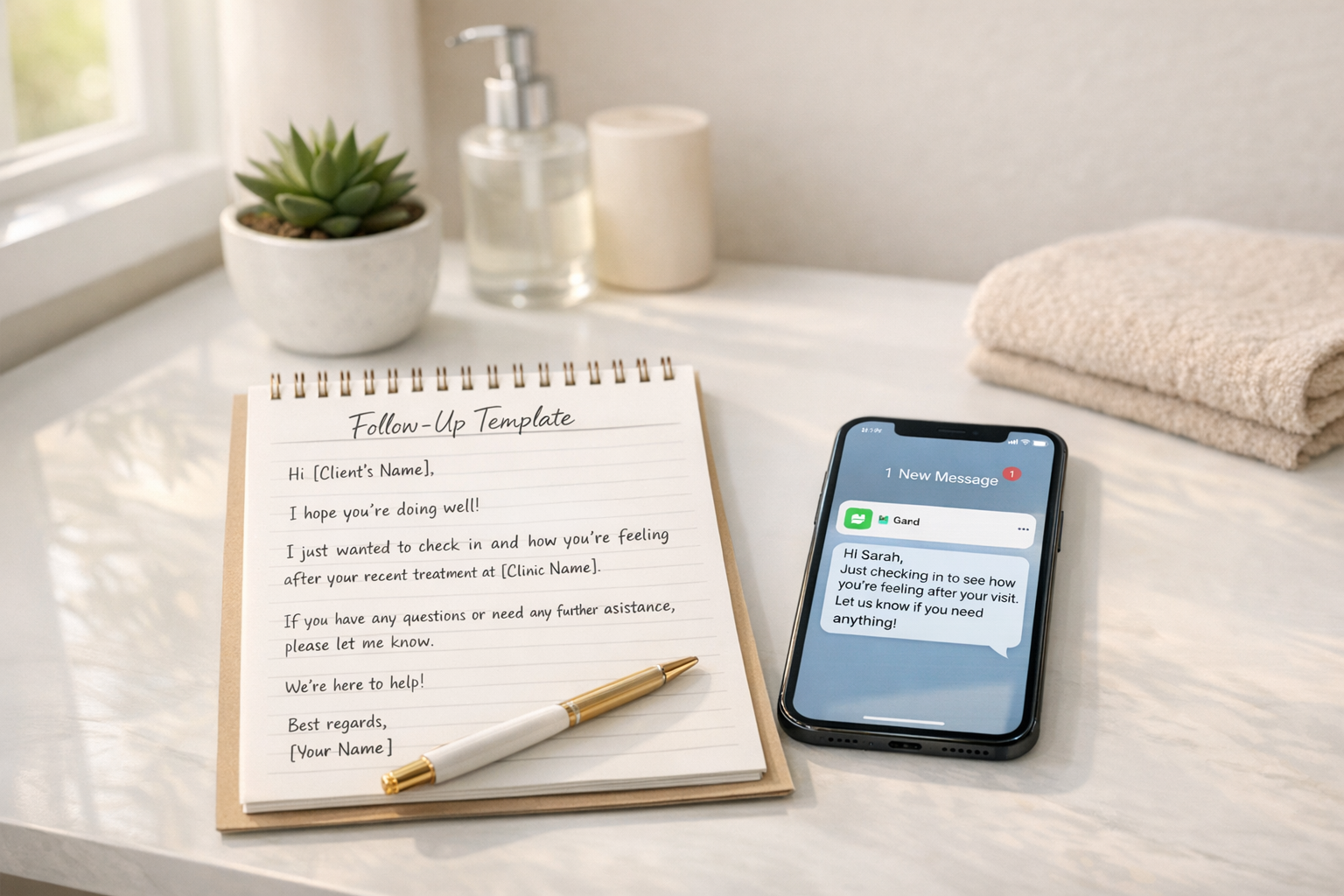

5 Follow-Up Templates for Aesthetic Clinics
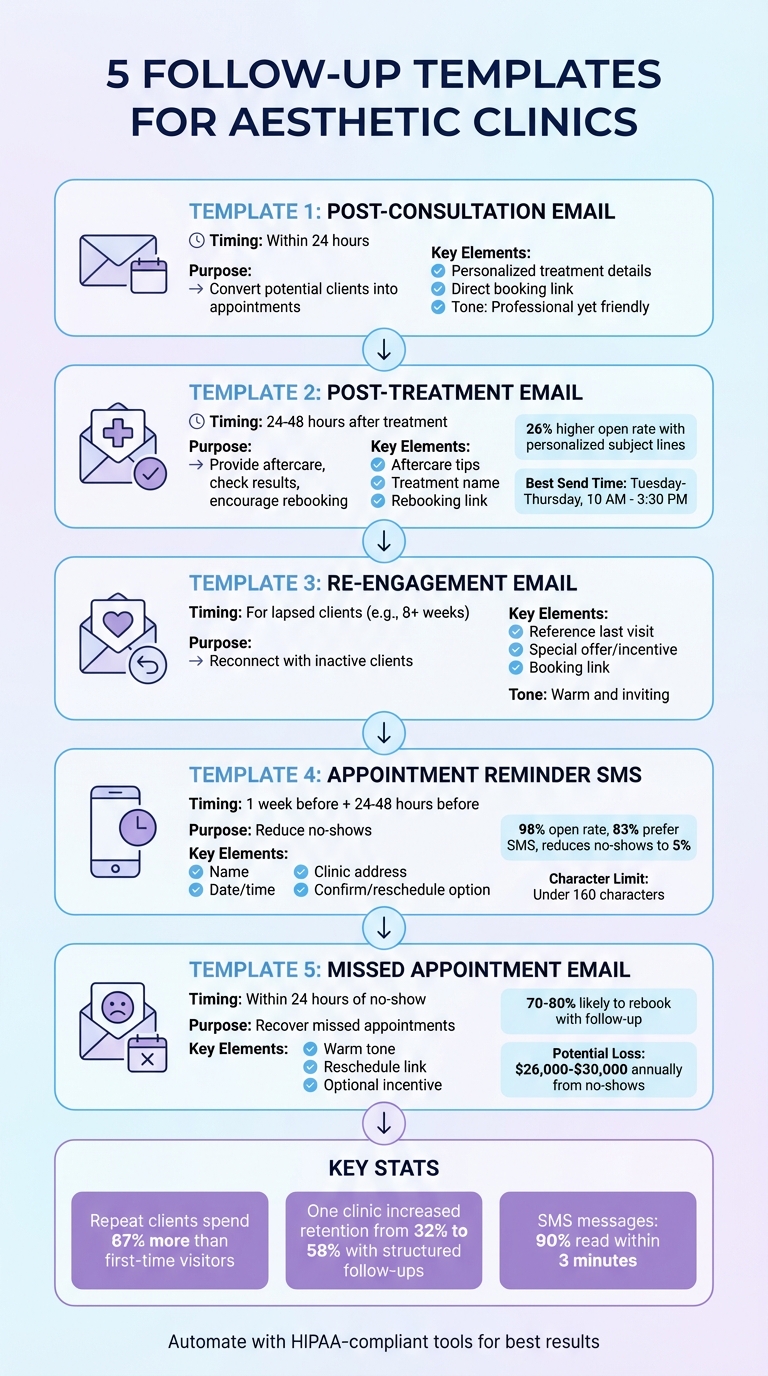
Follow-up communication is critical for keeping clients engaged in aesthetic clinics. Whether it’s post-treatment care, missed appointments, or re-engaging lapsed clients, timely and personalized messages can improve retention, reduce no-shows, and boost revenue. Here’s a quick overview of the five types of follow-ups every clinic should use:
- Post-Consultation Email: Sent within 24 hours to convert potential clients into appointments with personalized details and a direct booking link.
- Post-Treatment Email: Delivered 24–48 hours after a session to provide aftercare tips, check on results, and encourage rebooking.
- Re-Engagement Email: Target lapsed clients with a friendly message referencing their last visit, offering incentives, and including a booking link.
- Appointment Reminder SMS: Short, clear reminders sent a week before and 24–48 hours prior to appointments to reduce no-shows.
- Missed Appointment Email: Sent within 24 hours of a no-show, maintaining a warm tone and providing a quick way to reschedule.
These templates not only improve client relationships but also streamline clinic operations. Tools like Prospyr can automate this process, ensuring HIPAA compliance while saving staff time. Start using these strategies to keep your calendar full and clients happy.
5 Essential Follow-Up Templates for Aesthetic Clinics
1. Post-Consultation Follow-Up Email
A well-crafted post-consultation email can turn potential clients into confirmed appointments. Timing is everything - send this email within 24 hours to keep the discussion fresh in their minds. Reference the specific treatment you talked about, and make it simple for them to take the next step.
Personalization is your secret weapon. Use their name and mention the treatment they’re considering - whether it’s Botox, laser therapy, or microneedling. This shows you’re attentive to their unique needs. As Ben O'Brien from Faces Consent advises:
Address the client by name and provide details specific to their appointment. This adds a personal touch and can make the experience more engaging.
Keep your message brief - no one likes long emails. Include a direct booking link to make scheduling effortless. For example: "Schedule your treatment here: [Link]." This small detail reduces friction and encourages quick action.
Your tone should be professional yet friendly, reflecting your clinic’s brand. Skip the medical jargon that might confuse or overwhelm clients, and avoid ALL CAPS, which can feel overly aggressive. If the treatment is sensitive, keep the details general to ensure privacy in case the email is seen by someone else.
Finally, include an opt-out option, such as "Click here to unsubscribe", to stay compliant and respect client preferences. You can also invite them to ask any lingering questions, keeping the conversation open and approachable.
sbb-itb-02f5876
2. Post-Treatment Follow-Up Email
Reaching out to clients within 24–48 hours after their treatment shows you genuinely care about their recovery and results. This follow-up is the perfect opportunity to share aftercare tips, check on their experience, and encourage them to schedule their next session. A timely, personalized email can make all the difference.
Make sure to include the client’s name, the treatment they received (like dermal fillers or laser resurfacing), and your name or the practitioner’s name. As Featheredge Media points out:
Generic emails get deleted. Personal emails get opened and acted upon.
Personalization is key. Emails with personalized subject lines see a 26% higher open rate, and tailored messages drive transaction rates that are six times higher than generic ones.
When sharing aftercare instructions, keep them straightforward and actionable. For instance: "Avoid direct sunlight for 48 hours and use the recommended SPF 50." If specific products were used during the session, mention them to create a stronger connection and reinforce trust.
Include a clear call-to-action in the email, such as: "Book your next appointment here: [Link]." Adding a suggested timeframe, like "We’d love to see you again in 4 weeks", makes it even easier for clients to rebook. For the best engagement, send these emails between Tuesday and Thursday, ideally from 10:00 AM to 3:30 PM.
Don’t forget to include an unsubscribe link at the bottom, such as: "Click here to unsubscribe from marketing emails." This keeps your communication compliant and respects client preferences. Maintain a warm, professional tone, and avoid sharing sensitive details to protect client privacy.
For an even smoother process, consider using tools like Prospyr’s platform (https://prospyrmed.com), which automates and personalizes follow-up emails with embedded marketing tools. This kind of system makes it easier to keep clients engaged and connected long after their treatment.
Reading about the problem? See how Prospyr solves it in one platform.
Book a Demo3. Re-Engagement Follow-Up for Lapsed Clients
Re-engagement emails are designed to reconnect with clients who haven’t visited in a while. A personalized message that includes their name and references their last visit can make all the difference. For example: "Hi Sarah, it’s been 8 weeks since your last facial - we miss you and would love to see you again!" This kind of thoughtful outreach shows clients you value them, which can encourage them to return.
Your subject line is key to grabbing attention. Keep it warm and inviting, like "We Miss You, Sarah! ✨" or "Time for Your Next Treatment?" Adding a well-placed emoji can help your email stand out in a crowded inbox. Inside the email, keep the tone friendly and professional, and get straight to the point. Mention any special offers or incentives, such as: "Book this week and enjoy 10% off your next session." Providing a clear benefit gives clients a reason to act.
Make scheduling easy by including a direct booking link and a clear call-to-action, like "Book your appointment here." For added convenience, consider including an "Add to Calendar" option, which helps clients commit to their appointment. Keeping the message concise and focused ensures they can quickly understand the value of returning.
Avoid overloading your email with unnecessary details. As Ben O'Brien from Faces Consent points out:
The goal is to inform and remind, not annoy or overwhelm.
This approach respects your clients' time while showing genuine interest in their return. Don’t forget to include an opt-out option at the bottom of the email, such as "Click here to unsubscribe from marketing emails," to stay compliant with regulations and respect client preferences.
For clinics looking to simplify this process, tools like Prospyr can automate personalized re-engagement emails while adhering to HIPAA guidelines. This allows you to stay in touch with lapsed clients without adding to your workload.
4. Appointment Reminder Follow-Up SMS
Text reminders are a game-changer - 98% of text messages get opened, and 83% of people prefer receiving appointment details this way. For aesthetic clinics, a concise and clear reminder can cut no-show rates to as low as 5%. The trick? Keep it short, actionable, and HIPAA-compliant.
Your message should include the essentials: the client’s name, appointment date and time, your clinic’s name, and the address (or a link to directions). Stick to under 160 characters and make it easy for clients to confirm or reschedule. Here’s an example:
"Hi Jessica, this is Radiance Aesthetics. Your appointment is on 1/25/26 at 2:00 PM at 123 Main St. Reply YES to confirm or call (555) 123-4567 to reschedule. Reply STOP to opt out."
Timing is everything. Send your first reminder a week before the appointment, followed by a final one 24 to 48 hours prior. Some clinics swear by the 3-3-3 approach: reminders at three weeks, three days, and three hours before the appointment. This strategy has been shown to boost confirmation rates by 156%. If specific preparation is required - like arriving 15 minutes early - make sure to include that in the 24-hour reminder.
To stay compliant with regulations, always offer an opt-out option like "Reply STOP to unsubscribe".
Using tools like Prospyr can make this process seamless. These platforms automate reminders, ensuring HIPAA compliance while saving your team from manual follow-ups and reducing errors. Automated SMS reminders not only simplify your workflow but also reinforce your commitment to personalized, timely communication.
For even better results, enable two-way texting. This allows clients to confirm, cancel, or ask questions directly, making scheduling more efficient and reducing the need for additional follow-ups. As noted by Solutionreach:
Text reminders are hands down the most effective way to ensure patients keep their appointments.
5. Missed Appointment Follow-Up Email
Missed appointments can take a serious toll on aesthetic clinics, with annual losses ranging from $26,000 to $30,000. However, studies show that 70% to 80% of clients are likely to rebook if they receive a friendly follow-up message.
Timing is everything. Aim to send your follow-up within 24 hours of the missed appointment, while the memory is still fresh. Start with a warm and understanding tone - something like, "We missed you today", works well. Avoid language that might feel accusatory. Personalize the message by addressing the client by name, mentioning the specific service they missed (e.g., "your Botox appointment"), and providing a direct, clickable link to reschedule.
If your clinic has a no-show fee, mention it delicately. For example: "As per our policy, a no-show fee has been applied, but it can be credited toward your next visit."
Here’s a sample template you can use:
Subject: We missed you today 😢
Body:
Hi Sarah,
We missed you at your lip filler appointment today at 3:00 PM. Please feel free to reschedule at your convenience here: [Booking Link]. If you have any questions, reply to this email or give us a call at (555) 123-4567.
– The [Clinic Name] Team
Click here to unsubscribe from future emails.
To increase the chances of re-engagement, consider a dual-step approach. Start with a quick text message within 1–2 hours of the no-show for immediate visibility. If there’s no response, follow up with a more detailed email the next day. For first-time no-shows or high-value clients, offering a small incentive - like 10% off their next appointment or a complimentary LED therapy add-on - can encourage them to rebook.
Using tools like Prospyr can simplify this process. The platform can automatically send follow-up messages whenever an appointment is marked as a no-show. It’s a hands-off way to ensure consistent outreach, all while staying HIPAA-compliant and freeing up your team’s time.
Best Practices for Follow-Up Communication
Timing is everything. When it comes to follow-ups, acting quickly can make all the difference. For missed appointments, reach out within 1–24 hours. Appointment reminders work best when sent twice: one a week before for high-value services like full-face laser treatments or body contouring, and another 24 hours prior to the visit. As Workee suggests:
A prompt 'We missed you, is everything okay?' text an hour or two after a no-show can often prompt an immediate reschedule.
These timing strategies lay the groundwork for effective and thoughtful communication.
Personalization drives engagement. Adding a personal touch to your messages makes a huge impact. Use dynamic tags to include the client’s name, the specific service they’re scheduled for (like "your microneedling session"), and even the provider’s name. This approach makes your communication feel genuine rather than automated. Keep the tone warm and understanding, especially for no-shows. Something as simple as "We missed you today" conveys care without sounding critical or accusatory.
Limit follow-up frequency to avoid overwhelming clients. For missed appointments, stick to two follow-ups: a quick SMS within 1–2 hours and, if needed, a follow-up email the next morning. SMS messages are particularly effective, with 98% open rates and 90% read within just 3 minutes. Use emails for more detailed communication, such as aftercare instructions or re-engagement campaigns.
Always include a direct booking link. Make rebooking as effortless as possible by including a direct booking link in your messages. This not only simplifies the process but also reinforces a seamless communication strategy. Quick and easy rebooking is a practical way to recover missed appointments and maintain a full schedule .
Platforms like Prospyr can take the hassle out of follow-ups. With features like two-way SMS and an integrated CRM, Prospyr automates the process, saving over 10 hours weekly for your team . It detects no-show appointments and sends personalized follow-up messages automatically. Plus, all communications stay within the HIPAA-compliant EHR, so your team can track every interaction without juggling multiple tools. The Direct Marketing module also ensures prospects receive timely follow-ups, helping to convert leads into appointments effortlessly.
Conclusion
Consistent follow-up communication is a game-changer for aesthetic clinics. These templates aren’t just about filling up appointment books - they’re about building lasting client relationships and boosting revenue. Did you know repeat clients typically spend 67% more than first-time visitors? One med spa saw their retention rate jump from 32% to 58% simply by implementing a structured follow-up plan. Plus, friendly outreach works wonders - 70–80% of clients who missed appointments rebooked after being contacted. The numbers speak for themselves.
But follow-ups aren’t just about revenue - they make life easier for your team, too. Instead of creating new messages for every client, your staff can rely on pre-written, polished templates that are both warm and professional. This approach eliminates the chance of awkward or overly formal communication while ensuring no client is overlooked.
For clinics looking to take it a step further, Prospyr offers a smart solution. This platform automates HIPAA-compliant follow-ups, detects no-shows, and sends personalized messages with booking links - all with minimal effort from your team. Features like two-way SMS and CRM integration make it easy to turn potential leads into loyal, returning clients.
FAQs
How do follow-up emails help retain clients in aesthetic clinics?
Follow-up emails are a straightforward yet effective way to nurture client loyalty in aesthetic clinics. Sending a personalized message after a visit not only shows clients that you care about their experience but also reinforces the benefits of the treatment they received. These messages can include a clear call to action, such as scheduling a follow-up appointment or highlighting a special promotion. Considering that retaining existing clients is far more cost-effective than acquiring new ones, even a slight boost in retention can significantly impact your clinic's revenue.
Follow-up communication also plays a key role in reducing missed appointments. Sending reminders 48 and 24 hours before a scheduled visit can cut no-show rates by as much as 50%. This not only saves your clinic money but also ensures your schedule stays on track. Automated emails and SMS systems make this process effortless while still allowing for a personal touch - like addressing clients by name or mentioning specific treatments. Consistent communication like this builds trust, encourages repeat visits, and fosters stronger, long-term relationships with your clients.
When is the best time to send appointment reminders to minimize no-shows?
To cut down on no-shows, it’s smart to send appointment reminders at two critical times: 48 hours before the appointment and then again 24 hours ahead. This approach gives patients ample time to confirm, reschedule, or get ready, helping to minimize missed visits.
Why is it important to personalize follow-up messages in aesthetic clinics?
Personalized follow-up messages turn routine reminders into meaningful conversations, helping patients feel understood and cared for. By tailoring communication to address specific needs - like skin type, treatment goals, or recovery timelines - clinics can significantly enhance patient satisfaction and foster stronger relationships. This approach not only improves the overall experience but can also boost loyalty and word-of-mouth referrals.
For instance, a clinic might send customized texts or emails to check on how a Botox® or filler treatment is settling, offer tailored after-care tips, or address common concerns such as swelling. These personalized touches provide patients with relevant guidance, ensuring optimal results while building trust and engagement.
With tools like Prospyr, clinics can automate this process by integrating patient data into follow-up messages. This makes communication seamless, reduces missed appointments, and improves the overall patient journey - all while maintaining HIPAA compliance.