Georgia Med Spa Insurance Requirements
Required and recommended insurance for Georgia med spas—malpractice, workers' comp, cyber and general liability plus compliance tips.


Georgia Med Spa Insurance Requirements
Running a med spa in Georgia comes with unique risks and legal obligations. Here's what you need to know:
- Insurance is critical: Med spas face risks like malpractice lawsuits, data breaches, and employee injuries. Without proper coverage, these can lead to severe financial losses.
- Workers' compensation: Required for businesses with three or more employees.
- Malpractice insurance: While not mandatory, it's highly recommended due to Georgia's lack of caps on non-economic damages in liability cases. Typical coverage limits are $1M/$3M or $2M/$4M.
- Cyber liability: Essential for HIPAA and Georgia's data breach notification law compliance.
- General liability: Protects against premises-related risks like client injuries.
Georgia's regulations, such as strict licensing requirements and mandatory reporting of adverse events, directly impact insurance needs. To avoid coverage gaps, ensure compliance with state rules, maintain proper documentation, and verify staff licenses regularly.
A comprehensive insurance plan tailored to Georgia's legal landscape safeguards your med spa from financial and legal risks.
Key Insurance Policies for Georgia Med Spas
To manage the wide range of risks med spas in Georgia face, a multi-policy insurance strategy is essential. Each type of coverage addresses specific concerns, creating a solid safety net for both the business and its practitioners.
Professional Liability and Malpractice Insurance
Professional liability insurance, often referred to as malpractice insurance, is a cornerstone for med spas. It covers legal defense costs, settlements, and court judgments if a patient claims harm from a treatment. In Georgia, common claims stem from issues like laser burns, vascular occlusions caused by fillers, infections due to unsterilized tools, or scarring from chemical peels.
Most med spas in Georgia opt for coverage limits of $1M per occurrence / $3M aggregate, though some prefer $2M / $4M for added protection. It’s important to understand the difference between claims-made and occurrence-based policies. Claims-made policies only cover incidents reported during the active policy period unless you purchase tail coverage.
Malpractice coverage operates on two levels:
- Entity coverage: Protects the med spa as a whole.
- Per-provider coverage: Covers each licensed professional, such as MDs, NPs, PAs, or RNs.
Additionally, the entity name on the malpractice policy must exactly match the name registered with the Georgia Secretary of State and any trade name filed at the county level.
General Liability and Premises Coverage
General liability insurance is equally important, safeguarding against physical risks like slips, trips, or property damage. For example, if a client slips on a wet floor or a visitor is injured on the premises, this policy steps in. In Georgia, most commercial leases require tenants to carry at least $1M per occurrence in general liability coverage, making it a must-have for med spas renting space.
Beyond lease compliance, general liability also shields the professional corporation (PC) or professional limited liability company (PLLC) from premises-related claims. However, underinsuring can leave you vulnerable if a claim exceeds the policy limits.
Cyber Liability and HIPAA Compliance
Med spas are classified as covered entities under HIPAA, meaning they must protect patient health information (PHI) from day one. Georgia law, specifically O.C.G.A. §10-1-912, adds another layer of responsibility. This law requires businesses to notify affected residents of any unencrypted data breaches "as quickly as possible without unreasonable delay." If the breach impacts more than 10,000 Georgia residents, you must also inform nationwide consumer reporting agencies.
Cyber liability insurance helps cover costs like breach notifications, legal fees, and other financial impacts. It complements your HIPAA compliance efforts, such as conducting Security Risk Assessments, maintaining Business Associate Agreements (BAAs), and providing regular HIPAA training. Using a HIPAA-compliant platform like Prospyr can further secure patient data.
| Insurance Type | Georgia Requirement / Standard | Typical Limits/Costs |
|---|---|---|
| Workers' Compensation | Required for businesses with 3+ employees | Varies based on payroll |
| Professional Liability | Standard for Georgia Composite Medical Board (GCMB) compliance | $1M/$3M to $2M/$4M |
| Cyber Liability | Essential for HIPAA and O.C.G.A. §10-1-912 compliance | Often part of med spa packages |
| General Liability | Needed for lease agreements and premises safety | $1M+ per occurrence |
sbb-itb-02f5876
Reading about the problem? See how Prospyr solves it in one platform.
Book a DemoGeorgia Regulations That Affect Med Spa Insurance
Ownership and Supervision Rules
In Georgia, non-physicians are allowed to own med spas, but all medical decisions must be made by a Georgia-licensed MD or DO. Even if you own the business, the clinical authority rests entirely with the physician.
Every med spa is required to have a designated medical director who actively oversees clinical operations. A medical director who only signs paperwork without conducting chart reviews or being readily available is considered a "paper" director. This practice is one of the most common reasons for enforcement action by the Georgia Composite Medical Board (GCMB).
"A paper director is one of the most common GCMB enforcement triggers in Georgia." - MedSpaStandards
Additionally, before any delegated procedure, a physician, APRN, or PA must conduct a Good Faith Examination (GFE) to create a treatment plan. Relying solely on intake forms violates regulations. While RNs, PAs, and APRNs can perform certain procedures under written protocols, LPNs, medical assistants, and estheticians are not legally permitted to perform laser treatments or injectables, even under supervision. Claims involving untrained or unsupervised operators may be denied coverage altogether. This strict supervision framework means med spas must secure both entity-level and per-provider malpractice coverage for every clinician on staff.
Next, let’s look at how licensing and registration rules shape insurance coverage requirements in Georgia.
Licensing and Registration Requirements
Georgia’s licensing rules play a big role in determining what insurance carriers will cover. Med spas must be set up as either a Professional Corporation (PC) under O.C.G.A. §14-7 or a Professional Limited Liability Company (PLLC) under O.C.G.A. §14-11. To avoid coverage gaps, the name on your insurance policy must exactly match your registered entity name.
For laser services, practitioners must hold either an Assistant Laser Practitioner or Senior Laser Practitioner license. Insurers often require proof of these licenses along with documented training before offering coverage for energy-based procedures. If your med spa provides treatments involving scheduled drugs, such as weight loss or hormone therapy, you’ll also need a federal DEA registration and registration with the Georgia Drugs and Narcotics Agency (GDNA).
Georgia businesses must file an annual registration by April 1 to avoid administrative dissolution, which can create liability issues. These licensing requirements directly impact how insurers assess your med spa’s risk and determine coverage needs.
| Requirement | Governing Body | Impact on Insurance |
|---|---|---|
| PC/PLLC Formation | GA Secretary of State | Ensures the correct named insured on the policy |
| Laser Practitioner License | GA Composite Medical Board | Required for laser/IPL liability coverage |
| GDNA Registration | GA Drugs & Narcotics Agency | Necessary for coverage of controlled substances |
| Nurse Protocol Agreement | GA Board of Nursing | Validates NP-led treatments for liability coverage |
| Workers' Compensation | GA State Board of Workers' Comp | Mandatory for businesses with 3 or more employees |
Now, let’s explore the legal risks med spas face in Georgia and how they affect insurance strategies.
Legal Risks for Med Spas in Georgia
Georgia’s lack of caps on medical malpractice damages creates a high-liability environment. A single incident, such as a laser burn, vascular occlusion, or nerve injury, could lead to an uncapped jury award. For this reason, med spas in Georgia are often advised to carry malpractice insurance with limits of $2M/$4M.
The GCMB has the authority to impose fines of up to $3,000 per violation, plus administrative costs, and can suspend or revoke licenses for unprofessional conduct. Allowing an unlicensed individual to operate a laser, even once, could result in charges for the unauthorized practice of medicine, which carries misdemeanor or even felony penalties. Most liability policies exclude coverage for treatments performed outside a provider’s legal scope or without proper supervision.
Another critical legal risk involves adverse event reporting. Any incident that results in a patient’s death or hospitalization for more than 24 hours must be reported to the GCMB within 10 working days. Failing to report such incidents can lead to disciplinary action and complications when renewing insurance. Maintaining written, medical-director-approved Standard Operating Procedures (SOPs) for every procedure can also help reduce malpractice premiums. These legal risks highlight the importance of tailoring insurance policies to Georgia’s specific regulatory requirements.
Building an Insurance Plan for Your Georgia Med Spa
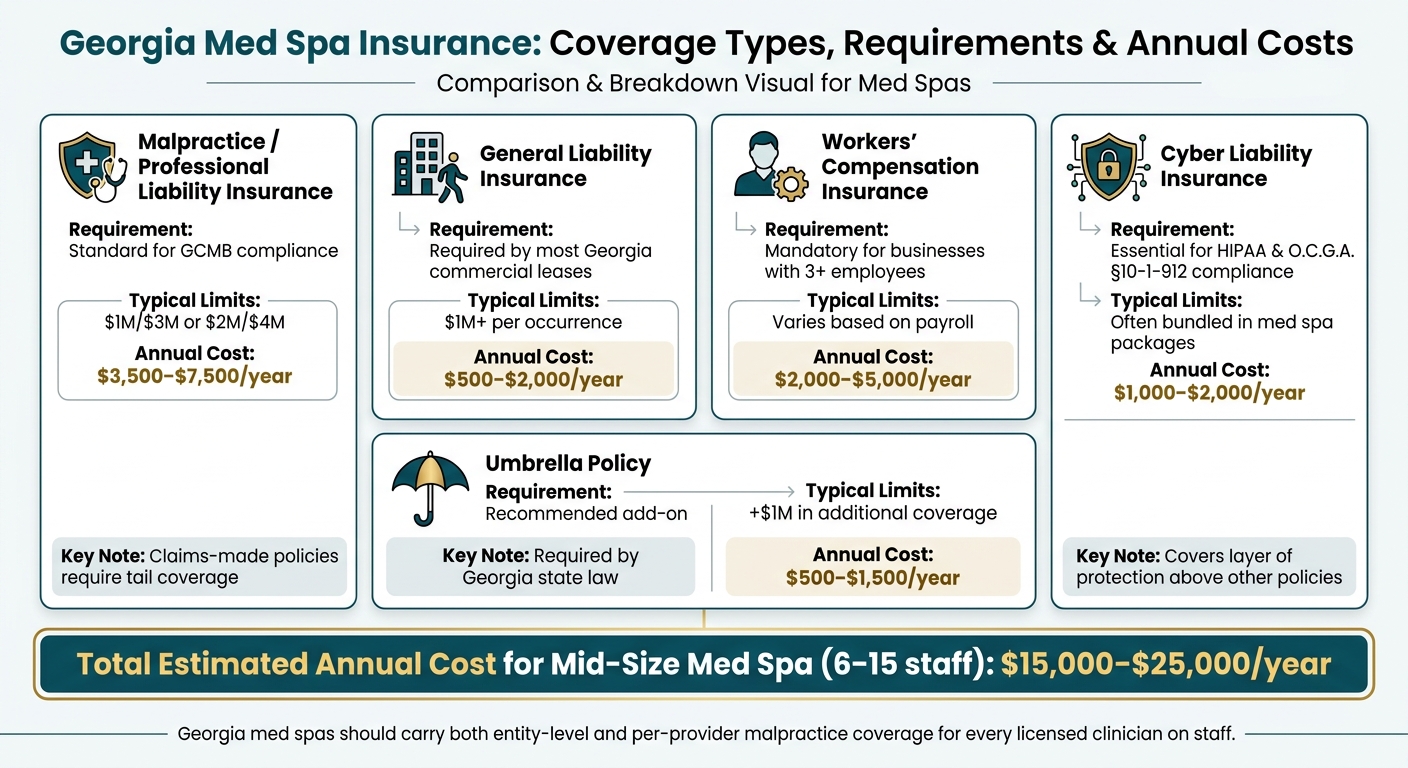
Georgia Med Spa Insurance Coverage Guide: Types, Requirements & Costs
Steps to Securing the Right Coverage
Before diving into insurance quotes, get your paperwork in order. Insurance carriers expect to see written SOPs approved by your medical director, signed nurse protocol agreements, and verified staff licenses. Practices that provide these documents upfront often secure lower premiums.
Once your documentation is ready, request quotes for all necessary policy layers. For a mid-size med spa with 6–15 staff members, the annual insurance cost typically falls between $15,000 and $25,000. Here's how that breaks down:
- Malpractice insurance: $3,500–$7,500/year
- General liability: $500–$2,000/year
- Workers' compensation: $2,000–$5,000/year
- Cyber liability: $1,000–$2,000/year
- Umbrella policy: $500–$1,500/year for an extra $1 million in coverage
Most malpractice policies are claims-made, which means you’ll need to address tail coverage in your provider contracts. Always specify who is responsible for this expense if a provider leaves the practice.
These steps set the stage for integrating insurance into your med spa’s daily operations.
Aligning Insurance with Compliance and Daily Operations
Insurance carriers expect proof that your practice follows its protocols. This includes regular chart reviews by your medical director, up-to-date Georgia licenses for all staff, and SOPs that clearly outline indications, contraindications, and responses to adverse events for each procedure.
However, many med spas struggle to connect compliance with their everyday workflows. Tools like Prospyr can help bridge this gap. With features like HIPAA-compliant CRM/EMR systems, digital intake forms, and AI-generated notes, Prospyr simplifies the process of keeping records organized and auditable. This not only helps during insurance reviews but also strengthens your position in audits or claims investigations.
Marketing compliance is another critical area that ties into insurance. Under GCMB Rule 360-3, med spas cannot guarantee results or use misleading provider titles. A regulatory investigation - even one sparked by a social media post - can complicate your next insurance renewal. Regularly auditing your website and marketing materials is an essential part of risk management.
By embedding compliance into your operations now, you’ll have a solid foundation for managing risks as your practice grows.
Maintaining Risk Controls Over Time
To keep your insurance coverage effective, it’s crucial to maintain and update your risk controls regularly. For example, Georgia law (O.C.G.A. §43-34-23) requires annual reviews of nurse protocol agreements. If your med spa uses Class 3B or 4 lasers, a Laser Safety Officer (LSO) must conduct yearly hazard evaluations, with results signed by both the LSO and the medical director. Additionally, resuscitative equipment must be checked every six months for facilities performing sedation-based procedures, per GCMB Rule 360-41-.02.
At every insurance renewal, verify the license status of all clinical staff through the GCMB and Georgia Board of Nursing portals. A single expired license can lead to claim denials. Also, notify your insurance carrier immediately if you add high-risk services like IV therapy, fat-dissolving injections, or thread lifts. These procedures may require higher premiums or policy riders, and failing to update your policy could leave you without coverage in the event of an issue.
Here’s a quick guide to key tasks and their timelines:
| Review Task | Frequency | Basis |
|---|---|---|
| Nurse Protocol Agreement Review | Annually (minimum) | GA Code §43-34-23 |
| Laser Hazard Evaluation | Annually | ANSI Z136.3 / OSHA |
| Resuscitative Equipment Check | Every 6 months | GCMB Rule 360-41-.02 |
| Secretary of State Annual Registration | Annually by April 1 | GA Secretary of State |
| HIPAA Workforce Training | Annually | Federal HIPAA / OCR |
| Staff License Verification | At every policy renewal | GCMB / GA Board of Nursing |
Maintaining a well-organized compliance binder - complete with LSO appointment letters, protocol reviews, equipment logs, and incident reports - demonstrates your med spa’s commitment to risk management and strengthens your insurance standing.
Conclusion: Getting the Right Coverage for Your Georgia Med Spa
Operating a med spa in Georgia means navigating a complex web of rules - from GCMB physician oversight requirements and two-tiered laser practitioner licensing to mandatory nurse protocol agreements. Having the right insurance safeguards both your finances and legal compliance.
The risks are serious. Even a minor licensing error can lead to hefty penalties.
"Getting the licensing wrong doesn't just risk fines up to $3,000 per violation - it can cost a practitioner their license entirely." - LegalClarity
A well-rounded insurance plan is crucial, covering malpractice, workers' compensation, and cyber liability. Each type of coverage addresses specific vulnerabilities created by Georgia's regulatory framework. By proactively managing risks like practitioner supervision and cyber compliance, you strengthen your med spa's protection against unexpected challenges.
This strategy works hand-in-hand with strict digital intake and documentation practices. Proper documentation ties everything together: signed protocol agreements, medical-director-approved SOPs, verified staff licenses, and an up-to-date compliance binder. These details are critical when insurers assess claims . As MedSpa Standards explains:
"A signed protocol is what distinguishes 'supervised practice' from 'unsupervised practice' in front of the GCMB or the Georgia Board of Nursing."
FAQs
What insurance does a Georgia med spa actually need to open?
To start a med spa in Georgia, you'll need several types of insurance to protect your business and meet state regulations. Here's what to have in place:
- Liability insurance: Ensure you have at least $1 million per occurrence and $3 million aggregate coverage (or more).
- Malpractice insurance: Required for every licensed provider working in your med spa.
- Workers' compensation insurance: Necessary if your business employs three or more staff members.
These policies safeguard your business, employees, and clients, while also keeping you compliant with Georgia's legal requirements.
How do claims-made malpractice policies and tail coverage work?
Claims-made malpractice policies provide coverage for claims filed as long as the policy is active. Tail coverage, on the other hand, offers protection for claims that arise after the policy has ended. This is especially important when you're switching insurance providers or retiring from practice, as it ensures you're still covered for incidents that happened while the original policy was in effect.
Can my insurer deny a claim if a service was done outside scope or without supervision?
If a service is performed outside your professional scope of practice or without the required supervision, your insurer has the right to deny the claim. To ensure your insurance coverage remains valid, it's crucial to operate within your defined scope and adhere to all supervision requirements.