Want to attract med spa clients ready to book? Google Ads can help you target high-intent searchers like those looking for "Botox near me" or "laser hair removal." These ads deliver immediate visibility and can convert at rates of 10%–18% with the right strategy.
Here’s the quick formula for success:
- Focus on high-intent keywords like "Botox near me" or "CoolSculpting consultation."
- Target locally - set a 10–15 mile radius around your clinic for precise reach.
- Craft compelling ad copy with clear benefits, pricing, and calls to action.
- Organize campaigns by service to optimize budget and improve relevance.
- Use ad extensions like location, call, and sitelinks to boost performance.

5-Step Formula for Successful Med Spa Google Ads
Know Your Audience and Services
Define Your Target Audience
Before crafting your ads, it's crucial to identify your target audience. The typical med spa patient falls between the ages of 25 and 55, with women making up about 85% of the clientele. However, this demographic is far from uniform, with varying needs, goals, and budgets.
To connect effectively, build detailed buyer personas that reflect specific life stages and treatment preferences. For instance:
- Young professionals (25–35): Often interested in preventative treatments like baby Botox or chemical peels.
- Busy moms: Seek anti-aging solutions that fit into their tight schedules.
- Affluent clients: Frequently opt for premium, long-term treatments such as body contouring packages.
Each group responds to different messaging, whether it’s about maintaining youthful skin, achieving quick rejuvenation, or indulging in luxurious self-care.
Geography plays a big role, too. Most patients won’t travel more than 10–15 miles for treatments like Botox. To make your ads effective, set a tight geographic radius around your location. Use Google’s built-in audience segments - like "Cosmetic Procedures", "Skincare Treatments", or "Anti-Aging" - to refine your targeting further.
It’s also key to differentiate between searchers in "research mode" and those ready to book. A query like "what is Botox" signals someone gathering information, while searches like "Botox near me" or "Botox cost" often indicate higher intent to purchase. Allocate around 80% of your ad budget to high-intent searches, as these typically convert at rates of 10%–18%, compared to just 2%–4% for informational queries.
By understanding who your patients are and what they’re looking for, you can tailor your services and messaging to meet their needs.
Focus on Your Most Popular Services
To get the best results, prioritize advertising your most in-demand treatments - those with proven conversion rates. Botox and fillers are standout performers, often serving as "gateway" services that attract new clients, many of whom later invest in higher-priced treatments.
Laser hair removal is another strong contender, with lead costs ranging from $18 to $35. Body contouring treatments like CoolSculpting or Emsculpt may have higher click costs ($8–$18), but their package values - ranging from $2,000 to $6,000 - can make the investment worthwhile.
HydraFacial deserves special attention. Its search volume is climbing 25%–35% annually, making it a high-demand entry-point service. Similarly, microneedling and RF microneedling are popular, especially among patients seeking solutions for acne scars or skin resurfacing. Start by promoting one or two core services, then expand your offerings based on performance data.
Don’t overlook seasonal trends, either. Searches for body contouring typically spike 35%–50% during the New Year’s resolution season (January through March), while laser hair removal sees a 40%–60% surge in the months leading up to summer (April through June). Aligning your ad campaigns with these patterns can help you make the most of your marketing budget.
sbb-itb-02f5876
Find the Right Keywords
Select High-Intent Keywords
Choosing the right keywords can make or break your Google Ads campaign. Bidding on irrelevant terms is one of the quickest ways to drain your budget. Instead, focus on decision-stage keywords - phrases that indicate someone is ready to take action, like "Botox near me", "lip fillers cost", or "CoolSculpting consultation". These keywords not only improve your return on ad spend but also help shape your ad messaging to match what potential patients are looking for.
Allocate 80% of your budget to these high-intent keywords, which typically convert at rates between 10%–18%, compared to just 2%–4% for informational searches. Adding location-specific terms, like "near me" or the name of a city, can also boost conversions significantly - by as much as 40%–70%. In fact, "near me" searches often outperform city-specific keywords, converting 15%–25% higher.
Think about what patients want. Many people search for outcomes rather than technical terms. For example, someone is more likely to type "fat freezing treatment" than "Cryolipolysis". A strategy like the "Keyword Tree" can help: start with your core service (e.g., "Botox") and expand by adding location (e.g., "Los Angeles"), urgency (e.g., "same day appointment"), and buyer-readiness terms like "cost" or "consultation".
Don’t forget to block irrelevant traffic. Build a negative keyword list to exclude terms like "jobs", "training", "DIY", "side effects", and "Groupon". A strong negative keyword list can reduce wasted spend by 20%–35% in just 30 days. To stay on top of irrelevant queries, review your Search Terms Report weekly.
| Treatment Category | Example High-Intent Keyword | Avg. CPC Range |
|---|---|---|
| Injectables | Botox near me | $5–$12 |
| Injectables | Lip fillers near me | $5–$14 |
| Body Contouring | CoolSculpting near me | $8–$18 |
| Laser Treatments | Laser hair removal near me | $4–$10 |
| Skin Treatments | HydraFacial near me | $3–$8 |
Once you’ve nailed down the right keywords, refine your strategy further with match types.
Use Match Types to Control Targeting
Match types are like filters that control how closely a user’s search must align with your chosen keywords before your ad is displayed. This helps you avoid irrelevant clicks, like those from searches for "Botox training" or "med spa jobs".
Start with Exact Match for your most valuable treatments. This ensures your ads only appear for precise queries, such as "Botox near me" or "CoolSculpting consultation". For broader coverage, use Phrase Match for core treatments. This allows your ads to show for relevant variations, like "best Botox injections in Dallas for forehead lines", while still maintaining control.
Avoid Broad Match unless you’re using Smart Bidding strategies (like Target CPA or Maximize Conversions) and have at least 30 conversions per month. Without enough data, Broad Match can quickly waste your budget.
"Broad match without Smart Bidding is a budget incinerator for medspas. Google's algorithm needs conversion data to make broad match work."
– Kerim Gulec, BestPPC
Lastly, set your geographic targeting to a 10–15 mile radius around your clinic. Most patients won’t travel far for treatments, so this ensures your ad spend is focused on people who are most likely to book an appointment. Combining smart match types with precise location targeting helps you maximize every dollar spent.
Write and Structure Your Ads
Organize Campaigns by Service
To make the most of your ad budget and reach the right audience, divide your campaigns by specific services. For example, treatments like Injectables, Body Contouring, and Skin Rejuvenation should each have their own campaigns. This strategy ensures you can allocate your budget effectively, avoiding situations where less profitable clicks overshadow your top-performing services.
Take Botox as an example: low-value searches like "$12/unit Botox" need a different approach than high-value treatments, such as a $3,000 CoolSculpting package. By organizing campaigns by service, you can customize messaging, budgets, and even landing pages to match the intent of the search. Inside each campaign, create ad groups tailored to specific audience segments - such as younger clients interested in acne solutions or older clients seeking anti-aging treatments.
"When you run PPC for med spas without strict segmentation, you end up paying premium prices for low-quality leads."
– BestPPC
Make sure each ad directs users to a relevant landing page. For instance, someone searching for "Botox in Austin" should land on a Botox-specific page for Austin, not a general services page.
Once your campaigns are structured, it’s time to craft headlines that grab attention.
Write Headlines That Get Clicks
A great headline does three things: mentions the treatment and location, highlights a benefit, and includes a call to action. Here's how to structure each headline:
- Headline 1: Include the Treatment + Location (e.g., "Botox Injections in Fort Lauderdale").
- Headline 2: Showcase a Benefit or Offer (e.g., "Free Consult | No Downtime").
- Headline 3: Add a Call to Action (e.g., "Book Today | Spots Fill Fast").
Focus on the results clients can expect, not just the service. Instead of saying "We Offer Laser Treatments", try something like "Reveal Radiant Skin - Painless Laser Rejuvenation in 30 Minutes!". Build trust with phrases like "5-Star Rated" or "Trusted by 500+ Patients". Words that evoke emotion and imagery - like "glowing", "youthful", or "rejuvenated" - resonate particularly well with med spa audiences.
Creating urgency works wonders too. Phrases like "Limited Appointments Available" or "First 10 Clients Get 20% Off" can drive immediate action. If your click-through rate (CTR) falls below the typical range of 4% to 7%, experiment with different headline styles. For instance, test an offer-based headline against one that highlights social proof for at least seven days to find what resonates.
| Headline Component | Purpose | Example |
|---|---|---|
| Headline 1 | Treatment + Location | "Botox Injections in Fort Lauderdale" |
| Headline 2 | Benefit or Offer | "Free Consult | No Downtime" |
| Headline 3 | Call to Action | "Book Today | Spots Fill Fast" |
With strong headlines in place, your descriptions should take over and seal the deal.
Write Descriptions That Convert
Your ad descriptions should build on the promises made in your headlines. Speak directly to what patients care about - results, convenience, and trust. Avoid technical jargon and focus on benefits. For example, instead of saying "FDA-approved technology", try something like "Feel confident in your skin again with 15-minute, no-downtime sessions".
Match your descriptions to the search intent. If someone is looking for "Botox cost", mention pricing or a special offer. If they search for "Botox near me", emphasize your location and availability. Trust markers like "10 Years Experience" or "Board-Certified Providers" can help reassure potential clients.
Always include a clear call to action, such as:
- "Book your free consultation today."
- "Schedule your visit now."
- "Claim your $50 off coupon."
For services like laser hair removal, package pricing often performs better than single-session pricing. For example, "6 Sessions for $999" is more appealing than listing the price for just one session. To attract serious clients and weed out bargain hunters, include specifics like "Book with a Medical Provider."
"Your Google Ads aren't trying to convince someone that Botox exists; they're trying to get someone already searching for Botox to choose you."
– ClinicGrower
Finally, use ad extensions - like sitelinks, call extensions, and location extensions - to make your ad stand out and provide more ways for users to take action. These small tweaks can boost your CTR by 10% to 15%.
Use Location Targeting and Ad Extensions
After fine-tuning your keyword strategy and crafting compelling ad copy, it's time to focus on targeting local audiences and enhancing your ads with extensions.
Target Your Local Area
Most med spa patients are unlikely to travel more than 15 miles for treatments like Botox or fillers. To ensure your ads reach the right people, set Google Ads to "Presence: People in or regularly in your targeted locations" rather than "Interest." This way, your ads won't appear outside your service area.
Once your ads have been running for 7–14 days, check the "Locations" report to pinpoint the zip codes driving the best results. For areas within 5 miles of your spa, consider increasing bids by 20%. On the flip side, reduce bids for outer zones or neighborhoods with a history of higher no-show rates.
"Near me" searches tend to convert 15% to 25% better than city-name keywords, often indicating a higher intent to book. For upscale neighborhoods, adjust your ad copy to reflect a more luxurious tone. In broader areas, focus on competitive pricing or fast results to appeal to a wider audience.
Add Extensions to Your Ads
Once you've honed in on your local audience, take your ads to the next level using extensions that can significantly improve performance.
- Location extensions: These show your address along with a clickable map link, making it easier for users to find you. This simple addition can increase click-through rates by 10% to 15%. To enable this, link your Google Business Profile to your Google Ads account.
- Call extensions: Adding a click-to-call button simplifies the booking process. Set these to appear only during business hours to ensure calls are answered promptly.
- Sitelinks: Use these to direct users to specific pages like "Book Now", "Pricing", or "Before & After Gallery." Including at least four sitelinks not only improves navigation but also increases your ad's visibility.
- Callout extensions: Highlight trust-building details such as "5‑Star Rated", "Board‑Certified Providers", or "Free Consultation".
- Promotion extensions: Perfect for showcasing time-sensitive offers, these can create urgency with deals like "20% off first‑time Botox treatments".
| Extension Type | Primary Benefit | Example Usage |
|---|---|---|
| Location Extension | Drives foot traffic | Displays physical address and distance |
| Call Extension | Shortens booking path | Click-to-call button for consultations |
| Sitelink Extension | Increases site exploration | "View Results Gallery", "Book Lip Filler" |
| Callout Extension | Highlights trust signals | "500+ Happy Patients", "Open Weekends" |
| Promotion Extension | Boosts CTR with urgency | "Save $50 on your first treatment" |
Use Tools to Manage Your Ads
If you're not tracking conversions, you're leaving money on the table. Conversion tracking is essential to understand which ads are driving results. Make sure to set up tracking for form submissions, phone calls, and online bookings before launching your campaigns. This data gives you a clear picture of how your ads contribute to revenue.
How Prospyr Supports Your Marketing
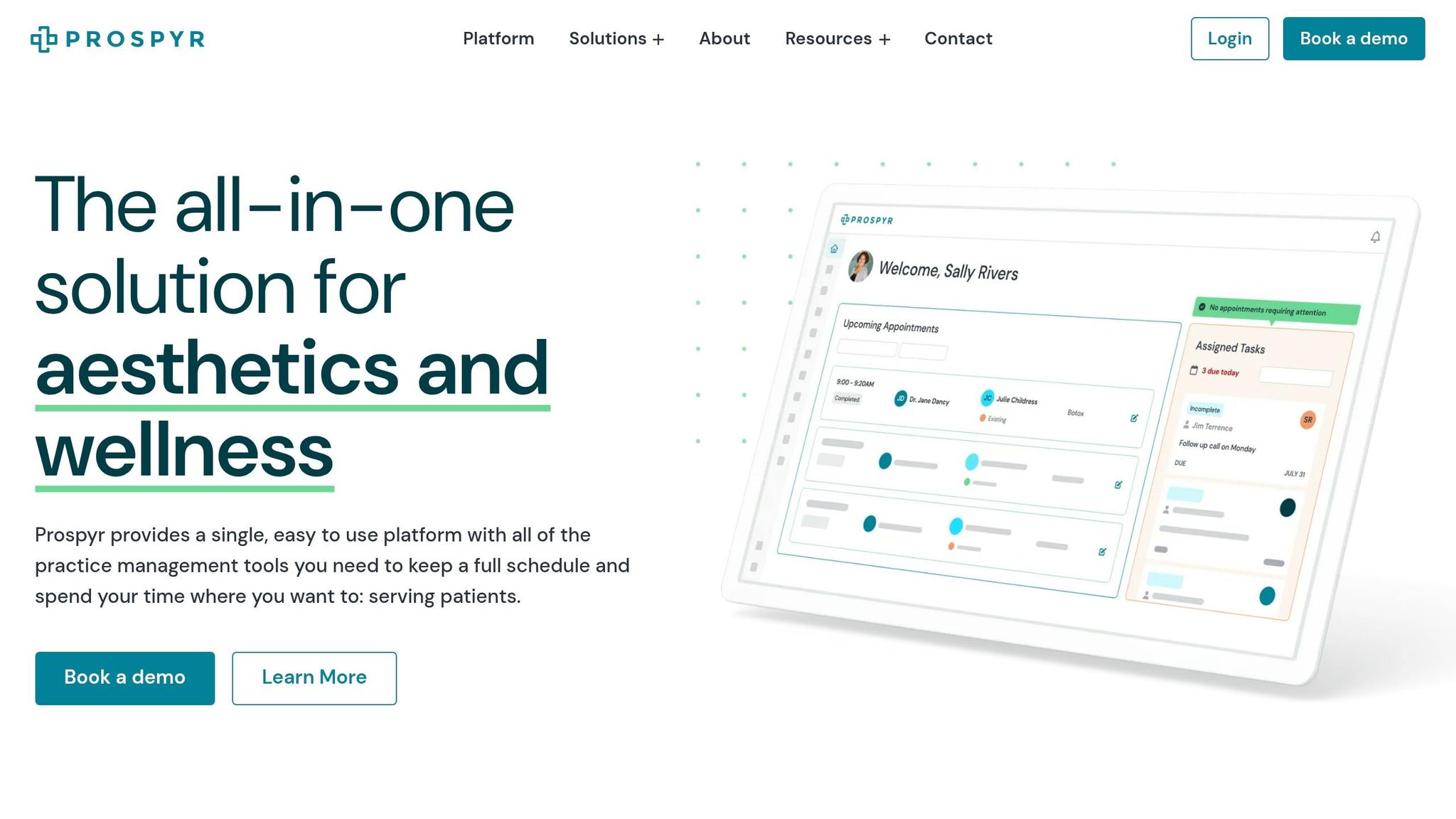
Once your conversion tracking is set up, the next step is leveraging advanced tools to get the most out of your ad spend. Prospyr takes campaign organization to the next level, helping you turn local clicks into actual appointments.
Prospyr's CRM provides detailed insights by tracking lead sources. You'll know exactly which Google Ads campaigns are bringing in patients and where each lead stands in the patient journey. This allows you to fine-tune your bids for better results. Plus, Prospyr automates follow-ups and recapture workflows, ensuring that even leads who don't book immediately are nurtured effectively, making every paid click count.
Take SOM Aesthetics as an example. In 2024, they used Prospyr to launch their practice, achieving $40,000 in sales within just two days. By their second month, they were pulling in $100,000 per month - 21 times more than their initial targets. Dr. Saami Khalifian, the practice’s Founder and CEO, attributed this success to Prospyr:
"Their powerful platform and helpful support have enabled us to exceed our financial targets while delivering an unmatched experience for our patients."
Prospyr also simplifies the booking process with tools like 2-way SMS, online scheduling, and digital intake forms. These features ensure potential patients can quickly move from clicking your ad to booking an appointment without unnecessary delays. For instance, when someone searches for "lip filler near me" and clicks your ad, they can book directly through your site - no waiting for callbacks. This seamless experience keeps your practice top-of-mind and ensures your campaigns stay optimized for success.
Conclusion
Running effective Google Ads for med spas requires a sharp focus and well-thought-out tactics. Start with high-intent keywords like "Botox near me" to attract patients who are ready to book. Structure your campaigns by specific services and keep your targeting local to maximize relevance.
Your ad copy should aim to refine search results rather than oversell your services. As ClinicGrower explains:
"Your ad copy isn't trying to convince someone that Botox exists; it's trying to get someone already searching for Botox to choose you".
Make sure your headlines and descriptions include clear pricing, professional credentials, and strong calls-to-action. To further enhance your visibility, use ad extensions - just adding location extensions can boost click-through rates by 10% to 15%.
The final piece of the puzzle is tracking and optimization. Without tracking form submissions, phone calls, and bookings, you're essentially guessing. Prospyr helps bridge this gap by integrating your Google Ads with your CRM, giving you a clear view of which campaigns generate appointments and revenue. This also allows you to identify the most effective keywords and automate follow-ups for leads who don’t book right away.
FAQs
What budget should my med spa start with on Google Ads?
A good starting budget for Google Ads falls between $10 and $50 per day. Even at the lower end of $10 daily, you can still see results with well-structured campaigns that focus on efficiency. For more competitive keywords, where the cost per click can range from $2.50 to over $10, a $50 daily budget allows for greater reach and visibility.
Starting within this range gives you room to test and refine your campaigns while ensuring a consistent flow of new patient inquiries.
How do I know which keywords are wasting my ad spend?
To avoid wasting your ad budget, prioritize high-intent keywords - these are the ones that lead to actual conversions. Steer clear of broad terms like "DIY" or "how to", as they tend to attract clicks from users who aren’t ready to buy. Instead, use negative keywords such as "free" or "DIY" to block irrelevant traffic. Choosing exact or phrase match types can also help ensure your ads reach the right audience. Make it a habit to regularly analyze your campaign metrics so you can pause or tweak keywords that aren’t delivering results.
What should I track to prove Google Ads are booking clients?
Tracking the right conversion metrics is key to showing that Google Ads are actually bringing in clients for your med spa. Pay close attention to metrics tied directly to booked appointments, such as inquiry-to-consultation and consult-to-close rates. These numbers help you understand how well your ads are turning clicks into actual bookings.
Focus on specific actions that matter, like appointment bookings, consultation requests, or form submissions. At the same time, keep an eye on key performance indicators like click-through rates (CTR), cost per acquisition (CPA), and the total number of booked consultations. These metrics give a clear picture of whether your ads are delivering tangible results.