

If you want tight control over how your brand is used, franchising usually gives you more protection than licensing. If you want a simpler setup with less day-to-day control, licensing may fit better.
Here’s the short version:
- Licensing lets someone use your trademark, logo, or other IP
- Franchising lets someone use your brand and your business system
- In the U.S., a deal can be a franchise by law if it includes:
- a trademark
- control or support
- a required fee
- If you cross that line by mistake, penalties can reach $11,000 per day, per violation
- Poor trademark control can also put your mark at risk through naked licensing
So when I look at this choice, I see one main question: Do you want flexibility, or do you want tighter brand control?
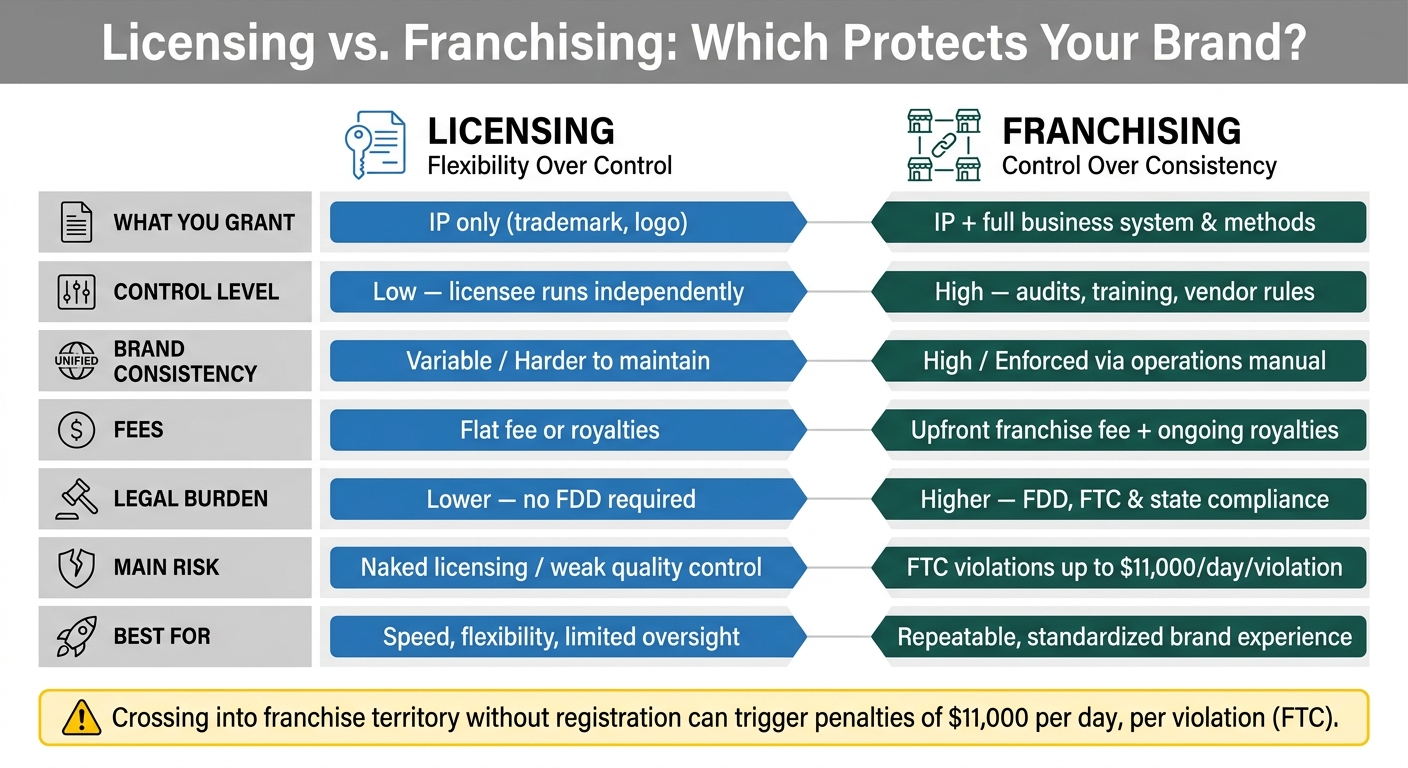
Licensing vs. Franchising: Brand Control Comparison
Quick Comparison
| Point | Licensing | Franchising |
|---|---|---|
| What you grant | IP only | IP + business system |
| Control level | Low | High |
| Brand consistency | Harder to keep uniform | Easier to keep uniform |
| Fees | Flat fee or royalty | Upfront fee + royalties |
| Legal burden | Lower | Higher |
| Main risk | Weak quality control | FTC and state compliance risk |
I’d sum it up like this: licensing is narrower, while franchising gives you more power to police quality, training, marketing, and site standards. But that extra control comes with more legal work, including an FDD and franchise-law compliance.
If your brand depends on the same client experience at every location, this choice is not just about growth. It’s about keeping your name from drifting.
sbb-itb-02f5876
Licensing vs. Franchising: Key Differences at a Glance
At first glance, licensing and franchising can seem pretty close. In both cases, another party gets to use your brand. But once you look at how each model works day to day, the gap becomes clear.
Here’s the side-by-side view:
| Feature | Licensing | Franchising |
|---|---|---|
| Scope of Rights | Specific IP only, such as a trademark or logo | IP plus the business system, operating methods, and brand standards |
| Operational Control | Limited; the licensee runs the business independently | Extensive; the franchisor controls standards, training, and approved vendors |
| Brand Consistency | Variable; harder to guarantee uniform quality | High; maintained through audits and operating manuals |
| Fees & Royalties | One-time fee or ongoing royalties | Upfront franchise fee + ongoing royalties (often a percentage of gross sales) |
| Regulatory Burden | Low; simple contracts and lower regulatory oversight | High; requires an FDD, FTC compliance, and state registrations |
Rights Granted and Day-to-Day Control
The main difference isn’t only what you allow someone to use. It’s also how much control you keep after the deal is signed.
With a license, control usually stays narrow. You may set rules around trademark use, logo placement, or brand presentation. But the licensee generally runs the business on their own.
Franchising goes much further. It covers IP, but also the business model, training, systems, and operating methods.
"Franchising is essentially a specialized form of licensing - sometimes called a 'superlicense' - because you are granting not just IP usage, but also rights to your entire business model, systems, and operational methods." - Torres & Zheng at Law, P.C.
That broader scope brings more legal and operational work.
Fees, Compliance, and Administrative Burden
This is where franchising gets heavier.
A licensing deal often involves a simpler contract, with either a one-time fee or royalties. Franchising usually includes an upfront franchise fee plus ongoing royalties, often based on gross sales.
It also comes with more rules to follow. In the U.S., franchising means a Franchise Disclosure Document (FDD), compliance with FTC rules, and state-level registrations. That adds legal work, paperwork, and cost.
How Each Model Affects Brand Consistency
Licensing gives you some control over IP standards, like how the logo appears and what the trademark covers. But it gives you much less say over how the business runs each day. That can lead to uneven client experiences and brand dilution.
Franchising is built to keep things uniform. Operating manuals, required training, vendor rules, and regular audits help each location deliver the same experience. For aesthetics and wellness brands, that level of control can matter a lot.
That’s why the contract terms and legal setup matter so much in the next step.
Brand Control and Intellectual Property Management
Brand control comes down to one thing: how much oversight you keep.
With licensing, that usually means watching how your trademark gets used. With franchising, it goes much further. You’re not just watching the name or logo. You’re controlling the whole operating system.
That’s the core split between the two models. It’s not only about trademark use. It’s about how much authority the agreement gives you over day-to-day execution.
Trademark Use, Ownership, and Quality Control
Under U.S. law, a license without real quality control provisions creates what attorneys call a naked license. Naked licensing can cost you trademark rights.
That’s why quality control can’t be vague or casual. It needs to be written down and enforced through regular review. In practice, that legal duty shows up in things like approvals, audits, and written standards.
Approvals, Audits, and Operating Standards
The enforcement gap is pretty simple: licensing gives you less control, while franchising gives you more. You see that difference in the tools each model gives you to monitor quality and consistency.
| Quality-Control Tool | Licensing | Franchising |
|---|---|---|
| Approvals | Limited to logo/IP usage and end-product quality | Comprehensive: signage, marketing, vendors, site design |
| Audits | Periodic; focused on trademark compliance | Regular, full operational and compliance site audits |
| Operating Standards | Licensee retains full independence | Strict adherence to a detailed operations manual |
Franchising gives you more ways to enforce standards. Licensing gives you fewer. And here’s the catch: if those controls aren’t spelled out clearly in the contract, they may fall apart when you need to enforce them.
Why This Matters for Aesthetics and Wellness Brands
In med spas and wellness clinics, reputation is the product. If protocols vary from one location to another, trust can take a hit across the whole brand.
Legal Structure and Contract Terms That Protect the Brand
The difference here is legal, not just a matter of wording. The way the agreement is set up decides whether you have a license or a franchise. If brand control matters, the contract has to fit the model.
When a License Can Be Treated as a Franchise
A license starts to look like a franchise when it includes trademark use, required payment, and meaningful control over how the other party runs things.
In practice, most accidental franchises happen because of operational control. Rules around hours, staffing, systems, or training can push a license into franchise territory. Required payments can also trigger franchise classification.
If that line gets crossed and you have not registered as a franchisor or issued a Franchise Disclosure Document (FDD), penalties can reach $11,000 per day, per violation. That is a serious legal risk for something that may feel like normal brand oversight.
The more control you want in order to protect the brand, the more careful the contract language needs to be.
Contract Terms That Need to Be Written Clearly
These clauses do most of the heavy lifting.
| Contract Term | Licensing Model | Franchising Model |
|---|---|---|
| Territory | Often single-use or multi-territory; exclusive national grants help avoid franchise status | Specific, protected territories defined in the FDD |
| Approved Mark Use | Exactly which names, logos, taglines, and layouts are allowed, and what needs written approval | Exactly which names, logos, taglines, and layouts are allowed, and what needs written approval |
| Termination | Triggered by breach of quality standards or non-payment | Triggered by failure to follow operational systems, brand standards, or financial defaults |
| Post-Termination Brand Use | Immediate cessation of licensed IP use | Full removal of branding, signage, and proprietary systems |
Enforcement and Exit Rights
Once the agreement is signed, enforcement is what keeps the brand consistent. Contract language turns brand rules into duties.
With licensing deals, audit rights should stay focused on quality results, not day-to-day operating methods. If you start auditing how a licensee handles staff or accounting systems, you may drift into active control and increase franchise-risk concerns. In a franchise setup, broader oversight fits the model.
Exit terms matter just as much. Both models need clear termination triggers and direct post-termination duties. In a license, that usually means the other party must stop using your trademark right away. In a franchise, it goes further. The franchisee must also remove branding, signage, and proprietary systems from the location.
Weak exit language leaves the brand exposed. If those duties are not spelled out in the contract, a clean separation can turn into a legal dispute instead of a simple enforcement step.
Write cure periods for minor breaches, but allow immediate termination for brand misuse.
Choosing the Right Model for Growth and Brand Protection
Once control, compliance, and trademark rights are clear, the next step is simple: decide how much brand consistency you need.
When Licensing May Be the Better Fit
Licensing makes sense when the goal is to earn from intellectual property without stepping into the other party’s day-to-day business. If you own a proprietary brand name or a specialized process, a license can let another operator use it while you stay out of daily management.
It’s also faster to get off the ground because it avoids FDD and state registration requirements. The downside is pretty clear: brand consistency is harder to police. If a licensee creates a poor patient experience, your ability to step in is limited by the structure itself.
That tradeoff can work well when flexibility matters more than uniform execution.
When Franchising May Offer Stronger Protection
Franchising is often the better choice when your brand depends on a repeatable, standardized experience. In aesthetics and wellness, that matters a lot. One off-brand location can weaken the whole system.
A franchise model gives you more tools to protect consistency, including training, audits, and operating rules. Yes, the compliance burden is real. But that burden is also what gives you clearer power to enforce brand standards.
Conclusion: Control vs. Flexibility
At its core, the choice is about control. How much of your brand protection depends on the other party’s daily operations?
Licensing leans toward speed and flexibility. Franchising leans toward control and consistency. The right fit depends on how closely you need to guard the way your brand shows up in the market.
When brand value depends on how services are delivered, franchising gives you stronger protection. When speed and limited oversight matter more, licensing is the simpler path.
FAQs
How do I know if my license could be treated as a franchise?
Under FTC guidelines, a license can be treated as a franchise no matter what the contract says.
In most cases, it falls into franchise territory if you do all three of these things:
- Grant a trademark license
- Exercise major control or provide major support
- Require at least $500.00 during the first six months
Courts look at what the relationship is in practice, not just how the paperwork labels it.
What quality controls should a trademark license include?
To protect trademark rights and keep the brand in good shape, the license should include quality controls tied to the licensed asset.
That can mean things like:
- ownership notices
- design rules for logos, fonts, and colors
- review of marketing materials, finished goods, or services before they go out
There’s a fine line here. You want enough control to protect the mark, but not so much that the deal starts to look like a franchise.
To help avoid franchise classification, don’t place heavy control on the licensee’s broader business operations. That includes areas like:
- staffing
- training
- pricing
The focus should stay on the licensed asset itself, not on running the other party’s whole business.
Which model is better for a wellness or med spa brand?
It depends on your goals, but franchising is usually the better fit for med spas.
Why? Med spas operate in a space where brand trust, patient experience, staff training, and healthcare rules all matter a lot. Franchising gives you more control over how the business runs day to day. That makes it easier to deliver a consistent customer experience, handle complex healthcare regulations, and put standard operating procedures in place across locations.
If your top concern is tight control over brand reputation and service quality, franchising is the stronger option.
Licensing makes more sense only if you want a more hands-off setup.