Checklist: Risk Planning for New Med Spa Locations
Essential risk checklist for opening a med spa: compliance, startup costs, insurance, staffing, HIPAA security, and marketing rules.


Opening a med spa is a complex process with strict regulations and financial risks. Here's what you need to know to plan effectively:
- Regulatory Compliance: Understand state-specific rules like the Corporate Practice of Medicine (CPOM) doctrine, licensing requirements, and scope of practice for providers.
- Financial Planning: Startup costs range from $250,000 to $500,000, with equipment taking up 40%-50% of the budget. Plan for at least 6-12 months of operating expenses.
- Insurance: Secure policies for liability, property, workers' compensation, and cyber risks, ensuring coverage for high-risk procedures.
- Operational Setup: Choose a location that meets OSHA standards, train staff thoroughly, and develop policies for emergencies and patient care.
- Marketing Compliance: Avoid misleading claims, secure patient consent for photos, and follow FTC, TCPA, and CAN-SPAM rules.
Key Tip: Use tools like Prospyr for HIPAA-compliant management and regular audits to ensure smooth operations and compliance.
This guide breaks down each step to help you navigate risks and set up a successful med spa.
Financial Risk Assessment
Med Spa Startup Costs and Financial Planning Breakdown
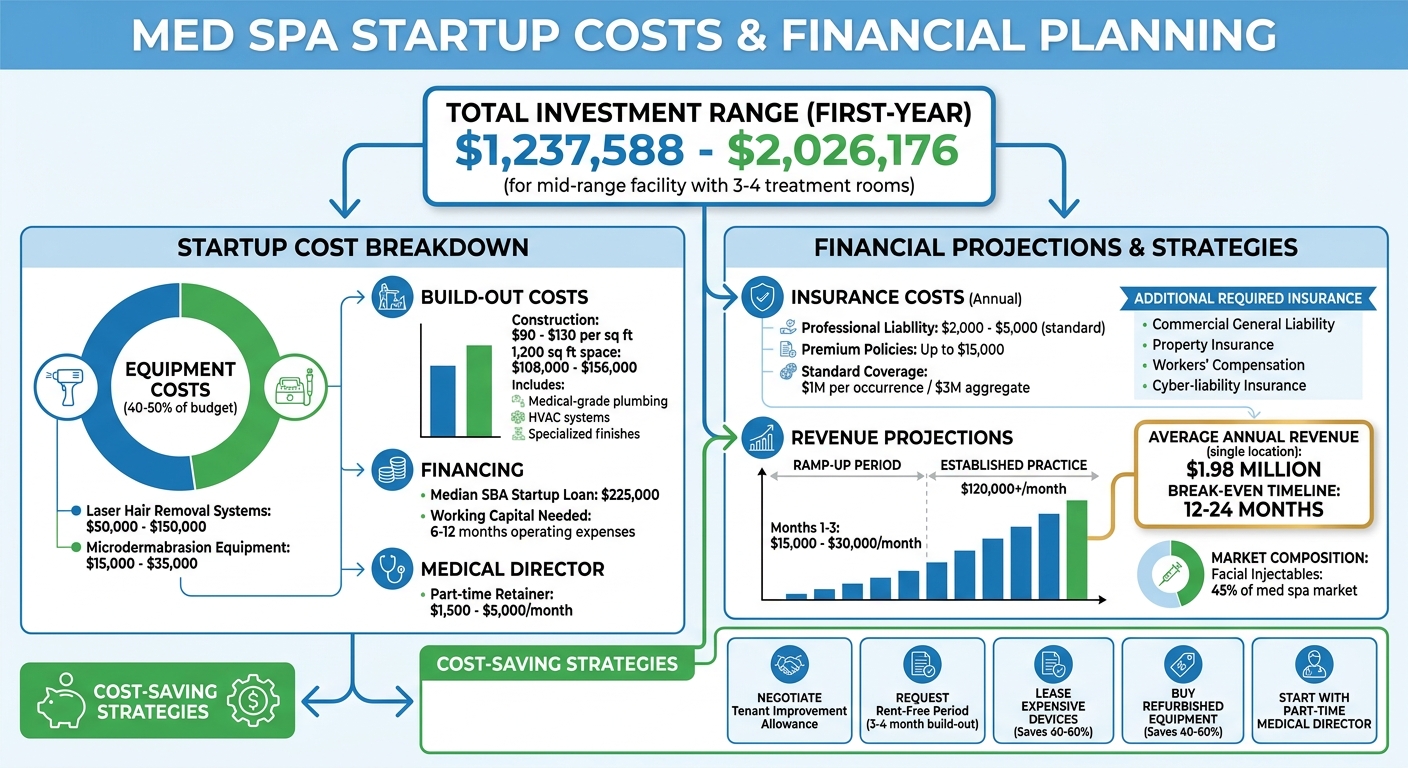
Planning the financial side of your med spa is a critical step in managing risks. If you’re opening a new location, a detailed financial assessment is essential. For a mid-range facility with 3–4 treatment rooms, your first-year investment could range from $1,237,588 to $2,026,176. Equipment alone can take up 40%–50% of these startup costs, with laser hair removal systems priced between $50,000 and $150,000, and microdermabrasion equipment ranging from $15,000 to $35,000.
Startup Cost Budgeting
Building out a med spa requires specialized construction, including medical-grade plumbing, HVAC systems, and finishes. These costs typically run between $90 and $130 per square foot. For a 1,200-square-foot space, that means spending anywhere from $108,000 to $156,000 before you even start operations. While the median SBA startup loan for this industry is around $225,000, it’s usually not enough to cover all costs. You’ll also need working capital to handle 6 to 12 months of operating expenses while growing your client base.
To save on costs, negotiate lease terms that include a tenant improvement allowance or a rent-free period during the 3–4 month build-out phase. Leasing expensive devices or buying refurbished equipment can cut initial costs by 40%–60%. Similarly, hiring a part-time medical director on retainer - typically $1,500 to $5,000 per month - can help keep expenses down until patient volume supports a full-time role.
Once you’ve accounted for startup costs, focus on projecting revenue to balance these investments.
Revenue Forecasting and Market Demand
"Average household income within a 10-mile radius is the single best predictor of med spa revenue." - Zachary Stewart
Revenue projections should account for a ramp-up period. In the first three months, monthly revenue may range from $15,000 to $30,000 before scaling to $120,000 or more as the practice becomes established. On average, a single-location med spa generates about $1.98 million in annual revenue, with most breaking even financially within 12 to 24 months.
Before signing a lease, analyze local demographics, such as household income and age distribution within a 10-mile radius, to confirm market demand. Using accrual-basis accounting can help smooth out revenue fluctuations, especially when dealing with prepaid packages, memberships, and gift cards. Since facial injectables make up about 45% of the med spa market, they’re a great high-margin service to start with, while delaying big-ticket purchases like body contouring equipment until you hit key revenue milestones.
These strategies can help you prepare for any revenue gaps or unexpected market challenges.
Insurance Coverage
Protecting your med spa from liability risks requires strong insurance coverage. Professional liability insurance typically costs between $2,000 and $5,000 annually, but premium policies can go up to $15,000. A standard policy might offer $1 million per occurrence and $3 million in aggregate coverage. Beyond malpractice insurance, you’ll also need:
- Commercial general liability insurance (for incidents like slip-and-fall accidents)
- Property insurance (to cover expensive equipment like lasers)
- Workers' compensation insurance
- Cyber-liability insurance (to protect against data breaches and HIPAA violations)
Work with insurance agents familiar with healthcare and aesthetic practices in your state. Make sure your policies explicitly cover high-risk procedures like laser treatments and injectables, as some basic plans might exclude them. If you’re using a Management Services Organization (MSO) model, ensure the MSO is listed as an additional insured on your policy. Lastly, always notify your insurer of patient complaints to maintain your policy rights.
sbb-itb-02f5876
Legal and Regulatory Compliance
Breaking into the med spa market means dealing with a maze of state-specific regulations. For example, states like California, New York, Texas, and Michigan enforce the Corporate Practice of Medicine (CPOM) doctrine, which bars non-physicians from owning medical practices. On the other hand, states like Ohio are more flexible and allow non-physician ownership.
If you're a non-physician entrepreneur in a CPOM state, you'll likely need a dual-entity setup. In this structure, a physician-owned Professional Corporation (PC) or Professional Limited Liability Company (PLLC) handles clinical services, while a Management Services Organization (MSO), owned by non-physicians, takes care of administrative tasks for a fee. For instance, California mandates that physicians own at least 51% of a professional corporation, with the remaining 49% reserved for licensed professionals like RNs, NPs, or PAs.
State Licensing and Ownership Requirements
Once you understand CPOM regulations, the next step is ensuring compliance with state licensing and ownership rules. Before committing to a lease, confirm the CPOM status of your target state and review ownership restrictions. In California, for example, a physician cannot supervise more than four mid-level providers (PAs or NPs) at a time. However, starting January 1, 2026, certain Nurse Practitioners in California will be eligible for independent practice certification, which could shift supervision requirements.
State rules also vary widely regarding the scope of practice for NPs, PAs, RNs, and estheticians. To stay compliant, assign medical-grade treatments like Botox injections or laser hair removal only to the appropriate licensed professionals. For example, RNs can administer injectables under physician supervision in most states, but estheticians generally cannot. If you’re using the MSO model, be cautious with management fees. They must reflect fair market value - structured as a flat fee or cost-plus arrangement - to avoid fee-splitting or anti-kickback violations.
In some states, like California, you'll also need a Fictitious Name Permit (FNP) if your business operates under a name different from the physician's own name. Be sure to register all "Doing Business As" (DBA) names with the relevant state medical board before opening.
Compliance Audits
Before launching, conduct a detailed compliance audit. Verify that all business licenses, professional licenses, and DEA registrations for controlled substances are secured. If your med spa offers injectables, your supervising physician or provider must have DEA registration.
Your med spa must also meet OSHA standards, such as maintaining a bloodborne pathogen plan, a laser safety plan, and a written hazard communication program for chemicals. Even if your med spa operates on a cash-only basis and doesn’t bill insurance, following HIPAA guidelines for data security and patient privacy is considered a best practice.
Review your informed consent forms to ensure they cover the risks, benefits, and alternatives for every procedure. If you plan to use before-and-after photos in marketing, secure specific written authorization from patients to comply with privacy laws. These audits are essential to avoid regulatory penalties and ensure smooth operations in your new market.
Once you've confirmed operational compliance, shift your attention to reviewing legal contracts to protect your med spa's framework.
Legal Review of Contracts
A healthcare attorney should carefully examine your Management Services Agreement (MSA) and workforce agreements to maintain a clear boundary between clinical and administrative responsibilities.
"Med spa legal compliance isn't just a legal concern - it's the foundation of your entire business model." - Dike Law Group
Your attorney should also review employment agreements, independent contractor agreements, and patient intake forms. Include restrictive covenants like confidentiality, non-solicitation, and non-compete clauses in workforce agreements. Additionally, ensure influencer and referral contracts comply with anti-kickback and false advertising laws.
Keep in mind that states like Oregon, Massachusetts, and California are working on legislative changes that could tighten CPOM enforcement and potentially limit the MSO model. Stay ahead of these developments by subscribing to updates from your state medical board and scheduling regular consultations with legal counsel - not just at launch, but quarterly.
Reading about the problem? See how Prospyr solves it in one platform.
Book a DemoOperational Risk Planning
After addressing legal and compliance measures, the next step is ensuring smooth day-to-day operations. Even with legal boxes checked, poor choices in site selection, staffing, or policy development can throw expansion plans off track.
Site Selection and Demographics
Make sure your facility complies with OSHA standards, including regulations for bloodborne pathogens and laser safety protocols. Each service you plan to offer must align with the licensed provider's legal scope of practice, with supervision requirements tailored to state-specific rules for every procedure.
Your staffing model should also reflect state-mandated supervision ratios. For instance, some states limit how many mid-level providers a single physician can oversee at one time. This directly impacts how many treatment rooms you can operate simultaneously, which ties into your overall revenue potential. Once you've outlined these requirements, ensure your team and training programs are structured to meet them.
Staffing and Training
Every practitioner - whether an MD, NP, PA, RN, or esthetician - must have an active license and work strictly within their state-defined scope of practice. Develop a streamlined onboarding process that includes license verification and mandatory training.
To stay organized, create a matrix that matches each medical-grade treatment (like Botox, laser hair removal, or dermal fillers) to the specific license type required to perform or supervise it under state law. Additionally, train your staff on standardized clinical protocols, including patient assessments, documentation, and emergency response procedures. Keep a record of all training sessions to demonstrate compliance.
Once your team is fully trained, the next step is to formalize your operational policies.
Policy Development
Your new location needs detailed, written policies for patient intake, informed consent, and emergency preparedness. These should address scenarios like vascular occlusion, anaphylaxis, and laser burns.
"If you're running a med spa without standard operating procedures, you're running on borrowed time." - Med Spa Standard Operating Procedures: 2026 Guide
Have your Medical Director review and approve all clinical SOPs to ensure they meet care standards and comply with state delegation rules. Plan for annual policy reviews and update them immediately after any adverse event or regulatory change. Additionally, remember that before-and-after photos are part of the medical record and require written patient consent before being used for marketing purposes.
Technology and Data Management
Once your operational policies are in place, the next step is selecting technology that actively helps reduce risk. A practice management system should do more than just handle scheduling - it needs to act as a compliance tool.
Using Prospyr for Practice Management
Prospyr, a HIPAA-compliant platform, centralizes real-time risk monitoring and streamlines various processes. Its integrated CRM/EMR system supports detailed charting, which includes provider notes, device settings, products used, and follow-up instructions - all essential for audits. Since incomplete charting often raises red flags during audits, Prospyr's automated prompts for clinical reasoning and supervisory sign-offs ensure thorough documentation, including who supervised specific activities, not just the services performed.
The platform also enhances liability management through secure digital intake and consent forms, which archive photo release authorizations. Prospyr’s compliance features allow for internal audits of clinical documentation, expired inventory, and scope of practice alignment, helping you address concerns before state inspectors step in. Additionally, it tracks workforce credentials such as staff training, device certifications, and emergency drill records. For communication, Prospyr includes email and SMS tools designed to comply with the Telephone Consumer Protection Act (TCPA) and CAN-SPAM Act.
Before using any patient data, it’s critical to execute a Business Associate Agreement (BAA) with your technology provider. Prospyr’s HIPAA-compliant infrastructure includes encrypted data (both at rest and in transit), multi-factor authentication, role-based access, and detailed audit logs. These features ensure adherence to the "minimum necessary" standard and can demonstrate compliance during audits. Automatic session timeouts on devices further protect against unauthorized access when staff step away.
With these integrated tools, Prospyr helps establish strong data security practices and continuous patient privacy monitoring.
Data Security and Patient Privacy
Effective cybersecurity requires more than just the right software - it also depends on well-trained staff. Ensure your team understands HIPAA requirements, such as proper handling of patient data, identifying phishing attempts, and reporting suspicious activity. The HHS Office for Civil Rights recommends conducting a security risk assessment at least once a year. Reviewing audit logs regularly can also help identify unauthorized access.
HIPAA violations come with steep penalties, which are tiered based on the level of responsibility. The maximum fines can reach $1.5 million per violation category per year. For data breaches affecting 500 or more individuals, you’re required to notify the HHS Secretary and local media within 60 days of discovering the breach. To further mitigate risks, consider securing cyber-liability insurance to cover potential data breaches. Additionally, HIPAA documentation, including policies and procedures, must be kept for at least six years.
Marketing and Growth Contingencies
Even with well-organized operations, weak patient acquisition strategies can hold back your launch. Marketing in the aesthetics industry comes with its own set of compliance hurdles, and growth is rarely a smooth ride. The next step? Scrutinize your marketing content to ensure every claim aligns with regulatory standards.
Compliant Marketing Practices
Just like your operations, your marketing efforts must meet strict federal and state regulations. Your materials need to comply with Federal Trade Commission (FTC) truth-in-advertising rules, FDA guidelines for medical devices and injectables, and state medical board requirements. Words like "permanent results", "pain-free", or "guaranteed outcomes" should be avoided unless you can back them up with solid evidence and proper qualifications. If you're using before-and-after photos, make sure you have explicit, HIPAA-compliant written authorization.
"No med spa should use a before or after photo of a patient unless there is an appropriate written authorization in place" - Kathryn Hickner
To stay on the safe side, schedule a legal review for every new marketing asset. Implement a compliance checklist for lead capture during the content creation process and before final approvals to catch any unverifiable claims, especially in headlines or calls to action. Regulatory or performance issues typically flag about 24% of marketing messages, so a systematic review process is essential. Be cautious with patient testimonials - they must reflect typical outcomes, be truthful, and have written informed consent.
"Testimonials should align with the typical patient experience, not the exceptional outlier" - Onspire Health Marketing
Don't overlook compliance for outreach efforts like text, phone, or email campaigns. These must adhere to the Telephone Consumer Protection Act (TCPA) and CAN-SPAM Act. Additionally, train your front-desk staff and social media managers on the "dos and don’ts" of healthcare marketing to ensure messaging remains consistent and compliant across all platforms.
Contingency Planning for Slow Growth
When growth slows, refining your marketing strategy becomes essential. Use analytics to monitor campaign performance and make adjustments as needed. Staying informed about regulatory updates is also critical - 77% of corporate risk and governance professionals stress the importance of keeping up with the latest developments. This knowledge can help your team pivot quickly when necessary.
Reevaluate patient loyalty and referral programs to ensure they comply with state anti-kickback and fee-splitting laws by avoiding payments tied to the volume or value of medical business. To avoid Corporate Practice of Medicine (CPOM) violations, ensure that marketing decisions, especially during aggressive growth phases, remain under the physician-owner’s control rather than being delegated to a management entity. Regular audits of your campaigns are key - adjust budgets to cut underperforming channels. Without proper tracking, practices waste about 40% of their PPC budget on unqualified clicks.
Conclusion
Launching a new med spa location requires careful planning to address risks across financial, legal, operational, and technological areas. Financially, it’s essential to prepare for startup costs, which typically range from $250,000 to $500,000 for most med spas.
From a legal standpoint, compliance with the Corporate Practice of Medicine doctrine is critical. In states where required, adopting an MSO or "Friendly PC" model ensures that licensed professionals retain control over clinical decisions. Operationally, it’s important to confirm that providers stay within their scope of practice, follow state supervision requirements, and complete standardized onboarding procedures.
Technology plays a vital role in supporting operations. Practice management software tailored for med spas can streamline HIPAA-compliant record keeping, digital consent forms, and audit trails. This setup not only reduces administrative risk but also lays the groundwork for effective marketing from day one.
"The difference between a thriving med spa and a struggling one often comes down to preparation and infrastructure".
Marketing efforts must adhere to strict guidelines. Claims, testimonials, and patient photos require proper authorization and legal review to ensure compliance with TCPA and CAN-SPAM regulations. Attorney Kathryn Hickner highlights this as a key legal risk area: "Advertising and business development practices are one of the most significant legal risk areas for med spas".
To address these challenges, Prospyr offers a comprehensive, HIPAA-compliant practice management solution built specifically for aesthetics clinics. By combining CRM/EMR, scheduling, digital intake forms, payment systems, marketing automation, and practice analytics into one platform, Prospyr helps med spas reduce risks, maintain compliance, and focus on patient care as they grow.
FAQs
Do I need an MSO (Friendly PC) structure in my state?
Whether you should choose a Management Services Organization (MSO) or a Friendly PC (Professional Corporation) structure hinges on your state's specific laws and the unique needs of your business. Regulations for med spas differ from state to state, so it's crucial to seek guidance from local legal experts to decide on the best structure for your practice.
How much working capital should I keep for the first year?
If you're starting a new med spa, it's wise to keep $50,000 to $100,000 in working capital for your first year. This cushion helps you handle ongoing expenses and maintain steady cash flow as you navigate the early stages of your business.
What insurance limits and coverages should a med spa carry?
A med spa needs to have malpractice insurance with coverage of at least $1 million per claim and $3 million aggregate, especially when performing higher-risk procedures. Beyond that, it’s wise to include general liability, property insurance, and cyber liability insurance to safeguard against various potential risks.