Legal Definitions for Microneedling: State-by-State Guide
Microneedling rules differ by state—depth limits, licenses, and supervision vary; verify FDA device class and your state board's guidance.

Legal Definitions for Microneedling: State-by-State Guide
Microneedling regulations in the U.S. vary significantly by state, creating confusion for professionals. Here’s what you need to know:
- Microneedling Depths: Many states classify needle depths over 0.5mm as medical procedures. For example, California prohibits estheticians from using metal needles entirely, while Utah allows Master Estheticians to use depths up to 1.5mm.
- Licensing & Supervision: Some states, like Florida, require microneedling to be performed under medical supervision or with a tattoo license. In Texas, estheticians can perform it under medical delegation.
- FDA Classification: Devices penetrating living skin layers are regulated as Class II medical devices, requiring strict compliance with safety standards.
- Evolving Laws: States like Wisconsin and Colorado are revising unclear or outdated regulations, so staying updated is critical.
Key Takeaway: Always confirm your scope of practice with your state board and document compliance to protect your license. Laws are complex and change frequently, so written guidance is essential. Utilizing digital intake forms can help streamline this documentation process.
FDA Classification and Federal Standards

In 2018, the FDA shifted microneedling devices from Class III to Class II medical devices, specifically for those used in aesthetic treatments involving mechanical skin injury. This change, effective June 8, 2018, introduced special controls to ensure safety and effectiveness in their use. This federal framework provides a foundation for understanding the more varied state-level regulations that follow.
How the FDA Classifies Microneedling Devices
The FDA determines a device’s classification based on how deeply it penetrates the skin. Devices that only interact with the non-living stratum corneum are considered cosmetic. However, if a device penetrates the living layers of the epidermis or dermis, it is classified as a medical device. For Class II devices, manufacturers must meet specific requirements, including:
- Validated needle dimensions.
- Sterile, biocompatible materials for any parts that contact patients.
- Verified software for motorized systems.
- Proven cleaning protocols for reusable components. Maintaining these standards requires robust inventory management to track sterile supplies and device maintenance.
Needle Depth Thresholds
The FDA does not establish a single, universal needle depth threshold for microneedling devices. Instead, the classification depends on whether the device impacts only non-living skin layers or reaches living tissue, which requires regulation as a medical device. Practitioners are expected to use FDA-cleared devices (approved via 510(k) or De Novo pathways) and adhere to manufacturer guidelines for safe penetration depths. These devices must also include clear patient labeling that outlines potential risks and benefits.
sbb-itb-02f5876
Reading about the problem? See how Prospyr solves it in one platform.
Book a DemoState-by-State Regulations
State regulations for microneedling add another layer of complexity to federal standards. Each state sets its own rules, meaning what’s allowed in one state might be off-limits in another. Knowing where your state stands is crucial to stay within legal boundaries.
States generally fall into three categories: those that permit estheticians to perform microneedling under specific conditions, those that limit the procedure to medical professionals, and those with unclear or evolving guidelines.
States That Allow Microneedling with Conditions
Certain states allow estheticians to perform microneedling, but only within strict parameters. For example:
- Utah: Master Estheticians can perform microneedling up to a depth of 1.5 mm.
- Arizona: Estheticians can perform microneedling up to 0.5 mm, but anything deeper is classified as an "advanced procedure" requiring a doctor or nurse.
Some states offer tiered licensing, such as "Master" or "Advanced" esthetician credentials, which can expand the scope of practice. However, even in states with more lenient rules, estheticians often need additional training, certifications, or proof of competency before they can legally perform microneedling.
On the flip side, many states adopt stricter rules.
States That Restrict Microneedling to Medical Professionals
In several states, microneedling that involves dermal penetration is restricted to licensed healthcare providers. This is because motorized microneedling devices are often classified as Class II medical devices, which limits their use to medical professionals such as physicians, nurse practitioners, physician assistants, and registered nurses.
Kristy Underwood, Executive Director of the California Board of Barbering and Cosmetology, stated: "This isn't new - aestheticians cannot penetrate the skin. They also can't use any metal needles, period."
For example, in Louisiana, estheticians are explicitly banned from performing microneedling, even under medical supervision.
In these restrictive states, estheticians may still be involved in microneedling procedures as "medical assistants" working under a physician’s direct supervision. However, this requires formal delegation agreements and strict adherence to medical oversight protocols.
States with Unclear or Changing Regulations
Some states fall into a gray area, where regulations are either ambiguous or actively changing. For instance:
- Wisconsin: Regulatory changes planned for 2025 aim to clarify medical spa licensing and supervision requirements.
- Colorado: Historically vague regulations have left questions about the scope of practice, which the board is now reviewing.
- Illinois: Efforts are underway to better define delegation and supervision rules.
Here’s a quick look at some states with evolving or unclear regulations:
| State | Regulatory Status | Nature of Uncertainty/Change |
|---|---|---|
| Wisconsin | Evolving | 2025 changes to clarify medical spa licensing |
| Colorado | Ambiguous | Board reviewing scope-of-practice questions |
| Nevada | Evolving | Examining differences between superficial and medical-grade depths |
| Illinois | Evolving | Working on clearer rules for delegation and supervision |
| Minnesota | Evolving | Reviewing newer aesthetic technologies and their scope |
Ambiguity often arises from gaps between written laws and how they’re enforced, conflicting rulings by state boards, or simply the lack of clear guidance.
According to the Medical Aesthetics Advocacy Council, "Variation is the norm, not the exception. States define medical procedures differently, and what an esthetician can do in one jurisdiction may be prohibited in another."
In states with unclear regulations, practitioners should seek written clarification from both the State Board of Cosmetology and the State Board of Medical Examiners. Since jurisdiction often overlaps, securing this documentation can help avoid legal risks. Many professionals in these areas choose to work in medical spas under physician supervision to ensure compliance while navigating uncertain guidelines. This is a critical consideration when opening a med spa in a highly regulated environment.
Understanding these state-specific rules is essential to protecting your professional practice and staying compliant.
State Examples: Florida, California, and Texas
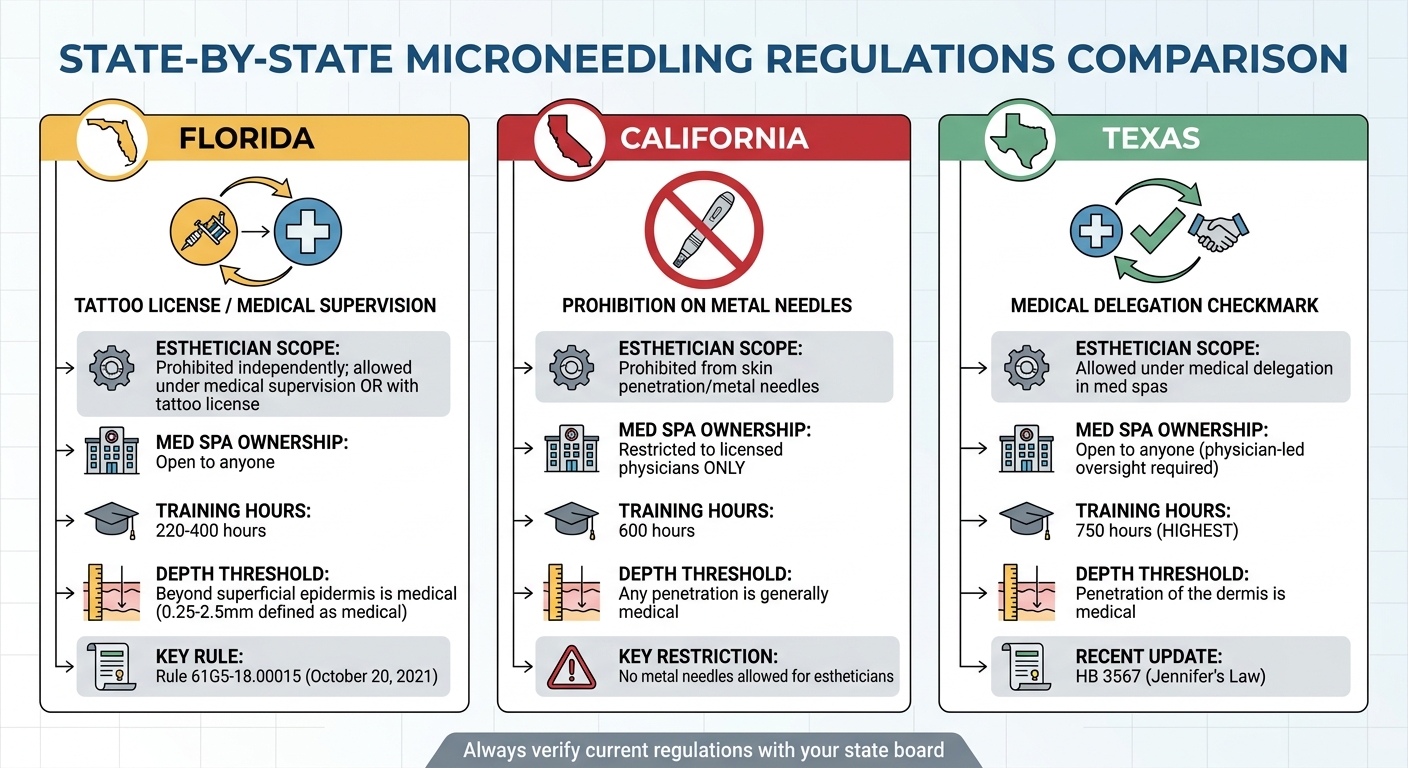
Microneedling Regulations Comparison: Florida, California, and Texas State Requirements
Florida, California, and Texas each have distinct regulations governing microneedling practices, creating significant differences in what is legally allowed for estheticians.
Florida Regulations
Florida's approach to microneedling changed significantly with the introduction of Rule 61G5-18.00015 on October 20, 2021. This rule defines microneedling as a "bodily intrusion", placing it outside the scope of cosmetology or facial specialist licenses. Specifically, microneedling involves using a multi-needled device to create microchannels in the skin, ranging from 0.25 mm to 2.5 mm in depth.
"Microneedling or 'collagen induction treatment or therapy' is a procedure that uses a multi-needled device to create microchannels in the skin 0.25 – 2.5 mm deep to stimulate the body's natural wound healing process while minimizing cellular damage. This piercing of the skin is beyond the scope of a Florida licensed cosmetologist or registered full or facial specialist." - Florida Board of Cosmetology
Estheticians in Florida have two pathways if they wish to perform microneedling. They can either obtain a tattoo artist license and work in a licensed tattoo establishment or perform the procedure under medical supervision in a medical practice. Florida requires 220 training hours for a Facial Specialist license and 400 hours for a Full Specialist license.
California, however, takes an even stricter stance.
California Regulations
In California, microneedling is classified as a medical procedure. The Board of Barbering and Cosmetology explicitly prohibits estheticians from using metal needles or any device that penetrates the skin. These procedures must be performed by physicians or Registered Nurses working under physician supervision.
While California mandates 600 training hours for an esthetician license, this training does not grant permission to perform microneedling. Additionally, California restricts med spa ownership to state-licensed physicians only. Devices that create superficial effects (like rollers with a depth of 0.25 mm or less) may sit in a regulatory gray area, but estheticians are strongly encouraged to seek written approval from the board before use.
Texas offers a more moderate regulatory framework, allowing some flexibility under medical oversight.
Texas Regulations
In Texas, microneedling that penetrates the dermis is classified as a medical procedure. However, estheticians can perform it if they are supervised and delegated by a medical director in a medical spa setting. This structure provides opportunities for estheticians while maintaining strict oversight. Effective lead management is also crucial for these businesses to convert inquiries into consultations.
Texas requires 750 training hours for an esthetician license, the highest requirement among the three states. Despite this, the FDA has recently cited Texas medical spas for compliance issues. Unlike California, anyone can own a med spa in Texas, but medical practice laws still regulate who can perform procedures.
| Feature | Florida | California | Texas |
|---|---|---|---|
| Esthetician Scope | Prohibited independently; allowed under medical supervision or with tattoo license | Prohibited from skin penetration/metal needles | Allowed under medical delegation in med spas |
| Ownership | Open to anyone | Restricted to licensed physicians | Open to anyone (physician-led oversight required) |
| Training Hours | 220-400 hours | 600 hours | 750 hours |
| Depth Threshold | Beyond superficial epidermis is medical | Any penetration is generally medical | Penetration of the dermis is medical |
How to Maintain Compliance
Staying compliant in the aesthetics field requires staying on top of state-specific regulations, maintaining thorough documentation, and understanding the ever-changing legal landscape. State laws and enforcement priorities can shift quickly, so ongoing vigilance is key.
Verify and Document Your Scope of Practice
Start by reaching out to your State Board of Cosmetology and Board of Medicine, as these entities often share jurisdiction over procedures like microneedling. Always request written guidance rather than relying on informal advice or hearsay.
"Advisory opinions from the board carry far more weight than what CE course marketing materials claim or what other estheticians in your area happen to be doing".
When seeking clarification, ask targeted questions: Does your state differentiate between basic and advanced esthetician licenses? Are there specific limits on needle depth, such as 0.25 mm or 0.5 mm? Or is microneedling classified as a medical procedure regardless of depth? For example, in early 2025, the Arizona State Board of Nursing clarified that only APRNs and RNs could perform microneedling deeper than 0.5 mm, while cosmetologists must stay at or above the skin's surface.
Keep copies of all written responses, license certificates, and training records. Having this documentation on hand not only ensures compliance but also protects your practice in case of audits or disputes.
Work Under Proper Medical Supervision
If you’re performing microneedling under medical delegation, it’s essential to understand your state’s requirements for supervision. Alex R. Thiersch, JD, Founder and Director of the American Med Spa Association, explains:
"The supervising physician doesn't have to be in the room watching the aesthetician perform the procedure, and in many states does not have to see the patient before every treatment - just the first one".
In many cases, you may need to adjust your visible credentials to reflect the supervising physician’s license when working under delegation. Make sure you’re familiar with these requirements to avoid any compliance missteps.
Monitor Regulatory Changes
Regulatory changes can happen quickly, so it’s essential to stay informed. For example, recent advisories in California and new restrictions in Texas under HB 3567 (Jennifer's Law) highlight the importance of regular compliance reviews.
Joining professional organizations such as the American Med Spa Association (AmSpa) or the Medical Aesthetics Advocacy Council (MAAC) can provide valuable resources. These groups offer state-specific legal summaries and early alerts about enforcement trends. As MAAC points out:
"The real risk often lies in the shifting enforcement landscape. In states like California, Texas, Florida, and Georgia, regulators are increasing scrutiny through board advisories, public comments, and targeted enforcement - even without formal legislative changes".
To simplify compliance, consider using tools like Prospyr, a practice management platform. It can securely store your documentation, schedule regular audits, and send timely updates about regulatory changes. This ensures you stay focused on delivering excellent patient care while staying compliant with evolving laws.
Conclusion
Main Points to Remember
State-specific regulations around microneedling play a big role in protecting your license and ensuring patient safety. In most states, microneedling is classified as a medical procedure because it penetrates the skin and alters tissue structure. This means that standard aesthetician licenses typically don’t cover microneedling, even if you hold an "Advanced" or "Master" credential.
For reference, devices that penetrate between 0.5 mm and 2.5 mm are generally considered medical-grade. For example, California prohibits aestheticians from using metal needles or performing procedures that break the skin. States like Texas and Florida require physician oversight for any procedure involving dermal penetration.
When working under physician supervision, you’re essentially acting as a medical assistant. Patrick O’Brien from the American Med Spa Association highlights this distinction:
"While the person who holds a license as an aesthetician can often perform medical treatments under a physician, it is the physician's license that is being used and not the aesthetician's".
To stay compliant, it’s crucial to get written guidance from your state board, keep proof of your training, and ensure that a licensed prescriber conducts the initial patient exam. These steps align with the varying state regulations discussed earlier. Staying informed about regulatory updates is just as important, as enforcement priorities can shift over time.
Tools for Practice Management
Applying these regulatory insights to your daily operations can feel overwhelming, especially when managing compliance across multiple systems. Platforms like Prospyr simplify this process by consolidating everything into a single HIPAA-compliant system. This makes it easier to organize delegation protocols, training certificates, and state board advisory opinions.
Streamlined recordkeeping not only reduces stress during audits but also ensures you’re always prepared for regulatory changes. Prospyr’s integrated CRM and EMR tools help with scheduling, patient communication, and maintaining compliance. For instance, Dr. Daniel Lee at New Life Cosmetic Surgery used Prospyr to replace four separate software systems. As a result, his practice saw a 50% increase in revenue and a 40% jump in appointments. Keeping all your compliance documentation in one secure platform allows you to adapt quickly to new regulations without disrupting patient care.
FAQs
Is microneedling legal for estheticians in my state?
Microneedling rules for estheticians differ from state to state and often hinge on factors like the depth of the needles used and the type of license you hold. To ensure you're operating within the law, it's essential to check your state's specific guidelines. Regulations can vary significantly across the U.S., so staying updated on local requirements is crucial.
What needle depth classifies microneedling as a medical procedure?
Microneedling is generally considered a medical procedure when the needle depth falls between 0.5mm and 1mm. At this depth, the needles reach the deeper layers of the skin, which often necessitates professional supervision to ensure safety and effectiveness.
How do I get written scope-of-practice guidance from my state board?
To get clear, written guidance on scope-of-practice rules, reach out to your state’s regulatory board or check their official resources. Many boards provide online policies or statements detailing who is allowed to perform microneedling and the permitted needle depths. Visiting their website or requesting written clarification is the best way to ensure you have the most current and accurate information for your state.