Med Spa Consent Forms: What to Include
Clear checklist for med spa consent: treatment details, risks, screening, photo use, payment, and signatures.

A med spa consent form should do 4 jobs at once: explain the treatment, list risks and aftercare, screen for safety issues using digital intake forms, and record clear permission with signed payment and photo terms.
That matters because consent problems show up often in legal claims. In the article, insufficient consent appeared in 32% of reviewed aesthetic procedure cases and was paired with malpractice in 53%. Another review found lack of informed consent in 43.8% of cosmetic surgery malpractice claims.
If I were checking a form, I’d make sure it covers:
- What the patient is getting: treatment name, body area, how it works, likely results, limits, and other options, including no treatment
- What can happen after treatment: common side effects, rare but serious risks, downtime, aftercare steps, and when to call the clinic or go to the ER
- Who may need treatment delayed or changed: medical history, allergies, medications, pregnancy or breastfeeding status, skin issues, and recent procedures
- How photos can be used: one permission for chart photos and a separate, optional one for marketing
- What the patient will pay: price in U.S. dollars, deposits, cancellation rules, package terms, and refund rules
- How consent is recorded: acknowledgment, date and time, patient signature, and provider or guardian signature when needed
Bottom line: if a form leaves out risks, aftercare, screening questions, photo rules, or payment terms, it leaves room for confusion later.
Here’s a quick snapshot:
| Area | What the form should say |
|---|---|
| Treatment | Name, area treated, steps, expected results, limits, alternatives |
| Risks | Common side effects, serious complications, warning signs |
| Recovery | Downtime, activity limits, home care, follow-up timing |
| Screening | Conditions, allergies, meds, pregnancy, skin issues, recent treatments |
| Photos | Separate approval for chart use and marketing use |
| Money | Cost, deposit, cancellation window, refunds, package terms |
| Sign-off | Acknowledgment, signatures, date, time |
If you want a simple test, ask this: Would a first-time patient know exactly what they are agreeing to, what could go wrong, what it will cost, and what to do after treatment? If the answer is no, the form needs work.
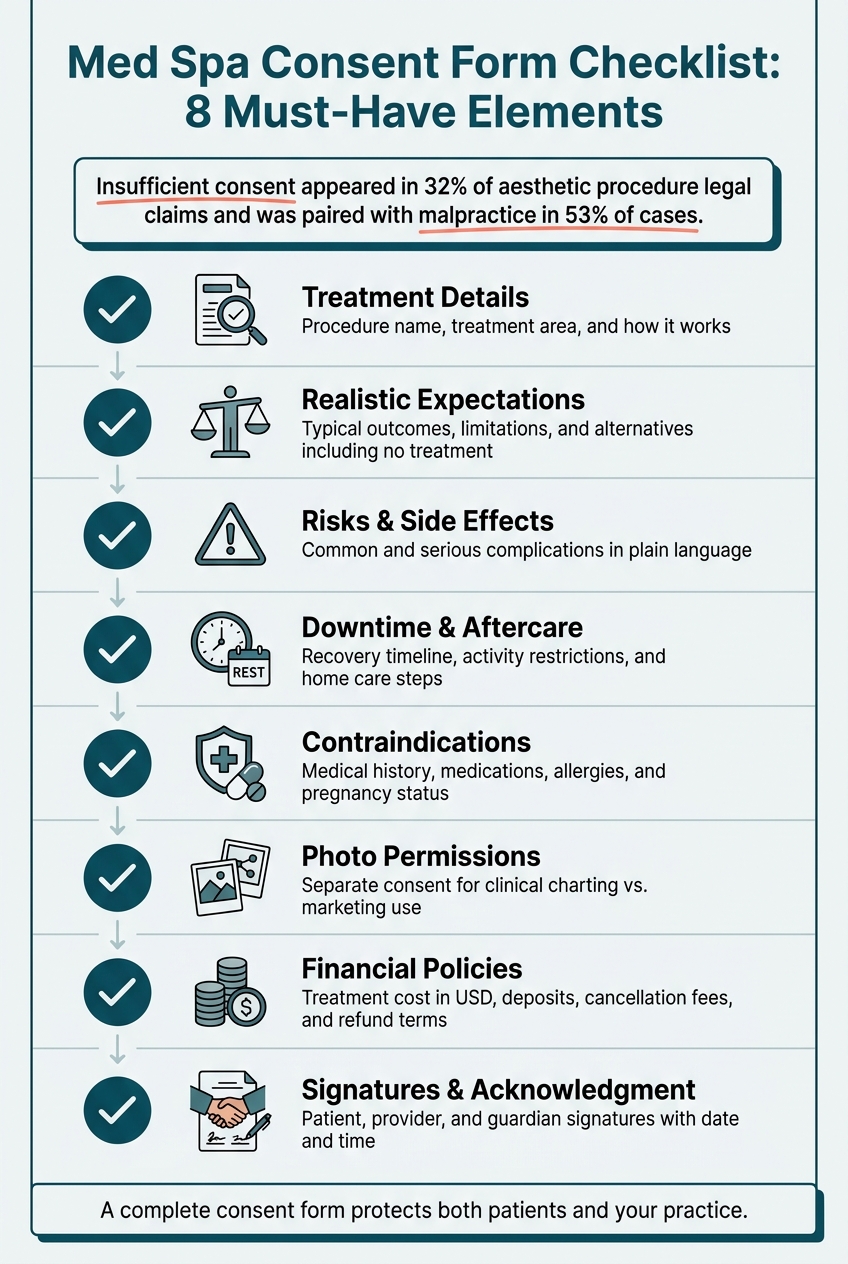
Med Spa Consent Form Checklist: 8 Must-Have Elements
Checklist Item 1: Procedure Details and Treatment Expectations
Start by saying exactly what the patient is agreeing to.
Treatment Name, Area, and How the Procedure Works
Name the treatment and list every area being treated. Then explain the visit in plain English: cleansing, numbing, the treatment itself, and the immediate post-treatment check.
For neuromodulator injections, say that results usually show up in 3–14 days and tend to last about 3–4 months.
Expected Results, Limitations, and Alternatives
Spell out the treatment goal, the likely range of results, and what the treatment will not do. The form should clearly say that the procedure does not promise a specific look, a set duration, or full correction.
Add an Alternatives, including no treatment section. Based on the service, options may include:
- a different device
- a lower setting
- topical skincare
- no treatment at that visit
After the procedure is defined, move on to the risks, downtime, and aftercare.
sbb-itb-02f5876
Checklist Item 2: Risks, Side Effects, Downtime, and Aftercare
Once the procedure is defined, the consent form should explain what patients may notice after treatment. This part needs to be specific. Patients should be able to use it to plan work, travel, social events, and to know when something needs medical attention.
Common Side Effects and Serious Complications
A good form separates side effects into two simple groups: expected short-term effects and warning signs. Across many treatments, common short-term effects include redness, swelling, bruising, tenderness, itching, and tightness. These usually improve on their own over the next few days to weeks.
Procedure-specific risks should also be spelled out in plain English:
- Neuromodulators (e.g., Botox): small bumps at injection sites, transient headache, temporary numbness at the injection site, and, in rare cases, brow droop or uneven brows or forehead movement.
- Dermal fillers: lumps, nodules, allergic reaction, infection, and, rarely, blocked blood flow, tissue death, or blindness. Unevenness from side to side can also happen.
- Laser and resurfacing treatments: redness, swelling, mild burning, skin dryness, temporary pigment changes, flaking or peeling, and, rarely, burns, scarring, or infection.
- Chemical peels: stinging or burning, redness, peeling, crusting, tightness, and temporary sun sensitivity. In patients prone to pigment change or scarring, there is also a risk of persistent pigment changes, scarring, infection, or keloid formation.
- Body contouring (e.g., cryolipolysis or radiofrequency): temporary numbness, tingling, mild pain or aching, swelling, bruising, and skin sensitivity, and, rarely, contour irregularities, nerve injury, or paradoxical fat increase.
The form should also make urgency crystal clear.
Call the clinic immediately for:
- Severe or worsening pain
- Pale or dusky skin
- Increasing redness or warmth
- Pus
- Fever
- Blistering
- Open wounds
- Persistent numbness
- Hard nodules
Call 911 or seek emergency care for:
- Sudden visual changes
- Severe eye pain
- Difficulty breathing
- Swelling of the tongue or throat
- Widespread hives
- Dizziness or fainting
- Rapidly spreading redness with severe pain or fever
Recovery Time, Activity Limits, and Follow-Up Instructions
Downtime can vary a lot from one procedure to another. That’s why the form should give time-based ranges, not vague wording. If a patient has a wedding, a flight, or an in-office presentation next week, this section should help them plan around it.
| Procedure | Typical Downtime | Key Restrictions |
|---|---|---|
| Neurotoxin injections | Minimal; most patients resume normal activity the same day | Avoid vigorous exercise, heat, saunas, hot tubs, and alcohol for about 24 hours; keep the head upright for at least 6 hours |
| Dermal fillers | 1–7 days of bruising, swelling, or unevenness | Avoid facial massage or pressure for 1–2 weeks; plan treatment at least 2 weeks before major events |
| Non-ablative laser / IPL | 24–72 hours of redness and mild swelling | Use daily broad-spectrum SPF 30+; makeup is often allowed after 24 hours if the skin is intact |
| Ablative resurfacing / deeper peels | 7–14 days of crusting, oozing, and redness, with residual redness lasting longer | Avoid strenuous exercise, swimming, saunas, and hot yoga for 1–2 weeks; avoid makeup over broken skin until the barrier has healed, often 5–7 days; avoid retinoids and AHA/BHA acids until cleared |
| Body contouring | Minimal functional downtime | Numbness or soreness may last for days to weeks; follow device-specific instructions on massage and activity; results typically develop over several weeks to months |
Aftercare should be just as practical. Patients need plain steps they can follow at home, such as gentle cleansing, using bland moisturizers or ointments if recommended, applying cold compresses for swelling, and taking acetaminophen for discomfort. If the clinic wants patients to avoid ibuprofen or similar pain relievers, the form should say that directly.
It also helps to set timing expectations for results. Neurotoxins usually peak around day 14. Fillers tend to settle over 1–2 weeks. Laser and peel results may take multiple sessions and several weeks before changes are easy to see.
Once recovery details are covered, the form should move into contraindications, photo consent, and payment terms.
Reading about the problem? See how Prospyr solves it in one platform.
Book a DemoChecklist Item 3: Contraindications, Photos, and Financial Policies
After risks and aftercare, add three items that head off most disputes: contraindications, photo consent, and payment terms.
Medical History and Contraindications to Review Before Treatment
Use a simple yes/no screening list with a notes field. Patients should confirm or deny each item before signing, and staff should review any flagged answers before treatment starts.
The form should ask about current medical conditions, allergies, medications and supplements, pregnancy or breastfeeding status when relevant, active infections or inflammation near the treatment area, skin conditions, a history of poor wound healing, autoimmune conditions, and any recent procedures that could affect safety or results, such as lasers, peels, or injectables.
Don’t rely on one generic medical history section. Tailor the contraindication list to each specific service. That matters. A laser treatment, for example, doesn’t carry the same screening needs as injectables or a peel.
If a patient answers yes to any item, include a notes field so the provider can document what was discussed and whether treatment was modified, postponed, or cleared.
Photo Consent for Charting and Marketing Use
Once eligibility is documented, keep clinical photos separate from promotional use.
Clinical photos taken for the medical record are part of standard documentation. Marketing use should never sit on the same consent line.
The form should include two clearly labeled permissions:
- One for clinical photography for charting, treatment comparison, and internal records
- One for optional, separately signed authorization for promotional use, including before-and-after images on the clinic's website, social media, email campaigns, printed materials, or in-office displays
That second permission should spell out exactly where images may appear, whether faces or other identifying features will be shown, and that saying no to promotional use does not affect care.
Verbal permission is not enough for public-facing photo use. Written authorization with a separate date and signature line is the standard.
Treatment Cost, Cancellation Terms, and Refund Policies
Finish with clear payment terms so patients know the cost before treatment starts.
List the price in U.S. dollars, whether a deposit or prepayment is required before the appointment, and when the remaining balance is due.
Cancellation, rescheduling, and no-show policies should define the notice window clearly - often 24 to 48 hours - and state what happens if that window is missed, whether that means deposit forfeiture or a flat cancellation fee.
If the clinic offers prepaid packages or memberships, the form should spell out:
- The number of sessions included
- Any expiration dates
- Whether unused sessions roll over or convert to account credit
- How cancellations affect pricing or credits
Refund rules for partially used packages are a common source of disputes, so clear language upfront saves a lot of back-and-forth at checkout.
Checklist Item 4: Patient Acknowledgment, Signatures, and Digital Workflow
After risks, costs, and photo use are documented, the form still needs a clear acknowledgment and signature block. This last part confirms informed consent.
Required Acknowledgment and Signature Fields
Signatures create a record that the patient received and accepted the consent discussion. Add a short acknowledgment right above the signature block saying the procedure, key risks, benefits, alternatives, and aftercare were explained; no result was guaranteed; and the patient had a chance to ask questions before signing voluntarily.
Close that acknowledgment with a plain statement that the patient read, understood, and signed voluntarily. Then place the patient and witness signature lines right after it when a witness is required.
The form should collect:
- Patient full name
- Date of birth
- Contact information
- Date and time of consent
- Patient signature
- Provider and witness signatures when required
If the patient is a minor, a legal guardian must sign.
Using Digital Forms to Standardize Consent Collection
Once the paper form is set, digital intake can make consent collection more consistent. Digital workflows help keep forms complete, legible, and easy to pull up later. They can require missing fields, add automatic date and time stamps, and store signed forms right in the patient chart.
Before the signature step, show the full document to the patient and require an active acknowledgment before they sign. Patients should also get a copy of the signed consent, either electronically or on paper.
In the U.S., electronic signatures are valid when they are captured in a HIPAA-compliant, encrypted system. Patients can also complete forms before the visit on their own devices. That cuts down on check-in delays and helps make sure the form is complete before treatment starts.
Prospyr can support digital intake, signatures, scheduling, payments, and chart storage in one HIPAA-compliant system.
Conclusion: A Med Spa Consent Form Checklist at a Glance
A strong consent form sets clear expectations, cuts down on misunderstandings, and helps protect both patients and the practice. If your current forms leave out any of the items below, it’s time to update them.
At minimum, every consent form should cover:
| Checklist Item | What to Include |
|---|---|
| Treatment details | Procedure name, treatment area, and how it works |
| Realistic expectations | Typical outcomes, limitations, and alternatives |
| Risks and side effects | Common and serious complications in plain language |
| Downtime and aftercare | Recovery timeline, activity restrictions, and care steps |
| Contraindications | Medical history, medications, allergies, and pregnancy status |
| Photo permissions | Separate consent for clinical charting and marketing use |
| Financial policies | Treatment cost in USD, deposits, cancellation fees, and refund terms |
| Signatures and acknowledgment | Patient, provider, and guardian signatures when required; date and time |
Digital forms make this much easier to manage. They standardize required fields, add timestamped signatures, and keep forms stored in the patient chart. Prospyr supports this workflow in a HIPAA-compliant system.
The goal is simple: patients should know exactly what they’re agreeing to, and your practice should have a complete record.
FAQs
Why should photo consent be separate?
Photo consent should be separate from general medical consent. Why? Because treatment photos are sensitive patient data, and they may count as protected health information under HIPAA.
That changes the stakes.
A patient can agree to care without agreeing to have their images posted online, used in ads, or shared in other public-facing ways. Those are two different decisions, and the paperwork should reflect that.
Patients need explicit written permission before photos are shared online or used for marketing. Keeping that permission in its own document helps draw a clear line: consent to treatment is not the same as consent to public use of images.
This separate step also cuts down on privacy mistakes. It makes expectations plain, protects patient rights, and helps your practice avoid avoidable HIPAA trouble.
When should a med spa update its consent forms?
Med spas should update consent forms on a regular basis to reflect changes in state laws, FDA updates, and any new treatments or procedures.
They should also review those forms to stay compliant as rules change and revise risk disclosures or procedure details when needed. Consent isn’t a one-and-done formality. It’s an ongoing process. So if new risks or benefits come up during treatment, patients should be told clearly and promptly.
Can digital consent forms hold up legally?
Yes. Digital consent forms are legally valid when the system meets key technical and process standards.
For that to hold up, the workflow should:
- verify the patient’s identity
- include a clear timestamp and version history
- use a HIPAA-compliant platform with encryption, access controls, audit logs, and tamper-proof signatures where required
Prospyr supports these needs through secure, integrated digital intake workflows.
Related Blog Posts
- Checklist for Body Contouring Consent Forms
- Consent Form Trends in Aesthetics
- 5 Common Laser Consent Form Mistakes
- Legal Standards for Aesthetic Consent Forms
{"@context":"https://schema.org","@type":"FAQPage","mainEntity":\[{"@type":"Question","name":"Why should photo consent be separate?","acceptedAnswer":{"@type":"Answer","text":"
Photo consent should be separate from general medical consent. Why? Because treatment photos are sensitive patient data, and they may count as protected health information under HIPAA.
That changes the stakes.
A patient can agree to care without agreeing to have their images posted online, used in ads, or shared in other public-facing ways. Those are two different decisions, and the paperwork should reflect that.
Patients need explicit written permission before photos are shared online or used for marketing. Keeping that permission in its own document helps draw a clear line: consent to treatment is not the same as consent to public use of images.
This separate step also cuts down on privacy mistakes. It makes expectations plain, protects patient rights, and helps your practice avoid avoidable HIPAA trouble.
"}},{"@type":"Question","name":"When should a med spa update its consent forms?","acceptedAnswer":{"@type":"Answer","text":"Med spas should update consent forms on a regular basis to reflect changes in state laws, <a href=\"https://www.fda.gov/\\" target=\"_blank\" rel=\"nofollow noopener noreferrer\">FDA updates, and any new treatments or procedures.
They should also review those forms to stay compliant as rules change and revise risk disclosures or procedure details when needed. Consent isn’t a one-and-done formality. It’s an ongoing process. So if new risks or benefits come up during treatment, patients should be told clearly and promptly.
"}},{"@type":"Question","name":"Can digital consent forms hold up legally?","acceptedAnswer":{"@type":"Answer","text":"Yes. Digital consent forms are legally valid when the system meets key technical and process standards.
For that to hold up, the workflow should:
- verify the patient’s identity
- include a clear timestamp and version history
- use a HIPAA-compliant platform with encryption, access controls, audit logs, and tamper-proof signatures where required
Prospyr supports these needs through secure, integrated digital intake workflows.
"}}]}