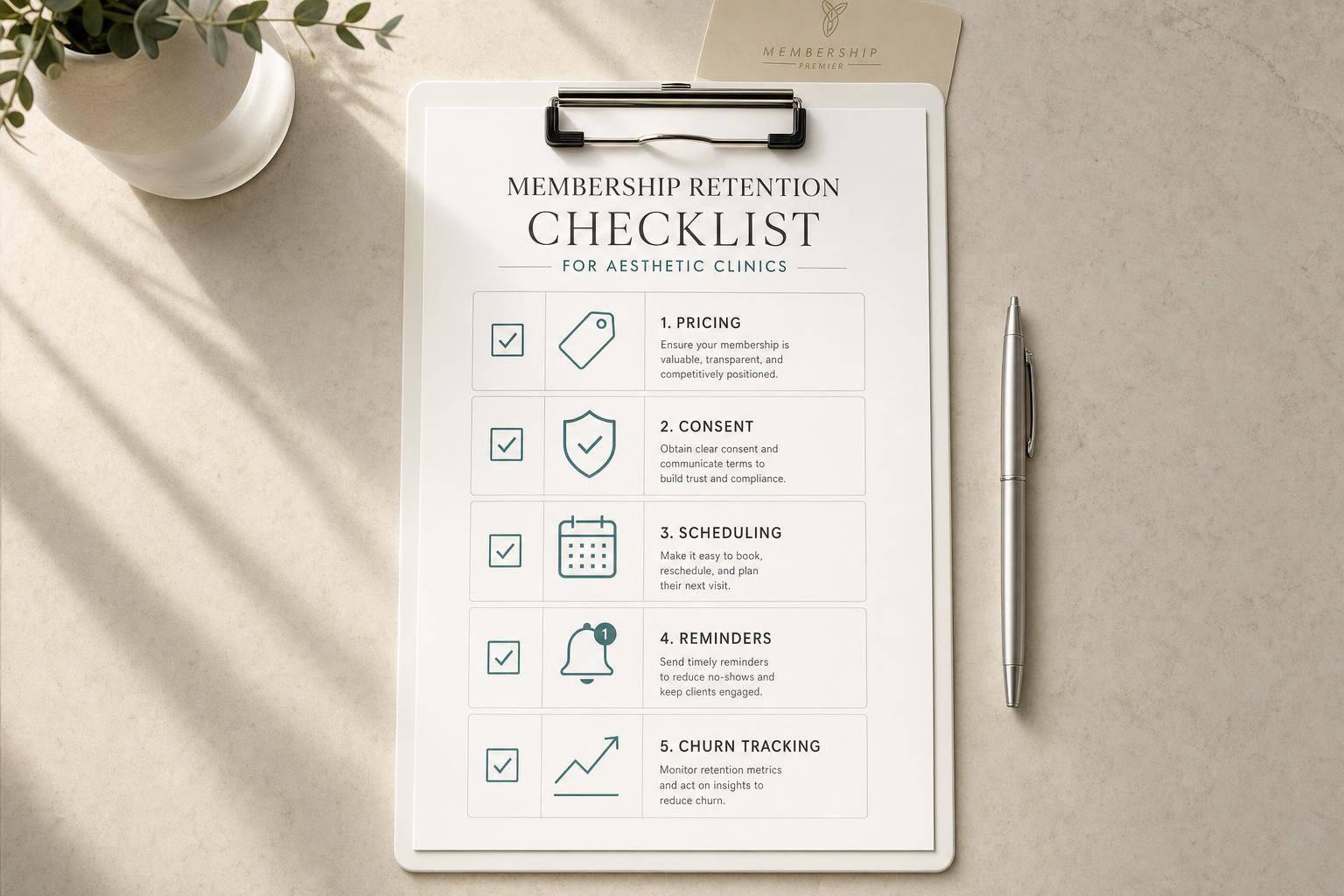

A clinic membership keeps patients longer when it drives visits, renewals, and autopay - not when it just gives a discount. In this guide, I boil it down to the parts that matter most: build a plan around repeat treatments, set clear billing and cancellation rules, make rebooking automatic, and watch churn signs before members drop off.
Here’s the short version:
- Price the plan around usage, often in the $99–$299/month range
- Limit rollover, usually to 1–3 months, so unused credits don’t pile up
- Separate treatment consent from payment approval
- Set failed-payment rules in advance, with retries over 7–10 days
- Tie the membership to a visit schedule like monthly facials or quarterly tox
- Use reminders at booking, 7 days, 48 hours, and 24 hours
- Flag churn early when members miss visits, stack credits, or fail payments
- Review monthly KPIs like revenue per member, autopay rate, and add-on sales
A few numbers stand out: members can drive 3x lifetime value compared with non-members, reminders can cut no-shows from 23.1% to 13%, and memberships may account for 20%–30% of clinic income.
If I were setting up or fixing a clinic membership, I’d focus on one thing: make it easy for patients to stay on schedule and hard for the program to drift into confusion.
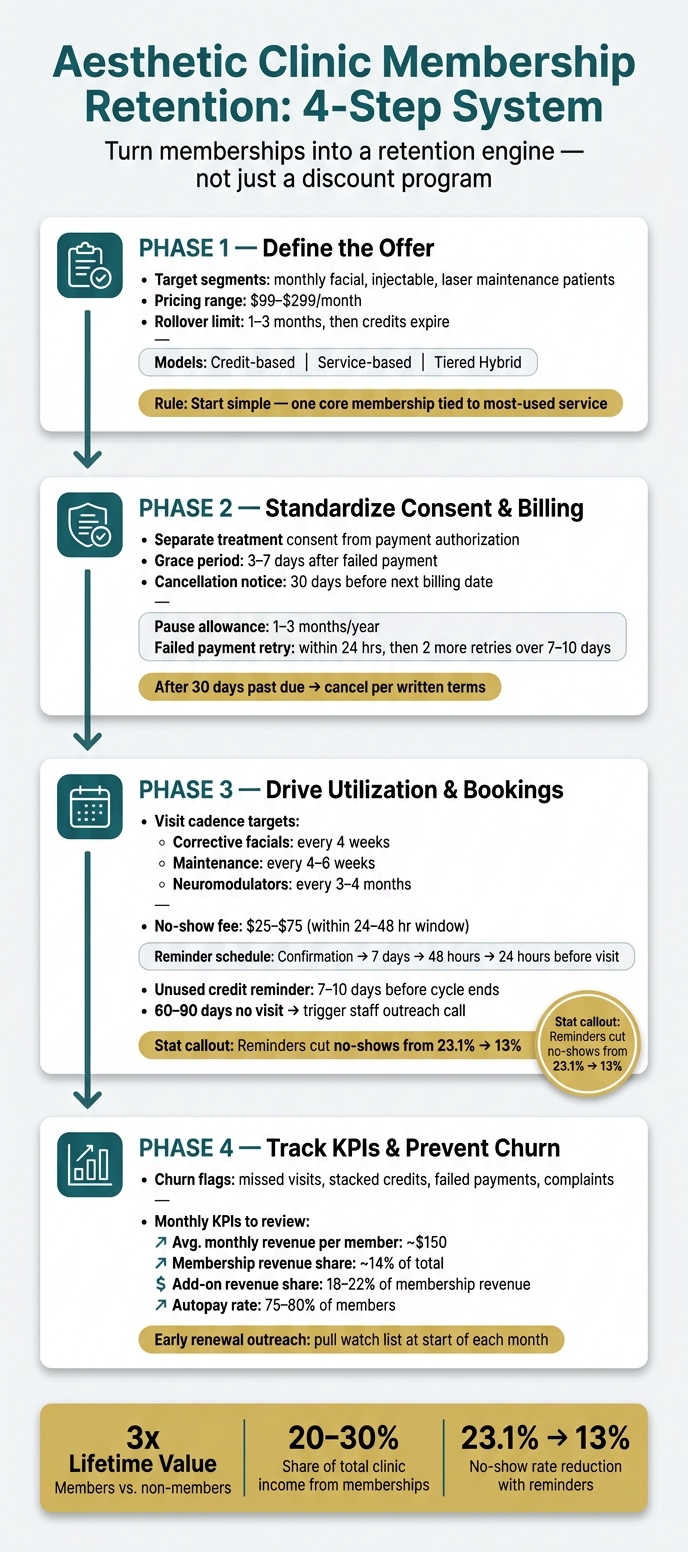
Aesthetic Clinic Membership Retention: 4-Step System
1. Define the membership offer before launch
Before enrollment opens, nail down the offer: who it's for, how it works, what it costs, and how the rules will run inside your software. Keep your attention on the patient group, the membership structure, and what day-to-day use will look like. The best place to start is usually the patient group that already comes back on a steady schedule.
Choose patient segments, membership model, and tiers
Start with the patients who already return on a set cadence. Monthly facial and skincare clients, recurring injectable patients, and laser maintenance patients tend to fit well because their upkeep schedule is already built in. Irregular patients are tougher to keep unless the membership gives them more room to move.
Once you know which segment you're going after, pick the model that lines up with how those patients buy and how likely they are to renew. For aesthetic clinics, the three most practical options are credit-based, service-based, and tiered hybrid.
| Model | Operational simplicity | Perceived value | Flexibility | Retention fit |
|---|---|---|---|---|
| Credit-based | Moderate | High | High | Strong |
| Service-based | High | Moderate | Low to moderate | Strong for consistent routines |
| Tiered hybrid | Moderate | Very high | High | Very strong |
Start with one core membership tied to the service patients use most often. Add tiers later, after usage shows there's demand. In the first version, simple wins. Staff should be able to explain it fast, and patients should get it on the first read.
Set pricing, rollover limits, and value rules
Set pricing based on expected visit frequency, treatment mix, and delivery cost. The goal is to price below retail while still protecting margin at expected usage. For many aesthetic clinics, a monthly fee between $99 and $199 can work when benefits are tightly defined and part of the value expires each month.
Unused value can turn into a headache. It creates liability and makes the program harder to run. A common setup is to allow 1 to 3 months of rollover, then let unused value expire. Whatever rule you choose, spell it out in plain English before launch. If a patient has to squint to figure it out, the rule is too messy.
Configure the membership in your software
Before launch, make sure your software can handle the nuts and bolts:
- billing cadence
- auto-renewals
- credit rules
- checkout visibility
- reporting tags
- failed payments
- manual credit adjustments
Benefits should be visible at checkout and applied on their own. Put automated renewal tracking and failed-payment handling near the top of your checklist. Those two items do a lot of the heavy lifting for repeat visits and long-term retention.
If you use Prospyr, membership management sits alongside payment processing, scheduling, patient communication, and reporting in one HIPAA-compliant system. That cuts down on manual handoffs and makes program tracking easier.
Once the offer is set up, get consent and payment authorization locked in before enrollment starts.
sbb-itb-02f5876
2. Standardize consent, payment authorization, and policy documents
Before enrollment, put your paperwork in place. This is the paper trail that protects the clinic and shows patients exactly how the membership works. It should spell out what happens at sign-up, during billing, when someone wants to pause, and when they cancel.
Write clear membership terms and cancellation rules
Write your billing, renewal, grace period, pause, cancellation, reactivation, and refund rules in plain English before launch. The goal is simple: no guessing, no mixed messages.
For example, you might set:
- A 3- to 7-day grace period after a failed payment
- 30 days' notice before the next billing date for cancellation
- Pauses of 1 to 3 months per year for medical or personal reasons
If a patient pauses, pause billing and new credit accrual. Freeze existing credits during that period too. And if fees are non-refundable once charged, say that in direct terms.
Once the rules are written, get them signed before the first charge runs.
Collect signed consent and recurring payment authorization
Keep treatment consent separate from financial authorization. Don’t mash them into one vague form. Use separate forms or separate workflows for each.
Treatment consent covers the clinical side, including risks, benefits, and alternatives for the procedures included in the membership. Financial consent covers recurring charges, the billing schedule, auto-renewal, credit expiration, and how cancellation works.
The recurring payment authorization needs to be specific. Include the:
- Cardholder name
- Last four digits of the card
- Monthly amount
- Billing date
- Clear approval for recurring charges until cancellation
Patients should sign electronically and get a copy by email. Store the signed authorization in the patient record with a timestamp.
Set a documentation and payment failure workflow
Once consent is in place, use the same record structure for renewals and failed payments. Store each membership document in the patient record under a standard label, such as "Membership Terms – Gold Tier – Effective 09/01/2026" or "Recurring Payment Authorization – Gold – Card ending 4321." Give front desk staff view access to status, and let billing edit payment authorizations through role-based access.
For failed payments, decide the workflow before you need it. Retry the payment within 24 hours, then retry twice more over the next 7 to 10 days, with automated email and SMS at each step. If payment still hasn’t cleared after the grace period, pause benefits and flag the account. After 30 days past due, cancel the membership based on the written terms.
A fast, documented response helps cut avoidable churn. Log every payment attempt, every notice sent, and every status change in the patient record. If a chargeback shows up later, that record is your first line of defense. Prospyr can centralize forms, payment authorizations, and status flags in one HIPAA-compliant record.
3. Build booking rules and staff scripts that drive utilization
Once enrollment is done, retention comes down to one thing: getting members to use the plan. Clear booking rules, staff scripts, and reminders help keep people on schedule. After consent and billing are set, the next move is simple: make rebooking feel automatic.
Set booking cadence, access rules, and no-show policies
The cadence should feel like part of the treatment plan, not some extra desk task.
Set a target visit window for each tier:
- Corrective facials: every 4 weeks
- Maintenance: every 4 to 6 weeks
- Neuromodulators: every 3 to 4 months
For series-based services, link visits to finishing the treatment series first, then shift the patient to maintenance.
A one-page cadence cheat sheet can save a lot of back-and-forth at the desk. Include each membership name, its target visit window, the best rebooking script, and what happens if the patient misses that window. Keep it posted at the front desk and match the same rules in your scheduling software.
For cancellations and late reschedules, a 24- to 48-hour notice window is the most common standard. Cancellations inside that 24- to 48-hour window can trigger a $25 to $75 fee. No-shows can either forfeit that month’s credit or lead to a flat lost-appointment fee. Staff reminders cut no-shows from 23.1% to 13%.
If a member wants more visits than their plan covers in one billing cycle, don’t block access. Offer extra visits at a member-only rate, like 20% off.
Create enrollment, handoff, and objection scripts
Use the same cadence rules in the front desk script so each rebooking conversation sounds the same.
Providers tend to do best when they present the membership as part of clinical follow-through, not just a deal. A simple consult script works:
Goal recap: You want smoother texture and fewer breakouts. Treatment plan: That usually requires monthly treatments for 3 to 6 months. Membership fit: Our Glow membership matches that schedule and includes one facial a month, product savings, and add-on pricing.
Once the provider recommends a membership, the handoff to the front desk should be direct. The provider introduces the patient by name and states the recommendation. Then the front desk follows with the value summary, key policies, and close.
- Provider handoff - Jordan, this is Sarah at the front desk. We've decided that our Glow membership is the best way to support your monthly facial plan for the next 6 months.
- Value summary - This membership includes one facial every month, 10% off products, and member-only pricing on add-ons.
- Key policies - It's $149 per month, billed automatically on the 15th. You can cancel after 3 months with a 30-day notice, and we just ask for 24 hours' notice if you need to reschedule.
- Enrollment close - If that sounds good, we can set it up now and book your first two visits so you're set.
When objections come up, staff need responses that are clear and consistent. If the concern is cost, explain the per-visit savings versus the standard rate, along with any product discounts. If the patient is worried about commitment, point to the minimum term - say, three months - and the month-to-month option after that. If they hesitate on autopay, confirm that card details are stored in a HIPAA-compliant system and that an email receipt goes out with every charge.
Automate reminders for unused credits and missed visit windows
Once the schedule is set, reminders help keep that cadence from slipping.
Automated reminders reduce non-attendance, and several touchpoints work better than one late reminder. In plain English: don’t wait until the last minute.
Send the confirmation right away. Then send reminders at 7 days, 48 hours, and 24 hours before the visit. Send an unused-credit reminder 7 to 10 days before the cycle ends. If a member goes 60 to 90 days without a visit, trigger a staff call to review retention analytics.
These reminders do more than fill chairs. They help protect credit use and make renewals more likely.
| Reminder Strategy | Retention Impact | Patient Experience | Staff Workload |
|---|---|---|---|
| Early + late (4 and 6 weeks) | High – supports habit-forming | Moderate – needs opt-out option | Low – automation with light review |
| Monthly unused credit reminder | High – protects credit usage | Positive if framed as a value reminder | Low – automated, occasional calls |
| Phone outreach at 60–90 days | Very high for at-risk members | Personalized but more intrusive | Moderate – manual staff effort |
Prospyr can run this whole layer with smart scheduling prompts, automated email and SMS reminders, and task-based follow-up when a member hits a threshold like 60 days without a visit or two unused credits. So even when the front desk is slammed or staff changes, the retention work keeps moving.
4. Track renewals, churn flags, and monthly membership performance
Once visits and rebooking are in motion, monthly tracking tells you if those patterns are leading to renewals. It shows whether the membership is keeping patients engaged or quietly losing revenue. Review these numbers each month, before a small problem turns into churn.
Monitor renewal timing and contact at-risk members early
Members getting close to the end of their initial term should go on a renewal watch list. Pull that list at the start of each month and assign a staff member to reach out with a personal appreciation message or set up a provider check-in before the anniversary date.
That same list can drive appreciation notes, provider outreach, or renewal offers before the contract ends. It also helps to watch for seasonal renewal spikes so your team can time outreach when it matters most.
Define churn flags and intervention triggers
Churn usually shows up in behavior first. The job here is simple: spot the signal early and assign the next step before the member walks away.
Flag any member who shows one or more of these conditions:
- Missed visits, long gaps, or a growing number of unused credits
- Repeated cancellations within a billing cycle
- A failed payment that isn't resolved promptly
- A documented complaint or service issue
Each flag should have one clear owner, whether that's the front desk, a patient coordinator, or the provider. That person should also have one clear next step, like payment recovery, a rebooking call, or a provider check-in.
Review a monthly retention dashboard and adjust the program
Look at the numbers that lead to action, not a long report that just sits there.
| KPI | Benchmark | Why It Matters |
|---|---|---|
| Avg. monthly revenue per member | $150 | Shows whether pricing matches usage |
| Membership revenue share | ~14% of total revenue | Balances recurring membership revenue and one-time sales |
| Add-on revenue share | 18%–22% of membership revenue | Shows upsell performance |
| Share of members on autopay | 75%–80% of members | Confirms predictable cash flow |
If add-on revenue is below 18%, check whether staff are consistently mentioning retail discounts during visits. If churn is going up, make sure renewal outreach is happening early enough. If membership revenue share is well under 14%, the program may need a pricing change or a tier adjustment.
Every metric should point to a decision: outreach, pricing adjustment, staff coaching, or billing follow-up.
Prospyr can centralize active-member, renewal, payment, and credit reports for faster monthly review.
Conclusion: Use the checklist to turn memberships into a retention system
Memberships only work when the offer, consent, booking, and reporting pieces work together. When you put that checklist in place, a membership stops being just a discount program and starts acting like a retention system.
Use the checklist to build a new program or tighten up the one you already have. That setup helps patients stay on track and gives your team a repeatable playbook - one that leads to repeat visits and renewals, not just lower-priced services.
In U.S. practices, memberships can account for 20–30% of total income, which can help smooth seasonal dips. Start with patient data, build tiers around actual treatment journeys, and set up the workflows that keep members involved with embedded marketing. Prospyr can bring billing, scheduling, reminders, and reporting into one place.
Handle the basics well, keep a close eye on the numbers, and make changes before churn starts to climb.
FAQs
How do I choose the right membership tier?
Use a three-tier setup to keep choices clear without overwhelming clients. Start by looking at past client spending, then set your entry, mid, and top tiers at points that feel within reach while still giving people a reason to move up.
Give each tier names that fit your brand, and make sure the value grows from one level to the next. You can also use a hybrid model based on annual spending, visit frequency, or both if your clients book in different ways. Prospyr can help you track those numbers and manage tiered memberships.
What should I do if members stop booking visits?
Take a multi-channel approach before members churn.
Start by spotting inactive members. Then segment them based on signals like their last visit or a pattern of missed appointments. From there, send personalized outreach that feels helpful, not accusatory, and include a direct booking link so taking the next step is easy.
If email goes unanswered, follow up with a text. A second touchpoint can make all the difference.
For high-value members, a small incentive may help bring them back. And if the issue comes down to trust or money, a manager's phone call can go a long way. It gives the member space to share frustrations and shows that someone at the business actually cares.
Which retention KPIs matter most each month?
Track membership retention rate every month with this formula:
[(members at period end - new members gained) / members at period start] x 100
That gives you a clear read on how many existing members stayed with you during the period.
You should also keep an eye on a few other metrics:
- Tier distribution to see how members are spread across plans
- Engagement, including reward redemption and booking conversions
- Tier transitions to track upgrades, downgrades, and movement between levels
- Average revenue by membership level to spot which tiers bring in the most income
- Overall membership-related treatment satisfaction to understand how members feel about the experience
Prospyr brings these analytics into real-time dashboards and automates renewals, so you can monitor performance without digging through reports by hand.