5 Profitability Metrics for Scaling Aesthetic Clinics
Tracking five core profitability metrics—CUR, GM%, ATV, LTV, and practitioner labor cost—gives aesthetic clinics the data to scale profitably.


5 Profitability Metrics for Scaling Aesthetic Clinics
Running a successful aesthetic clinic isn’t just about offering treatments - it’s about tracking the right numbers to grow your business. Here are five key metrics every clinic owner should know:
- Capacity Utilization Rate (CUR): Measures how efficiently staff time is used. Aim for 70–80% treatment time to balance care and operations.
- Gross Margin Percentage (GM%): Tracks profit after direct costs. A healthy GM% is around 60%.
- Average Treatment Value (ATV): Reveals the revenue per appointment. Clinics should target $350–$425 per visit.
- Patient Lifetime Value (LTV): Calculates total revenue per patient over time. A good LTV-to-CAC ratio is 3:1.
- Practitioner Labor Cost Percentage: Monitors staff costs as a percentage of revenue. Keep it between 25–35%.
These metrics help identify inefficiencies, improve profitability, and guide smart decisions. Tools like Prospyr can simplify tracking and provide real-time insights to support growth.
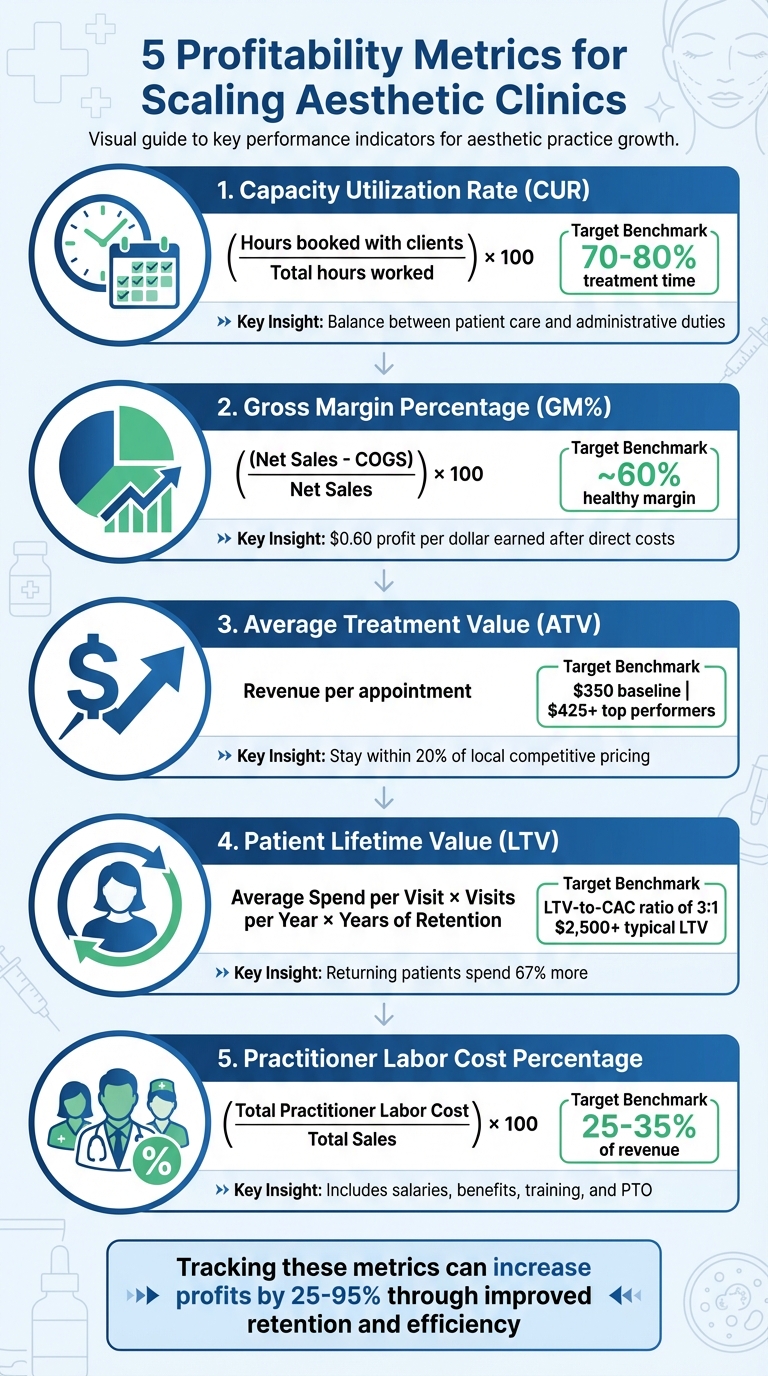
5 Essential Profitability Metrics for Aesthetic Clinics with Target Benchmarks
1. Capacity Utilization Rate (CUR)
In the world of data-driven growth, understanding how effectively your clinic operates starts with measuring capacity utilization.
The Capacity Utilization Rate evaluates how well your clinic maximizes its most critical resource - time. It does this by comparing the hours spent on revenue-generating treatments to the total hours worked. The formula looks like this:
100 × (hours booked with clients / total hours worked).
This metric provides a clear picture of your clinic's operational efficiency. A lower utilization rate might suggest that staff hours are underutilized, pointing to gaps in marketing or scheduling strategies. On the other hand, an excessively high rate could signal staff burnout and a potential dip in the quality of patient care.
Industry standards recommend that practitioners allocate 70–80% of their time to treatments, striking a balance between patient care and essential administrative duties.
If practitioners are spending more than 70% of their time on treatments, it may be time to hire additional staff or consider extending clinic hours - perhaps by offering evening or weekend appointments. Conversely, if treatment time falls below 80%, it’s a sign to ramp up efforts in lead generation and patient retention.
To make the most of your scheduling data, use advanced analytics tools. Platforms like Prospyr, designed specifically for aesthetic practices, can generate tailored reports to help identify where your team’s time is being used effectively and where adjustments are needed.
sbb-itb-02f5876
2. Gross Margin Percentage (GM%)
Let’s talk about measuring profit per service with Gross Margin Percentage (GM%).
GM% helps you understand how much profit remains after covering direct costs like injectables, clinical supplies, and labor tied to treatments. You calculate it using this formula: (Net Sales – COGS) / Net Sales × 100. Essentially, GM% tells you how efficiently your clinic turns revenue into profit before factoring in overhead costs like rent, utilities, or admin salaries.
For aesthetic clinics, a gross profit margin of about 60% is considered healthy. This means that out of every dollar earned, $0.60 remains after direct costs, while the other $0.40 goes toward fixed expenses. Terri Ross from APX Platform explains it well:
"If you can pay all your fixed expenses out of the 60% [gross profit margin]... that means you have 40% net profit to pay yourself a salary, invest or save money each month".
Why Tracking GM% Matters
Breaking down GM% by service type - like injectables, lasers, retail products, and memberships - gives you a clearer picture of which treatments are most profitable. For instance, retail skincare products often have profit margins over 50%, while injectables should ideally cost no more than 30% of revenue. Even small inefficiencies, like wasting neurotoxins, can add up and drain thousands from your annual profits.
Tools to Monitor GM%
Platforms like Prospyr can connect with your accounting software to provide real-time dashboards that track margins, product usage, and revenue by category. These insights make it easier to identify problems early. For instance, if margins are shrinking, you might need to adjust service prices, renegotiate supplier contracts, or review credit card processing fees, which can eat up 2–3% of revenue. Without this level of detail, expanding your business gets risky - low margins mean opening new locations could actually lose money if direct costs aren’t tightly managed.
Reading about the problem? See how Prospyr solves it in one platform.
Book a Demo3. Average Treatment Value (ATV)
Average Treatment Value (ATV), often referred to as Revenue Per Appointment, measures the average revenue generated from each appointment. This metric shifts the focus to maximizing earnings per visit, making it a key tool for identifying ways to increase revenue as your clinic grows.
ATV works alongside other metrics like capacity and gross margins to offer a clearer picture of your clinic's revenue efficiency. By tracking ATV, you can pinpoint high-margin treatments such as injectables and identify services that may not deliver a strong return on investment (ROI). As Terri Ross, Founder of APX Platform, explains:
"The only way to truly know if your pricing strategy is on point and profitable is to know the cost of each service. It really is as simple as that."
Benchmarks and Pricing Strategy
For aesthetic clinics, the baseline benchmark for ATV typically hovers around $350 per appointment, while top-performing practices aim for $425 or more. Achieving higher ATV often involves strategies like bundling services or upselling. When setting prices, aim to stay within 20% of the competitive norm in your local market unless you can justify premium pricing with a standout value proposition. For instance, maintaining strong gross margins - even on premium treatments like a $1,800 Halo Facial - can significantly increase hourly revenue.
Tools like Prospyr can help track ATV in real time, showing which services and providers are the most profitable. Use this data to evaluate your service menu, phase out low-ROI treatments, and prioritize high-value options like lasers and injectables. Keeping a close eye on ATV can guide you toward smarter decisions and more profitable growth.
4. Patient Lifetime Value (LTV)
Patient Lifetime Value (LTV) represents the total revenue a patient brings to your clinic over the entire course of their relationship with you. Unlike metrics that focus on individual transactions, LTV takes a broader view, highlighting the long-term financial impact of each patient. The formula is simple: Average Spend per Visit × Visits per Year × Years of Retention.
Why does LTV matter? It shifts the way you think about patient acquisition costs. For example, if a patient’s LTV is $6,000 over five years, spending $250 to acquire that patient makes financial sense. Ideally, your LTV-to-CAC (Customer Acquisition Cost) ratio should be at least 3:1, meaning each patient should generate three times what you spent to bring them in. In cosmetic laser clinics, for instance, LTV generally exceeds $2,500, with annual revenue per patient typically ranging from $800 to $1,200. This perspective underscores the value of nurturing long-term patient relationships.
Sean Miles, a Financial Consultant at Maven Financial Partners, explains it well:
"It's not just about how much a patient spends today; it's about how much revenue (and profit) they generate over the entire relationship."
Retention plays a massive role in boosting LTV. For example, if average patient retention drops from five years to two, the potential revenue loss can be significant. Plus, returning patients tend to spend 67% more, and referrals from these loyal clients often result in 16% higher lifetime values.
Modern analytics tools make it easier to understand and improve LTV. Platforms can segment patients by services, track rebooking rates, and identify membership churn. These insights help you refine marketing strategies, adjust services, and improve rebooking processes.
To maximize LTV, consider using an integrated platform like Prospyr (https://prospyrmed.com). Tools like this enable you to track patient LTV and automate practice analytics, giving you the data you need to make smarter decisions and grow your clinic effectively.
5. Practitioner Labor Cost Percentage
The Practitioner Labor Cost Percentage reflects how much of your total revenue goes toward compensating the clinical staff who deliver treatments. It’s calculated using this formula: (Total Practitioner Labor Cost ÷ Total Sales) × 100. This includes everything from base salaries to Social Security, health insurance, retirement benefits, paid time off, and training expenses.
For most aesthetic clinics, keeping this percentage in the range of 25% to 35% ensures healthy profit margins. In some service-based practices, the percentage can climb to 40%, but anything higher might indicate inefficiencies. Gary Anderson from Sage HCM highlights the importance of this metric:
"Understanding and managing the labor cost percentage goes beyond cutting costs - to optimizing spending and developing processes that enhance efficiency in the right ways".
This metric becomes especially important when planning for growth. Labor costs directly affect expansion decisions, and overtime pay - at 1.5 times the regular rate - can quickly add up. In many cases, hiring new staff is more cost-effective than overloading current employees. Tools like practice management systems can help by tracking "Provider Time" (revenue-generating activities) separately from "Administrative Time", giving you a clearer picture of where your labor dollars are going.
Keeping an eye on this percentage also helps with smarter scheduling. If practitioners are working during slow periods or frequently logging overtime, adjusting schedules or cross-training team members can reduce reliance on specific individuals and improve overall efficiency.
Platforms like Prospyr (https://prospyrmed.com) take this a step further by integrating time-tracking with practice analytics. They generate real-time revenue-per-hour reports for each practitioner, giving you the data you need to make informed decisions about hiring, scheduling, and expansion. This ensures your labor investments contribute to growth instead of cutting into profits.
Conclusion
Running an aesthetic clinic without tracking key metrics is like flying blind. These five metrics together paint a clear picture of your clinic's financial health. As the PatientNow Team wisely states:
"Success in this competitive landscape requires more than just providing excellent treatments – it demands a data-driven approach to business management".
These numbers don’t just measure your clinic’s current performance - they predict its future growth. For example, increasing patient retention by just 5% can raise profits by 25% to 95%, and returning clients spend about 67% more than new ones. These aren’t just numbers - they’re evidence that focusing on the right metrics can fundamentally change how your clinic operates.
Manually tracking all this data can be overwhelming and prone to mistakes. That’s why practice management platforms are such game-changers. They automate tracking and reporting, delivering real-time insights into your clinic’s performance. Take Dermani Medspa, for instance - they automated scheduling and billing, which increased appointment capacity by 15%, boosted patient retention by 25%, and saved $50,000 annually.
Tools like Prospyr (https://prospyrmed.com) make it even easier. By integrating CRM/EMR data with practice analytics, Prospyr provides a single dashboard to track everything from provider productivity to patient lifetime value. Real-time reports, automated reminders, and membership tools alongside embedded marketing features help clinics shift from reactive to proactive management. The result? Less time spent on spreadsheets and more time focused on patients and long-term growth.
The clinics that truly excel won’t just rely on high-end equipment or flashy ads. They’ll be the ones that understand their numbers and use that knowledge to make smarter, data-driven decisions every day.
FAQs
What are the best ways for aesthetic clinics to increase Patient Lifetime Value (LTV)?
To boost Patient Lifetime Value (LTV), the key lies in fostering strong, long-term relationships with your patients while ensuring they stay actively engaged with your services.
Start by focusing on patient retention. Keeping loyal patients is far more cost-effective than constantly acquiring new ones. Even a slight increase in retention can have a noticeable impact on your bottom line. Deliver outstanding experiences, gather patient feedback regularly, and act on it quickly. Simple strategies like personalized follow-ups, automated appointment reminders, and post-treatment check-ins can help maintain engagement. Additionally, loyalty or membership programs are a great way to encourage repeat visits while increasing the average spend per patient.
Another way to enhance LTV is by increasing revenue per patient. Use strategic upselling and bundling to highlight high-margin treatments and create packages that cater to complementary aesthetic goals. Train your staff to recommend relevant add-ons during consultations to maximize each visit. Tools like Prospyr, a practice management platform, can simplify these efforts by automating marketing, tracking essential metrics like retention and profitability, and offering insights to fine-tune your LTV strategy over time.
How can clinics improve their Capacity Utilization Rate (CUR)?
Improving the Capacity Utilization Rate (CUR) - the percentage of available clinical hours used for patient care - means tackling inefficiencies and fine-tuning workflows. A good starting point is analyzing the patient journey to pinpoint and eliminate bottlenecks. For example, delays caused by searching for records, unclear room availability, or waiting on equipment can disrupt the flow. Fixing these issues ensures exam rooms stay consistently occupied.
Another key step is reviewing provider schedules to better match clinical time with patient demand. This might involve adjusting appointment durations, reducing overbooking, or aligning provider availability with peak patient flow times. Automating front-end tasks, such as digital patient intake and check-in, can also help appointments run on time while cutting down on administrative burdens.
Using a comprehensive practice management platform like Prospyr can take efficiency to the next level. Features like real-time analytics, AI-powered scheduling, and automated alerts for idle rooms make it easier to keep things running smoothly. By regularly refining workflows and tracking key metrics, aesthetic clinics can not only improve CUR but also boost profitability and set the stage for growth.
Why is it important to manage practitioner labor costs as a percentage of revenue?
Keeping practitioner labor costs below 40% of your revenue is a key factor in safeguarding your clinic's profit margins. When payroll expenses climb too high, they can eat into your overall profitability, making it harder to sustain and grow your business.
By maintaining labor costs within this range, you establish a clear benchmark for financial efficiency. This not only ensures that resources are being used wisely but also creates a solid foundation for scaling your aesthetic clinic in a manageable and profitable way.