
Wage withholding compliance can feel overwhelming, especially for aesthetic practices balancing W-2 employees, 1099 contractors, commissions, and tips. Mistakes lead to costly penalties, audits, and unhappy staff. The solution? The right payroll tools.
Key Takeaways:
- Wage withholding compliance ensures accurate employee tax deductions and filings (e.g., federal income tax, Social Security, Medicare).
- Misclassifying workers (W-2 vs. 1099) or payroll errors can result in fines, penalties, or IRS audits.
- Automated payroll tools reduce manual effort by up to 75% and minimize errors.
What to Look For in Payroll Tools:
- Automation: Handles tax calculations, filings, and adjustments for federal, state, and local taxes.
- Integration: Syncs with scheduling, time tracking, and bookkeeping systems for accurate payroll runs.
- Real-Time Reporting: Prepares audit-ready records and flags discrepancies early.
Types of Payroll Tools:
- Tax Software: Best for large-scale operations; precise but complex.
- Payroll Platforms: Ideal for managing deposits, benefits, and compliance.
- All-in-One Solutions: Combines scheduling, payments, and payroll for small to medium practices.
Choose tools that match your practice's size, pay structure, and compliance needs. For example, platforms like Prospyr integrate payroll with scheduling and patient management, simplifying operations while reducing risks.
Key Features to Look for in Wage Withholding Tools
Payroll tools need to cater to the specific demands of different industries. For aesthetic practices managing diverse teams - including W-2 employees, 1099 contractors, commission-based staff, and tipped workers - the right tool must go beyond simple paycheck calculations to tackle the unique challenges of the field.
Automated Tax Calculation and Filing
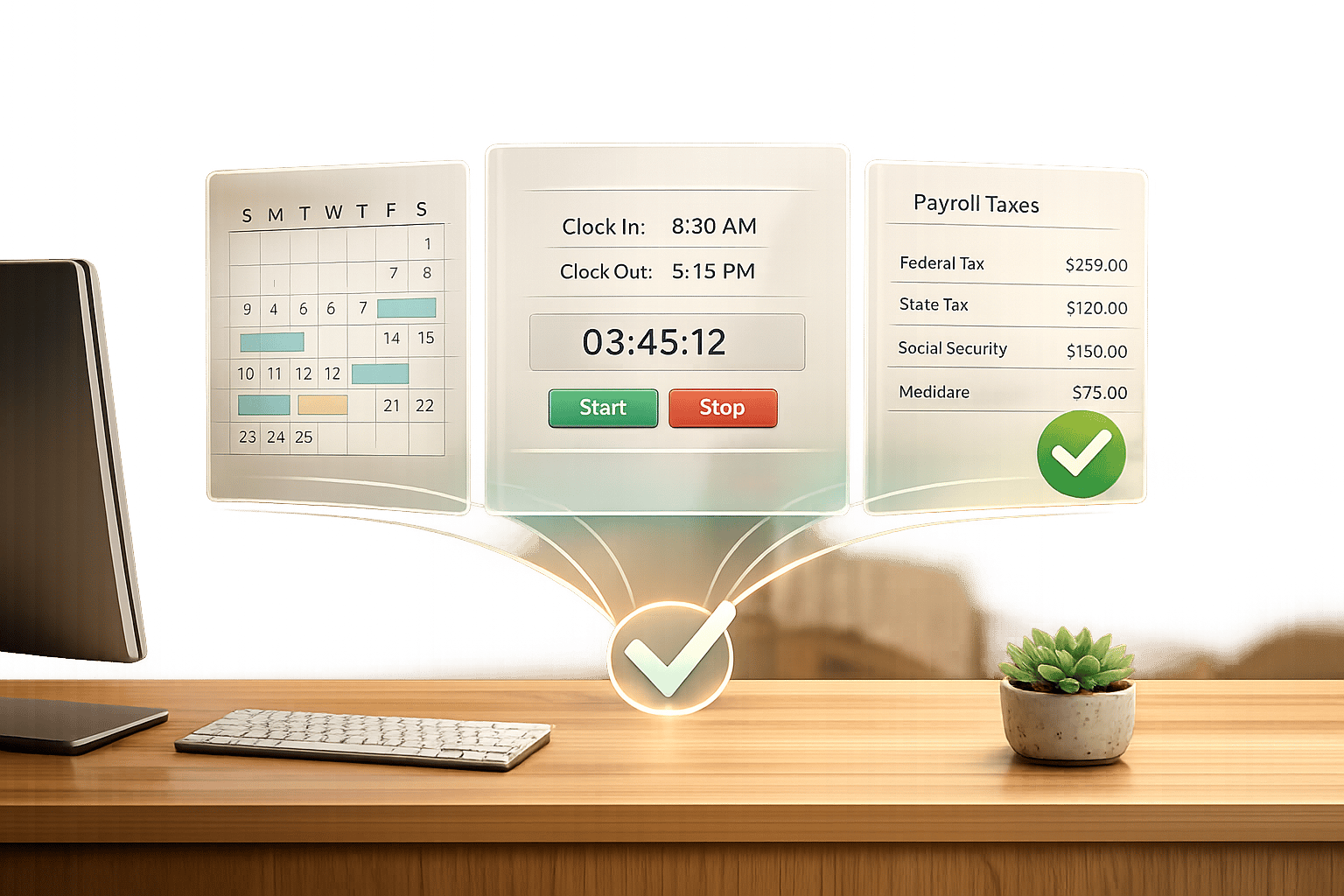
One of the most important features is full automation of tax calculations and filings. A reliable tool should handle federal, state, and local taxes, including FICA and unemployment taxes, while also automatically filing quarterly and annual forms like 1099-NECs for contractors.
Automation can simplify payroll further by syncing with appointment schedules to pull in commissions, tips, and hours worked, cutting down on manual errors. These systems can also monitor wage caps, such as the Social Security wage base, and adjust withholdings once thresholds are reached. In fact, automating tax withholding processes has been shown to reduce manual effort by up to 75%.
This level of automation is key to ensuring smooth and efficient data management across your operations.
Integration with Practice Management Systems
Integration is another critical feature that enhances efficiency. A wage withholding tool that doesn’t sync with your existing systems can create extra work and increase the risk of errors. The best tools seamlessly connect with HR systems, time-and-attendance records, and benefits data, ensuring everything flows directly into each payroll cycle.
This is especially useful for businesses where earnings fluctuate weekly due to services performed, product sales, or tips. Additionally, integration with bookkeeping platforms like QuickBooks ensures clean, accurate financial reporting without requiring extra manual input.
Real-Time Reporting and Audit Readiness
The combination of automation and integration lays the groundwork for real-time reporting, which bolsters audit preparedness. Tools with built-in audit trails and automated reconciliation between payroll data and forms like W-2s and 1099s can quickly flag discrepancies before filing.
Having digital storage for employee tax forms (like W-4s and state-specific forms) is another must-have for audits. Some tools even monitor tax rate changes across more than 7,000 U.S. tax jurisdictions and over 900 agencies, ensuring compliance with the latest rates. For businesses with employees working across state lines, this feature is invaluable.
sbb-itb-02f5876
Types of Wage Withholding Tools

Payroll Tools for Aesthetic Practices: Which One Is Right for You?
Navigating wage withholding compliance can be tricky, but choosing the right tool makes all the difference. Payroll tools come in three main types, each tailored to different needs and scales of operation. Let’s break them down to help you find the best fit for your aesthetic practice.
Dedicated Tax Withholding Software
These tools are built for precision and are typically geared toward large-scale operations. They excel at handling detailed tax calculations, liability tracking, and filing federal forms like 940, 941, and 1042. For example, Symmetry's tax engine processes paychecks for nearly 40% of the U.S. workforce, covering more than 7,000 taxing jurisdictions. This is especially handy if your team works across different localities. However, these platforms are more suited for large enterprises or developers creating payroll systems, rather than for the day-to-day operations of a practice owner.
Payroll Management Platforms
These platforms offer a broader range of services, going beyond tax calculations to manage direct deposits, generate W-2s and 1099s, oversee benefits, and handle industry-specific pay structures like tiered commissions or split tips. They also integrate with time-and-attendance systems, streamlining payroll runs by automatically syncing hours and earnings. In healthcare settings, using a compliance-focused payroll solution has been shown to reduce nearly 99% of HR-related legal claims. This makes them a solid choice for practices dealing with complex labor laws.
Practice Management Solutions with Payroll Support
For most aesthetic practices, an all-in-one platform is the way to go. These systems combine booking, point-of-sale, and payroll into one seamless solution. Take Prospyr, for example (https://prospyrmed.com). It automatically integrates tips, commissions, and work hours into payroll, eliminating manual reconciliation. As a HIPAA-compliant platform designed specifically for aesthetics and wellness clinics, Prospyr also includes scheduling, payment processing, and business analytics, offering a comprehensive foundation for smooth operations and accurate payroll.
| Category | Best For | Tax Filing | Industry Focus |
|---|---|---|---|
| Dedicated Tax Software | Large enterprises, developers | Via API or manual export | General / High-volume |
| Payroll Management Platforms | HR managers, healthcare admins | Automated federal/state/local | Healthcare, dental, medspa |
| Practice Management w/ Payroll | Practice owners, solo operators | Automated federal/state/local | Beauty, wellness, medspa |
Practical Resources for Staying Compliant
Pair your wage withholding tools with these essential, no-cost resources to stay informed and compliant. These resources are reliable and help ensure you're up-to-date with the latest requirements.
Government and Regulatory Websites
The Internal Revenue Service (IRS) is your go-to source for federal wage withholding information. Two essential publications to bookmark are:
- Publication 15 (Circular E): This guide covers employer tax responsibilities and is available at IRS.gov/Pub15.
- Publication 15-T: It includes the Percentage Method and Wage Bracket tables for calculating withholding amounts. Access it at IRS.gov/Pub15T.
Both are updated yearly, so make sure to review the latest versions regularly.
For federal tax deposits, the Electronic Federal Tax Payment System (EFTPS) at EFTPS.gov provides a secure way to make payments. Additionally, the Social Security Administration's Business Services Online (BSO) portal at SSA.gov/bso allows you to e-file W-2s and W-3s and verify employee Social Security numbers before submission.
Here are some important figures to keep in mind for 2026:
- The Social Security wage base is $184,500, with a tax rate of 6.2% for both employers and employees.
- The Medicare tax rate is 1.45% for each, with no wage cap.
- The backup withholding rate is 24%.
Employees can also take advantage of deductions for qualified tips (up to $25,000) and qualified overtime (up to $12,500). These official resources help ensure accuracy and readiness for any regulatory updates.
Staff Training Materials
Equip your team with tools like the IRS Tax Withholding Estimator, available at IRS.gov/W4App. This tool helps employees verify their Form W-4 entries, reducing the risk of under-withholding. Without a valid basis, under-withholding may result in a $500 penalty.
For payroll staff, subscribing to the IRS's E-News for Payroll Professionals is a quick way to stay updated on regulatory changes. Updates are sent directly to your email, keeping your team informed. Additionally, remember that signed Forms W-4 must be kept on file for at least four years for potential IRS inspections.
| Resource | Purpose | Where to Find It |
|---|---|---|
| Publication 15 (Circular E) | Employer tax responsibilities guide | IRS.gov/Pub15 |
| Publication 15-T | Withholding calculation tables | IRS.gov/Pub15T |
| Tax Withholding Estimator | Helps employees verify Form W-4 accuracy | IRS.gov/W4App |
| EFTPS | Secure federal tax deposit system | EFTPS.gov |
| Business Services Online | E-filing W-2s and SSN verification | SSA.gov/bso |
| E-News for Payroll Professionals | Email subscription for updates | IRS.gov |
Choosing the Right Tools for Your Practice
Matching Tools to Your Practice's Size and Needs
When selecting a payroll tool, it's important to align it with your practice's specific size and pay structure. The needs of a solo aesthetic practice differ greatly from those of a multi-location medspa. Start by considering your headcount: federal obligations like COBRA kick in at 20 employees, while the ACA and FMLA apply once you reach 50 employees. Your payroll tool should be able to grow with your practice.
Next, think about your pay structure. Aesthetic practices often juggle tiered commissions, service-based bonuses, and tip allocations - areas where generic payroll platforms often fall short. Opting for a platform that integrates with your scheduling, POS, and EMR systems can eliminate the manual data entry that leads to payroll errors. For practices in cities like New York, Philadelphia, or Pittsburgh, it's crucial to choose a tool that handles local tax requirements with precision.
For a seamless solution, consider platforms like Prospyr, which integrate scheduling, patient management, and payroll into one HIPAA-compliant system. The right tool not only supports your growth but also ensures accurate payroll management.
The Case for Accuracy and Efficiency
Payroll mistakes can be costly. For instance, a late 941 deposit on a $50,000 payroll tax liability could result in penalties as high as $7,500, with IRS late-deposit penalties ranging from 2% to 15%, depending on how overdue the payment is. These penalties directly affect your bottom line. Automating payroll processes reduces errors across tax jurisdictions, quarterly filings, and year-end W-2 generation, helping your practice avoid penalties and audits.
As one industry expert emphasized:
"People tech platforms live or die on payroll accuracy. The compliance infrastructure underneath your payroll product... is what determines whether your platform scales smoothly into new states or gets buried in compliance maintenance." - Symmetry
Choosing the right payroll tool goes beyond saving time - it safeguards your practice from compliance risks, penalties, and the administrative burden of manual processes.
FAQs
How do I avoid misclassifying W-2 employees vs. 1099 contractors?
To steer clear of misclassifying W-2 employees and 1099 contractors, it's crucial to grasp the legal guidelines outlined by the IRS and the Department of Labor. The main differences boil down to three factors: how much control the employer has, the level of independence in the work, and the financial setup between the worker and the employer.
To stay on the safe side, make sure to use clear, well-defined contracts, keep up with labor law updates, and consider using payroll tools that can help automate compliance checks. Getting these classifications right not only reduces legal risks but also keeps your payroll processes running smoothly.
What payroll data should I keep to be audit-ready?
To ensure you're always prepared for an audit, hold onto payroll tax records for at least 4 years. This includes tax forms, payment confirmations, employee details (like Social Security numbers), and wage records. For specific documents, such as retirement plan contributions, keep them for a longer period - around 6 years. Using a secure and searchable digital system can make storing and retrieving these records much easier while helping you stay compliant.
How do I handle multi-state and local tax withholding correctly?
Managing multi-state and local tax withholding can feel like a juggling act, but it starts with understanding where your employees live, work, or travel. These factors determine your tax obligations and ensure compliance with the right jurisdictions.
Using payroll software is a game-changer here. It automates complex jurisdiction-specific rules, handles calculations, and even manages filings. Staying on top of tax law changes is equally important - platforms like Prospyr are designed to focus on compliance, helping reduce errors and improve accuracy.
By combining automation with professional tools, you can simplify the process and meet regulatory requirements without unnecessary stress.