How to Benchmark Med Spa Profitability
Benchmark med spa profitability by tracking gross and net margins, revenue per provider hour, patient acquisition cost, and service-level ROI.


How to Benchmark Med Spa Profitability
Want your med spa to thrive? Start by knowing your numbers. Tracking profitability metrics like gross and net profit margins, revenue per provider hour, and patient acquisition costs can help pinpoint areas to improve. For example:
- Gross profit margin (50–65% industry average) shows how efficiently you manage services and supplies.
- Net profit margin (15–25% for mature med spas) reflects overall profitability after all expenses.
- Revenue per provider hour should ideally hit $600+ for top-performing practices.
Benchmarking against these standards reveals gaps in pricing, service efficiency, or costs. Use tools like Prospyr to automate tracking, compare metrics, and make data-driven decisions. Whether you're scaling up or refining operations, these insights keep your med spa competitive and profitable.
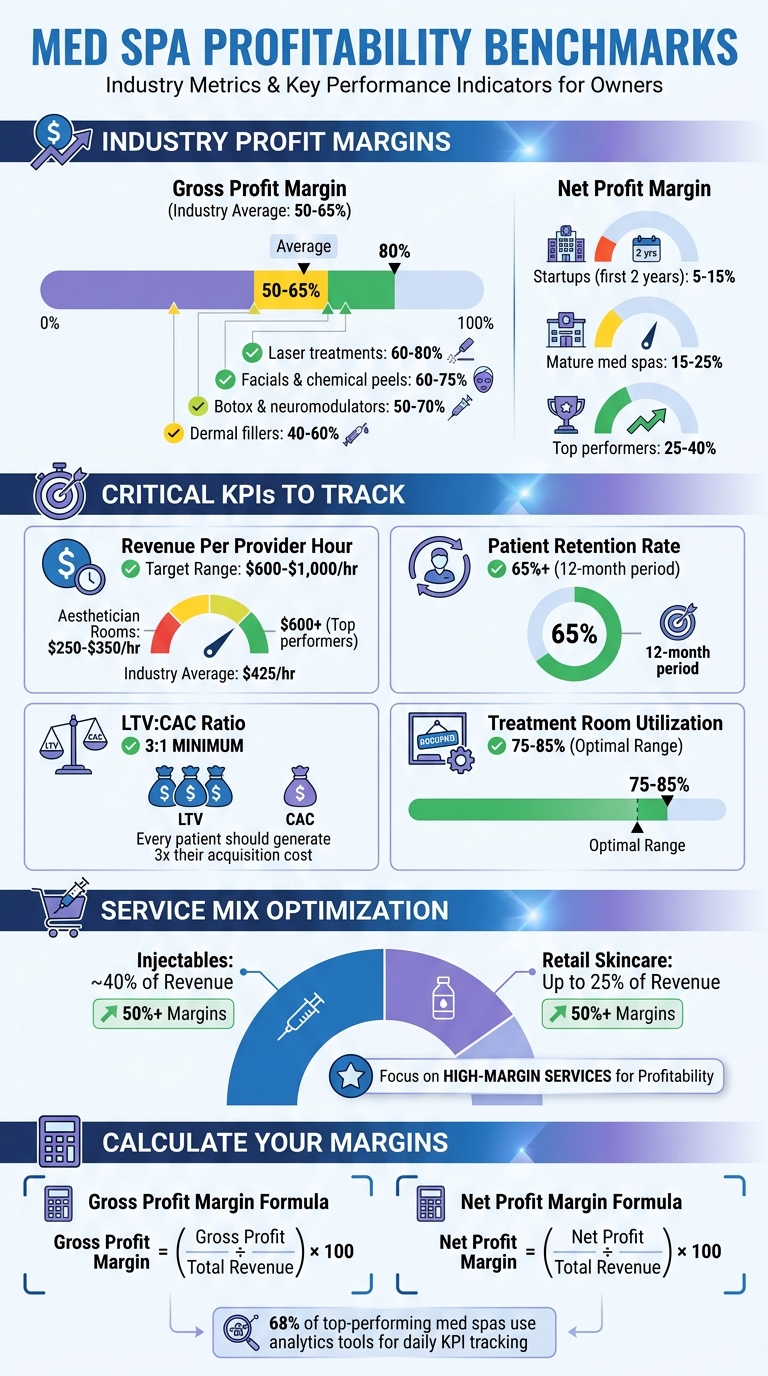
Med Spa Profitability Benchmarks: Key Metrics and Industry Standards
Key Profit Margins to Track
To effectively evaluate your med spa's financial health, focus on two critical metrics: gross profit margin and net profit margin.
Gross Profit Margin
Gross profit margin shows how much revenue remains after covering the direct costs of providing services. These costs, often referred to as Cost of Goods Sold (COGS), include items like injectables (e.g., Botox, fillers), skincare products, disposable supplies (needles, gloves), and the wages of providers directly delivering services.
This metric is a great indicator of how efficiently your operations are running and whether your pricing is on point. For instance, laser treatments often have gross margins between 60% and 80%, whereas dermal fillers typically fall between 40% and 60%. Across the med spa industry, gross profit margins generally range from 50% to 65%. If your margins are below this range, it could point to issues like overpaying for supplies, pricing services too low, or wasting products.
While gross profit margin focuses on service pricing and supply costs, it doesn’t tell the whole story. That’s where net profit margin comes in.
Net Profit Margin
Net profit margin provides a clearer picture of overall profitability by accounting for all business expenses. This includes everything from rent and administrative salaries to marketing, equipment depreciation, insurance, and taxes.
"Trying to gain insight from gross profit margin alone is like declaring a jigsaw puzzle finished when you only have one-third of the pieces."
In the med spa industry, net profit margins typically range from 15% to 25%, though top-performing businesses can hit 25% to 40%. For startups in their first two years, which often follow a med spa opening guide to manage initial overhead, margins are often lower, around 5% to 15%, as they work on building a steady client base. Even a solid gross margin can't make up for high fixed costs; a low net margin is a red flag for profitability challenges.
sbb-itb-02f5876
How to Calculate Profit Margins
Collecting Financial Data
To calculate profit margins accurately, start by gathering your financial data. Begin with your total revenue, which includes earnings from services like Botox, dermal fillers, laser treatments, and body contouring. Be sure to subtract any refunds or discounts to get the true revenue figure.
Next, identify your direct costs (COGS). These are the expenses directly tied to delivering your services, such as the cost of injectables, topical products, medical supplies, and disposable items used during treatments. Additionally, document your operating expenses, which include rent, utilities, administrative salaries, marketing costs, insurance, and equipment depreciation. Don’t forget to account for interest payments on loans and any taxes paid.
Using tools like Prospyr can simplify this process. These platforms can integrate data from your scheduling, inventory, and payment systems, automating much of the data collection. This reduces manual errors and ensures you’re working with up-to-date information rather than outdated spreadsheets.
Once you’ve collected all the necessary figures, you’ll be ready to calculate your profit margins.
Profit Margin Formulas
With your financial data organized, you can use the following formulas to calculate profit margins:
- Gross Profit Margin: Subtract your COGS from total revenue to get the gross profit. Then, divide the gross profit by total revenue and multiply by 100. For example, if your revenue is $100,000 and your direct costs are $40,000, your gross profit is $60,000. Dividing $60,000 by $100,000 and multiplying by 100 gives a 60% gross profit margin.
- Net Profit Margin: Subtract all expenses - COGS, operating costs, interest, and taxes - from your total revenue to calculate net profit. Divide the net profit by total revenue and multiply by 100. Using the same $100,000 revenue, if your total expenses leave you with $20,000, your net profit margin is 20%. This figure reflects how much profit you retain from every dollar earned.
Here’s a quick reference table for the key metrics:
| Metric | Formula | Purpose |
|---|---|---|
| Gross Profit Margin | (Gross Profit / Net Sales) × 100 | Evaluates the profitability of specific products or services |
| Net Profit Margin | (Net Profit / Total Revenue) × 100 | Shows how much profit is made per dollar of total revenue |
| Operating Profit Margin | (Operating Income / Total Revenue) × 100 | Measures operational efficiency, excluding taxes and debt |
Industry Profitability Benchmarks
Once you've calculated your profit margins, it's time to see how they stack up against industry standards. These benchmarks can help you evaluate the financial health of your med spa.
Gross Margin Standards
In the U.S., med spas typically achieve gross margins between 50% and 65%. This figure reflects what's left after deducting direct costs - like injectables, consumables, and product expenses - from total revenue. That said, your specific margin will depend on the services you offer.
Laser treatments tend to deliver the highest gross margins at 60–80%, thanks to high initial equipment costs but low ongoing per-use expenses. Facials and chemical peels come next, with margins of 60–75%, driven by low supply costs and the potential for high volumes. Botox and neuromodulators typically yield 50–70%, while dermal fillers fall slightly lower at 40–60%, largely due to moderate product costs. If your gross margin dips below 50%, it’s worth revisiting your pricing strategy or focusing more on higher-margin services. These benchmarks can guide you in adjusting your pricing and service offerings effectively.
"The advantage med spas hold is the combination of elective, cash-pay services (no insurance billing friction), high repeat purchase behavior, and strong pricing power relative to input costs." - Adam Durso, Vagaro
While gross margins highlight the profitability of individual services, net margins give you a clearer picture of your overall business performance.
Net Margin Standards
Net profit margins can vary widely depending on how established your med spa is. Newer practices often see lower net margins, around 5–15%, due to initial investments and the time needed to build a steady client base.
For mature and well-managed med spas, average net margins fall between 15–25%, with top-performing practices achieving 25–40% by streamlining operations. In comparison to similar industries, med spas (15–25% net) hold their own against plastic surgery practices (20–30% net) and outperform traditional day spas (5–15% net), thanks to premium pricing and a cash-pay model.
Reading about the problem? See how Prospyr solves it in one platform.
Book a DemoOther Financial Metrics to Monitor
Keeping an eye on profit margins is just the beginning. There are other key performance indicators (KPIs) that can reveal inefficiencies, pricing opportunities, and even patient retention challenges. Let’s dive into how certain operational metrics can give you a clearer picture of your financial standing.
Revenue Per Provider Hour
This metric looks at how much income a provider generates for every hour they spend delivering services. It’s a great way to measure efficiency and identify which services bring in the most revenue. To calculate it, divide your total service revenue by the number of hours providers spend performing treatments. Terri Ross, Founder of APX Platform, offers a benchmark:
"In a medical spa, a room should generate between $600 and over $1,000 per hour".
Currently, the industry average sits at about $425 per hour. Rooms used by aestheticians typically bring in $250 to $350 per hour. If your revenue per hour is less than $600, it might be time to investigate. Are providers spending too much time on services? Or is your schedule filled with low-margin treatments? Ross emphasizes:
"If your gross profit is not 50% or greater, you may just be breaking even or worse".
Next, consider how much you're spending to bring in new patients and how much revenue they generate over time.
Patient Acquisition Cost and Lifetime Value
Patient Acquisition Cost (PAC or CAC) tells you how much it costs to attract a new client. On the other hand, Lifetime Value (LTV) calculates the total revenue a patient brings in throughout their relationship with your practice. To get a clear picture, use data from the past 12 months to evaluate your marketing investments. A strong med spa should aim for an LTV:CAC ratio of at least 3:1. This means every patient should generate three times what you spent to acquire them. As Aesthetic.Consulting points out:
"Instagram followers and raw lead volume do not pay your staff. Focus on the metrics that private equity buyers actually review during acquisition".
Tracking these metrics weekly - using automated tools - can help you spot trends and make strategic adjustments. Combined with profit margins, they provide a well-rounded view of your practice's financial health.
Finally, let’s look at how effectively you're using your treatment rooms and retaining patients.
Treatment Room Utilization and Rebooking Rates
Treatment room utilization measures how well your appointment slots are filled with revenue-generating services. It’s a useful metric for identifying unused capacity or potential scheduling issues. Rebooking rates, on the other hand, show the percentage of patients who schedule their next visit before leaving. These rates are a great indicator of short-term patient engagement. A healthy med spa retains over 65% of its patients within a 12-month period. Breaking these metrics down by provider can highlight areas of strength and reveal where improvements are needed.
Measuring Service-Level Profitability
When you analyze your overall profit margins, diving deeper into service-level profitability can reveal which treatments are truly driving your practice’s success. Not all services contribute equally. A treatment might seem lucrative due to its price, but once you factor in labor, supplies, and the time it takes to perform, the reality can be very different. To get a clear picture, track these four critical data points for every service: price charged, labor costs, cost of goods (COGS), and service duration.
Calculating Profit Margins by Service
To identify trends, analyze your data over a three-, six-, or 12-month period. For each service, calculate gross profit by subtracting labor and COGS from total revenue. Then, determine how much revenue each service generates per hour by dividing the service revenue by its duration. A service might have a high price tag, but if it takes too long, it could drag down your overall profitability.
Terri Ross, Founder of APX Platform, underscores the importance of this calculation:
"From a financial perspective, the only way you can arrive at your gross profit is by knowing your revenue less the cost of goods and labor... If your gross profit is not 50% or greater, you may just be breaking even or worse".
If your revenue per hour falls below $600, it's time to make adjustments. Low revenue per hour often points to issues like underpricing, overly long service durations, or an unbalanced service mix.
Take Olam Med-Spa in Florida as an example. By optimizing their service performance, they achieved an impressive 485% revenue growth in just one year.
Armed with this data, you can streamline your offerings and focus on the treatments that yield the best results.
Optimizing Your Service Mix
Service-level insights can guide you in refining your treatment options to maximize profitability. For instance, injectables typically contribute around 40% of the average med spa’s revenue, with profit margins exceeding 50%. Retail skincare products often bring in similar margins, making them another high-performing category. On the other hand, spending too much time on low-margin treatments like IV vitamin therapy or laser hair removal can hold your practice back.
To boost profitability, consider bundling high-margin services with complementary treatments. For example, pairing injectables with skin rejuvenation packages can increase the average ticket size while delivering added value to your patients. You might also explore tiered pricing, offering standard and premium options based on provider expertise or product quality. This approach can increase revenue by as much as 20%.
Don’t forget about retail sales either. Training your staff to recommend products during treatments adds revenue without extending appointment times. In top-performing med spas, retail can account for up to 25% of total revenue.
Using Analytics Tools for Benchmarking
Relying on manual spreadsheets can be a time sink and a source of errors. Automated dashboards, on the other hand, are game-changers. A 2024 survey of over 500 practices found that these tools improve operational efficiency by 20–30% and boost net profit margins by 15%. They also cut reporting time from 10–15 hours down to less than 2 hours. Here's the kicker: 68% of the most profitable med spas - those in the top quartile - use integrated analytics tools for daily KPI tracking, compared to only 32% of lower-performing practices. These tools don’t just crunch numbers; they turn raw data into actionable insights, helping you pinpoint where you're falling short and fine-tune your service offerings. Let’s dive into how tracking KPIs and generating service-specific reports can directly impact your bottom line.
Tracking KPIs and Profit Margins
Platforms like Prospyr provide real-time dashboards that track critical metrics like gross profit margin, net profit margin, revenue per provider hour, and treatment room utilization. These platforms don’t just track - they benchmark. For example, if your net margin dips below 40%, the system flags it for immediate attention.
Take revenue per provider hour as an example. Prospyr calculates this by dividing total revenue by billable hours pulled from scheduling data. It then compares your results to the industry standard of $150–$250 per hour for U.S. med spas. If a provider averages $180 per hour when the benchmark is $220, the dashboard identifies underperformance and suggests solutions like AI-powered booking tools to optimize schedules. One med spa saw a 15% jump in profitability after using these insights to address low rebooking rates.
Service-Level Profitability Reports
Beyond KPIs, service-level reports offer a deeper dive into treatment-specific profitability. Modern analytics tools automatically calculate profit margins for each treatment by combining inventory costs, pricing, and provider time data. Prospyr’s service-level reports, for instance, rank treatments by profitability. You might see fillers delivering a 68% gross margin while lasers lag at 52%. You can even filter data by provider or location to uncover specific issues, like a 15% margin drop in facials due to high supply costs.
The platform also creates exportable PDFs with visual aids like pie charts, making it easy to identify which treatments are driving profits and which are dragging you down. Consultants often recommend using 30-day rolling averages to account for seasonal trends, such as the summer surge in aesthetic treatments.
Taking Action on Benchmarking Results
Benchmarking should lead to meaningful changes. Use the insights you've gathered to make measurable improvements right away. For instance, if your net margins fall short compared to top-performing practices, develop a clear plan to bridge that gap. Focus on actionable areas like reducing patient acquisition costs or improving how treatment rooms are utilized.
Finding and Fixing Performance Gaps
Start by comparing your metrics to industry benchmarks to identify problem areas. For example, if provider salaries are consuming more than 25–35% of your total revenue, consider automating administrative tasks. This allows providers to dedicate more time to revenue-generating treatments. Tools such as Prospyr, which offers features like AI-powered note creation and automated scheduling, can help reduce non-billable hours and improve efficiency.
Take a closer look at your service offerings. If data shows that some services (like facials with a 62% gross margin) underperform compared to others (like laser treatments with a 75% gross margin), it may be time to refine your service menu. Eliminate low-margin treatments and shift focus to higher-margin options like injectables and lasers. High-performing practices often convert 15–20% of their active clients into membership programs, turning occasional visits into steady, recurring revenue.
Inventory management is another critical area. Product waste can eat into your margins. Use digital tools to track inventory and set reorder thresholds to avoid overstocking. Additionally, negotiate volume-based discounts or join group purchasing networks to lower product costs, which typically account for 10–20% of revenue.
Addressing these gaps can streamline your operations and set the stage for cost-efficient marketing strategies.
Improving Operations and Marketing
Once you've identified performance gaps, focus on refining your operations and marketing to boost profitability. For instance, if your treatment room utilization is below the ideal 75–85% range, you're missing out on potential revenue. Smart scheduling tools can help fill cancellation slots and optimize appointment times. Automated reminders and AI-driven booking systems can also keep your schedule running smoothly.
On the marketing front, cut back on costly ad campaigns and focus on reactivating existing patients. Automated email sequences and referral programs are often more affordable and yield better lifetime value. Aim for an LTV to CAC ratio of at least 3:1 to ensure sustainable growth.
To increase revenue per provider hour, eliminate operational bottlenecks. If providers are bogged down with administrative tasks, consider using tools like Prospyr's real-time dashboards and AI conversation agents to streamline workflows. This frees up providers to concentrate on high-value treatments rather than paperwork, maximizing both their time and your practice's revenue.
Conclusion
Keep a close eye on your med spa's profitability to remain competitive and financially stable. As Terri Ross from Terri Ross Consulting emphasizes:
"Without knowing your numbers, you cannot scale, you cannot make informed decisions and you cannot course-correct."
Regularly track key metrics like gross and net profit margins, revenue per provider hour, patient acquisition cost, and treatment room utilization. Monitoring these KPIs consistently helps you spot trends and make accurate forecasts, ensuring your business stays on track with industry standards.
Leverage tools like Prospyr for real-time dashboards that simplify KPI tracking and generate service-level profitability reports. These tools deliver actionable financial insights and reduce administrative tasks, allowing you to focus on growing your practice. Features like automated reporting and AI-powered analytics make decision-making faster and more efficient.
FAQs
What should I include in COGS for a med spa?
COGS, or Cost of Goods Sold, refers to expenses directly linked to providing treatments and services at a med spa. These costs typically include:
- Medical supplies: Items like syringes, needles, and anesthetics.
- Skincare products: Products used during various procedures.
- Consumables for equipment and treatments: Disposable items required for specific devices or services.
Keeping a close eye on these expenses is crucial for determining gross profit margins and assessing the overall financial health of the business.
How do I benchmark profit when my service mix is different?
To understand profitability across your service offerings, start by analyzing revenue and margins for each treatment type. For example, compare how injectables stack up against laser treatments in terms of profit. This helps you pinpoint which services are driving the most value.
Focus on tracking key metrics like:
- Gross profit margin: This shows how much profit you're making after covering the costs of each service.
- Utilization rates: This measures how often each service is being used relative to its capacity.
Compare these metrics to industry standards to see how your business measures up. For even deeper insights, leverage real-time analytics tools. These tools can help you identify trends and make data-driven adjustments to your service mix, ultimately boosting both revenue and profitability.
How often should I review these KPIs to stay on track?
Regularly checking your KPIs is a key part of keeping your med spa profitable and on track for growth. How often you review them depends on your specific goals and metrics, but a monthly review is usually a solid choice. It allows you to monitor financial performance, client retention, and how smoothly your operations are running. If your clinic is going through a growth spurt or trying out new strategies, weekly or bi-weekly reviews might be helpful for staying on top of things. However, for most, monthly reviews provide a good middle ground.