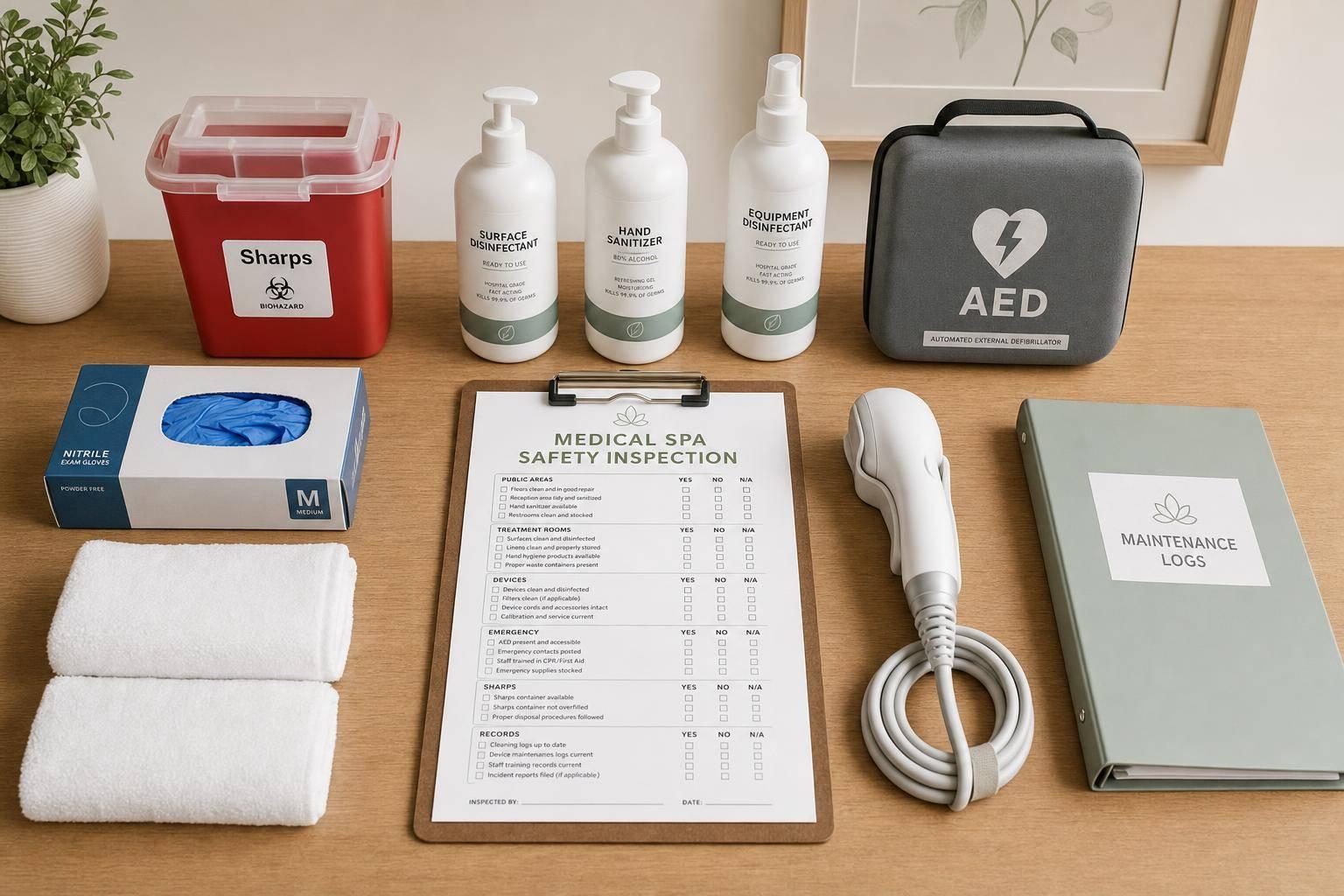

- Malpractice Claims: The most frequent and costly risk, with average verdicts reaching $440,323. Claims can also raise insurance premiums by 15%-30% for several years.
- Policy Exclusions: Treatments like IV therapy or advanced lasers may not be covered unless explicitly listed in your policy.
- Documentation Issues: Poor record-keeping can lead to claim denials. Consent forms, treatment logs, and before-and-after photos are critical.
- Employee Coverage Gaps: Staff treatments or injuries may not be covered under standard policies.
- Scope of Practice Violations: Operating outside licensing or training can void insurance and lead to lawsuits.
- Cyber Risks and HIPAA Violations: Fines for data breaches or HIPAA violations can exceed $2 million per violation category.
Quick Takeaways:
- Invest in proper insurance: Professional liability, general liability, and product liability are essential.
- Maintain detailed records: Proper documentation can protect against claims.
- Regularly review policies: Ensure all services and staff are covered.
- Use technology: Tools like Prospyr can simplify compliance and reduce risks.
These steps can help safeguard your practice from financial and reputational damage.

Top 6 Insurance Risks for Aesthetic Practices with Costs and Statistics
Common Insurance Risks in Aesthetic Practices
Aesthetic practices navigate a complex landscape of insurance risks that can lead to costly financial setbacks. Being aware of these vulnerabilities is key to protecting your business from claim denials and unexpected expenses. Let’s break down some of the most significant risks that aesthetic practices face.
Policy Exclusions for High-Risk Procedures
One of the most common pitfalls is the exclusion of certain treatments from liability policies. If your practice offers services like IV therapy, weight loss injections, or advanced laser treatments, these may not be covered unless explicitly listed in your policy. This becomes a major issue when practices expand their offerings without updating their insurance coverage. For instance, product liability coverage might be included but capped at limits like $100,000, which could fall short in situations involving multiple patients or severe adverse reactions.
Another challenge comes with claims-made policies. If your coverage lapses and you don’t purchase tail coverage, any claim filed after the lapse - even for treatments performed while the policy was active - can be denied. These gaps highlight how crucial it is to report claims promptly and maintain meticulous documentation.
Late Claim Notifications and Poor Documentation
Timely reporting is critical, as many insurers require claims to be reported within 24 to 48 hours. Missing this window often results in claim denials. Equally important is maintaining detailed and accurate records. Without proper documentation - such as consent forms, treatment logs, and before-and-after photos - it’s much harder to defend against negligence claims. In fact, before-and-after photos are considered one of the strongest defenses in malpractice cases. With 38% of nonsurgical cosmetic malpractice claims ending in plaintiff victories, thorough documentation isn’t just helpful - it’s essential.
Employee Treatment Coverage Exclusions
Another overlooked risk involves treatments provided to employees. Many malpractice policies exclude coverage for staff treatments, leaving a blind spot that could lead to uncovered claims. Beyond treatments, employee injuries are another area of concern. Needlestick injuries, repetitive strain, and chemical exposure are common in aesthetic practices. For example, needlestick injuries can cost between $5,000 and $30,000 per claim, while repetitive strain injuries may range from $10,000 to $50,000.
Additionally, workers' compensation insurance is required in 49 states. Failure to carry this insurance can result in state penalties and leave your business liable for medical costs and lost wages. Ensuring proper coverage for both patient and employee-related risks is non-negotiable.
Scope of Practice and Licensing Issues
Performing treatments outside a provider’s training or licensing is a significant liability. Insurers often deny claims when treatments are administered by unlicensed or improperly credentialed staff. Courts have imposed heavy penalties in cases where practices failed to verify credentials. A notable example occurred in 2021, when a Scottsdale, Arizona medical spa faced a lawsuit for permanent scarring caused by laser hair removal burns. The practice’s attempt to shift blame to an independent contractor revealed a common issue: many policies don’t cover non-employees.
Policies also typically exclude "illegal actions", meaning if a provider operates outside their legal scope, the entire policy could be voided. This underscores the importance of ensuring all practitioners are properly licensed and operating within their scope.
Unclear Policy Terms and Renewal Oversights
Ambiguous policy language and failure to update coverage as your practice grows can leave you exposed. Many practices mistakenly assume their general liability or malpractice policy covers all services, only to discover exclusions buried in the fine print. Independent contractors add another layer of complexity, as they may not be covered under your business policy if the insurer requires them to carry their own insurance.
Additionally, product liability sub-limits might not provide sufficient coverage for severe incidents. Regularly auditing your policy is crucial - make sure all services are explicitly listed, and review your coverage whenever you introduce new treatments, hire staff, or make changes to your business structure. These proactive steps can prevent costly surprises down the line.
sbb-itb-02f5876
Types of Insurance Coverage for Aesthetic Practices
Getting the right insurance coverage is crucial for safeguarding your aesthetic practice from unexpected risks. These core insurance policies address specific areas of concern that, if not properly covered, could leave your business exposed. Here's a breakdown of the three key types of insurance every aesthetic practice should have.
Professional Liability Insurance
Professional liability insurance, often called malpractice insurance, is the cornerstone of protection for aesthetic practices. It covers claims related to treatment errors, negligence, or insufficient informed consent. This is particularly important for managing complications like laser burns, nerve damage, scarring, or issues from procedures such as filler injections or chemical peels.
"Malpractice insurance (also called professional liability insurance) is the most critical policy for any med spa. It covers claims that a medical treatment caused patient injury due to negligence, error, or omission." - Latent Insurance
Coverage limits typically include $1 million per claim and $3 million in aggregate, with annual premiums ranging from $3,500 to $7,500. To avoid gaps, make sure every procedure you offer - from Botox to IV therapy - is explicitly listed on your policy.
General Liability Insurance
General liability insurance handles non-medical accidents that occur on your premises. This includes incidents like slip-and-fall injuries in your waiting area, damage to neighboring properties, or claims related to advertising injuries (e.g., copyright infringement or defamation). Many landlords require proof of general liability insurance before you can sign a commercial lease.
Annual premiums usually fall between $500 and $2,000, with standard coverage limits of $1 million per occurrence and $2 million in aggregate. It’s important to note that general liability doesn’t cover treatment-related claims, which are the domain of professional liability insurance. Many practices opt to bundle general liability and commercial property insurance into a Business Owner’s Policy (BOP) for cost savings.
Product Liability Insurance
Product liability insurance protects against injuries or adverse reactions caused by products used during treatments or sold to clients. This could include issues like allergic reactions, chemical burns, or complications from contaminated fillers or mislabeled products. While product liability is often included as a sub-limit within general liability policies, it may not fully cover incidents involving multiple patients.
If your practice sells private-label skincare, uses compounded medications, or imports products, you might need standalone or enhanced product liability coverage. These standalone policies typically cost between $300 and $800 per year. Be sure to review your general liability policy to confirm whether the product liability sub-limit is adequate, especially if you sell high volumes of retail or medical-grade products. Up next, explore ways to manage these risks effectively.
How to Reduce Insurance Risks
Minimizing insurance risks goes beyond just avoiding claims - it's about building a practice that not only qualifies for better rates but also safeguards your reputation. Clinics with well-documented protocols and clean claims histories can often secure insurance premiums that are 10% to 20% lower than standard rates. Here's how you can achieve that.
Improving Documentation and Record-Keeping
Keeping detailed, real-time records is one of your strongest defenses. Document every aspect of a treatment session immediately, including device settings, product lot numbers, and any patient reactions. This level of detail can be crucial in defending against claims.
"A thorough informed consent process and detailed treatment documentation are your two most powerful defenses in a malpractice claim. Without them, a provider's word against a patient's word is all you have." - Jatin Sandilya, Latent Insurance
Use consent forms tailored to each procedure instead of generic templates. For example, a filler consent form should explicitly mention the risk of vascular occlusion, while a laser consent form should address burns and scarring. To further strengthen your records, maintain a visual timeline with before-and-after photos taken under consistent lighting and angles. Store these securely in your EMR system, not on personal devices or unprotected cloud storage.
An example of how poor documentation can lead to trouble comes from a UK aesthetic clinic in November 2025. The clinic trialed a High-Intensity Focused Ultrasound (HIFU) treatment on an employee but failed to obtain a signed consent form or create a treatment record. When the employee sustained a burn and filed a claim, the insurer, Cosmetic Insure, denied coverage because the clinic hadn't followed proper record-keeping protocols.
Don't overlook equipment logs. Record every maintenance event, calibration, and safety check for lasers and other energy-based devices. Burns caused by uncalibrated lasers make up 47% of all cutaneous laser injury cases. Having detailed maintenance records can demonstrate that negligence wasn't a factor.
Lastly, ensure your entire team is properly trained and credentialed - this is just as important as maintaining solid documentation.
Regular Staff Training and Certifications
Credentialing mistakes are often behind the most expensive malpractice judgments in the aesthetics field. Always verify licenses directly with state licensing boards instead of relying on a provider's word. Check the active status and any disciplinary actions for MDs, RNs, NPs, PAs, and estheticians. To stay ahead, establish a system to re-verify all staff licenses and certifications annually.
"Training on every device and procedure should be documented, not just completed. Credentialing failures are the root cause of the most expensive med spa claims." - Jatin Sandilya, Latent Insurance
Training should go beyond basic licensing. Require device-specific certifications from manufacturers and supervised hands-on training for every procedure offered. For new staff, document observed procedures before allowing them to work independently. Additionally, track continuing education credits related to aesthetic medicine. These records can serve as critical evidence in the event of a claim.
A claim can lead to premium increases of 15% to 30% for 3 to 5 years. Avoiding that first claim through proper credentialing and training saves far more than the cost of maintaining detailed records.
Modern tools can simplify the process of managing these records, reducing the risk of errors.
Using Technology with Prospyr
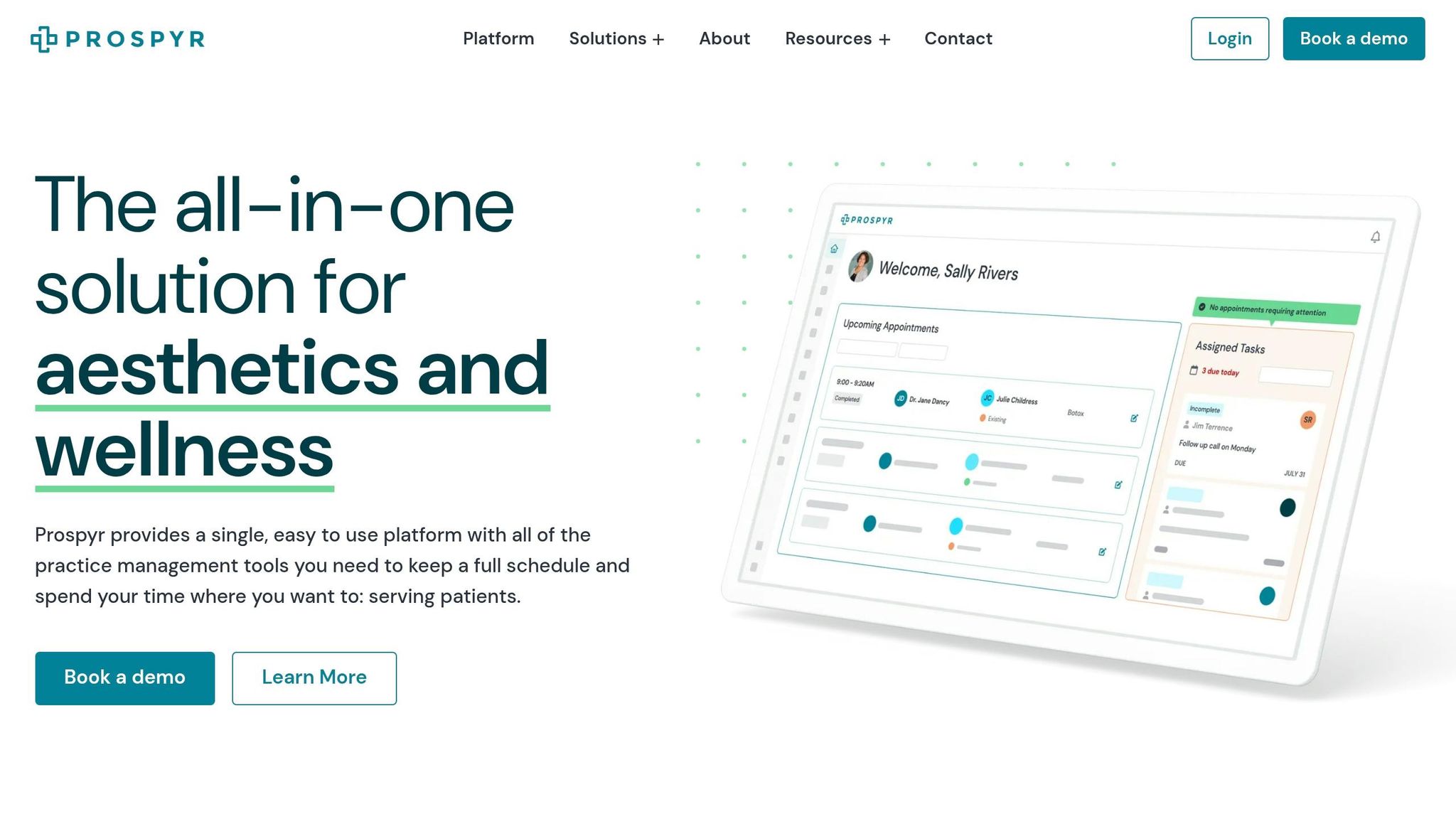
Technology can play a significant role in reducing risks and preventing costly claims. Platforms like Prospyr, which are HIPAA-compliant, help streamline operations and minimize human error. They encrypt patient data and are backed by Business Associate Agreements, reducing the risk of regulatory fines that can range from $145 to $2.19 million per violation category.
Prospyr's digital intake forms use conditional fields to align risk explanations with the specific treatment selected. This ensures every patient receives consent forms tailored to their procedure, closing documentation gaps. The platform also uses AI-powered note transcription to create timestamped records that link every communication, consent form, and photo directly to each appointment. These audit-ready records can be invaluable if a claim arises.
To further protect patient data, enable multi-factor authentication on all systems. Prospyr also offers practice analytics that can send digital alerts for annual license re-verifications, helping to prevent credentialing failures. Its task management features track equipment maintenance schedules and store staff training certifications, ensuring compliance during audits or claims.
| Documentation Element | Prospyr Feature | Risk Mitigated |
|---|---|---|
| Informed Consent | Procedure-specific digital forms | "He said, she said" disputes |
| Treatment Notes | AI note transcription with timestamps | Claims of negligence or improper technique |
| Photos | HIPAA-compliant EMR storage | Exaggerated or fabricated injury claims |
| Credentialing | Automated re-verification alerts | Million-dollar judgments for unlicensed practice |
| Equipment Logs | Task management for maintenance tracking | Burns from uncalibrated devices |
Conclusion
Aesthetic practices face a range of insurance risks that can jeopardize both their financial stability and reputation. Among these, malpractice claims stand out as the most severe, while cyber liability has emerged as a rapidly growing concern. For instance, data breaches in smaller practices can result in costs exceeding $100,000, and HIPAA violations carry penalties that can reach up to $2,190,294 per category. On top of that, employment disputes bring additional challenges, with legal defense costs ranging from $75,000 to $250,000.
These risks don't just threaten patient safety - they can also wreak havoc on your practice's financial health. A single claim can lead to cash flow issues and long-term expenses due to rising premiums. Worse still, underinsurance could expose your personal assets if a judgment surpasses your policy limits.
To address these challenges, a multi-policy insurance strategy is crucial. Coverage that spans six to eight policies can help safeguard against a variety of risks, from laser burns and cyberattacks to wrongful termination claims. Still, insurance is only part of the solution. Successful practices combine comprehensive coverage with strong internal protocols, such as meticulous documentation, regular credentialing checks, and the use of HIPAA-compliant technology.
Pairing robust insurance with proactive, technology-driven risk management is key. Tools like Prospyr can streamline documentation and compliance, turning risk management into a competitive advantage. When your systems are designed to protect both patient data and your financial stability, your practice is in a stronger position to thrive in an industry where reputation is everything.
FAQs
Does my malpractice policy cover every service I offer?
Your malpractice insurance might not automatically cover every service you perform. Unless each procedure is explicitly listed in your policy, you could be at risk. To avoid gaps in coverage, take the time to thoroughly review your policy and confirm that all the services you provide are included.
What documentation do I need to avoid claim denials?
To minimize the risk of claim denials, it's crucial to keep detailed and organized documentation. This should include:
- Digital consent forms: Ensure patients provide clear, documented consent before any procedure.
- Pre-treatment photos: Capture high-quality images to establish a baseline and support the necessity of the treatment.
- Detailed records: Document every procedure and patient interaction thoroughly, noting specifics that could be relevant to claims.
Maintaining precise and complete records not only helps safeguard your practice but also simplifies the claims process.
What happens if my claims-made policy lapses?
If your claims-made policy expires, you could lose coverage for claims tied to incidents that happened while the policy was in effect. This lapse might expose your practice to major financial risks and leave gaps in your protection. To prevent this, make sure your policy stays active or explore options like tail coverage, which can extend protection for prior incidents.