

Brand messaging and value proposition are often confused but serve distinct purposes in shaping a business's communication strategy, especially in competitive fields like aesthetic practices. Here's the core difference:
- Value Proposition: This is your clinic's promise. It answers, "Why should a patient choose you?" It’s a concise statement highlighting the core benefit you offer, the target audience, and what sets you apart.
- Brand Messaging: This is how you communicate that promise. It’s the tone, words, and stories used across platforms like your website, social media, and patient interactions to connect emotionally and build trust.
Key Takeaways:
- Value Proposition is stable and strategic, guiding your overall business positioning.
- Brand Messaging evolves based on the audience and platform but stays aligned with the value proposition.
- Both work together to ensure clarity and trust throughout the patient journey.
Quick Comparison:
| Aspect | Value Proposition | Brand Messaging |
|---|---|---|
| Purpose | Core promise, answers "why choose us?" | Communicates the promise emotionally |
| Scope | High-level, overarching statement | Broad narrative for various platforms |
| Use Case | Business strategy, competitive positioning | Day-to-day communication (ads, emails, etc.) |
| Longevity | Stable, changes with business growth | Adjusts with campaigns and audience needs |
Understanding and aligning these two elements ensures your practice delivers a consistent message that resonates with patients and builds trust over time.
What is Brand Messaging in Aesthetic Practices?
Brand messaging is how your practice communicates its story across every platform and interaction. It’s not just about having a catchy tagline - it’s a structured system that defines your positioning, value, credibility, and tone. This framework ensures that your messaging stays consistent and resonates with your audience.
"A brand messaging framework is how you stabilize that story. It's a working system for positioning, value propositions, proof, and tone, built so multiple teams can use it without rewriting the truth each time." - Brand Vision
Core Components of Brand Messaging
There are four key elements that form the foundation of your brand’s identity and how it’s perceived by patients:
| Component | Purpose |
|---|---|
| Positioning | Defines where your practice fits in the market, who you serve, and the outcomes patients want |
| Value Propositions | Translates your practice’s strengths into benefits that matter to your patients |
| Proof | Validates your claims with data, testimonials, and industry standards |
| Tone & Voice | Shapes your practice’s personality and ensures communication feels consistent |
Your voice stays steady, representing your brand’s personality. However, your tone can adapt to suit the situation. For instance, your website might use a confident, results-driven tone, while a follow-up email might feel more empathetic and calming.
Where Brand Messaging is Used
Brand messaging is present in every patient interaction - whether it’s your website, social media, or consultations. The goal isn’t to repeat the same phrases everywhere but to ensure all communication aligns with your brand’s identity. This consistency helps patients recognize and trust your practice.
As your practice grows, team members may describe your services in different ways, leading to mixed messages. Implementing a system for lead management ensures that every inquiry is handled with the same consistent brand voice. A clear messaging framework prevents this by keeping communication unified and on-brand.
What You Need Before Building Brand Messaging
Before you start crafting your messaging, make sure you’ve nailed down three critical factors:
- Your ideal patient: Understand not just demographics but also their key concerns, such as fears of unnatural results or worries about safety.
- Your unique position: Identify how your practice stands out in the market.
- Your patients’ challenges: Pinpoint the specific problems or pain points they want to solve.
This deeper understanding allows you to create messaging that feels personal and relevant. Instead of sounding generic, your practice can address patients’ concerns directly, building trust and connection.
sbb-itb-02f5876
What is a Value Proposition in Aesthetic Practices?
Your brand messaging tells the story of your practice, but your value proposition boils that story down into one powerful statement - a promise that defines why patients should choose you.
A value proposition is a concise, straightforward answer to the question every potential patient is asking: "Why should I choose you?" It highlights the specific benefit your practice offers, who it’s tailored for, and how it stands out from other options. Think of it as the heart of your practice's promise - the reason someone schedules a consultation with you instead of someone else.
"Your brand's value proposition is a promise of value to be delivered. It's the primary reason a prospect should buy from you." - Peep Laja, Founder, CXL
Unlike broader brand messaging, a value proposition zeroes in on solving a patient’s specific problem and positions your practice as the ideal solution. Kaplan and Norton sum it up perfectly: "Strategy is based on a differentiated customer value proposition."
Key Elements of a Value Proposition
A strong value proposition includes three essential components: who your target patient is, the key benefit they’ll receive, and what makes your practice stand out from the rest.
To refine your value proposition, try the "3 C's" framework:
- Customer: What are their emotional needs and frustrations?
- Competitor: What are the gaps in what others offer?
- Capability: What does your practice do better than anyone else in your market?
Types of Value Propositions in Aesthetics
Value propositions in aesthetics can work at two levels: practice-wide or service-specific.
- Practice-level value propositions: These define your overall brand promise. For example, "The region's leader in regenerative aesthetics" sets the tone for your entire patient base.
- Service-specific value propositions: These focus on individual treatments or offerings. Examples include "Natural-looking lip filler with zero downtime" or a membership program centered on long-term skin health.
While the practice-level proposition builds trust and recognition over time, service-specific propositions are what patients lean on when deciding between treatment options.
What You Need Before Defining a Value Proposition
Before crafting your value proposition, you’ll need to do some groundwork. Three critical steps include:
- Competitor Analysis: Understand what others in your market are promising and identify where they fall short.
- Patient Psychographics: Go beyond basic demographics - figure out what your patients truly want to achieve.
- Financial Clarity: Promise only what your practice can deliver sustainably. Overpromising can damage trust quickly.
Key Differences Between Brand Messaging and Value Proposition
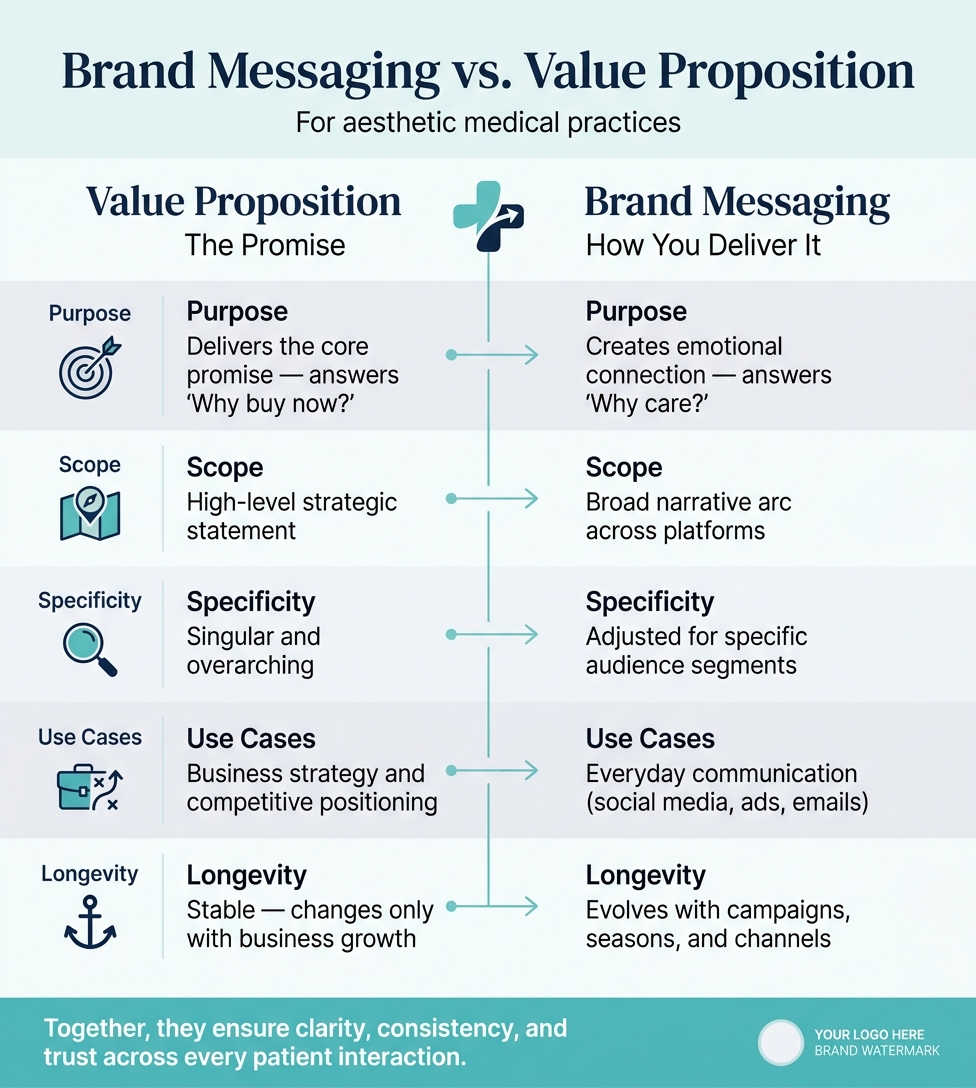
Brand Messaging vs. Value Proposition: Key Differences at a Glance
Brand messaging and value proposition may seem similar, but they serve distinct roles in your strategy. One shapes how you communicate, while the other defines what you promise. Mixing them up can weaken your overall approach. Your value proposition is the promise you make to your audience, while brand messaging is the way you deliver that promise through tone, language, and storytelling. Caleb Radford from 1 Bold Step captures this idea perfectly:
"In business, it's not always the best companies or products that succeed - it's the brands that communicate their value the clearest." – Caleb Radford, 1 Bold Step
Understanding the distinction between these two elements ensures they work together effectively.
Here’s a breakdown of how each functions across key dimensions:
| Dimension | Brand Messaging | Value Proposition |
|---|---|---|
| Purpose | Creates emotional connection, answers "why care" | Delivers the core promise, answers "why buy now" |
| Scope | Broad narrative arc | High-level strategic statement |
| Specificity | Adjusted for specific audience segments | Singular and overarching |
| Use Cases | Everyday communication (social media, ads, emails) | Guides positioning and overall business strategy |
| Longevity | Evolves with campaigns, seasons, or channels | Remains stable, changing only with business growth |
Side-by-Side Comparison
Think of your value proposition as the foundation - it stays consistent even as campaigns evolve. Brand messaging, on the other hand, is more adaptable. It shifts to resonate with different audience groups, platforms, and moments, all while staying rooted in your core promise.
Common Mistakes to Avoid
One frequent misstep when opening a med spa is mistaking a tagline for a value proposition. For instance, a tagline like "Where beauty meets science" may sound catchy, but it doesn’t clearly outline what a patient gains or why they should choose your practice. A value proposition should be a clear, strategic promise that answers a specific need, while a tagline is a creative expression of your brand’s personality.
Another major error is changing your value proposition too often. When a campaign doesn’t perform well, it’s tempting to rethink the core promise. However, the problem usually lies in the messaging, not the value proposition itself. Keep your value proposition steady and adjust the messaging to better connect with different patient touchpoints.
How Brand Messaging and Value Proposition Work Together
How the Two Concepts Relate
Think of your value proposition as the anchor - a clear promise that defines the results a patient can expect. Your brand messaging, on the other hand, is the current that carries that promise across various channels. Together, they ensure your practice communicates with clarity and consistency.
When these two elements align, your practice speaks with one voice. But if they're out of sync, trust can erode. This disconnect, often referred to as "messaging drift", leads to mixed signals across communication platforms.
"Messaging drift is usually a governance issue, not a talent issue." - Brand Vision
The fix? A single source of truth that keeps your promise and delivery in harmony. Create a concise internal document outlining your approved value statements, tone guidelines, and core messaging pillars. This ensures that everyone - from your marketing team to your providers - works in unison.
This alignment should extend across every patient interaction, evolving as patients move through their journey with your practice.
Their Roles Across the Patient Journey
The influence of a well-aligned value proposition and brand messaging shifts depending on where a patient is in their journey, as shown in the table below:
| Patient Journey Stage | Role of Value Proposition | Role of Brand Messaging |
|---|---|---|
| Awareness | Differentiates practice | Grabs attention with compelling storytelling |
| Consideration | Highlights key benefits | Builds trust and connection |
| Booking | Communicates value clearly | Inspires action through effective tone |
| Treatment | Reinforces promised outcomes | Offers reassurance |
| Follow-Up | Strengthens loyalty through consistency | Deepens relationships |
This breakdown shows that while your value proposition remains steady, your messaging tone should adapt to each stage of the patient experience. For instance, an educational blog post might use a more analytical tone (informed by performance analytics), while a follow-up message after treatment should feel warm and supportive. By maintaining a consistent voice but adjusting the tone to fit the context, you foster trust over time.
"Trust is earned through evidence and consistency, not intensity." - Brand Vision
Steps to Align Brand Messaging and Value Proposition
Audit and Clarify What You Have
Before creating anything new, take a moment to assess what’s already in place. Gather all patient-facing materials - your website content, social media bios, email templates, in-office scripts, and intake forms - and review them with fresh eyes. Ask yourself: does each piece reflect the same core message, or does the tone and promise vary depending on the channel?
Use the 4 C's to guide your audit:
- Clarity: Is the language free of jargon and easy to understand?
- Credibility: Are there testimonials or other proof to back up your claims?
- Competitiveness: Does your messaging highlight what makes you stand out?
- Consistency: Is the tone and message uniform across platforms?
If any of these areas feel off or inconsistent, you’ve identified where to start improving.
Here’s a quick test to evaluate your value proposition: plug your messaging into this formula - "For [target patient] who [specific need], [Practice Name] provides [unique benefit] because [proof point]." If you struggle to fill in each blank clearly, it’s a sign your value proposition needs refining. Use these insights to build a cohesive messaging framework in the next step.
Build a Framework and Apply It
After completing your audit, organize your findings into a one-page messaging matrix. This should include:
- A primary headline that sums up your value proposition
- Three supporting message pillars
- Specific proof points (e.g., "over 5,000 successful procedures performed")
This document acts as your team’s go-to reference for consistent messaging.
Next, create templates tailored to different touchpoints in the patient journey. For example:
- Email subject lines for initial outreach
- Consultation scripts for in-office visits
- Social media captions for awareness campaigns
- Follow-up messages for post-appointment engagement
Each template should align with where the patient is in their journey, shifting naturally from educational in the awareness phase to warm and reassuring during follow-up. However, the core promise must remain consistent throughout.
Remember, it typically takes 5 to 7 impressions for a patient to recognize and remember your brand. This makes consistent messaging across all channels essential. Once you’ve rolled out the framework, keep an eye on performance metrics to fine-tune your approach over time.
Track Results and Refine Over Time
Achieving alignment isn’t a one-and-done task - it’s an ongoing effort. Focus on a few key performance indicators (KPIs) to measure whether your messaging is resonating:
- Click-through rates (CTR) for ads
- Landing page conversion rates
- Net Promoter Score (NPS) to assess patient loyalty
For a structured approach, try a 30/60/90-day plan:
- Days 1–30: Conduct patient interviews and analyze competitors in your area.
- Days 31–60: A/B test new headlines on landing pages and social media posts.
- Days 61–90: Implement the successful messaging into onboarding flows and in-office scripts.
Tools like Prospyr (prospyrmed.com) can simplify this process. Their analytics and communication features make it easy to track engagement, monitor patient interactions, and adjust your messaging - all without juggling multiple platforms.
The key is to treat this as a continual process, using patient feedback and data to refine your messaging and strengthen your value proposition over time.
Conclusion: Putting Brand Messaging and Value Proposition to Work
Brand messaging and value proposition play distinct but interconnected roles, and the key is to make them work together seamlessly. Think of your value proposition as the core promise - the tangible benefits that convince people to choose your services. Brand messaging, on the other hand, is how you deliver that promise consistently across every touchpoint. One sparks action, while the other nurtures loyalty and trust.
When done right, this consistency doesn't just feel good - it pays off. Some practices have seen patient retention double and marketing ROI jump by 33% simply by maintaining clear and unified messaging. Marketing strategist Caleb Radford puts it well: “Clarity in communicating value is often what separates successful brands from the rest”. For aesthetic practices in competitive local markets, that clarity can be a game-changer.
Consistency ties everything together. When your website, social media, front-desk staff, and follow-up communications all reflect the same promise, patients notice - even if they can't quite put their finger on it. That alignment builds trust and strengthens the patient relationship.
Tools like Prospyr make it easier to maintain this alignment. With features for scheduling, email and SMS communication, marketing automation, and practice analytics, Prospyr ensures your messaging stays consistent across every patient interaction. The result? A patient experience that lives up to your promise, every time.
FAQs
How do I write a strong value proposition?
To build a strong value proposition, focus on clearly highlighting the core promise your product or service delivers. Address the specific need you meet, emphasize what makes you stand out, and explain the benefits your customers will experience.
Keep your message straightforward, engaging, and in tune with what your audience values most. Your value proposition should align with your overall business strategy - broad enough to cover all your offerings but precise enough to differentiate you from the competition.
What’s the difference between voice and tone?
Voice represents the steady personality and core identity of a brand, shaping how it communicates consistently across all platforms. Unlike voice, tone shifts depending on the context, audience, or situation, aiming to create specific emotions or reactions. Simply put, voice defines the brand's character, while tone adapts that character to suit various interactions.
How can I prevent messaging drift across my team?
To keep your messaging on point, it's crucial to have clear internal communication structures in place. One effective tool for this is a messaging house, which helps turn your brand's strategic positioning into a unified, shared language that everyone can use.
Pair this with a brand positioning statement - a concise declaration of your market identity and value - to ensure your entire team is aligned on what sets your brand apart. Regular training sessions and ongoing reinforcement are key to maintaining this consistency, no matter the location or communication channel.