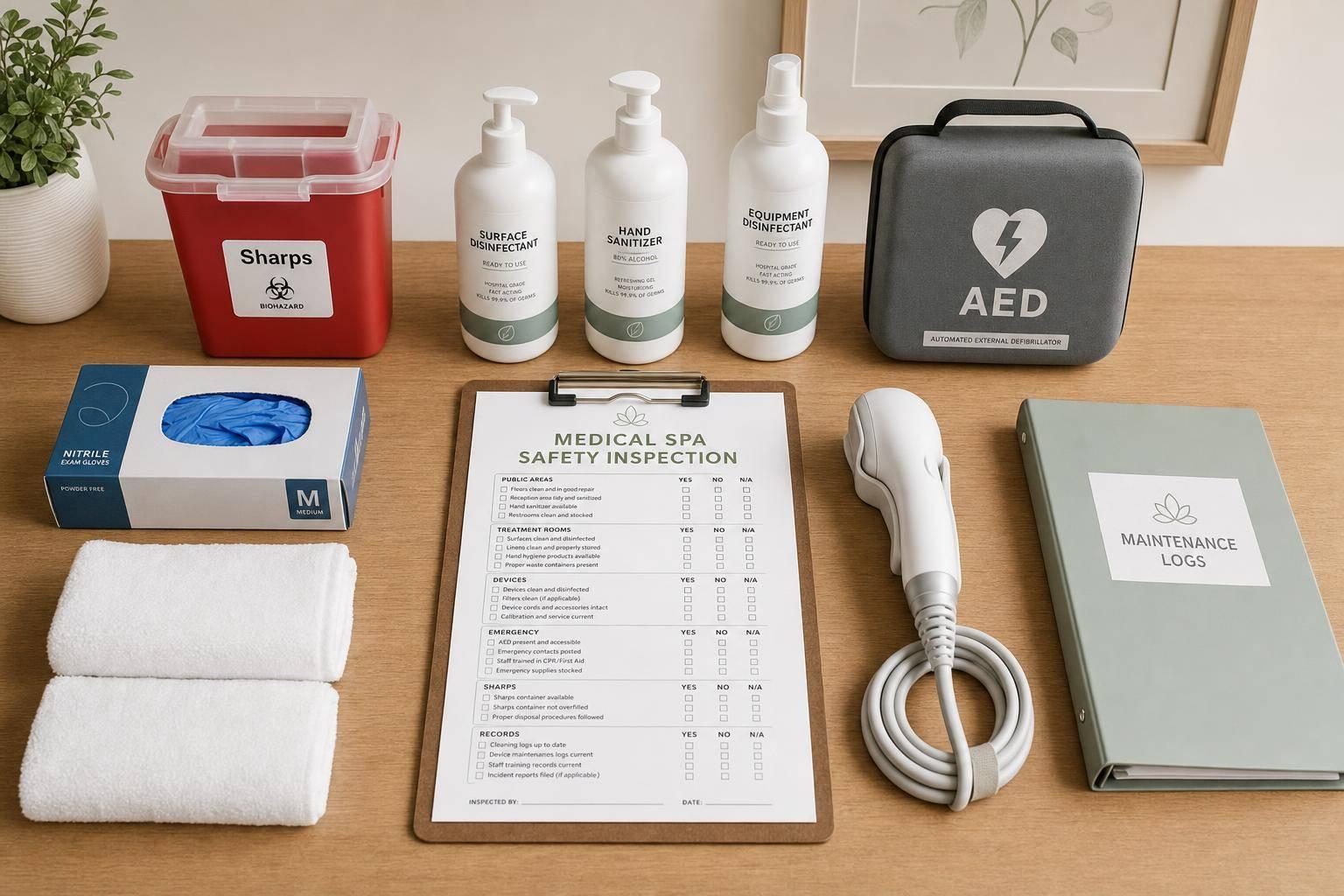

Facing a med spa licensing audit? Here's what you need to know:
Audits ensure your med spa complies with state medical regulations, federal safety standards, and licensing rules. Preparation is critical to avoid fines or shutdowns.
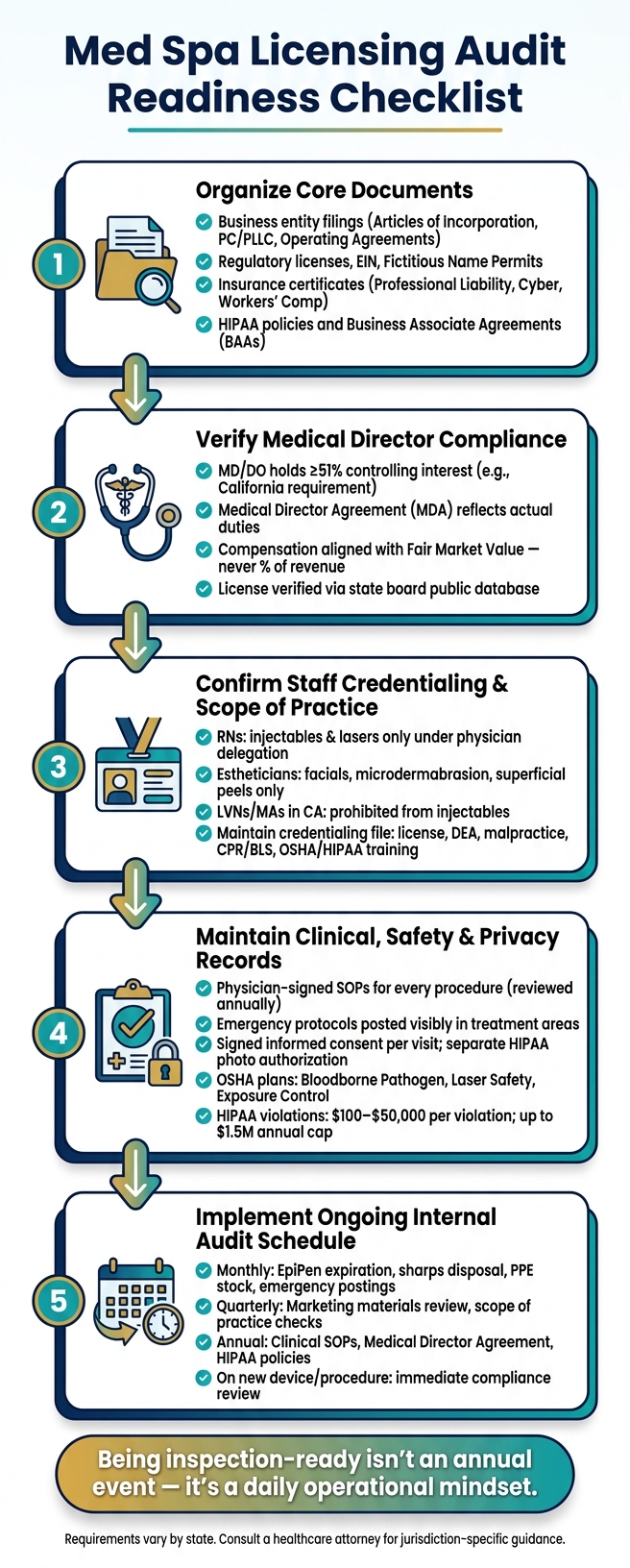
Key Steps for Audit Readiness:
- Organize Core Documents: Keep business entity filings, licenses, SOPs, and insurance policies up-to-date and accessible.
- Verify Medical Director Compliance: Ensure your medical director is actively involved and properly documented.
- Staff Credentialing: Confirm all team members are licensed for their roles and working within their legal scope.
- Clinical Procedures: Maintain physician-approved protocols for every treatment and ensure informed consent is documented.
- Safety & Privacy: Follow OSHA standards, update emergency plans, and comply with HIPAA for patient data security.
Regular internal audits and digital tools can help you stay prepared for inspections at any time.
Med Spa Licensing Audit Readiness: Key Steps & Compliance Checklist
Pre-Audit Preparation: Organizing Core Documents
Keeping your paperwork in order can make or break your audit experience. Auditors work fast, so having the right documents at your fingertips is essential.
Identifying the Audit Scope
Understanding what the audit agency is looking for helps you focus your efforts. For example, state medical boards often examine your med spa's ownership structure, the role of your medical director, and the scope of practice. OSHA inspectors, on the other hand, are likely to dig into your workplace safety plans. Meanwhile, local health departments may check your facility permits and zoning approvals. The key is knowing which agency is most relevant to your operations based on your state’s regulations and the services you offer. This knowledge helps you prioritize which documents to prepare first.
Organizing Legal Entity Documents
Your business formation documents are the backbone of compliance. These need to align with your state’s CPOM (Corporate Practice of Medicine) doctrines. States like California, New York, and Michigan require med spas to be structured as a Professional Corporation (PC) or Professional Limited Liability Company (PLLC). The table below outlines the essential documents you’ll need.
"An LLC cannot own a California med spa regardless of who operates it. A flawed structure undermines all compliance efforts." - MedSpaStandards.com
| Document Category | Required Documents |
|---|---|
| Legal/Entity | Articles of Incorporation, PC/PLLC filings, Operating Agreements, Bylaws |
| Regulatory | EIN (IRS Form SS-4), Business Licenses, Fictitious Name Permits, Medical Board Registrations |
| Clinical | Signed Treatment Protocols (SOPs), Emergency Response Plans, Informed Consent Forms |
| Personnel | Professional Licenses, DEA Registrations, I-9 Forms, Training Logs |
| Compliance | HIPAA Notice of Privacy Practices, Business Associate Agreements (BAAs), OSHA Exposure Control Plan |
| Insurance | Professional Liability, General Liability, Cyber-liability, Workers' Comp Certificates |
If your med spa operates under a brand name rather than the physician-owner’s legal name, you’ll likely need a Fictitious Name Permit (FNP) from your state medical board. Advertising under an unregistered name is a common audit red flag.
Once your legal documents are squared away, double-check that your ownership structure and medical director arrangements comply with state rules.
Medical Director and Ownership Compliance
Auditors will often start by scrutinizing your ownership structure and medical director documentation. For instance, in California, a licensed physician (MD or DO) must hold at least 51% of the controlling interest in the Professional Corporation. If non-physicians are involved as investors, they must do so through a Management Services Organization (MSO) that only handles administrative tasks - not clinical decisions.
Pay close attention to your Medical Director Agreement (MDA). Using a generic template can be risky.
"A generic template that doesn't reflect what the director actually does is as problematic as no agreement at all." - MedSpaStandards.com
The agreement should spell out supervision details, such as how often the medical director reviews patient charts and makes on-site visits. Make sure to verify the director’s license through your state board’s public database. Additionally, the medical director’s compensation must align with fair market value (FMV) and cannot be tied to a percentage of revenue or procedure volume to avoid fee-splitting violations.
Getting these documents in order not only simplifies audits but also strengthens your compliance efforts moving forward.
sbb-itb-02f5876
Licensing and Credentialing for Staff
Once you've sorted out your ownership structure and medical director documentation, the next step is ensuring that every team member is properly licensed for their role. This is one of the most common areas where med spas run into compliance issues. It's essential to review the credentials required for each position to make sure you're following the rules.
Role-Specific Licensing Requirements
Each role in a med spa comes with its own set of licensing requirements, and these aren't interchangeable. For example, Registered Nurses (RNs) can administer injectables and perform laser treatments, but only when delegated by a physician. Meanwhile, estheticians are limited to superficial treatments like facials and microdermabrasion. No matter how experienced they are, they cannot legally perform injections, laser procedures, or deep chemical peels. In California, Licensed Vocational Nurses (LVNs) and Medical Assistants (MAs) are also barred from performing injectables like Botox or fillers.
| Staff Role | Required License/Credential | Permitted Scope |
|---|---|---|
| Medical Director | MD or DO (or qualifying 104 NP in CA as of Jan. 2026) | Clinical oversight, protocol approval, delegation |
| NP / PA | State NP/PA License + Delegation Agreement | Medical evaluations, injectables, lasers (under delegation) |
| Registered Nurse | State RN License + Supervision Agreement | Injectables and lasers (under physician delegation) |
| Esthetician | State Esthetician/Cosmetology License | Facials, microdermabrasion, superficial peels |
| LVN / MA | State LVN/MA License | Varies by state; prohibited from injectables in CA |
| Prescriber | DEA Registration + State Controlled Substance Registration | Prescribing controlled substances and medical-grade products |
It’s also crucial that every clinical provider carries procedure-specific professional liability insurance. To stay compliant, verify each team member's license directly through the appropriate state board at every renewal cycle. For instance, in California, you can check physician licenses at mbc.ca.gov and nurse licenses at rn.ca.gov. Keep a credentialing file for each staff member that includes their current license, DEA registration (if applicable), malpractice insurance, CPR/BLS certification, and OSHA/HIPAA training records.
Scope of Practice Documentation
Checking licenses is just the beginning. You also need to clearly document the tasks each staff member is allowed to perform. Auditors will expect to see physician-approved Standard Operating Procedures (SOPs) for every procedure your clinic offers. Without these documented protocols, you could face violations of state medical oversight requirements.
"It's important that the procedure-specific protocols of each med spa are consistent with the applicable state scope of practice, delegation and supervision requirements." - Kathryn Hickner, BMD Law
For Nurse Practitioners (NPs) and Physician Assistants (PAs), delegation agreements must outline exactly what procedures they’re authorized to perform and the required supervision levels. Starting in 2026, California will require Patient-Specific Orders (PSOs) for treatments such as injectables, lasers, and IV therapy. This change replaces the broader standing orders that many clinics have relied on. If your collaboration agreements don’t align with your clinic’s actual practices, you could be putting yourself at risk. Be sure to update delegation agreements and training records whenever you introduce new treatments or devices.
Clinical, Safety, and Privacy Compliance
Once your staff credentials and delegation agreements are squared away, the next step toward audit readiness is organizing your clinical protocols, workplace safety records, and patient privacy documentation. These elements need to be easily accessible and up-to-date.
Clinical Governance and Treatment Protocols
Every clinical procedure should be backed by a physician-approved Standard Operating Procedure (SOP). These SOPs must outline patient selection criteria, contraindications, dosing ranges, step-by-step instructions, and follow-up requirements. Importantly, each SOP should be signed and dated by your medical director. This ensures compliance with regulatory standards and proper clinical oversight.
"The Medical Board considers operating a procedure without an approved SOP to be practicing medicine without appropriate physician oversight." - California Med Spa Compliance Checklist 2026
Emergency response protocols are another key area. These should cover potential anaphylaxis triggers, clearly define staff roles, pinpoint Epinephrine storage locations, and outline documentation procedures. These protocols must be visibly posted in treatment areas.
Informed consent and photo authorizations are also critical. Every procedure requires a signed consent form that explains risks, benefits, alternatives, and expected outcomes. If you plan to use before-and-after photos for marketing, you’ll need a separate HIPAA-compliant written authorization for each patient. This consent cannot be bundled into a general intake form.
"Using a patient's before/after photo in any marketing without a specific, separate written authorization (not buried in a general intake form) is a HIPAA violation." - California Med Spa Compliance Checklist 2026
All SOPs, emergency protocols, and consent forms should be clearly documented and updated annually or whenever a new treatment is introduced. Patient records, including signed consent forms, must be retained for at least seven years in California.
Adhering to consistent treatment protocols not only ensures compliance but also supports a safer clinical environment. This safety-first approach extends into workplace safety practices.
| Document | Key Requirements | Review Frequency |
|---|---|---|
| Clinical SOPs | Patient selection, contraindications, dosing, instructions, adverse events | Annually or with new equipment |
| Emergency Protocols | Symptom triggers, staff roles, medication storage, 911 procedures | Annually |
| Informed Consent | Risks, benefits, alternatives, outcomes, patient signature | Every visit |
| Photo Authorization | Separate written HIPAA authorization for marketing use | Per patient |
OSHA and Workplace Safety
Your workplace safety measures should align seamlessly with clinical protocols while meeting federal OSHA standards. Since med spas fall under OSHA’s jurisdiction, on-site inspections are always a possibility. To stay prepared, maintain three essential safety plans: a Bloodborne Pathogen Plan, a Laser Safety Plan, and an Exposure Control Plan. If your clinic uses hazardous chemicals, you’ll also need a Hazard Communication Program complete with Safety Data Sheets (SDS).
Staff safety training must be well-documented, including records of initial onboarding, annual refreshers, and device-specific certifications. OSHA-mandated posters should be displayed prominently in your clinic. A good rule of thumb: if you can’t produce a requested document for an auditor within 60 seconds, it’s not audit-ready.
"We got audited by our state board six months after opening. The auditor specifically asked for our patient intake documentation process and staff training records. Because we had these SOPs in place, we were able to hand them everything they asked for on the spot. No findings, no corrective actions." - Sarah M., Practice Manager
HIPAA and Data Security
If your med spa handles medical treatments, patient records, or electronic health information, HIPAA compliance is non-negotiable - even for cash-only practices. Protected Health Information (PHI) includes everything from intake forms and treatment records to before-and-after photos, appointment details, and payment data.
Failing to comply with HIPAA can lead to steep fines. Penalties range from $100 to $50,000 per violation, with an annual cap of $1,500,000 for uncorrected willful neglect. In the event of a data breach, you must notify affected patients within 60 days. If more than 500 individuals are impacted, you’re also required to notify the Department of Health and Human Services (HHS) within the same timeframe.
To stay compliant, create a "Minimum Viable HIPAA" folder containing these six essential documents:
- Notice of Privacy Practices (NPP)
- Internal Privacy Policy
- Staff Training Acknowledgments
- Business Associate Agreements (BAAs) for vendors with PHI access
- Breach Notification Policy
- Patient Consents
Services like Prospyr can simplify HIPAA compliance by managing BAAs, digital intake forms, and communication workflows. Beyond documentation, ensure all computers are password-protected, use encrypted or HIPAA-compliant communication tools, and implement shredding policies for paper records. Retain staff HIPAA training records for at least six years. These steps are crucial for maintaining audit readiness at all times.
Maintaining Audit Readiness Over Time
Once you've established your core compliance procedures, the next step is ensuring they remain effective over time. Regular internal audits are key to staying compliant with regulations. A single audit won't guarantee long-term compliance - you need to be prepared every day. The aim is to create systems that make your med spa ready for inspections at any moment.
"Being 'inspection-ready' isn't an annual event, but a daily operational mindset." - Steph Fernandez, Phorest
Internal Audit Schedule
Instead of trying to address everything at once, break your compliance checks into manageable, recurring intervals. For instance:
- Monthly audits: Focus on essentials like sharps disposal, ensuring PPE is stocked, checking the expiration dates on emergency medications like EpiPens, and verifying emergency protocol postings are visible.
- Quarterly reviews: Dive deeper into areas such as marketing materials and ensuring staff are operating within their scope of practice.
- Annual reviews: Examine clinical SOPs, medical director agreements, and HIPAA policies.
Anytime a new device or procedure is introduced, it's critical to conduct an immediate compliance review. New equipment often requires updated protocols, revised training records, and possibly new delegation agreements.
| Audit Category | Frequency | Key Items to Verify |
|---|---|---|
| Facility Safety | Monthly | EpiPen expiration, sharps disposal, PPE stock, SDS sheets |
| Marketing Materials | Quarterly | Physician name displayed, no "guaranteed results" claims |
| Staff Credentials | Per renewal cycle | Active license status, scope of practice alignment |
| Medical Director | Per agreement | Physical visit logs, chart review documentation |
| Clinical Protocols | Annual / On-change | Physician signature, dosing ranges, adverse event steps |
These scheduled audits ensure your documentation stays up-to-date and your procedures remain compliant.
Tracking and Updating Documentation
A centralized "compliance playbook" is essential for staying organized. This resource should include licenses, medical director agreements, training logs, HIPAA policies, and equipment maintenance records - all in one easily accessible location. When updating documents, archive older versions instead of deleting them. Auditors may request prior versions to verify that policies were in place at specific times.
Tools like Prospyr streamline this process. Their platform offers HIPAA-compliant document storage, task management, and integrated CRM/EMR tools. These features help you track renewal deadlines, store patient consent forms, and set reminders for recurring compliance tasks. Role-based access controls ensure staff only see data relevant to their roles, which is another compliance requirement.
Keeping up with regulatory changes is another critical part of audit readiness. For example, as of 2026, Florida's SB 1728 mandates that med spas dealing with prescription medications maintain pharmacy-level licenses and implement strict inventory audit trails. Monitoring updates from your state's Board of Medicine, Board of Nursing, and Board of Pharmacy should be a routine quarterly task.
Financial and Marketing Compliance
Financial and marketing practices often get overlooked during compliance reviews, but they carry significant legal risks.
For financial arrangements, MSO (Management Services Organization) fees must align with fair market value. These fees should be structured as flat fees or cost-plus arrangements - never as a percentage of revenue or procedure volume.
"The management fee must be carefully structured in accordance with applicable rebate, fee-splitting and kickback prohibitions." - Kathryn Hickner, Health Law Attorney, BMD LLC
When it comes to marketing, ensure all promotional materials - whether on your website, Instagram, or email campaigns - clearly display the supervising physician's name or fictitious name permit. If you offer membership or subscription programs, keep signed agreements and renewal records well-organized. For text message marketing, stay informed about updates to TCPA rulings. As of 2026, courts have been active in this area, and digital consent agreements are now considered the standard for reducing liability.
Conclusion: Keeping Your Med Spa Audit-Ready
Staying prepared for audits isn’t just a one-time task - it’s a continuous process that protects your med spa. Kathryn Hickner, Health Law Attorney at BMD, emphasizes this point:
"The level of scrutiny and the punitive enforcement environment means it is more important than ever for each healthcare provider, including med spas, to adopt and implement strong compliance programs..."
Regulations are always evolving. For instance, in April 2026, the Ohio Board of Nursing updated its CE reporting periods, and amendments to 42 CFR Part 2 were enforced. These changes introduced stricter penalties and brought substance use disorder recordkeeping closer in line with HIPAA standards. Such shifts can easily catch practices off guard, highlighting the importance of keeping policies and documentation up to date.
Embracing digital tools is a smart way to stay ahead. Moving from paper records to a digital compliance system simplifies the process. Digital platforms allow real-time updates, easier retrieval during inspections, and better archiving of past versions. Platforms like Prospyr offer HIPAA-compliant solutions, streamlining everything from audit trails to centralized credential management.
Think of compliance as an ongoing system, not a yearly task. When your documentation is well-organized, staff credentials are up to date, and protocols align with current regulations, audits become far less daunting. By integrating these practices into your daily operations, you can transform audits into routine, stress-free checks.
FAQs
What triggers a med spa licensing audit?
A med spa licensing audit often stems from concerns such as unlicensed or unqualified staff, complaints about improper procedures, or failure to adhere to licensing regulations. For instance, investigations across New York have revealed cases where unlicensed businesses were performing medical procedures, leading to warnings and inspections. Staying compliant with licensing rules is crucial to steering clear of these audits.
What documents should be easiest to pull during an inspection?
The documents that are easiest to access during an inspection are those that are well-organized and kept up-to-date. Common examples include patient intake and consent forms, staff licenses and credentials, and facility safety records, as these are often requested for compliance checks and legal reviews.
How do I prove my medical director is providing real oversight?
To show that your medical director is actively overseeing your operations, it's essential to keep clear, documented proof of their involvement. This starts with a signed Medical Director Agreement that spells out their supervision responsibilities, how often they’ll visit, and the requirements for reviewing patient charts.
Additionally, maintain detailed records of their visits, patient chart reviews, and any other oversight activities they perform. Having these documents regularly updated and well-organized will help confirm their active role in supervising your med spa's operations.