
If you treat a patient who is in California, you need an active California physician license. That rule applies even if you are in another state and seeing the patient by telehealth.
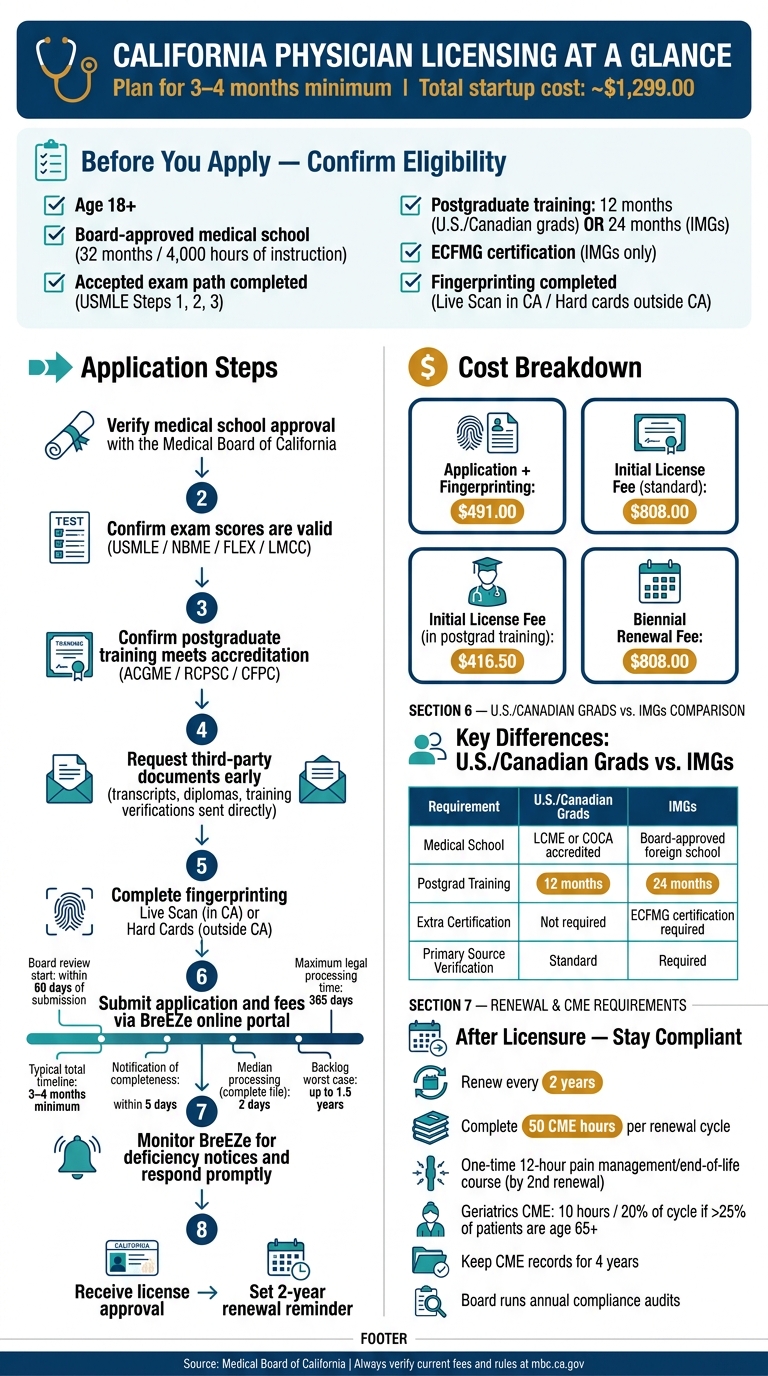
Here’s the short version: I’d plan for 3 to 4 months at a minimum, budget for $491.00 in application and fingerprinting costs plus an initial license fee of $808.00 (or $416.50 for some physicians still in training), and make sure all school, training, exam, and license records go to the Board directly from the source.
Before I apply, I’d make sure I can check all of these boxes:
- Medical school approved by California
- Accepted exam path completed such as USMLE Steps 1, 2, and 3
- Postgraduate training done
- 12 months for many U.S./Canadian graduates
- 24 months for many IMGs
- Fingerprinting completed
- BreEZe application filed
- Third-party verifications sent in
- Renewal plan set for every 2 years with 50 CME hours
A few rules matter more than most:
- A PTL is required for many residents training in California and must be obtained within 180 days of enrollment.
- A PTL ends 90 days after the minimum training period is completed.
- California can take action if someone practices medicine without a license.
- After licensure, physicians renew every 2 years and keep CME records for 4 years.
Here’s a fast side-by-side view:
| Topic | What to know |
|---|---|
| Who needs the license | Any physician treating a patient physically in California |
| Main application system | BreEZe |
| Common exam route | USMLE Step 1, Step 2, Step 3 |
| Training rule | 12 or 24 months, based on applicant type |
| Fingerprinting | Live Scan in California; hard cards if outside California |
| Application review | Often starts within 60 days; delays can run much longer |
| Renewal cycle | Every 2 years |
| CME | 50 hours per renewal cycle |
If I were using this guide to plan a start date, I’d treat it as a checklist: confirm eligibility, line up source documents early, finish fingerprinting fast, and watch BreEZe until the license is active.
California Physician License: Step-by-Step Application Process & Key Requirements
Eligibility, Exams, and Training Requirements
Medical School Eligibility and Applicant Tracks
In California, licensure starts with approved medical education. After that, it moves to exams and supervised training.
Applicants must be at least 18 years old and graduate from a Board-approved medical school. The program must include at least 32 months of professional instruction and 4,000 total hours of instruction, including clinical training in surgery, medicine, pediatrics, obstetrics and gynecology, and psychiatry. That is the first major step toward full licensure.
Where you trained changes what California expects next:
| Requirement | U.S. / Canadian Graduates | International Medical Graduates (IMGs) |
|---|---|---|
| Medical School | LCME or COCA accredited | Foreign medical school approved by the Board |
| Postgraduate Training | 12 months of board-approved training | 24 months of board-approved training |
| Required proof | Standard diploma/transcripts | ECFMG certification |
| Training License | PTL if training in California | PTL if training in California |
For IMGs, there’s one more thing to plan for: primary source verification. In plain English, that means records must come straight from the school or issuing body, not from the applicant.
Accepted Exams and California Training Requirements
Once your education is cleared, the next step is the exam path.
California accepts several exam routes, including USMLE, NBME, FLEX, and LMCC. For most people applying now, the standard route is USMLE Steps 1, 2, and 3.
Postgraduate training must be accredited by the ACGME, the Royal College of Physicians and Surgeons of Canada (RCPSC), or the College of Family Physicians of Canada (CFPC). If you're in residency training in California, the timing of your Postgraduate Training License (PTL) matters a lot. California residents must get a PTL within 180 days of enrollment. The PTL then expires 90 days after the minimum training period is finished, and at that point the physician must move to a full Physician's and Surgeon's Certificate.
If you finished ACGME-accredited training outside California, you do not need a PTL. You can apply straight for full licensure once you meet the 12-month or 24-month training rule that fits your background.
sbb-itb-02f5876
Application Documents and BreEZe Submission
Once your education, exams, and training are confirmed, the next part is pretty straightforward: gather the right documents and submit everything through BreEZe using a digital intake process.
Required Documents and Verification Sources
Here’s the part that trips people up: some documents cannot come from you at all. They have to be sent straight from the school, training program, exam body, or licensing board to the Medical Board of California. If you send in something that the Board expects from the issuing source, it may reject that item and send a deficiency notice, which slows things down.
Put simply, primary-source documents must come from the issuing institution, not the applicant.
| Document | Who Submits It | Submission Method |
|---|---|---|
| Application form & fees | Applicant | Via BreEZe online system |
| Fingerprinting | Applicant | Live Scan (electronic) or hard cards (mail) |
| Medical school transcripts | Medical school | Directly to the Board |
| Medical school diploma | Medical school | Directly to the Board |
| Certificate of medical education | Medical school | Directly to the Board |
| Postgraduate training verification | Program director | Directly to the Board |
| Official exam scores | FSMB / NBOME | Directly to the Board |
| License verifications, if applicable | Other state boards | Directly to the Board |
It’s smart to request third-party documents early. Schools and training programs often move slower than applicants expect, and one late form can hold up the whole file.
Using BreEZe and Completing Fingerprinting
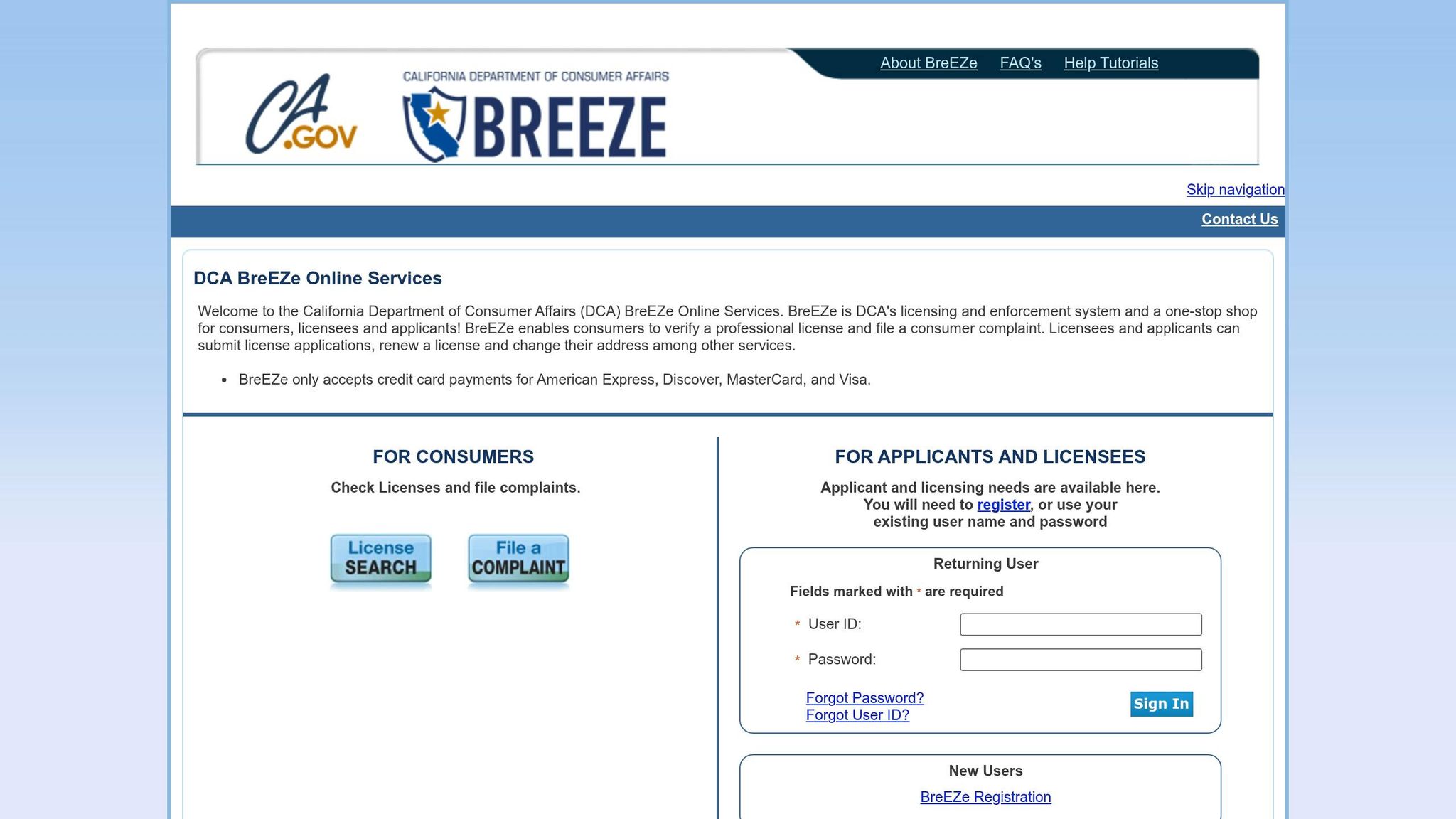
BreEZe is California’s online licensing portal. You’ll use it to apply, pay fees via payment links, and check your status.
Your name needs to match exactly across BreEZe, school records, exam records, and ECFMG certification, if that applies to you. Even a small mismatch can create delays. If your legal name has changed, send the supporting paperwork as soon as possible.
Fingerprinting is part of the background check that must clear before approval. If you’re in California, use Live Scan because it moves faster. If you’re outside California, ask the Board for fingerprint hard cards and mail them in. Either way, do this early. The license cannot be approved until the background check clears.
BreEZe will also show deficiency notices for missing or incomplete items. Check the portal often and reply fast when something comes up.
Moving from Training License Status to Full Licensure
If you’re in a California training program, there’s one more piece to handle: moving from temporary training status to a full license.
A PTL is temporary and nonrenewable. That means you need to watch the expiration date closely and apply for full licensure before your training authority ends. As soon as you meet your PTL training requirement, start the full-license application.
While you hold a PTL, you may practice only within your board-approved training program. If the PTL expires before your full license is approved, you must stop practicing until the new license becomes active.
Fees, Timelines, Renewal, and Ongoing Compliance
Once your documents and fingerprinting are in, the last pieces are cost, timing, and making sure nothing slows the file down.
Application Fees, Processing Time, and Approval Delays
The application and fingerprinting cost $491.00. The standard initial license fee is $808.00. If you're in postgraduate training when the license is issued, the initial fee drops to $416.50.
The Medical Board usually reviews applications within 60 days and must tell applicants within 5 days if the file is complete or missing something. When an application is complete, it can move through in a median of 2 days. That said, the legal maximum is 365 days.
And yes, delays can stretch far past what most people expect. Some backlogged applications have taken up to 1.5 years. The usual reasons are pretty simple:
- Incomplete forms
- Gaps in training records
- Third-party verifications that show up late
License Renewal and California CME Requirements
Once you're licensed, the calendar matters. California physician licenses must be renewed every two years to stay active.
The biennial renewal fee is $808.00. Renewal processing usually takes a median of 15 days, with a maximum of 60 days.
To renew, physicians must complete 50 hours of approved CME during each two-year cycle. There are also a few extra rules tied to CME:
- Finish the one-time 12-hour pain-management/terminal-illness course by the second renewal
- General internists and family physicians whose patient panels are more than 25% age 65+ must spend 10 CME hours, or 20% of each cycle's CME, on geriatrics
- Residents and fellows may count up to 6 CME hours per month of accredited residency or fellowship
- Board certification or recertification counts for 100 CME hours over four years
Keep CME records for four years and certify completion under penalty of perjury when you renew. The Medical Board runs annual audits to check compliance.
Compliance Obligations After Licensure
After licensure, a lot of compliance comes down to plain recordkeeping. Hold on to CME records for at least four years, certify completion at renewal, and answer Board audit requests without delay.
California Physician Licensing Checklist and Conclusion
Application-Order Checklist
Use this checklist to turn California's requirements into a clear filing sequence.
- Verify Board-approved medical education - Confirm your medical school meets the Medical Board of California's requirements.
- Confirm your accepted exam pathway is complete and still valid - Check that your scores are current and meet California's validity rules.
- Confirm the required accredited postgraduate training for your applicant track - Make sure you've met the ACGME- or RCPSC-approved training threshold that applies to your background.
- Gather your diploma and training verification before opening BreEZe - Have these documents ready so third-party submissions can begin without delay.
- Submit in BreEZe and complete fingerprinting - File your application and complete fingerprinting as early as possible. Once BreEZe and fingerprinting are complete, the file moves into Board review.
- Monitor your BreEZe status until approval - Check for deficiency notices and respond quickly to keep the file moving.
- Set your two-year renewal date now - Mark your renewal deadline before your license is even issued.
Key Takeaways for Physicians and Clinic Leaders
California licensure involves a lot of paperwork, and timing matters at every step. For clinic leaders, that means hiring plans and opening timelines should account for licensing delays. The safest move is to start early, submit a complete file, and track each deadline all the way through renewal.
FAQs
Do I need a California license for telehealth?
Yes. To practice medicine in California, including through telehealth, you need a physician and surgeon license issued by the Medical Board of California.
California does not offer a separate telehealth license. To provide medical services to patients located in the state, you must hold a full, unrestricted physician and surgeon license.
What can delay my California license approval?
Delays usually happen when an application is incomplete or includes documents that don’t meet California requirements. The Medical Board of California will not speed up its review if required materials are missing or deficient.
Other common causes include criminal conviction records found in background checks, along with information that is inaccurate or can’t be verified. To help avoid delays, submit complete documents and respond promptly to any board requests.
When do I need a PTL instead of a full license?
You need a Postgraduate Training License (PTL) if you’re in an ACGME-accredited postgraduate training program in California. You must get it within 180 days of starting the program.
The PTL stays valid for 36 months. After that, you need to apply for a full Physician’s and Surgeon’s License once you’ve finished the required amount of credit:
- 12 months if you graduated from a U.S. or Canadian medical school
- 24 months if you graduated from an international medical school