California Privacy Laws for Med Spas: Key Rules
Overview of HIPAA, CCPA and CMIA rules for California med spas, plus photo consent, BAAs, breach plans, and a compliance checklist.

California med spas must follow strict privacy laws to protect patient data. These regulations include HIPAA, the California Consumer Privacy Act (CCPA), and the California Confidentiality of Medical Information Act (CMIA). Non-compliance can lead to fines, lawsuits, and reputational damage. Here's what you need to know:
- HIPAA: Covers patient health information (PHI). Requires notices, vendor agreements, photo consent, and staff training. Fines range from $141 to $2.1M annually, depending on the violation.
- CCPA: Governs consumer personal data, including marketing information. Applies to businesses meeting specific revenue or data thresholds. Fines can reach $7,988 per violation.
- CMIA: Adds stricter state-specific rules. Patients can sue for negligent disclosures, with fines up to $2,500 per violation.
Key compliance steps include providing privacy notices, securing patient consent for photos, training staff, and using secure systems for data management. Tools like Prospyr can simplify compliance by centralizing patient data and ensuring HIPAA and CCPA requirements are met.
Bottom line: Protecting patient privacy is critical for med spas to avoid penalties and maintain trust.
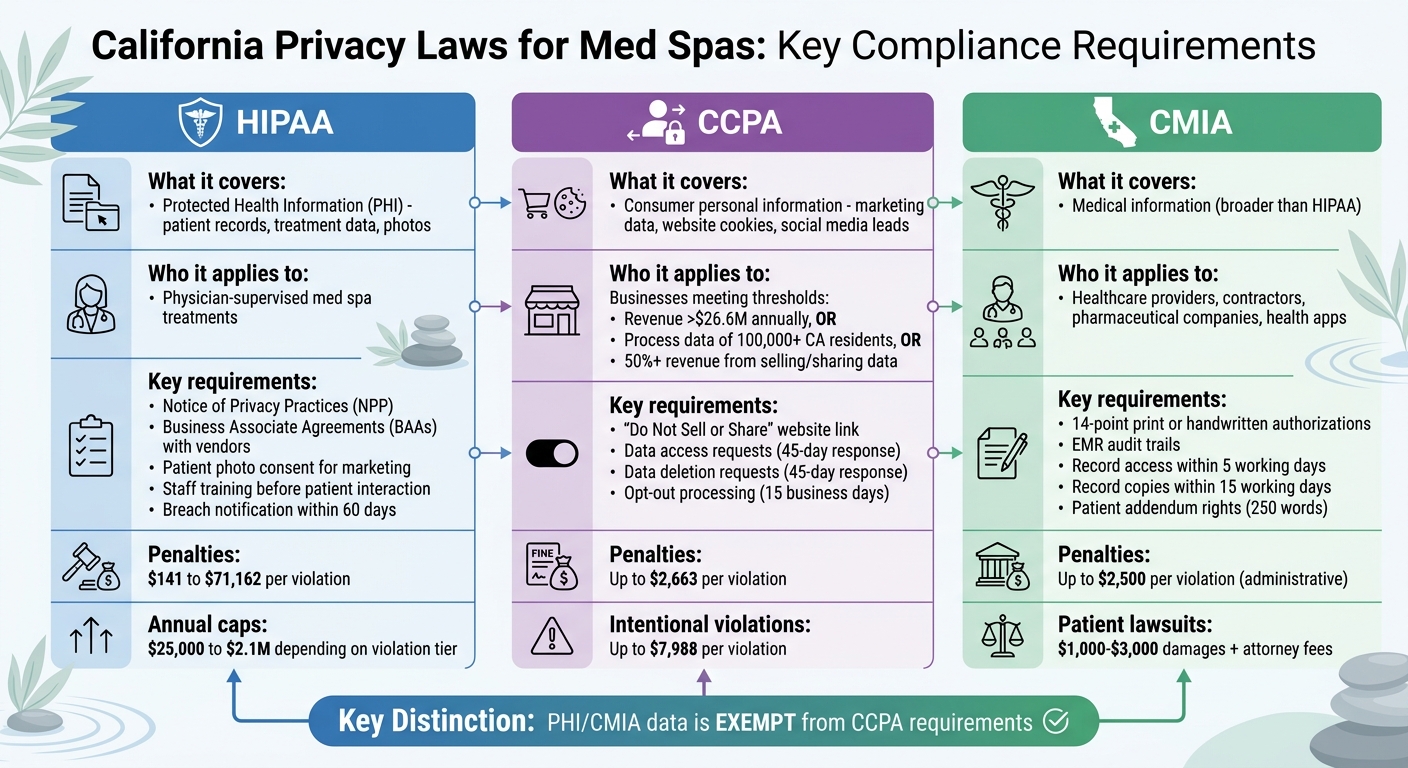
California Privacy Laws for Med Spas: HIPAA, CCPA, and CMIA Comparison
HIPAA Requirements for Med Spas
Physician-supervised treatments at med spas bring your practice under the umbrella of HIPAA regulations. These rules cover all Protected Health Information (PHI), including patient records and photos. Following HIPAA guidelines isn't just about compliance - it safeguards patient trust and protects your business's reputation. Non-compliance can lead to hefty fines, ranging from $141 to $71,162 per violation, with annual caps as high as $2,134,831.
| Tier | Culpability | Fine per Violation | Annual Cap |
|---|---|---|---|
| 1 | Unknowing | $141 – $36,054 | $25,000 |
| 2 | Reasonable cause | $1,424 – $71,162 | $100,000 |
| 3 | Willful neglect (corrected) | $14,232 – $71,162 | $250,000 |
| 4 | Willful neglect (not corrected) | $71,162 | $2,134,831 |
Source: Office for Civil Rights penalty structure
Below, we’ll cover key protocols for maintaining compliance, including patient notifications, vendor agreements, photo consent, and staff training.
Notice of Privacy Practices
Every patient must receive a Notice of Privacy Practices (NPP) before or during their first visit. This document explains how your med spa uses and shares their health information, outlines their rights under HIPAA, and provides steps for filing a privacy complaint. Make sure to:
- Obtain a signed acknowledgment from the patient and keep it on file for at least six years.
- Display the NPP prominently in your waiting area and on your website.
Business Associate Agreements
If you work with third-party vendors that handle patient data - like cloud storage services, billing companies, or appointment reminder platforms - they must sign a Business Associate Agreement (BAA). This contract ensures they follow the same HIPAA rules you do. Without a BAA, your med spa could be held responsible for breaches that occur through their systems.
Patient Photo Marketing Authorizations
Using before-and-after photos for marketing purposes requires a separate, detailed authorization. A general consent form won't cut it. The authorization must include:
- The specific treatment date.
- Details about where the images will be shared (e.g., a specific Instagram handle or website).
- The duration of the authorization.
- Instructions for revoking consent.
California law adds another layer: any social media post or advertisement featuring patient photos must include the supervising physician's name or a Medical Board-issued fictitious name permit number. Keep these signed authorizations indefinitely, as HIPAA violations related to publicly shared content have no expiration. Also, avoid using manufacturer-provided stock photos to represent your results - this could be flagged as deceptive advertising by the FTC.
Staff Training and Breach Notification
HIPAA training is mandatory for all staff before they interact with patients. Assign a HIPAA officer to oversee training, documentation, and compliance. Social media mishaps, like accidental disclosures, highlight the importance of thorough training.
In the event of a breach, you must notify affected patients within 60 days. For breaches impacting 500 or more individuals, you’ll also need to inform the Department of Health and Human Services (HHS) and local media. Develop a breach response plan, test it regularly, and retain all related records for at least six years.
CCPA Compliance for Aesthetic Practices
While HIPAA focuses on safeguarding medical records, the California Consumer Privacy Act (CCPA) outlines how businesses must handle consumer personal information. For med spas, this often includes data gathered through marketing campaigns, website cookies, or social media lead generation. Together, HIPAA and the CCPA strengthen a med spa's privacy practices. Knowing when the CCPA applies and how to respect consumer rights is key to staying compliant with both regulations. This is particularly important for practices that must juggle obligations under both laws.
Applicability Thresholds
The CCPA applies to for-profit businesses in California that meet at least one of these criteria (effective January 1, 2025):
- Annual gross revenue exceeds $26,625,000 in the prior calendar year.
- The business processes, buys, sells, or shares personal information of 100,000 or more California residents or households.
- At least 50% of annual revenue comes from selling or sharing consumers' personal information.
These thresholds are adjusted every odd-numbered year based on the Consumer Price Index (CPI). While smaller med spas may not meet these benchmarks, those heavily involved in digital marketing or sharing client data with advertisers should carefully assess how much consumer data they handle. Non-compliance can lead to fines of up to $2,663 per violation - or up to $7,988 for intentional violations or those involving minors under 16. Additionally, consumers can seek statutory damages ranging from $107 to $799 per incident if a data breach occurs.
Consumer Rights to Data Access and Deletion
California residents have the right to know what personal information is collected about them, access it, and request its deletion. Med spas must offer at least two methods for such requests, such as a toll-free number, email, or website form. Once a request is received, businesses have 45 calendar days to respond, with the possibility of a 45-day extension if the consumer is informed. Opt-out requests must be processed within 15 business days.
Before fulfilling deletion requests, verify the consumer's identity and notify service providers to ensure the data is removed from their records as well. If your med spa sells or shares personal information for targeted advertising, your website must prominently display a "Do Not Sell or Share My Personal Information" link. Consumers can also make "requests to know" twice per 12 months at no cost. Importantly, you cannot deny services or charge different prices to individuals exercising their CCPA rights.
Overlaps and Differences with HIPAA
While HIPAA and the CCPA both address data privacy, they govern different types of information. HIPAA focuses on Protected Health Information (PHI), such as treatment records and diagnoses, while the CCPA emphasizes consumer rights over personal information, such as email addresses collected for marketing.
For example, a patient's Botox treatment record is considered PHI under HIPAA, but an email address gathered through a Facebook ad is personal information under the CCPA. PHI and data covered by the Confidentiality of Medical Information Act (CMIA) are exempt from the CCPA. HIPAA also requires Business Associate Agreements for vendors, whereas the CCPA gives consumers the right to control how their personal information is used, including opting out of data sales. Understanding these distinctions helps ensure the right privacy measures are applied to the appropriate data.
Reading about the problem? See how Prospyr solves it in one platform.
Book a DemoAdditional California Privacy Regulations
California imposes state-specific laws that go beyond HIPAA and CCPA, directly affecting how med spas handle patient data. These laws not only complement federal mandates but also enforce stricter standards. They offer greater protections for patients and include enforcement mechanisms that allow individuals to take legal action against med spas. Below are the key details.
California Confidentiality of Medical Information Act
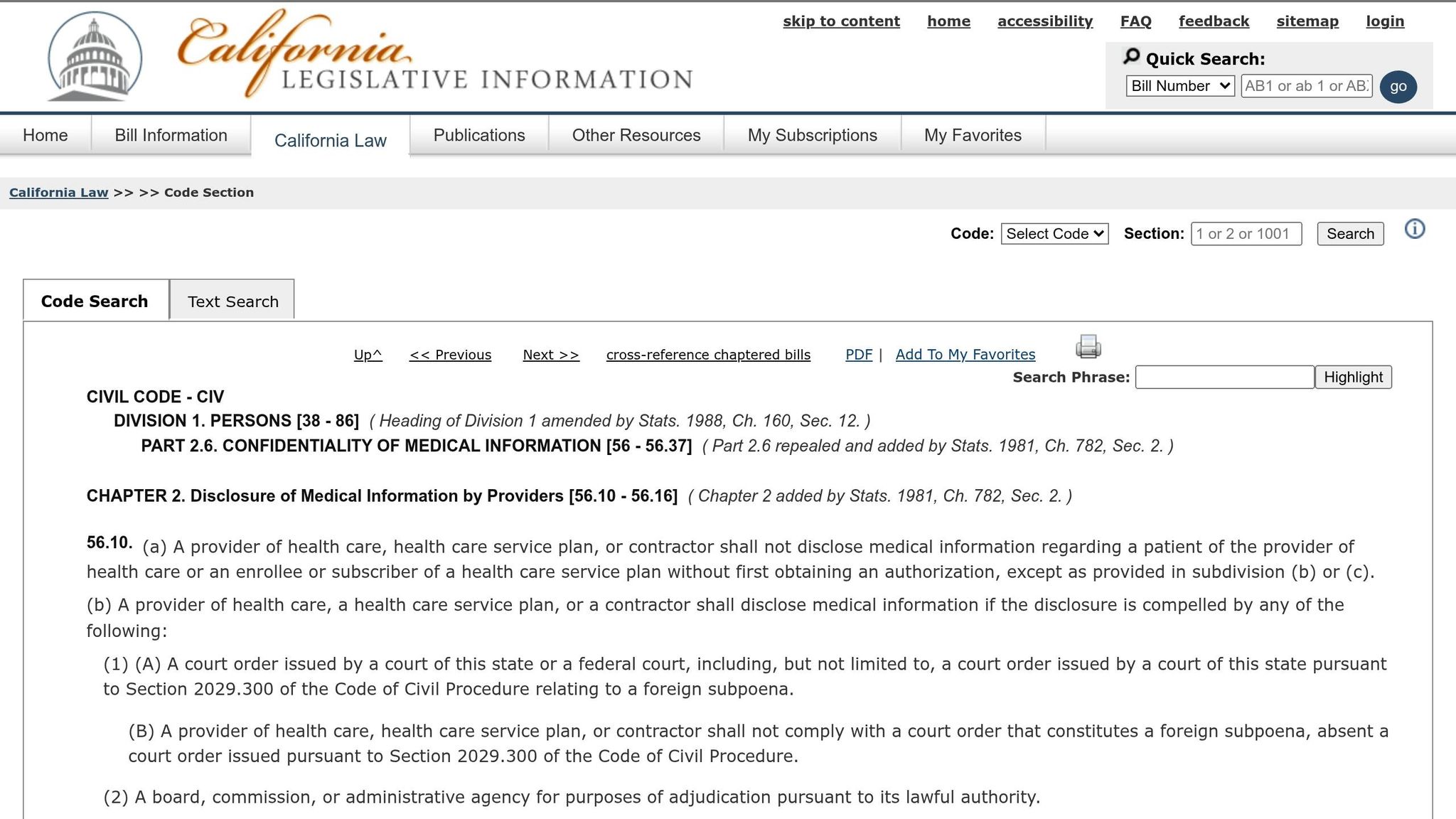
The California Confidentiality of Medical Information Act (CMIA) (California Civil Code §§ 56 et seq.) expands privacy protections beyond what HIPAA covers. While HIPAA focuses on covered entities and business associates, the CMIA applies to a wider range of organizations, including healthcare providers, contractors, pharmaceutical companies, employers, and even health apps. For med spas, this means stricter rules on managing, disclosing, and storing patient information.
One key difference from HIPAA is that the CMIA allows patients to file lawsuits directly for negligent disclosures. Patients can recover $1,000 in nominal damages without needing to prove harm, up to $3,000 in punitive damages, and attorney fees and costs. For knowing and willful violations, the law imposes administrative fines of up to $2,500 per violation.
The CMIA also sets specific formatting requirements for patient authorizations. Written authorizations must be either handwritten or in 14-point print, and the signature must be used solely for execution. Additionally, your electronic medical record (EMR) system must maintain an audit trail. Patients have the right to inspect their records within 5 working days and receive copies within 15 working days of a written request - much faster than HIPAA’s 30-day timeframe. If patients believe their records are incomplete or incorrect, they can submit a written addendum of up to 250 words, which you must attach to their file.
Record Retention and Secure Storage Rules
Record retention and secure storage are crucial under California law. Med spas must ensure confidentiality in all record management practices. When disposing of records, methods like professional shredding must be used to prevent unauthorized access. Improper disposal can result in penalties under CMIA for record abandonment.
Your data systems must meet dual requirements: they must securely store information while allowing quick access for consumer requests and provide the ability to delete data upon request. This means investing in technology that balances security with accessibility. Staff must be trained to handle, verify, and respond to consumer data requests within the required deadlines to avoid litigation. Since the CCPA does not apply to data already covered by HIPAA or the CMIA, it’s essential to consult a healthcare attorney to determine which laws govern specific data sets in your med spa. As Brad Adatto, JD, Partner at ByrdAdatto, explains:
"Medical businesses will need to determine what information they have and comply with the Privacy Act for other types of information not covered by HIPAA or CMIA".
sbb-itb-02f5876
Med Spa Privacy Compliance Checklist
To help your med spa stay on top of privacy regulations like HIPAA, CCPA, and CMIA, here’s a checklist covering the essentials. These steps can guide you in managing patient data responsibly and avoiding compliance missteps.
1. Administrative Safeguards
- Assign a compliance officer and perform an annual risk assessment to identify vulnerabilities in how PHI is stored and transmitted.
- Keep detailed documentation of your policies and maintain compliance records for at least six years.
- Sign Business Associate Agreements (BAAs) with all vendors who handle patient data. This includes partners like EMR software providers, IT support, and billing services.
2. Physical and Technical Safeguards
- Protect physical spaces by positioning screens securely, using locked storage, and ensuring private treatment areas.
- Encrypt electronic PHI (ePHI), require unique logins with multi-factor authentication (MFA), and maintain thorough audit logs.
- Restrict staff access to only the information they need to perform their duties.
3. Patient Rights and Social Media Protocols
Make sure patient privacy is respected by:
- Providing every patient with a Notice of Privacy Practices.
- Getting explicit written consent before sharing before-and-after photos. Simply blurring faces may not meet compliance standards. Avoid publicly confirming patient treatments.
- Ensuring your systems can handle data requests, including retrieving patient information and deleting consumer data, as required by the CCPA.
4. Breach Response and Staff Training
- Create and regularly test a breach response plan. Notify affected patients within 60 days of a breach and, if 500 or more individuals are impacted, report it to HHS and local media.
- Train employees on HIPAA rules, including deadlines for responding to consumer data requests.
- Use professional shredding services to securely dispose of paper records and prevent unauthorized access.
5. Data Segmentation
- Separate PHI governed by HIPAA or CMIA from other consumer data that falls under CCPA rules. Proper segmentation ensures the correct privacy framework is applied to each data type.
- Refer back to earlier sections for handling data that isn’t covered by HIPAA or CMIA.
This checklist offers a practical way to navigate California’s complex privacy laws and ensure your med spa remains compliant. By following these steps, you can safeguard patient trust and meet regulatory expectations.
Using HIPAA-Compliant Tools like Prospyr
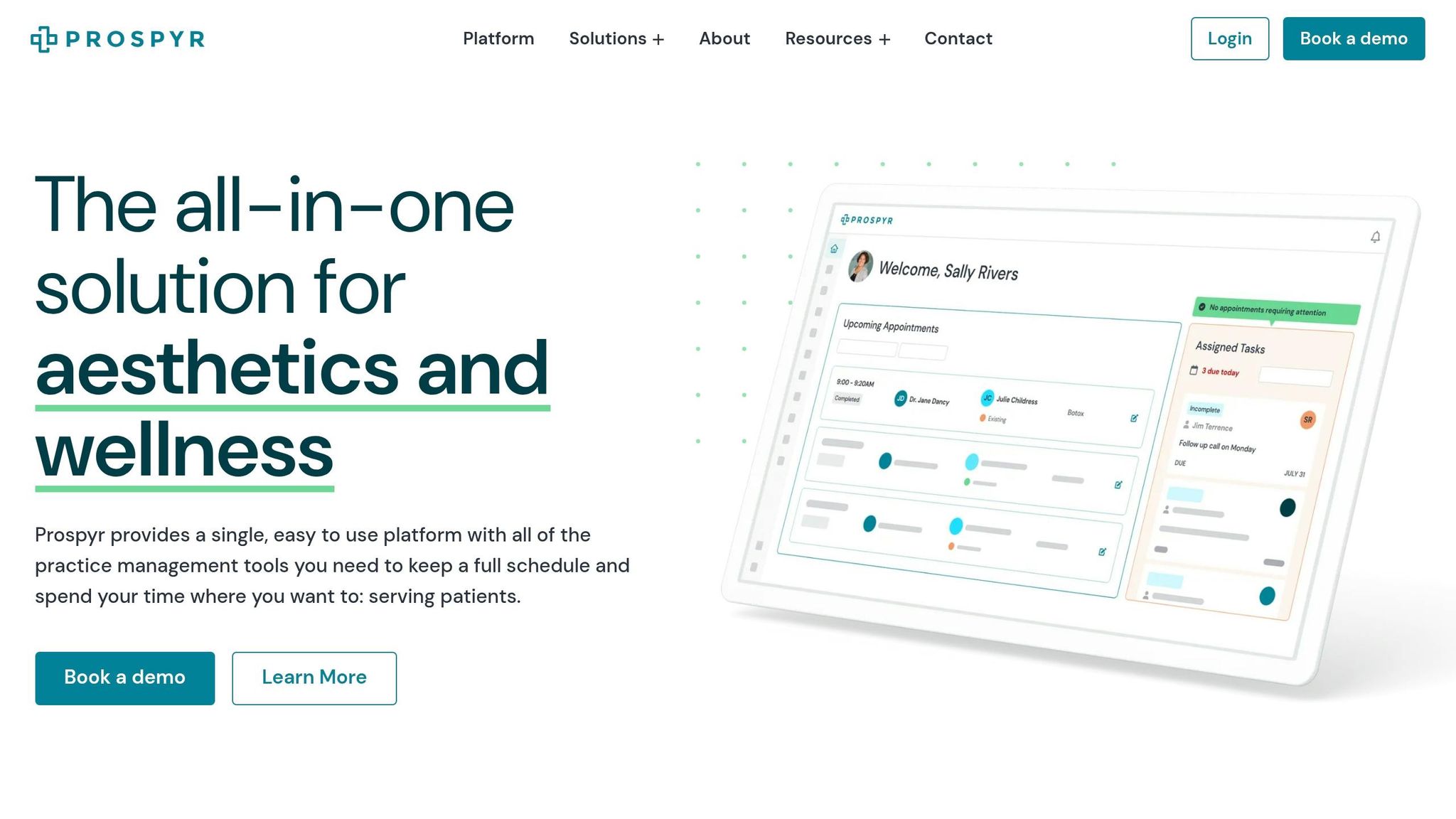
Juggling patient data across multiple tools that don’t meet regulatory standards can create unnecessary compliance headaches. A platform like Prospyr simplifies this by combining bookings, digital intake forms, patient records, payments, and marketing into a single, HIPAA-compliant system. This not only aligns with federal and state regulations but also makes managing data far more efficient.
Prospyr's HIPAA Features for Data Security
Prospyr is built with essential safeguards to protect electronic Protected Health Information (ePHI). It encrypts data both during storage and while it's being transmitted, uses individualized logins with multi-factor authentication (MFA) to prevent unauthorized access, and implements role-based access controls. This means staff can only view the information they need - receptionists see scheduling details, while clinical staff access patient notes. Plus, all activity is logged with automated audit trails, ensuring compliance with the "minimum necessary" standard.
The platform also handles sensitive patient imagery in line with photo authorization rules. As Bellator Cyber highlights, "The photograph issue is particularly acute for aesthetic practices. Before-and-after images are a core marketing tool, but they are also PHI when they can be linked to an individual patient". Prospyr ensures this data is managed securely and appropriately.
Another critical feature is Prospyr’s Business Associate Agreement (BAA), which makes the platform legally accountable for protecting patient data. Without a signed BAA from any vendor handling PHI, practices risk HIPAA violations - even if no breach occurs.
Benefits for CCPA and Record Management
Prospyr doesn’t stop at HIPAA compliance - it also supports practices in meeting California Consumer Privacy Act (CCPA) requirements. Its centralized system simplifies responding to consumer data requests. Practices can quickly search, retrieve, and export patient information or delete it upon request, all within mandated timelines.
The platform also helps with California's record retention rules by offering secure storage options. Additionally, its identity management tools let practice owners immediately revoke access for employees who leave, ensuring no unauthorized access to sensitive data.
Conclusion
California med spas operate under both federal HIPAA guidelines and stringent state laws like the CCPA and CMIA. Recent enforcement actions highlight the risks of failing to meet these requirements, making compliance a critical priority for med spa owners and operators.
Key steps to staying compliant include conducting annual risk assessments, securing Business Associate Agreements (BAAs) from all vendors managing patient data, implementing role-based access controls with multi-factor authentication, and establishing clear social media policies - especially regarding the use of before-and-after photos. As Brad Adatto, JD, Partner at ByrdAdatto, emphasizes:
"The safe and accurate handling of information and consumer requests will be critical to medical practices in particular as the Privacy Act creates substantial penalties for failure to maintain compliance".
Technology plays a pivotal role in supporting compliance efforts. Tools like Prospyr, which centralize patient records, ensure secure data management, and simplify responses to CCPA and HIPAA requirements, can streamline operations. By reducing data fragmentation and enhancing audit readiness, such platforms help med spas build a solid compliance foundation.
Beyond legal obligations, compliance strengthens patient trust and supports the longevity of your business. With over 133 million healthcare records exposed in 2023 alone, patients are more aware than ever of their privacy rights. Adopting rigorous data security measures not only fulfills legal requirements but also demonstrates your commitment to patient care and privacy, fostering trust and ensuring your practice’s success in the long run.
FAQs
Does my med spa have to follow HIPAA?
If your med spa handles patient health information, offers treatments under a licensed physician, or keeps medical records, you are required to follow HIPAA regulations. These rules are designed to protect the privacy and security of sensitive patient data, which helps ensure legal compliance and maintain patient confidence.
What patient data is covered by CCPA vs HIPAA/CMIA?
Under California privacy laws, the CCPA deals with general personal information - things like names, addresses, emails, IP addresses, and browsing history. On the other hand, HIPAA/CMIA are designed to protect sensitive health-related data, including medical records, treatment details, and diagnoses.
The key difference lies in focus: CCPA centers on non-health-related personal data, while HIPAA/CMIA are all about safeguarding health information connected to patient care. Both frameworks share the goal of ensuring privacy but apply to distinct types of data, which is particularly relevant for med spas and aesthetic practices.
What do I need for before-and-after photo consent in California?
In California, written HIPAA authorization is required from the patient before using any before-and-after photos. This authorization must clearly state permission to use the images and confirm that the photos represent actual patient results. Always adhere to privacy laws when managing patient images to ensure compliance.