
Proper Family and Medical Leave Act (FMLA) recordkeeping is essential for clinics to avoid legal risks and operational issues. Clinics must maintain accurate records for at least three years, store medical documents separately from general personnel files, and ensure confidentiality. Key points include:
- Required Records: Track payroll details, leave dates, hours taken (including partial days), and employee communications.
- Confidentiality: Secure medical records in separate files with limited access.
- Challenges: Irregular schedules, intermittent leave, and employee count thresholds can complicate compliance.
- Digital Tools: Platforms like Prospyr can simplify tracking, storage, and compliance.
Failure to meet FMLA requirements can lead to Department of Labor audits, fines, and reputational damage. Clinics should audit their processes, use secure systems, and train staff to ensure records are accurate and accessible.
Required FMLA Records for Clinics
Core FMLA Recordkeeping Requirements
Federal regulations outline the key details your clinic needs to document to stay compliant. These requirements range from basic employee information to meticulous tracking of leave.
Start with the essentials: payroll and identification details. This includes the employee’s name, address, job title, rate of pay, terms of compensation, daily and weekly hours worked, any wage adjustments (like additions or deductions), and total compensation paid. These records form the foundation for demonstrating compliance.
Precise tracking of leave is critical. Record the exact dates and hours of FMLA leave, especially for intermittent or reduced schedules. Regulations specify:
"Leave must be designated in records as FMLA leave; leave so designated may not include leave required under State law or an employer plan which is not also covered by FMLA."
Save copies of all written notices exchanged between your clinic and employees. This includes eligibility and designation notices, as well as employee-provided documentation. Make sure to document your clinic’s policies on paid and unpaid leave, along with records of employee benefit premium payments. If there’s any question about an employee’s eligibility, keep written statements from both sides.
Additionally, retain medical certifications, recertifications, and any related medical histories securely and confidentially (refer to the confidentiality section for more details).
Once you’ve compiled these records, focus on organizing and safeguarding them to ensure they’re easy to retrieve when needed.
How Long to Keep FMLA Records
FMLA records must be kept for at least three years. This applies regardless of whether you store them on paper, microfilm, or digital platforms. According to the Department of Labor:
"Employers must keep the records specified by these regulations for no less than three years and make them available for inspection, copying, and transcription by representatives of the Department of Labor upon request."
While you can choose how to store your records, they must remain easily accessible. Digital files should include clear dates or pay period labels to allow quick retrieval during inspections. Although there’s no required format or order, your system should ensure you can provide the requested documentation without delay.
How to Organize FMLA Records
Staying on top of FMLA records is essential for meeting compliance requirements and keeping clinic operations running smoothly.
Keep FMLA Files Separate from Other Employee Records
Federal law requires that medical records related to FMLA be kept separate from general personnel files. While some FMLA documents - like leave dates, hours used, and written notices - can be filed with regular employee records, anything involving medical certifications or health histories must be stored confidentially and apart from other files.
For paper records, use locked cabinets. For digital records, set up secure folders with role-based access, ensuring only authorized personnel - like supervisors or emergency staff - can view them. This separation not only protects sensitive information but also sets the stage for using digital tools to streamline recordkeeping.
Using Digital Tools to Manage Records
Switching to digital recordkeeping can make managing FMLA files easier and more compliant. The Department of Labor allows electronic storage as long as records are clear, date- or pay-period identifiable, and accessible for review or copying when needed.
Platforms like Prospyr, designed to meet HIPAA standards, offer clinics a secure way to manage FMLA records. With features like document management and role-based access controls, these tools help clinics maintain confidentiality by keeping medical certifications separate from general personnel files. Plus, they simplify compliance with the three-year retention rule.
Digital tools also minimize errors, which is crucial given the financial risks tied to FMLA lawsuits - damages can reach up to $450,000, with defense costs averaging $80,000. Automated alerts can remind administrators when retention periods are up, while compliance dashboards highlight missing or incomplete documentation. This creates a standardized, auditable system that helps clinics avoid recordkeeping mistakes and stay ahead of potential issues.
Protecting Confidentiality of FMLA Medical Records
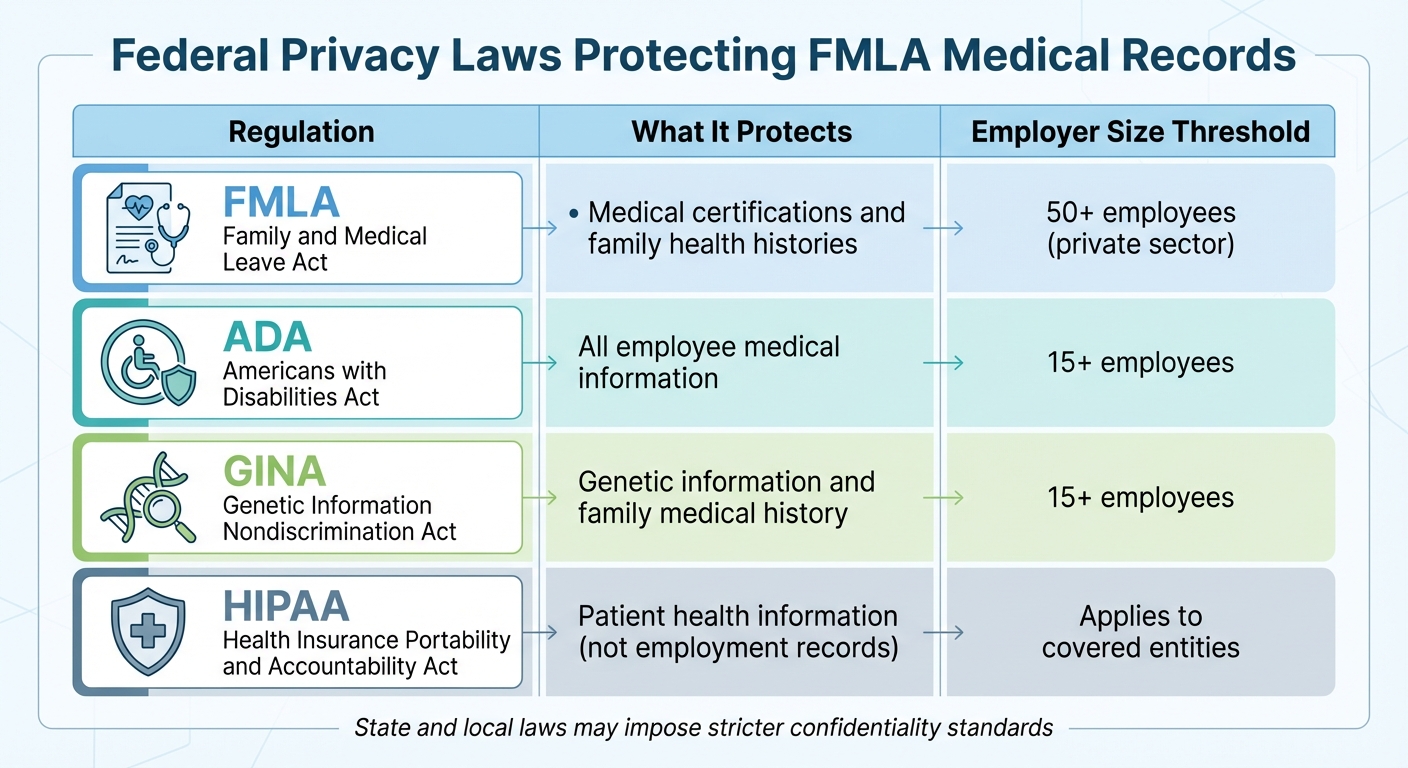
Federal Privacy Laws for FMLA Medical Records Compliance
Keeping employee medical information confidential is not just a best practice - it’s a legal requirement. Handling FMLA records involves managing highly sensitive health data, and clinics must navigate multiple federal privacy laws, each with specific rules and penalties for non-compliance.
Storage and Access Controls
The first step in protecting FMLA records is implementing strong physical and digital security measures. For paper records, use locked filing cabinets in a secure location. For digital files, role-based access controls are essential, ensuring that only authorized personnel can view sensitive medical details.
Access to FMLA medical files should be strictly limited. HR administrators may need full access, but supervisors and managers should only receive information about work restrictions or necessary accommodations - they should never be informed of an employee's medical diagnosis. As federal regulations clarify:
Supervisors and managers may be informed regarding necessary restrictions on the work or duties of an employee and necessary accommodations [but not the underlying medical condition].
First-aid and safety personnel can access medical records only if an employee might require emergency treatment. Additionally, government officials conducting FMLA compliance investigations are permitted to review relevant documentation. Outside of these exceptions, medical records must remain strictly confidential.
To strengthen security, clinics should adopt technical safeguards alongside physical protections. Encrypt digital files, enforce unique user IDs and passwords, and enable automatic logoffs to prevent unauthorized access. Assigning a dedicated Security Officer to oversee these protocols ensures accountability and consistent monitoring. Using a HIPAA-compliant digital platform, like Prospyr (https://prospyrmed.com), can simplify these efforts by automating encryption and role-based access systems.
These measures align with the broader legal framework designed to protect employee medical information.
Legal Requirements for Confidentiality
FMLA confidentiality rules intersect with several key federal laws, including the Americans with Disabilities Act (ADA), the Genetic Information Nondiscrimination Act (GINA), and HIPAA. Each law has unique requirements:
- ADA mandates that all employee medical information is kept confidential and stored separately from personnel files. This applies to employers with 15 or more employees.
- GINA protects genetic information and family medical history and also applies to employers with 15 or more employees.
- HIPAA generally excludes employment records but applies to clinics as "covered entities" when managing patient data. If a clinic requests medical information directly from a healthcare provider for an employee’s FMLA leave, a HIPAA authorization is required.
| Regulation | What It Protects | Employer Size Threshold |
|---|---|---|
| FMLA | Medical certifications and family health histories | 50+ employees (private sector) |
| ADA | All employee medical information | 15+ employees |
| GINA | Genetic information and family medical history | 15+ employees |
| HIPAA | Patient health information (not employment records) | Applies to covered entities |
State and local laws may impose stricter confidentiality standards than federal regulations. Consulting legal counsel familiar with your region can help ensure compliance. Additionally, staff members handling employee records should receive training on these specific confidentiality requirements. Mishandling records - even unintentionally - can lead to serious consequences. The Department of Labor’s optional-use certification forms include GINA-compliant warnings, which help employees avoid sharing unnecessary genetic information.
FMLA documentation must be retained for three years, while HIPAA-related policies and procedures require a six-year retention period. Establish clear retention schedules that address both requirements, and ensure secure disposal of outdated hardware and electronic media to prevent unauthorized access to sensitive information.
sbb-itb-02f5876
Common FMLA Recordkeeping Mistakes to Avoid
Mistakes in FMLA recordkeeping can lead to disputes, fines, and unnecessary headaches. Addressing these issues is just as important as organizing your files properly, as discussed earlier. Taking a proactive approach to recordkeeping can save clinics from costly consequences.
Mixing FMLA Files with General Personnel Records
A common misstep is storing sensitive medical certifications or health histories in general personnel files. Federal regulations require that FMLA-related medical records be stored separately and accessed only by authorized personnel. Keeping these records isolated is essential for compliance and privacy.
To avoid this, create dedicated medical files solely for FMLA documentation. Regularly audit your filing system to ensure proper separation is maintained. Train staff to file documents correctly and perform periodic checks to catch errors before they become bigger problems.
Failing to Track Partial-Day Leaves
Intermittent FMLA leave presents a unique challenge, especially when it comes to tracking partial-day absences. Many clinics fall short here, risking compliance issues. Federal law requires precise tracking of FMLA leave, often in hourly increments, to prevent overuse of the 12-week entitlement.
"A frequent error is failing to designate small chunks of time off as FMLA leave. An employee who leaves two hours early for a physical therapy appointment is using FMLA leave, and that time must be tracked and deducted from their entitlement." – HR Certification
Federal guidelines mandate that FMLA leave be tracked using the smallest increment your payroll system uses for other types of leave, as long as that increment doesn’t exceed one hour. Train managers to recognize and report smaller absences - like arriving late for a doctor’s visit or leaving early for treatment - so these can be logged before the end of the pay period. Without detailed records, you may find yourself defenseless if an employee later alleges discrimination or retaliation, as FMLA law assumes the employer is at fault in the absence of adequate documentation. The same level of precision is required for financial records, as errors in this area also draw scrutiny.
Not Keeping Premium Payment Records
Another frequent oversight is failing to document benefit premium payments. This can leave your clinic vulnerable during a Department of Labor audit and complicate compliance efforts.
To avoid this, document all premium payment arrangements clearly and in writing. Specify how employees will pay their share of premiums - whether through regular payroll deductions, lump sum payments, or increased contributions before leave begins. Use DOL Form WH-381 (Notice of Eligibility and Rights & Responsibilities) to outline the employee’s premium payment obligations and the consequences of non-payment. Integrate these records with your payroll system to ensure payments are easily traceable by date or pay period. If an employee is using accrued paid leave alongside FMLA, make sure premium deductions are processed through standard payroll and properly documented. Keeping a dedicated benefits file for each employee on leave can simplify this process and ensure all necessary records are easily accessible.
Tools like Prospyr (https://prospyrmed.com) can simplify these administrative tasks by automating recordkeeping, ensuring your FMLA documentation stays accurate and compliant.
Conclusion
Key Takeaways
Keeping thorough FMLA records is your clinic's best safeguard against Department of Labor (DOL) audits and employee disputes. Under FMLA law, if proper records aren't available, the responsibility shifts to the employer to prove compliance. Without detailed documentation, your clinic could face back-pay awards, fines, and other penalties.
The rules are simple but critical: hold onto all FMLA records for at least three years. Medical certifications should be stored separately and confidentially, away from general personnel files. Track all leave in the smallest payroll increment your clinic uses. Your records should include payroll data, exact dates and hours of leave taken, copies of communications with employees, and documentation of any disputes.
Accurate tracking of intermittent leave is especially important. Even short absences, like a two-hour physical therapy session or leaving early for a family member’s treatment, count toward the 12-week entitlement and need to be properly logged. Don’t forget to document arrangements for benefit premium payments as well.
By following these practices, your clinic can strengthen its compliance and reduce risks, paving the way for smoother operations.
Next Steps for Your Clinic
Now that you know the essentials, it’s time to take action. Start by auditing your current FMLA files. Ensure medical records are stored separately, partial-day absences are tracked properly, and benefit premium payment records are up to date. Regularly reviewing your files can help you catch and resolve potential issues before they become bigger problems.
You might also want to explore digital tools to simplify FMLA management. For instance, platforms like Prospyr (https://prospyrmed.com) offer HIPAA-compliant solutions to automate calculations for rolling 12-month periods, set alerts for certification deadlines, and keep medical and personnel files separate. For clinics balancing patient care with employee compliance, these tools can reduce errors and free up your team to focus on what matters most - providing excellent care to your patients.
FAQs
How can clinics ensure FMLA records remain confidential?
To keep FMLA records secure in aesthetics and wellness clinics, handle them with the same care as protected health information (PHI). This means using a HIPAA-compliant system that encrypts data during both storage and transmission. Access should be limited to authorized personnel, such as HR managers or clinicians involved in managing leave. Strengthen security with tools like unique user IDs, strong passwords, and multi-factor authentication, and make it a habit to check access logs for any suspicious activity.
It's also crucial to have clear policies in place that restrict sharing FMLA details to only what's absolutely necessary. Require staff to sign confidentiality agreements during onboarding and provide regular training to reinforce these protocols. When it's time to dispose of records, shred paper documents and securely delete electronic files after the mandatory retention period, typically six years under HIPAA guidelines. Regular audits and refresher training sessions can help ensure your clinic stays compliant and safeguards patient privacy effectively.
How can Prospyr help clinics simplify FMLA recordkeeping?
Prospyr takes the hassle out of FMLA recordkeeping by replacing the traditional, paper-heavy process with a secure, streamlined digital system. It keeps track of employee leave requests, approvals, and certifications automatically, ensuring everything aligns with federal regulations. Plus, with encrypted storage and user-specific permissions, your records stay HIPAA-compliant and are ready for audits or inspections when needed.
The platform minimizes mistakes by automating leave entitlement calculations, flagging overlapping requests, and generating necessary forms. Built-in reminders and reporting tools ensure clinics meet deadlines and provide clear, organized summaries for internal or external reviews. By simplifying these administrative tasks, Prospyr frees up your team to focus on what truly matters - delivering quality patient care.
What are common FMLA recordkeeping mistakes clinics should avoid?
Clinics often stumble into avoidable mistakes when handling FMLA records, and these missteps can lead to compliance headaches. A big one? Not retaining all the necessary documents for at least three years. This includes medical certifications, employee notices, and detailed leave-tracking records. Another common issue is inaccurate or incomplete leave logs, particularly when dealing with intermittent or reduced-schedule leave. Without accurate records, keeping tabs on an employee's total leave entitlement becomes a challenge.
Another key point is to store FMLA records separately from other HR files. This makes it easier to retrieve them during audits and ensures better organization. Clinics also sometimes fail to document critical communications, such as leave requests, employer responses, and follow-ups. And let’s not forget the importance of protecting confidential medical information - these records must be stored securely and accessed only by authorized personnel to meet both HIPAA and FMLA confidentiality requirements.
By focusing on strong organization, thorough documentation, and secure storage systems, clinics can sidestep these issues and maintain smooth, compliant FMLA recordkeeping.