HIPAA and Consent Forms: Key Legal Terms
Clear guide to HIPAA consent and authorization for aesthetic clinics—PHI protection, photo consent, e-signatures, security safeguards, and breach penalties.

HIPAA and Consent Forms: Key Legal Terms
HIPAA compliance is non-negotiable for aesthetic clinics handling patient data. It ensures patient privacy, protects sensitive health information, and minimizes legal risks. Consent forms play a critical role in this process, authorizing the use or disclosure of Protected Health Information (PHI) beyond routine care. Without proper compliance, clinics risk fines, audits, and loss of trust.
Key Takeaways:
- HIPAA Rules: Privacy, Security, Breach Notification, and Enforcement Rules govern how clinics handle PHI.
- Consent Forms: Required for non-standard uses like marketing or third-party data sharing. Must include details on PHI use, expiration, and revocation rights.
- PHI Protection: Covers all identifiable health data, including treatment records, photos, and billing details.
- Security Measures: Clinics must use encryption, multi-factor authentication, and secure storage to protect electronic PHI (ePHI).
- Legal Penalties: Breaches can result in fines up to $2.1 million annually, with criminal violations reaching $250,000 and 10 years in prison.
Pro Tip: Use tools like Prospyr to simplify HIPAA compliance with pre-built templates, secure e-signatures, and automated record management.
This article dives deeper into compliance requirements, legal terms, and practical steps to ensure your clinic meets HIPAA standards.
HIPAA Requirements for Aesthetic Clinics
HIPAA Security Safeguards for Aesthetic Clinics
Navigating HIPAA requirements is essential for creating consent forms that safeguard both patient rights and your clinic's operations. Aesthetic clinics handle a mix of medical and cosmetic data, such as treatment notes, photos, payment details, and contact information. All of this qualifies as Protected Health Information (PHI), and HIPAA establishes strict rules for collecting, storing, and sharing it. Three main regulations guide these practices: the Privacy Rule, the Security Rule, and the Breach Notification Rule.
Privacy Rule and Patient Information Protection
The Privacy Rule dictates how PHI can be used and shared. In aesthetic clinics, this includes medical histories, treatment records, and any patient identifiers. Every patient must receive a Notice of Privacy Practices (NPP), which explains how their information will be used. Patients should sign this document during intake, and if your clinic collects data online (e.g., through appointment requests), the NPP should also be available on your website.
Access to PHI must follow the "minimum necessary" standard. For example, front desk staff don’t need access to treatment notes, and marketing teams shouldn’t handle medical histories. Regularly review access permissions to limit exposure to essential roles only. Physical privacy is just as important - discussing treatments in shared spaces like waiting rooms or hallways is a HIPAA violation, even if the conversation seems casual.
"Many practices forget that identifiers such as phone numbers, addresses, email addresses, and full-face photos are considered PHI." - Paulina Riedler and Suzanne Natbony, Esq., Spakinect
Social media often presents compliance challenges. Never confirm a patient’s treatment in public comments or tags, even if the patient posts about your clinic. Explicit written consent is required before sharing any patient photos online. Additionally, any third-party vendor handling patient data, such as EMR software providers or marketing agencies, must sign a Business Associate Agreement (BAA) with your clinic.
Security Rule and Data Protection
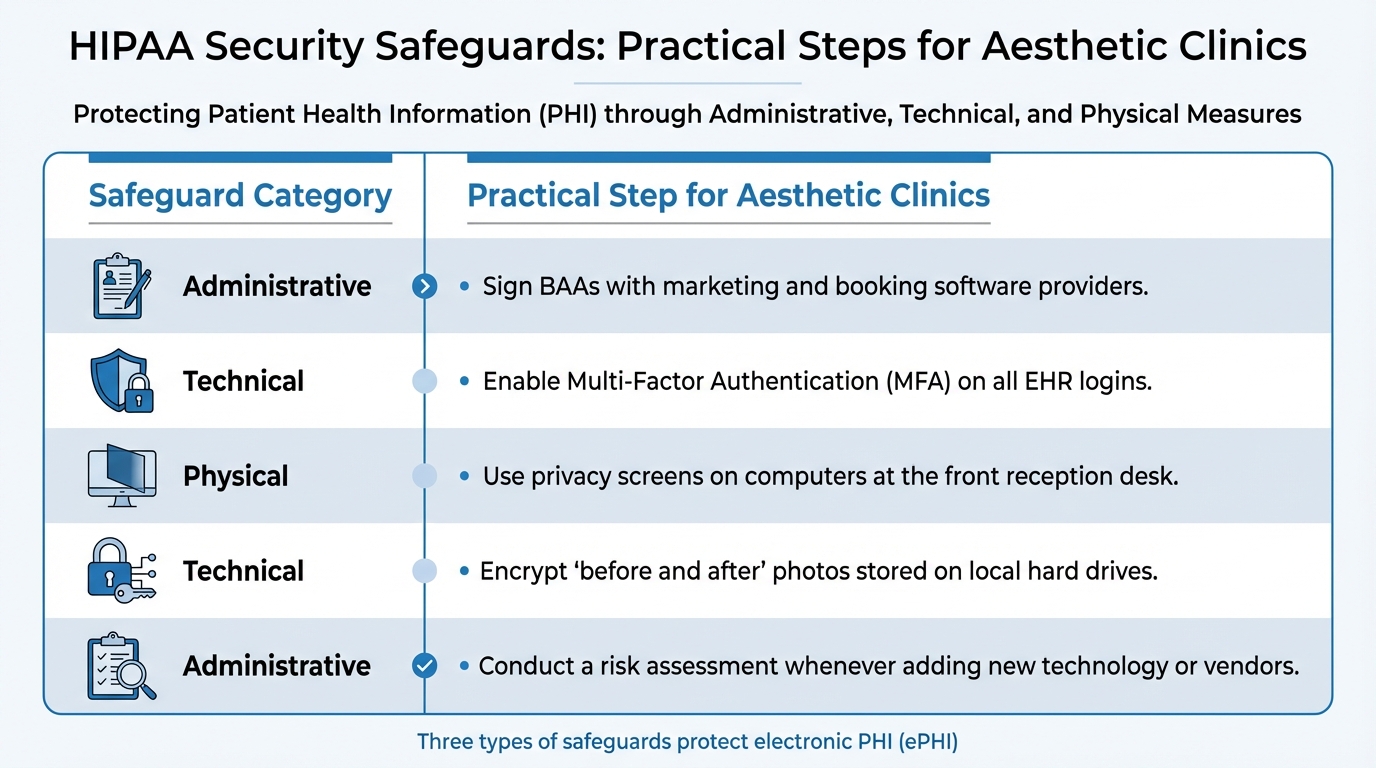
The Security Rule focuses on safeguarding electronic PHI (ePHI) through administrative, physical, and technical measures.
- Administrative safeguards include conducting annual Security Risk Assessments (SRA), forming a security committee, and ensuring all staff - receptionists and marketing teams included - receive HIPAA training every two years.
- Physical safeguards involve securing devices and spaces. For instance, if you use shared iPads for patient intake, enable "kiosk mode" to prevent unauthorized access to other patients' data. Install privacy screens at reception and ensure consultations happen in private rooms.
- Technical safeguards require measures like multi-factor authentication (MFA), unique user IDs, automatic log-offs, and encryption of PHI both at rest (on servers) and in transit (during transmission).
| Safeguard Category | Practical Step for Aesthetic Clinics |
|---|---|
| Administrative | Sign BAAs with marketing and booking software providers |
| Technical | Enable Multi-Factor Authentication (MFA) on all EHR logins |
| Physical | Use privacy screens on computers at the front reception desk |
| Technical | Encrypt "before and after" photos stored on local hard drives |
| Administrative | Conduct a risk assessment whenever adding new technology or vendors |
Proposed updates for 2025 will require measures like MFA and encryption for all clinics, removing the current flexibility between "required" and "addressable" specifications. The Office for Civil Rights (OCR) plans to increase audits in 2024–2025, focusing on cybersecurity vulnerabilities. Strong security measures are critical, but clinics must also be prepared to act quickly if a breach occurs.
Breach Notification and Penalties
If patient data is compromised, you must notify affected individuals within 60 days. For breaches involving over 500 individuals, you’re also required to inform the Department of Health and Human Services (HHS) and local media. In 2024, the OCR issued 22 enforcement actions, resulting in nearly $12.8 million in penalties. Civil fines range from $141 to over $2.1 million annually, depending on the severity and intent. Criminal violations can lead to fines up to $250,000 and up to 10 years of imprisonment.
Even small breaches can lead to significant costs. For example, one clinic spent $20,000 on breach notifications after facing a $10,000 ransom demand. To stay compliant, you must retain all HIPAA-related records, including patient authorizations, for at least six years from creation or the date they were last effective.
"Real security comes from operational discipline: mapping data flows, obtaining valid authorizations, enforcing data use restrictions, and logging every action." - Konfirmity
Avoid sending PHI through standard email or SMS. Instead, use secure patient portals or messaging systems. Outdated operating systems like Windows 7 or Windows 10 should be phased out, as they lack critical security updates. Additionally, ensure data backups are encrypted and stored separately from your main network to protect against ransomware attacks.
sbb-itb-02f5876
Legal Terms Used in HIPAA Consent Forms
Understanding key legal terms is essential when creating HIPAA-compliant consent forms. Three primary terms form the backbone of HIPAA documentation: informed consent, Protected Health Information (PHI), and authorization for data use and sharing. Each term serves a specific purpose, and mixing them up can lead to compliance issues. Below, we break down these terms and their relevance to aesthetic clinics.
Informed Consent
Informed consent is the agreement a patient provides before undergoing a medical procedure, ensuring they fully understand the treatment, its risks, benefits, and alternatives. This concept stems from medical ethics and state malpractice laws and aligns with HIPAA’s focus on patient protection. In aesthetic clinics, informed consent applies to treatments like Botox, laser therapies, or dermal fillers.
To be valid, the consent must be clear and accessible, typically written at a 6th-to-8th-grade reading level. It should focus on the procedure itself, not on the use of patient data. For instance, a microneedling consent form would detail the process, potential side effects like redness or swelling, and alternative treatments.
"Informed consent is about agreeing to participate in an activity (such as research)... HIPAA authorization is permission to use or disclose PHI for specified purposes." - Kevin Henry, HIPAA Specialist, AccountableHQ
Next, we’ll explore Protected Health Information (PHI), which plays a central role in HIPAA compliance.
Protected Health Information (PHI)
Protected Health Information (PHI) refers to any information that can identify a patient and relates to their health, treatment, or payment. This includes records in any form - paper, electronic, or verbal. In aesthetic clinics, PHI might include treatment plans, injectable logs, billing information, and even biometric data like facial photos or fingerprints. PHI is created when health details are paired with identifiers such as names, email addresses, or social media handles.
"Protected health information means individually identifiable health information transmitted by electronic media, maintained in electronic media, or transmitted or maintained in any other form or medium." - Administrative Simplification Regulations (§160.103)
When PHI is stored or shared electronically, it becomes electronic PHI (ePHI). Examples include patient emails, digital photos, and data in electronic health records (EHRs). Even a single "before and after" photo saved on a clinic’s hard drive can qualify as a designated record set if it’s used to make decisions about the patient. Unauthorized disclosures of PHI can lead to fines ranging from $100 to over $71,000 per violation.
| Term | Definition | Application in Aesthetic Clinics |
|---|---|---|
| PHI | Individually identifiable health, treatment, or payment info. | Patient charts, injectable logs, billing info. |
| Identifiers | Data points linking health info to a person (18 types). | Names, social media handles, facial photos. |
| ePHI | PHI stored or shared electronically. | Emails, digital photos, and EHR data. |
This framework ensures that PHI is handled with the care and transparency required by HIPAA.
Authorization for Data Use and Sharing
Authorization is a formal document allowing the use or disclosure of PHI for purposes beyond routine care activities like treatment, payment, or operations. Unlike routine consent, authorization is mandatory for non-standard uses such as marketing, research, or sharing data with third parties like insurers.
A valid authorization must include specific details: the PHI being disclosed, the recipients, the purpose, an expiration date, and the patient’s right to revoke. For example, if an aesthetic clinic partners with a skincare brand to promote products using patient testimonials, this constitutes marketing and requires signed authorization. Similarly, if a life insurance company requests lab results, the clinic must obtain a separate, signed HIPAA authorization from the patient.
"Where the Privacy Rule requires patient authorization, voluntary consent is not sufficient to permit a use or disclosure of protected health information unless it also satisfies the requirements of a valid authorization." - U.S. Department of Health and Human Services (HHS)
Patients have the right to revoke their authorization at any time by submitting a written request, though this does not apply to information already shared. Clinics are required to retain all authorization records for at least six years from the creation date or the last effective date. If combining informed consent and HIPAA authorization in one document, it’s crucial to use clearly labeled sections with separate signature lines to ensure patients understand the distinction between the two agreements.
Reading about the problem? See how Prospyr solves it in one platform.
Book a DemoRequired Elements in HIPAA Consent Forms
In aesthetic clinics, ensuring HIPAA consent forms include all required elements is essential for patient safety and meeting legal standards. These forms must cover six key sections to be compliant. Each form should contain patient identifiers (like full name, date of birth, and another unique identifier), a detailed description of the Protected Health Information (PHI) being disclosed (including date ranges), the purpose of the disclosure and its recipients, an expiration date or triggering event, revocation instructions, and a signature with a timestamp. These components help patients clearly understand what they’re agreeing to while creating a reliable legal record.
| Mandatory Section | Required Information/Content |
|---|---|
| Patient Identifiers | Full name, date of birth, and at least one other unique identifier. |
| Scope of Disclosure | Specific details of the PHI being shared, including applicable date ranges. |
| Purpose & Recipients | The reason for the disclosure and the entities or individuals receiving the information. |
| Expiration | A specific calendar date or event marking the expiration of the authorization. |
| Revocation Clause | Instructions for revoking consent, including any limits to revocation. |
| Signature & Date | Patient or legal representative’s signature, their relationship, and the date/time of signing. |
Additionally, forms should include a redisclosure warning, explaining that once shared, the information may no longer be protected under HIPAA. A statement clarifying that signing the form is not typically required for receiving treatment must also be included. For aesthetic procedures, the consent form should provide detailed treatment information, covering risks, expected results, and alternatives. This information should be written in plain, easy-to-understand language, ensuring accessibility for all patients.
Next, let’s explore the specific details required for procedure descriptions, photo consent, and electronic signatures.
Procedure Information and Risk Disclosure
The section describing the procedure should use straightforward, non-technical language. For instance, a dermal filler consent might outline the injection sites, the type of filler, potential side effects like bruising or swelling, and the expected duration of results. Avoid overly complex or legalistic terms.
Risk disclosure is equally important. List potential complications in order of likelihood, starting with common minor effects and ending with rare but serious risks. Providing alternative treatment options allows patients to make informed decisions. The focus here is on clarity and transparency - patients should leave with a balanced understanding of both the benefits and possible downsides.
Now, let’s discuss the requirements for photo and marketing consent.
Photo Consent and Marketing Use
Patient photos are considered PHI if they can identify an individual and relate to their treatment. Using these images for purposes like social media, marketing, or training requires separate written authorization beyond the standard treatment consent. This is because marketing falls outside the scope of routine healthcare operations.
The photo consent section should clearly state how the images will be used. For example, specify whether the photos will appear on Instagram, in website galleries, or in training materials. Patients must have the ability to opt in or out of each use. For instance, someone might approve anonymous before-and-after photos for a training manual but decline their use on social media. Avoid vague terms like "any marketing purpose." Instead, provide specific checkboxes for each platform or intended use. While face-to-face communication between a provider and patient doesn’t require prior authorization, any public or digital sharing does.
Electronic Signature Standards
HIPAA allows electronic signatures on consent forms as long as the process verifies the signer’s identity, records their intent, and ensures a tamper-evident record. This means using methods like multifactor authentication, secure links, or knowledge-based verification to confirm the signer’s identity. The system must lock the document after signing and store a digital hash or checksum to prove it hasn’t been altered.
"Electronic signatures are acceptable when your process verifies identity, captures intent, and preserves a tamper-evident record." - Kevin Henry, HIPAA Specialist, Accountable
To meet compliance, the system should also log metadata such as timestamps and the method used to verify the signer. It’s crucial to use TLS 1.2 or higher for data in transit and AES-256 encryption for stored data. Patients should automatically receive a secure copy of their signed form. Importantly, never overwrite a signed form - retain the exact version for audits and maintain strict version control for all templates.
How to Standardize Consent Forms
Creating a consistent structure for consent forms is the first step in standardizing them across your aesthetic practice. A well-organized flow not only helps patients understand the forms but also makes it easier for staff to explain them. Arrange the content logically: start with an overview of the authorization, then outline the PHI (Protected Health Information) being shared, identify the authorized parties, address risks and safeguards, include a voluntary choice statement, and provide expiration and revocation details. Wrap up with contact information and signature blocks for clarity and completeness.
Version control is another key element. Every revision should have a date stamp, and a change log must be maintained to ensure you can always reference the version a patient signed. Never overwrite previously signed forms. To ensure consistency, schedule a yearly review of all consent templates or conduct one immediately after any regulatory updates. Front desk staff should verify patient identity and explain the consent options, while clinicians need to document the specific disclosure details. This approach helps prevent inconsistencies and ensures compliance.
Using Pre-Built HIPAA Templates
To simplify the process, consider using pre-built HIPAA templates. These templates are designed to include the essential HIPAA elements, such as a description of PHI, authorized parties, purpose, expiration, and revocation rights. Reliable sources for these templates include Institutional Review Board libraries, academic medical centers, professional associations, and government-issued model notices. Select a template that aligns with your practice type, then tailor it to fit your procedures and any relevant state laws.
For better accessibility, adapt the templates to an eighth-grade reading level. Keep sentences short, use active voice, and add plenty of white space to make them easier to read. Replace ambiguous terms like "all records ever" with specific descriptions and date ranges. Adding checkboxes - such as "share lab results" or "exclude behavioral health notes" - can help patients make informed choices.
"Write for an eighth-grade reading level so patients can understand their choices without assistance." – Kevin Henry, HIPAA Expert
If you’re using digital forms, ensure the platform complies with HIPAA requirements. This means encrypted data transmission (TLS 1.2 or higher), a signed Business Associate Agreement (BAA), and automatic delivery of a signed copy to patients via PDF or a secure portal. Since many patients complete forms on their smartphones, mobile optimization is essential.
Common Consent Form Mistakes
One frequent issue is using vague language like "all medical records." This violates HIPAA’s Minimum Necessary standard and could invalidate the authorization. Instead, specify the exact data types and date ranges, such as "medical records related to Botox procedure performed on 03/15/2026".
Another mistake is omitting an expiration date or stating "no expiration." Every authorization must include a clear expiration date or a specific triggering event. For one-time releases, a 30–90 day timeframe from the signature date works well. For ongoing care coordination, set a maximum of 12 months or specify "end of active treatment".
Combining multiple consents into one signature block is also problematic. For instance, merging HIPAA data-sharing consent with treatment informed consent can confuse patients and obscure their rights. Each type of consent should have its own section with clearly labeled signature lines. Additionally, include a conditioning statement explaining that treatment cannot be denied if the patient refuses to sign the HIPAA authorization (with limited exceptions).
Lastly, don’t forget to include revocation instructions. Patients should know they can revoke their authorization in writing, and the form should provide contact details for your privacy officer. Also, include a redisclosure warning to inform patients that once their information is shared, it may no longer be protected under HIPAA.
How Prospyr Simplifies HIPAA-Compliant Consent Forms
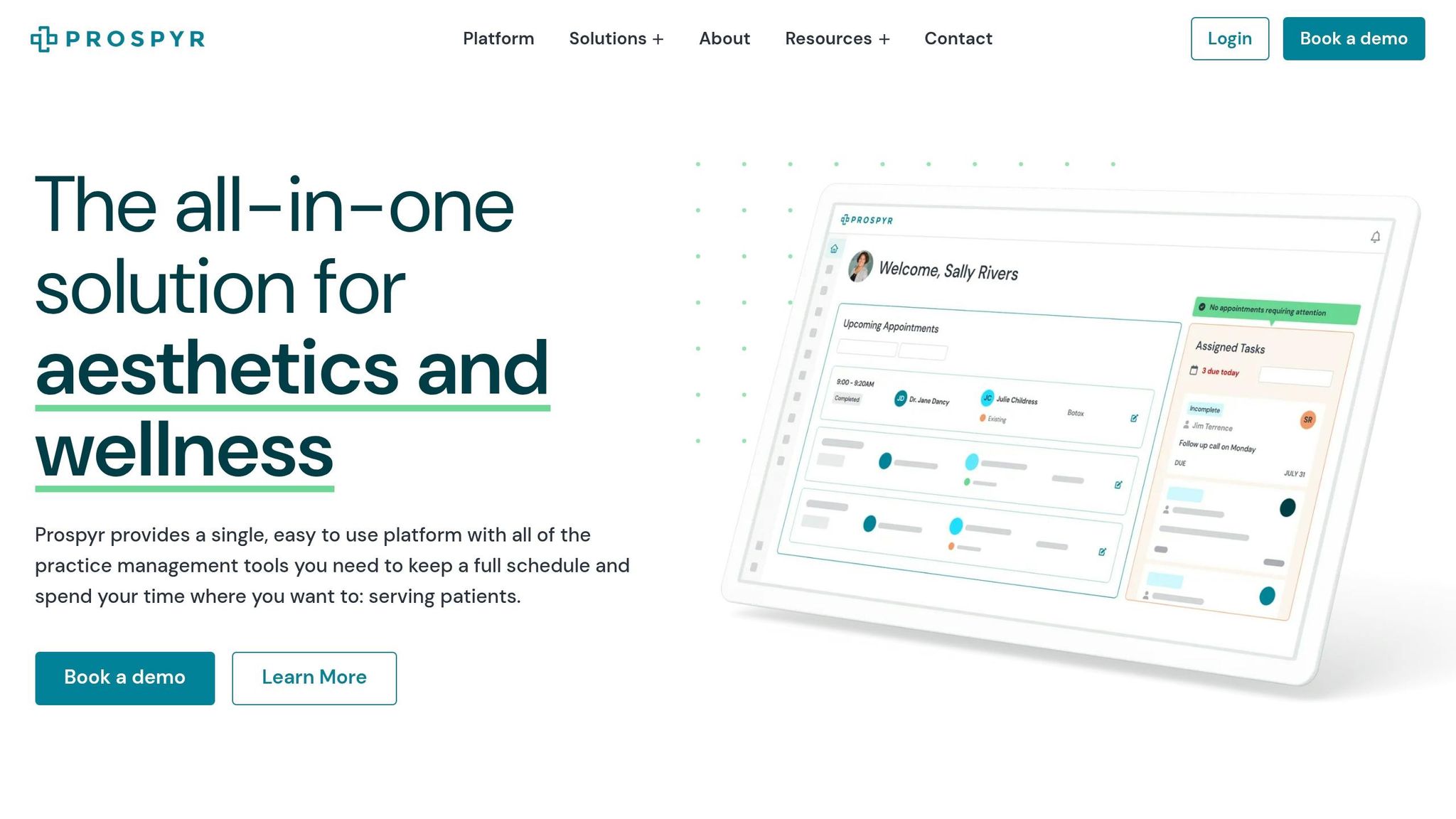
Prospyr takes the hassle out of creating and managing HIPAA-compliant consent forms for aesthetic clinics. It offers pre-built, customizable templates tailored specifically for these clinics, covering everything from informed consent to photo/video consents and medical history intake. These templates include all the necessary components like risk disclosures, alternatives, no-guarantee clauses, and pre/post-care instructions, saving clinics the effort of starting from scratch.
But it doesn’t stop there. Prospyr also ensures seamless data integration. Digital intake forms link directly with its CRM and EMR systems, automatically attaching signed consents to patient records. Patients can securely complete forms via the Patient Portal on their smartphones, computers, or even onsite. The platform supports electronic signatures that meet HIPAA standards and provides a signed Business Associate Agreement (BAA), offering legal protection for your practice.
"Simplify patient onboarding with customizable digital forms and consents, solving the challenges of paperwork, data accuracy, and patient experience." – Prospyr
Prospyr’s secure infrastructure ensures compliance with HIPAA’s Security Rule through encrypted storage, restricted access controls, and audit trails. For instance, let’s say a patient is scheduled for Botox. You can send them a digital intake form through the patient portal, which collects their medical history, allergies, and an e-signed informed consent. This consent would detail the procedure, potential risks (like bruising or asymmetry), alternatives, and a photo release for marketing purposes. Once completed, the form is automatically saved to the EMR and synced with scheduling to enable appointment reminders. This setup not only ensures HIPAA compliance but also keeps your clinic prepared for audits.
Prospyr also provides practice analytics to track consent form completion rates and generate audit logs. These features help you monitor compliance, spot issues like unsigned forms, and stay ready for audits. Dr. Daniel Lee shared that his practice saw a 50% boost in revenue and a 40% increase in appointments after implementing Prospyr. By combining compliance with operational efficiency, Prospyr makes life easier for aesthetic clinics while improving their bottom line.
Conclusion
HIPAA compliance plays a key role in maintaining patient trust and ensuring secure operations. When consent forms are written in clear, straightforward language and include essential elements like details on PHI disclosures, expiration terms, and revocation rights, patients gain confidence in how their sensitive information is managed. This level of transparency not only strengthens your clinic’s reputation but also helps minimize the risk of expensive data breaches. Given these stakes, staying compliant with HIPAA is non-negotiable.
Using advanced digital tools can turn compliance into an operational advantage. Platforms like Prospyr simplify HIPAA management by centralizing patient data, consent forms, and audit trails within a secure, compliant ecosystem. This structured approach - tracking data flows, ensuring valid authorizations, and maintaining detailed logs - shields your practice from regulatory fines and potential malpractice claims.
The benefits are evident in real-world outcomes. For instance, Dr. Daniel Lee of New Life Cosmetic Surgery reported a 50% boost in revenue and a 40% rise in appointments after adopting Prospyr to streamline his practice management. Similarly, SOM Aesthetics achieved $40,000 in revenue within just two days of opening, thanks to integrated digital intake and consent workflows.
"Real security comes from operational discipline: mapping data flows, obtaining valid authorizations, enforcing data use restrictions, and logging every action." – Konfirmity
FAQs
When do I need a separate HIPAA authorization vs. treatment consent?
When it comes to using or sharing protected health information (PHI) for anything outside of treatment, payment, or healthcare operations, you’ll need a separate HIPAA authorization. These standard activities are already covered under patient consent, but for non-standard uses, obtaining authorization ensures everything stays in line with HIPAA rules.
Do before-and-after photos count as PHI under HIPAA?
Yes, before-and-after photos can be considered protected health information (PHI) under HIPAA if they contain any of the 18 HIPAA identifiers or if they can be tied to an individual's health details. This becomes particularly important if the photos are stored, shared, or used in a manner that links them to a patient’s medical records or personal information.
What makes an electronic signature HIPAA-compliant?
An electronic signature meets HIPAA compliance when it guarantees data security and legal validity by incorporating the following elements:
- Strong user authentication: Verifying the identity of the signer to prevent unauthorized access.
- Encryption: Protecting the data during transmission and storage.
- Tamper-proof audit trails: Maintaining a secure record of signature activity to detect any alterations.
To fully comply with HIPAA, the use of electronic signatures must also be accompanied by a Business Associate Agreement (BAA). This agreement ensures all parties handle protected health information (PHI) responsibly and in accordance with HIPAA standards.