
Compliance training is essential for aesthetic practices to meet federal and state regulations, safeguard patient information, and maintain operational standards. Without proper training, your practice risks hefty fines, damaged reputation, and patient safety issues. Here's a quick roadmap:
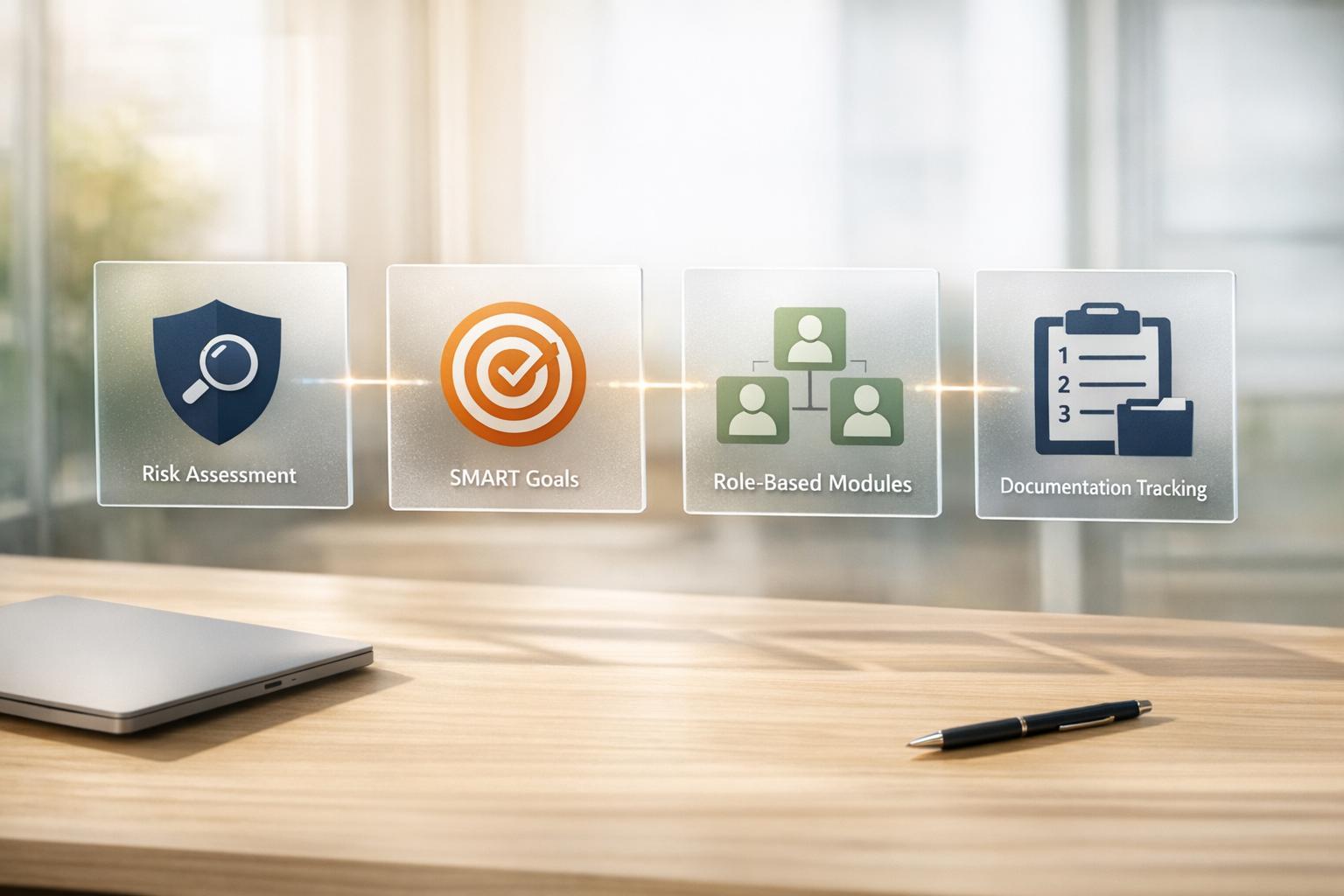
- Understand Key Regulations: Cover HIPAA, OSHA, state medical board rules, and marketing compliance.
- Assess Risks: Identify vulnerabilities like improper PHI handling or unauthorized staff roles.
- Set Clear Goals: Use measurable objectives, such as 95% training completion rates.
- Tailor Training by Role: Customize content for injectors, front desk staff, and others.
- Track and Document: Use tools to monitor progress and maintain records for audits.
How to Build a Compliance Training Program for Aesthetic Practices
Assessing Your Compliance Needs
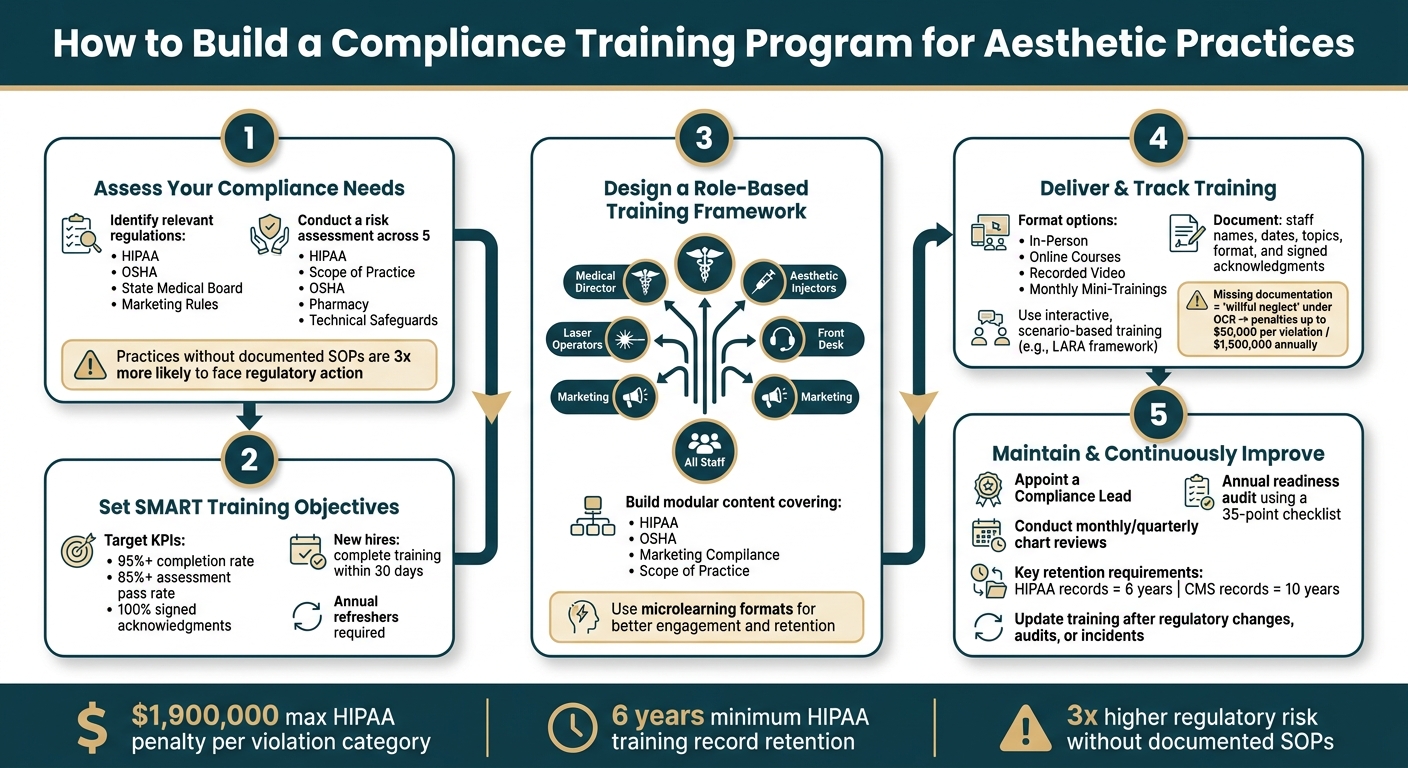
Before diving into the creation of any training module, it’s vital to understand what your practice is required to do - and where you might be most at risk. Skipping this step could result in a program that’s either too generic to be effective or too narrow to address critical issues.
Identifying Relevant Regulations
In the U.S., aesthetic practices must navigate several regulatory frameworks. HIPAA governs any practice handling Protected Health Information (PHI), which includes patient names, treatment records, and even before-and-after photos. Its main components are the Privacy Rule, the Security Rule, and the Breach Notification Rule. Additionally, OSHA’s Bloodborne Pathogens standard regulates infection control and the disposal of biohazard waste. State medical boards also impose rules on scope of practice, delegation to NPs, PAs, and RNs, and Medical Director oversight - regulations that vary widely across states.
An area often overlooked is marketing compliance. HIPAA mandates a specific written authorization before using patient photos or testimonials on websites or social media. Moreover, a 2023 FTC update prohibits generic disclaimers like "results not typical" for before-and-after photos. This means your marketing and front desk teams need proper training to avoid costly errors.
Once you’ve outlined these requirements, the next step is to pinpoint potential vulnerabilities.
Conducting a Risk Assessment
A thorough risk assessment identifies where your practice might fall short on compliance. Start by auditing how PHI is managed within your practice. This includes everything from digital intake forms and patient photos to staff communication via email or text. One of the most common violations is sending PHI through unencrypted channels.
Next, evaluate your clinical protocols and delegation agreements to ensure all staff members operate within their legal scope of practice. Review your vendor relationships as well - any third-party platform handling patient data, such as scheduling tools or billing software, must have a signed Business Associate Agreement (BAA). The table below highlights key areas to assess, potential vulnerabilities to check, and corresponding training priorities:
| Assessment Area | Vulnerability to Check | Training Priority |
|---|---|---|
| HIPAA | Posting photos without written consent | Obtain written marketing authorizations |
| Scope of Practice | Estheticians performing laser or injectable treatments | Role boundaries and delegation laws |
| OSHA | Improper sharps disposal or lack of PPE | Bloodborne pathogen exposure control |
| Pharmacy | Unsecured prescription medication storage | Inventory control and storage standards |
| Technical Safeguards | Sending PHI via unencrypted text or email | Secure communication protocols |
Practices lacking documented Standard Operating Procedures (SOPs) are three times more likely to face regulatory action after an adverse event. As part of your assessment, identify any gaps in these written protocols.
By understanding your risks, you can establish targeted training goals.
Setting SMART Training Objectives
With your risks identified, it’s time to set SMART objectives - goals that are specific, measurable, achievable, relevant, and time-bound. Vague goals like "improve HIPAA awareness" won’t cut it during an audit. Instead, aim for actionable objectives, such as: "100% of staff will secure a HIPAA-compliant photo authorization before using any patient image for marketing purposes."
To make goals measurable, define clear KPIs. For example, effective compliance programs often target a completion rate above 95%, an assessment pass rate above 85%, and 100% signed training acknowledgments to ensure audit readiness. Align deadlines with your operational calendar, such as requiring new hires to complete training within 30 days, scheduling annual refreshers, or implementing updates when regulations change - like the November 2026 DSCSA deadline for drug supply chain compliance.
"Regulatory compliance training is the bridge between policies on paper and practices in the workplace. Without effective training, even the best compliance programme is just documentation." - Patricia Harned, CEO, Ethics & Compliance Initiative (ECI)
These SMART objectives lay the groundwork for designing role-specific training, which will be explored in the next section.
sbb-itb-02f5876
Designing a Role-Based Training Framework
Once you've pinpointed your compliance risks and set clear goals, the next step is creating a training program tailored to specific roles. Generic, one-size-fits-all training often wastes time and misses the mark. Instead, each role should have content designed around its unique responsibilities. This approach aligns directly with the SMART objectives you’ve already established, ensuring that training is both relevant and impactful.
Mapping Training Topics to Staff Roles
Role-specific training begins by translating the risks you’ve identified into focused learning for each team member. Start by determining which roles involve access to Protected Health Information (PHI) or tasks that could impact patient safety or compliance. Then, assign training topics that directly relate to their day-to-day duties.
| Role | Core Training Topics | Regulatory Driver |
|---|---|---|
| Medical Director | Supervisory responsibilities, delegation protocols, chart review expectations | State Medical Board |
| Aesthetic Injectors (NP, PA, RN) | Anatomy, complication management, patient assessment, medical documentation | Medical Board / Nursing Board |
| Laser Operators | Laser safety standards, device-specific settings, LSO requirements | TDLR / DSHS |
| Front Desk | HIPAA Privacy Rule, intake form security, phone call PHI handling | Federal/State Law |
| Marketing | Before/after photo consent, social media authorizations, advertising compliance | HIPAA Privacy Rule |
| All Staff | Bloodborne Pathogens, Hazard Communication, Emergency Response | OSHA |
A commonly overlooked area is training for laser operators. In many states, agencies like the Texas Department of Licensing and Regulation (TDLR) or the Department of State Health Services (DSHS) mandate specific credentialing, including Laser Safety Officer (LSO) requirements. These legal requirements are non-negotiable and must be part of your training plan.
Building Modular Training Content
Organize your training into modules, with each module covering a single topic. This structure makes it easy to assign role-specific content, update materials as needed, and track progress efficiently.
Focus on four key areas in your training program: patient confidentiality and HIPAA compliance, infection control and OSHA standards, advertising and marketing regulations, and workplace conduct and scope of practice. Keep modules short - microlearning formats are proven to boost engagement and retention. When introducing new services, you can simply update the relevant module rather than overhauling the entire program.
For example, incomplete charting is a frequent issue uncovered during medical spa audits. This makes documentation training a vital standalone module for clinical staff, not just an add-on during orientation.
Using Practice Management Technology to Support Training
Once your training modules are in place, streamline delivery and tracking with practice management technology.
Platforms like Prospyr simplify the process by offering tools for task management, digital documentation, and communication. These features allow practice managers to assign training tasks, collect electronic acknowledgments, and maintain well-organized training records. This is especially important because HIPAA training records must be kept for at least six years. These records must include the employee's name, training date, topics covered, format, and a signed acknowledgment.
"Even if you train your staff, if you can't prove it, it's as if it never happened." - Complydome
Automated reminders for annual refreshers and alerts for incomplete modules reduce the administrative workload for managers. This ensures that nothing is missed, even as your team grows or regulations evolve.
Delivering and Tracking Training
Once you've developed tailored training content, the way you deliver and track that training becomes essential for maintaining compliance across your practice.
Choosing the Right Training Format
Each practice has unique needs when it comes to training formats. For example, a solo injector in a boutique medspa operates differently compared to a larger clinic with multiple providers, front desk staff, laser technicians, and a marketing team. The goal is to align the training format with both the topic at hand and the team’s regular workflow.
| Training Format | Description |
|---|---|
| In-Person Sessions | Great for onboarding and hands-on skills but can be tricky to schedule around patient appointments. |
| Online Courses | Useful for topics like HIPAA and OSHA compliance but may lack customization for your practice. |
| Recorded Video | Ensures consistency in delivery but should include follow-up quizzes to confirm understanding. |
| Monthly Mini-Trainings | Focused sessions that cover one topic at a time, reinforcing knowledge regularly. |
Short, focused sessions like "lunch and learns" (15 to 30 minutes) work particularly well for busy practices. These can tackle specific topics such as email security or phone call privacy protocols. Once you’ve chosen the right format, the next step is to keep staff engaged with interactive, scenario-based training.
Making Training Interactive and Case-Based
Training that lacks interaction often fails to hold staff attention. The best compliance training involves realistic scenarios that require active decision-making.
For aesthetic practices, tailor scenarios to the actual risks your team might face. For instance:
- Run a 15-minute mock consultation during a team meeting where a staff member acts as a patient requesting another person’s medical records.
- Practice responding to a spouse asking about a patient’s treatment history.
- Walk through the process of documenting and reporting an adverse event, such as complications from a filler treatment.
When near-misses occur, use them as learning opportunities. Debrief the team to identify what went wrong and how to improve future responses.
"When a patient complaint comes in, don't sweep it under the rug - treat it as training data. What could have been done differently? What script would help next time?" - Monsoft Solutions
The LARA framework - Listen, Acknowledge, Respond, Act - is a helpful tool for teaching staff how to handle tough patient interactions while maintaining proper documentation. Providing clear scripts can eliminate uncertainty and ensure your team responds consistently. After completing interactive training, it’s crucial to document everything for audit readiness.
Tracking Completion and Measuring Results
Interactive training is only impactful if it’s properly documented. Without records, the training might as well not have happened. The Office for Civil Rights (OCR) considers missing training documentation as "willful neglect", which can result in HIPAA penalties as high as $50,000 per violation and up to $1,500,000 annually for unresolved issues.
Tools like Prospyr make managing training records easier by automating task assignments and collecting digital acknowledgments. For every training session, document key details such as:
- Staff names
- Dates
- Topics covered
- Training format
- Acknowledgments of completion
Prospyr’s analytics features also let you track completion rates, collect assessment scores, and identify areas where staff may need extra help. Beyond completion rates, observing real-world behavior - like reduced unnecessary access to patient records - can provide valuable insight into the training’s effectiveness.
Maintaining and Improving Your Training Program
Once your training program is up and running, the focus shifts to keeping it accurate and effective. With the delivery and tracking systems in place, the next step is to fine-tune and maintain the program. A compliance program that doesn't keep pace with changing regulations can quickly become a liability.
Setting Up Governance and Communication
Every compliance program needs a clear leader. Appoint a Compliance Lead, whether it's your Office Manager, a senior provider, or a Privacy Officer. This person's responsibilities include staying updated on regulatory changes, managing the training schedule, and addressing staff questions about policies.
Beyond leadership, it's essential to create a safe and straightforward way for staff to voice concerns. Outline a clear process: who to contact, how to document the issue, and what follow-up steps will be taken. This isn't just about best practices - it’s about catching potential problems before they escalate into violations.
Keep all compliance-related materials in one centralized digital compliance playbook. This should include training logs, HIPAA policies, OSHA safety plans, Medical Director agreements, and staff acknowledgments. A well-organized playbook is invaluable during state board inspections or federal audits.
Monitoring and Auditing for Compliance
Tracking training completion is only part of the story. Internal audits are key to ensuring that training translates into real-world improvements. Schedule monthly or quarterly chart reviews with your Medical Director to confirm that clinical documentation, consent forms, and treatment records meet current standards.
Don’t forget to review your social media content regularly. For example, before-and-after photos require a specific HIPAA authorization, separate from general intake consents. This is a common oversight in aesthetic practices.
To get a full picture of your compliance, consider conducting an annual readiness audit. Use a detailed 35-point checklist to evaluate clinical documentation, expired inventory, billing practices, and vendor agreements. Spotting gaps early prevents surprises during regulatory reviews.
Using Data to Refine Your Program
Audits and observations provide valuable insights, but your practice management platform offers hard data. Tools like Prospyr’s analytics can track training completion rates, flag overdue assignments, and identify recurring problem areas, helping you refine your program continuously.
Let this data guide updates. Revise training materials after regulatory changes, audit findings, or compliance incidents. Even without specific triggers, schedule an annual review of all training content. As compliance expert Michael Berman of Ncontracts advises:
"While reinventing the wheel isn't necessary, freshening up presentations to ensure they remain engaging and reflect the most-up-to-date regulatory obligations and best practices is a good idea."
Here’s a quick look at minimum training and record-keeping requirements:
| Requirement Type | Frequency | Retention Period |
|---|---|---|
| CMS General Compliance | Within 90 days of hire; Annually | 10 years |
| CMS Fraud, Waste & Abuse | Within 90 days of hire; Annually | 10 years |
| HIPAA Training | Upon hire; Annually | 6 years |
Using a platform like Prospyr to automate renewal reminders ensures no one falls out of compliance between review cycles. Plus, it creates a clean, auditable record for when questions arise.
Conclusion: Building a Scalable Compliance Training Program
Creating a compliance program that stands the test of time requires consistent effort, but the rewards are clear - it helps avoid hefty penalties. For example, HIPAA violations tied to willful neglect can cost up to $1,900,000 per violation category. At its core, a successful program hinges on a few essentials: centralized documentation, well-defined roles and responsibilities, and a dedicated Medical Director to oversee compliance efforts. Beyond that, staying up-to-date is non-negotiable. Regulations evolve - OSHA, for instance, revised its sanitation and workplace safety requirements in 2025 - and failing to adapt can lead to trouble. Using technology can make navigating these changes much more manageable.
Platforms like Prospyr simplify the operational side of compliance. They handle tasks like tracking training completions, storing digital acknowledgments, and generating audit logs to prove your team is trained and your records are ready for inspection.
Think of your compliance program as a dynamic system rather than a one-and-done task. Regular reviews - whether annually or after regulatory updates - ensure it stays effective. Use audit data to identify gaps and guide improvements. This proactive approach lays the groundwork for a scalable compliance program that supports long-term growth.
FAQs
What should my compliance training cover first?
When starting compliance training, it's essential to cover the basics: HIPAA, patient privacy, and safety standards. These principles are the backbone of maintaining trust and avoiding costly violations in medical and aesthetic practices.
Focus on educating your team about HIPAA compliance and the proper handling of Protected Health Information (PHI). This includes secure documentation practices, safeguarding patient confidentiality, and understanding the legal requirements that govern your industry.
Additionally, training should address emergency protocols and treatment standards. By ensuring staff are well-versed in these areas, you create a solid framework for compliance and patient safety.
How often should we retrain staff and update modules?
Staff training isn’t a one-and-done deal - it requires regular updates to stay effective and compliant. For example, annual retraining is highly recommended, particularly for HIPAA compliance. This schedule aligns with best practices and meets the requirements of many state laws.
It’s also crucial to update training modules whenever there are changes in regulations or practice protocols. Keeping staff informed about the latest developments ensures they remain compliant and fully equipped to handle their responsibilities effectively.
What records do we need to prove training during an audit?
To prepare for audits and demonstrate compliance, it's essential to keep detailed documentation of staff training sessions. HIPAA regulations specifically require records that include the training dates, attendance lists, and the topics covered. For aesthetic practices, this means ensuring your records reflect training on critical areas such as privacy policies, security measures, and the proper handling of Protected Health Information (PHI). These documents not only show compliance with regulations but also highlight your readiness for potential audits.