OSHA Compliance for Med Spa Onboarding
Make med spa onboarding OSHA-compliant with role-specific training, exposure control, hazard communication, PPE, organized records, safety audits, and digital tracking.

OSHA Compliance for Med Spa Onboarding
Ignoring OSHA compliance can cost your med spa thousands of dollars in fines and compromise employee safety. To avoid this, you need to implement proper safety training, maintain accurate records, and tailor onboarding programs to specific roles. Key OSHA standards for med spas include:
- Bloodborne Pathogens Standard: Requires an Exposure Control Plan and Hepatitis B vaccinations for at-risk staff.
- Hazard Communication Standard: Mandates proper labeling and Safety Data Sheets (SDS) for hazardous chemicals.
- Personal Protective Equipment (PPE) Standard: Employers must provide PPE like gloves and masks at no cost.
- General Duty Clause: Ensures a workplace free from serious hazards.
Common onboarding issues include inconsistent training, poor documentation, and lack of role-specific protocols. Med spas can address these by:
- Tailoring Training: Focus on specific risks for clinical and administrative roles.
- Organizing Records: Keep training logs and safety documents easily accessible.
- Regular Audits: Conduct safety checks and update training for new risks.
Using tools like centralized compliance software can simplify tracking and ensure adherence to OSHA standards. Proper onboarding protects your staff, clients, and business from safety risks and legal penalties.
OSHA Standards That Apply to Med Spas
OSHA Standards and Requirements for Med Spa Compliance
Main OSHA Requirements for Med Spas
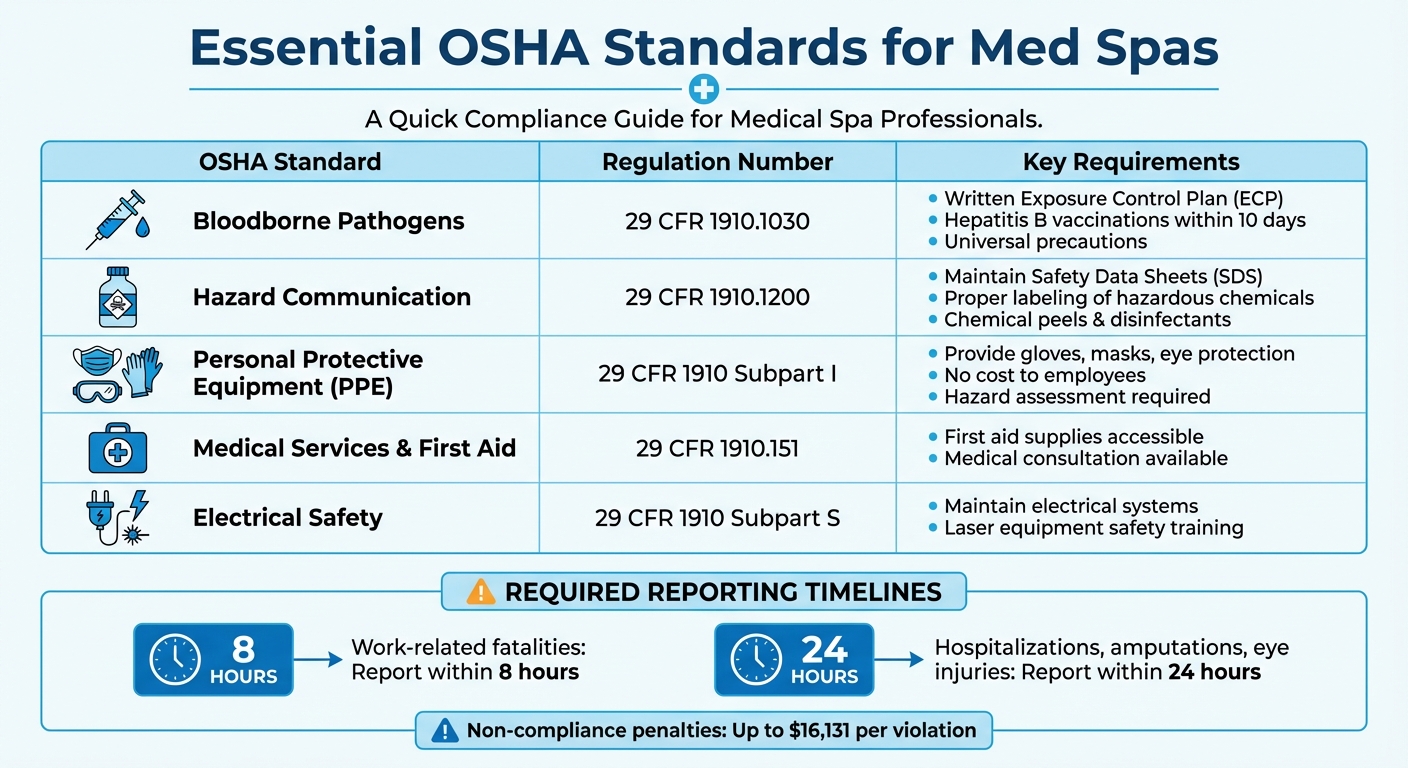
Creating a safe work environment in med spas begins with adhering to OSHA standards designed to protect employees. Among these, the Bloodborne Pathogens Standard (29 CFR 1910.1030) is a top priority. This regulation requires med spas to implement a written Exposure Control Plan (ECP), follow universal precautions, and offer Hepatitis B vaccinations to at-risk staff within 10 days of assignment. According to OSHA:
"Engineering and work practice controls shall be used to eliminate or minimize employee exposure."
The Hazard Communication Standard (29 CFR 1910.1200) is another critical regulation. It mandates that med spas maintain Safety Data Sheets (SDS) for hazardous chemicals - like those found in chemical peels and disinfectants - and ensure proper labeling on all containers. Similarly, the Personal Protective Equipment (PPE) Standard (29 CFR 1910 Subpart I) requires employers to assess workplace hazards and supply appropriate protective gear, such as gloves, masks, and eye protection, at no cost to employees.
Other essential OSHA standards include Medical Services and First Aid (29 CFR 1910.151), which ensures that first aid supplies and medical consultation are readily available, and Electrical Safety (29 CFR 1910 Subpart S), which focuses on maintaining electrical systems and ensuring laser equipment is operated safely. Additionally, the General Duty Clause requires med spas to provide a workplace free from recognized hazards that could lead to serious injury or death.
| Standard | Key Requirement for Med Spas |
|---|---|
| 29 CFR 1910.1030 | Implement a written Exposure Control Plan (ECP) and offer Hepatitis B vaccinations |
| 29 CFR 1910.1200 | Maintain SDS and ensure proper labeling of hazardous chemicals |
| 29 CFR 1910 Subpart I | Provide PPE (e.g., gloves, masks, eye protection) at no cost to employees |
| 29 CFR 1910.151 | Ensure access to first aid supplies and medical consultation |
| 29 CFR 1910 Subpart S | Maintain electrical systems and provide laser safety training |
Complying with these standards is essential to ensure a safe working environment and avoid serious repercussions.
Consequences of Non-Compliance
Ignoring OSHA regulations can lead to severe consequences. While med spas with 10 or fewer employees may be exempt from routine injury and illness recordkeeping, they are still required to report certain incidents. For example, work-related fatalities must be reported within 8 hours, while hospitalizations, amputations, or eye injuries must be reported within 24 hours. Beyond reporting requirements, non-compliance heightens the risk of workplace injuries, including needlestick incidents, chemical burns, and exposure to harmful pathogens. These risks not only jeopardize employee safety but can also result in significant legal and financial penalties.
sbb-itb-02f5876
Common OSHA Compliance Problems During Onboarding
Even with clear regulations, many med spas struggle to achieve proper OSHA compliance during the onboarding process. These challenges can lead to immediate safety risks and long-term legal issues. By identifying where onboarding often falters, med spa owners can address weaknesses before they result in injuries or penalties. Tackling these common pitfalls is key to creating effective, OSHA-compliant training programs.
Inconsistent or Incomplete Training
A major issue arises when training programs lack consistency or fail to ensure employees fully grasp safety requirements. Many med spas rely on generic safety presentations, rushing through them without confirming that new hires understand the material. This is particularly problematic when the content isn’t tailored to different literacy levels or language needs, leaving some employees confused about essential safety practices.
Another frequent gap is program awareness. For example, new hires might miss critical instructions on hazard reporting or emergency responses. As OSHA emphasizes:
"Employers, managers, and supervisors are responsible for workers' safety, yet sometimes have little training on safety-related concepts and techniques."
This challenge isn’t limited to frontline workers. Supervisors and managers, who are tasked with ensuring compliance and guiding their teams, often receive no formal safety training. This lack of preparation undermines their ability to enforce safe practices effectively.
Inadequate Documentation
Poor recordkeeping is another common compliance issue. Med spas often lack essential written programs, such as the Hazard Communication Program for chemical exposures or the Exposure Control Plan for bloodborne pathogens. These documents are required by law and must be accessible to all employees.
Additionally, many med spas fail to maintain accurate training records, which are essential for audit readiness. OSHA requires these records to be retained long-term. Missing or incomplete documentation not only complicates audits but also signals broader compliance issues. Another problem is the lack of competency verification. Employers sometimes fail to confirm that employees have the necessary knowledge and skills before allowing them to perform potentially hazardous tasks.
Missing Role-Specific Safety Training
Generic onboarding programs often overlook the unique hazards associated with specific roles, increasing risks. For instance, a medical aesthetician performing laser treatments faces dangers like laser plumes and ionizing radiation - hazards that don’t apply to front desk staff. Yet, many med spas use one-size-fits-all training that fails to address these specialized risks.
To ensure safety, training should be tailored to the specific duties of each role. This includes assessing tasks to determine the appropriate Personal Protective Equipment (PPE) requirements, which can vary widely depending on the job. For example:
- Clinicians handling injectables need detailed training on bloodborne pathogens and proper sharps disposal.
- Staff operating laser equipment require specialized instruction on laser plume safety and eye protection.
When onboarding skips these role-specific protocols, employees may encounter hazards they don’t recognize and are unprepared to manage. Addressing these gaps is crucial to creating a safe and compliant workplace.
Reading about the problem? See how Prospyr solves it in one platform.
Book a DemoBuilding an OSHA-Compliant Onboarding Process
When designing an onboarding process that aligns with OSHA standards, it's essential to address compliance gaps from the start. This means creating a system that not only meets regulatory requirements but also establishes a foundation for long-term workplace safety. Focus on role-specific training, clear timelines for completion, and organized documentation to ensure a smooth and effective onboarding experience.
Creating Training Programs by Role
Different roles come with different risks, so training must be tailored to the specific hazards employees may encounter. For example, clinical staff working with injectables or laser treatments need thorough training on Bloodborne Pathogens (29 CFR 1910.1030), sharps safety, proper use of personal protective equipment (PPE), and managing laser plume hazards. On the other hand, front desk and administrative staff should focus on emergency action plans, fire prevention, and hazard reporting.
To customize training effectively, start with a Job Hazard Analysis for each role. This helps identify the unique risks associated with specific tasks. OSHA's "Model Plans and Programs for Bloodborne Pathogens and Hazard Communications" can serve as a helpful guide, but you’ll want to adapt it to fit your facility's equipment and procedures.
Training should be delivered in a way that employees can easily understand. Combine classroom sessions, peer demonstrations, and hands-on practice to reinforce key concepts. OSHA highlights the importance of providing training in a language and at a literacy level that all workers can comprehend. For example, an experienced nurse could demonstrate proper sharps disposal techniques to a new hire, followed by a hands-on competency check to ensure the new employee is confident and prepared.
Setting Up a Training Schedule
Timing plays a critical role in meeting OSHA requirements. Some training must be completed immediately upon hire or before certain tasks are performed. For instance, clinical staff who may be exposed to blood or infectious materials should complete Bloodborne Pathogens training as part of their initial assignment. Similarly, all new employees should learn emergency exit routes and fire extinguisher locations on their first day.
Develop a tiered training schedule that prioritizes high-risk topics. During the first week, clinical hires should review the facility's written Exposure Control Plan, receive information about hepatitis B vaccinations, and complete hands-on PPE training. Administrative staff should cover Emergency Action Plans and hazard reporting procedures. Less urgent topics, such as ergonomics or electrical safety, can be addressed within the first 30 days. After each session, verify understanding through worksite demonstrations or competency checks. For example, a new laser technician might be required to activate safety features on the equipment before operating it independently.
Once the training is completed, ensure all records are meticulously documented to maintain compliance.
Organizing Training Records
Accurate recordkeeping is essential to meet OSHA standards. Employee exposure records should be maintained for 30 years, and medical records must be kept for the duration of employment plus an additional 30 years. Document key details like training completion dates, topics covered, trainer names, and evidence of competency verification. Missing or incomplete records can result in penalties during audits and may indicate broader compliance issues.
A centralized system can simplify the process of tracking training activities. For instance, Prospyr’s task management feature allows you to assign role-specific training modules, set deadlines that align with OSHA requirements, and monitor completion progress in real time. This eliminates the risk of losing paper records and ensures a streamlined approach.
Beyond individual training records, maintain facility-wide documentation. This includes the written Hazard Communication Program, Exposure Control Plan, and PPE assessment results. These documents should be easily accessible to all employees and updated whenever new hazards are identified. Storing them electronically in a secure, HIPAA-compliant system ensures they’re available for reference during daily operations and audits.
Making OSHA Practices Part of Daily Work
Structured onboarding is just the beginning. To truly protect your med spa and ensure compliance, OSHA practices need to be part of the everyday workflow. Safety protocols shouldn’t feel like an extra task - they should blend seamlessly into daily operations. When this happens, your team stays safer, and your facility steers clear of the steep penalties that come with non-compliance.
Using Checklists for Consistent Onboarding
A standardized checklist is your best friend when it comes to training new hires. It guarantees that every employee, no matter who conducts the onboarding, gets the same essential training. These checklists should include role-specific topics, such as Bloodborne Pathogens training for clinical staff, emergency exit routes for everyone, and hazard reporting procedures for administrative employees.
OSHA provides excellent resources to help you develop these checklists, which can be broken into clear phases to make the process more manageable:
- Day One: Cover emergency exits, fire extinguisher locations, and a full facility tour.
- Week One: Focus on Bloodborne Pathogens training and assess personal protective equipment (PPE) needs.
- Month One: Dive into ergonomics and electrical safety.
Each checklist item should include a signature line for both the trainer and the new hire. This creates a clear, verifiable record of completed training, which is invaluable during audits. By integrating these checklists into your daily routines, maintaining safety standards becomes second nature.
Adding Safety Protocols to Job Duties
Safety shouldn’t sit on the sidelines - it should be part of how every team member performs their job. For clinical staff, this means adhering to universal precautions, maintaining a Sharps Injury Log, and following specific protocols for tasks like laser treatments.
For example, the Bloodborne Pathogens standard (29 CFR 1910.1030) requires clinical staff to track and analyze needle-stick incidents using a Sharps Injury Log. If your med spa uses laser equipment, establish daily procedures for managing "laser plume" (surgical smoke) and make sure staff wear proper laser safety eyewear during treatments. Facilities with X-ray machines must also ensure that staff working in restricted areas wear personal radiation monitors and that all equipment displays appropriate caution signs.
Administrative employees have their own safety duties. They should perform daily checks to confirm that exit routes are clear and that Safety Data Sheets (SDS) for hazardous chemicals are easily accessible to everyone.
While these protocols provide clear guidance, digital tools can help ensure they’re followed consistently.
Using Software to Maintain Compliance
Tracking safety protocols manually can get overwhelming, especially as your team grows. This is where digital platforms come in handy - they centralize compliance documentation and automate repetitive tasks, saving time and reducing errors.
For instance, Prospyr’s task management feature assigns role-specific training, sends reminders, and securely stores records, keeping your facility audit-ready at all times. Its digital intake forms and electronic health records also help you stay compliant with OSHA’s 30-year retention requirement for employee exposure records.
Compliance software is also invaluable for storing critical safety documentation. Keep your Hazard Communication Program, Exposure Control Plan, and PPE assessment results in one centralized, easily accessible location.
This is especially important for facilities in states with OSHA-approved state plans, like California or New York, where regulations are often stricter than federal standards. Digital tracking ensures you stay on top of both sets of requirements without missing a beat.
Maintaining Compliance After Onboarding
While onboarding training sets the foundation, maintaining OSHA compliance is an ongoing responsibility. Without regular updates and vigilant monitoring, even the most thorough onboarding program can lag behind current safety standards. Continued efforts not only uphold compliance but also reinforce a workplace culture centered on safety.
Annual Training and Competency Checks
Initial onboarding is just the start - regular training ensures your team stays aligned with current safety practices. For facilities with potential exposure to bloodborne pathogens, OSHA mandates an annual review and update of the Exposure Control Plan. Training sessions should cover essential topics such as bloodborne pathogens, hazard communication, fire safety, infection control, hazardous chemicals, and workplace violence. Employees working with specialized equipment like lasers, X‑ray machines, or MRIs must also undergo equipment-specific training and competency assessments. It's crucial to deliver this information in clear, straightforward language.
Steve Wilder, President of Sorensen, Wilder & Associates, emphasizes the importance of staying proactive:
"OSHA is not getting any gentler... Expect them to be really aggressive in infection control in all areas of medical care".
Failing to provide bloodborne pathogen training within 10 days of hire can result in a fine of around $2,500. The same penalty applies if you neglect to offer the required medical follow-up after an exposure incident. To simplify compliance, tools like Prospyr’s task management feature can automate training reminders and securely store completion certificates, reducing the need for manual tracking.
Running Regular Safety Audits
Conducting safety audits is another critical step in maintaining compliance. Aim for comprehensive internal audits at least twice a year, with quarterly reviews for high-risk areas like laser rooms or chemical storage. These audits should cover both administrative tasks, like reviewing training files and injury logs, and physical inspections to ensure safety measures are in place. For example:
- Confirm personal protective equipment (PPE) is accessible and in good condition.
- Check that chemicals are stored correctly and equipment is maintained properly.
- Ensure emergency exits are clear, exit signs are illuminated, and electrical panels have at least three feet of clearance.
Additional tasks include weekly testing of eyewash stations (documenting flow rates) and ensuring fire extinguishers receive annual professional inspections alongside monthly visual checks. Update Safety Data Sheets promptly when product formulations change. If your facility maintains OSHA 300 logs, verify they are up to date and post the annual summary (Form 300A) from February 1 to April 30. Remember, even if exempt from routine recordkeeping, OSHA requires reporting of work-related fatalities within 8 hours and inpatient hospitalizations, amputations, or eye losses within 24 hours.
Updating Training for New Risks
Whenever new equipment, materials, or processes are introduced, training materials must be updated to address any new hazards. For instance, adding a new laser device requires specific operational training for staff, and adopting a new chemical disinfectant means revising the Hazard Communication Program and retraining employees on updated Safety Data Sheets. Conduct a hazard assessment to determine if PPE requirements need adjustments, and refer to OSHA Publication 2254 for guidance on revising safety training programs.
Involving employees in this process is vital - they are often the first to notice gaps in training or safety concerns. Even in the absence of significant changes, annual competency exams and protocol reviews help prevent violations. OSHA fines for non-compliance can reach $16,131 per violation, with repeated offenses leading to even steeper penalties.
Conclusion
Creating an OSHA-compliant onboarding process does more than just help you avoid fines - it lays the foundation for a safer workplace. It ensures employees are equipped to protect themselves from risks like bloodborne pathogens, hazardous chemicals, and equipment-related injuries. A well-structured system guarantees that every team member receives consistent training on critical areas such as emergency procedures, proper use of personal protective equipment (PPE), and infection control protocols right from the start.
This approach not only prioritizes safety but also reduces the risk of hefty penalties tied to non-compliance. OSHA’s strict requirements demand thorough documentation, but relying on manual recordkeeping often makes meeting these standards unnecessarily complicated.
That’s where Prospyr steps in. By centralizing all documentation in a cloud-based system, Prospyr makes compliance management much simpler. Safety training records, incident reports, and certifications are stored in one place, making them easily accessible during OSHA audits. Automated checklists ensure that daily sanitation tasks and infection control measures are consistently completed, while credential tracking confirms that only qualified staff handle high-risk procedures like laser treatments or injectables.
With digital records and automated reminders, compliance shifts from a last-minute scramble to a proactive system that protects both your employees and your business. By embracing these practices, compliance evolves from being just a checklist item to a continuous commitment to workplace safety.
FAQs
What OSHA standards should med spas follow when onboarding new employees?
Med spas are required to follow essential OSHA standards during employee onboarding to maintain a safe and compliant workplace. Key areas of focus include infection control protocols, proper sanitation practices, and comprehensive employee safety measures. Training should cover critical topics like bloodborne pathogens, the correct use of personal protective equipment (PPE), and establishing a thorough hazard communication program.
By prioritizing these practices, med spas not only ensure a safer environment for their staff and clients but also stay aligned with regulatory requirements.
How can med spas create effective training programs for different roles?
To build effective training programs, med spas should first pinpoint the skills and knowledge required for each position. For instance, team members handling medical procedures like Botox or laser treatments need thorough training in infection control and proper equipment use. Meanwhile, managers should focus on areas like OSHA regulations, incident reporting, and creating a safety-first workplace culture.
A detailed training needs assessment can guide the creation of role-specific modules, covering topics like hazard recognition, emergency protocols, and compliance standards. Regularly reviewing and updating these programs ensures they stay relevant and aligned with OSHA guidelines. Customizing training in this way not only boosts workplace safety but also instills confidence and ensures compliance throughout the team.
What happens if a med spa doesn’t maintain proper OSHA documentation?
Failing to stay on top of OSHA documentation can have serious repercussions, including steep fines. For instance, you could face penalties of $4,500 for not maintaining a written bloodborne pathogens or exposure control plan, $2,500 for failing to train employees within 10 days of their hire date, and another $2,500 for neglecting to provide medical follow-up after an exposure incident.
But it’s not just about the financial hit. Ignoring OSHA compliance can jeopardize employee safety, harm your med spa’s reputation, and lead to operational disruptions. Staying ahead of OSHA requirements isn’t just about avoiding fines - it’s about creating a safer, more reliable workplace for everyone.