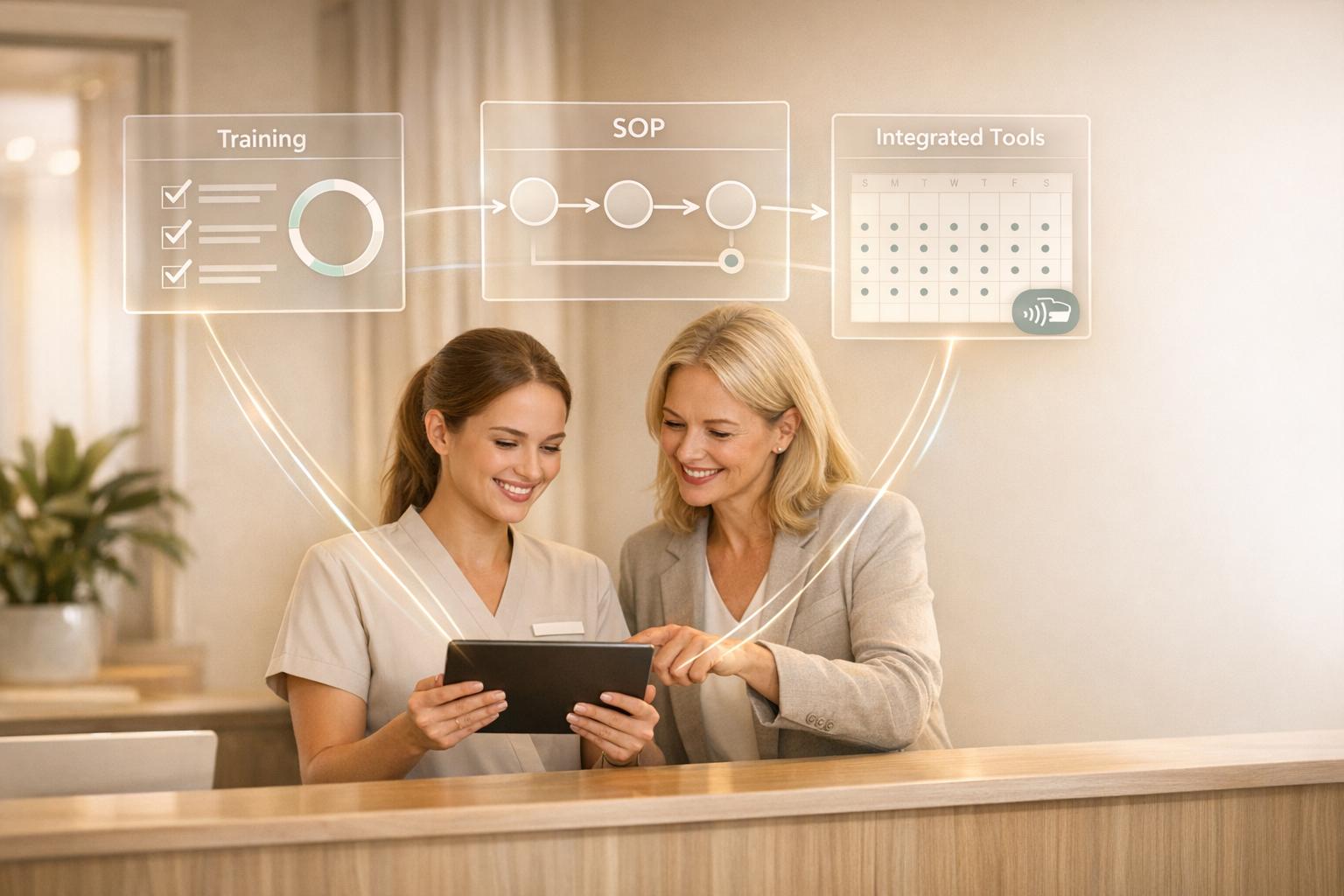

Staff training is the backbone of a smooth-running med spa. Without it, inefficiencies like scheduling errors, missed follow-ups, and disorganized processes can cost clinics thousands in lost revenue and lead to staff burnout.
Key takeaways:
- Repeat patients account for 73% of revenue. Consistent workflows ensure they keep coming back.
- No-shows can drain $15,000–$50,000 annually. Training staff to use automated systems reduces these losses.
- Disconnected tools waste 10–15 hours/month. Unified platforms and proper training streamline operations.
- Turnover costs 50–200% of annual salaries. A well-trained team stays longer and performs better.

Med Spa Workflow Inefficiencies: The Hidden Cost of Poor Staff Training
Workflow Inefficiencies in Med Spas: What Goes Wrong and Why
Common Workflow Pain Points
Med spa workflow issues often aren't flashy - they're the small, repetitive snags that pile up over time. Picture this: a front desk coordinator flipping between multiple software tabs just to confirm one appointment, or a provider walking into a treatment room only to find the intake form incomplete. These seemingly minor moments create friction that slows everything down.
Some of the biggest culprits include manual reminders, paper-based intake forms that require double data entry, and missed follow-up calls. These inefficiencies can be costly. Without automation, no-show rates can skyrocket to 80%. Even a smaller no-show rate of 10% can drain $15,000 to $50,000 in lost treatment revenue each year.
These recurring problems are often symptoms of deeper systemic issues.
Root Causes of Workflow Challenges
The root of most inefficiencies in med spas isn't about staff slacking off - it’s about missing or poorly designed systems. Three major factors stand out:
Disconnected technology: Many med spas rely on a patchwork of tools for scheduling, texting, EMRs, and marketing. This "bolted-on" approach forces staff to constantly switch between platforms, which leads to errors and wasted time. Did you know that 72% of administrative mistakes in healthcare are caused by juggling uncoordinated systems? On top of that, staff lose an average of 10 to 15 hours every month just navigating between these tools.
Lack of SOPs: Without written protocols for things like consultations, checkouts, or emergencies, critical knowledge stays locked in the heads of individual employees. A 2023 survey revealed that 34% of med spas had no documented emergency protocols. Alarmingly, those without standard operating procedures were three times more likely to face regulatory action after an adverse event.
"If you're running a med spa without standard operating procedures, you're running on borrowed time." - MedSpa Standards
Poor system implementation: Even the best software can become a liability if staff aren’t properly trained or if workflows aren’t mapped out before implementation.
These systemic shortcomings don’t just create headaches - they lead to tangible financial and operational setbacks.
The Business Cost of Inefficient Workflows
When staff are left to navigate clunky systems without proper training, the costs add up quickly. Aesthetic practices can lose as much as 30% of their potential revenue each year due to operational inefficiencies. Clinics using fragmented technology see up to 45% more no-shows and billing errors compared to those with integrated platforms.
It’s not just about money, either. Inefficiencies drive up staff turnover, which is expensive. Replacing a front desk employee can cost anywhere from 50% to 200% of their annual salary. In 2025, nearly 29% of practices reported higher staff turnover rates, often due to overwhelming manual workloads.
"Adding staff to a manual system doesn't fix the bottleneck. It scales it." - PatientNow Team
And then there’s the reputational risk. A single administrative error can lead to negative reviews, tarnishing the clinic’s image. In a market expected to hit $24.36 billion by the end of 2026, bad reviews can have serious competitive consequences.
sbb-itb-02f5876
Why Staff Training Directly Improves Workflow
Addressing inefficiencies head-on requires targeted staff training, which is one of the essential steps for opening a med spa. Without it, workflow issues linger. Clear and consistent training ensures every team member operates effectively, improving both individual performance and overall clinic operations.
How Standard Operating Procedures (SOPs) Create Consistency
Standard Operating Procedures (SOPs) are only as useful as the training that brings them to life. Written protocols alone won’t fix workflow issues unless staff are actively trained to use them. Whether it’s intake, consultations, checkout, or rebooking, training ensures the patient journey becomes predictable and smooth.
"Inconsistent consults and messaging are silent revenue killers." - DermAesthetic Consulting
Take checkout, for instance - it’s a critical revenue touchpoint. Proper training ensures staff follow SOPs that not only enhance operational consistency but also maintain legal compliance. With about 73% of med spa revenue stemming from repeat patients, consistency is essential to keeping these clients coming back.
SOPs also support legal and clinical safety. Comprehensive documentation ensures procedures are recorded accurately, meeting both regulatory and insurance standards.
While SOPs create a solid foundation, technology skills are equally crucial for improving efficiency.
Technology Literacy as a Workflow Driver
Mastering technology is just as important as following standardized procedures. Without proper technical training, staff may feel uncertain and fall back on outdated methods like manual note-taking, which can lead to errors and delays.
"Employees who are highly trained in using medspa management software play a pivotal role in streamlining operations, enhancing client experiences, maintaining data integrity, [and] optimizing resource allocation." - AestheticsPro
Training on a unified practice management platform - one that integrates scheduling, charting, and patient communication - eliminates inefficiencies like tab-switching and duplicate data entry. Providing task-specific guides and encouraging peer mentoring helps staff build confidence over time, far beyond the basics of onboarding. This seamless integration of technology not only speeds up operations but also enhances patient care.
How Trained Staff Improve Patient Experience and Revenue
Well-trained staff elevate every patient interaction, from quick check-ins to detailed follow-ups. Efficient processes build trust, which translates into higher return rates and increased revenue.
Structured training programs can lead to dramatic results, with some clinics seeing up to 100% revenue growth within 90 days. For example, implementing a simple SOP like the 72-48-2 reminder system - a reminder 72 hours before an appointment, a confirmation request 48 hours prior, and a final notice 2 hours ahead - can significantly reduce no-shows.
"The difference is not the people you hire but how you develop them after they arrive." - PAVAUSA
When staff are equipped to upsell, explain treatments clearly, and manage schedules efficiently, they not only boost clinic revenue but also create a better overall experience for patients.
How to Build a Staff Training Program for Med Spa Workflow
Mapping Your Current Workflows
Before diving into training content, take a step back and map out your clinic’s existing workflows. Walk through the entire patient journey - from booking and reminders to check-in, treatment, and follow-ups. Pay close attention to where processes slow down or break down. For example, are there delays during check-in? Are no-shows being noticed too late? Is rebooking often skipped at checkout? These are the red flags you want to identify.
Once you've spotted problem areas, start quantifying them. Measure things like no-show rates, treatment overruns, and scheduling mismatches. These metrics will help you pinpoint exactly where the friction lies.
"Your schedule is either your biggest asset or your biggest leak." - PatientNow Team
Armed with this detailed insight, you can set clear training objectives that directly address the weak spots in your workflow.
Setting Clear Training Goals and Metrics
After mapping your workflows, it’s time to turn your observations into actionable goals. But don’t settle for vague objectives - tie your training efforts to measurable outcomes.
| Metric | Target Benchmark |
|---|---|
| Room usage rate | 70% or higher |
| Scheduling efficiency | 90% or higher |
| No-show rate | Below 10–15% |
| Return visit rate | 70% (with automation) |
"If scheduling efficiency drops below 90%, it usually points to issues in follow-ups, patient drop-off, or front desk execution." - PatientNow Team
Use performance data to make your training more personalized. For example, tracking metrics like treatment uptake or units per session by provider can help you identify specific staff members who need targeted coaching. This approach is far more effective than rolling out generic training for everyone.
These metrics lay the groundwork for creating training modules that address real, quantifiable challenges.
Building and Running Training Modules
With workflow insights and measurable goals in hand, you can design training modules that tackle inefficiencies head-on. Focus your modules on four key areas: reception operations, clinical workflow, practice management software, and patient experience. Each module should align with the metrics you’ve set.
| Training Module | Key Focus Areas | Target Metrics |
|---|---|---|
| Reception Operations | Strategic scheduling, 72-48-2 reminders, rebooking at checkout | No-show rate, rebooking rate |
| Clinical Workflow | Treatment protocols, room turnover, numbing/prep timing | Room utilization, treatment overrun frequency |
| Practice Management | EMR proficiency, automated waitlist management, KPI dashboards | Slot fill rate, data accuracy |
| Patient Experience | lead management consistency, upselling, and follow-up protocols | Patient retention, revenue per consult |
Roll out your training over 30 days. Start by finalizing roles in week 1, implement standard operating procedures (SOPs) in week 2, and conduct competency checks in week 3. Wrap up with an emergency drill and documentation audit in week 4.
Make sure all training is properly documented. This includes signed SOP acknowledgments and skills checklists signed off by evaluators. As MedSpa Standards puts it, "If it's not documented, regulators and insurers assume it didn't happen".
Using Prospyr to Reinforce Trained Workflows
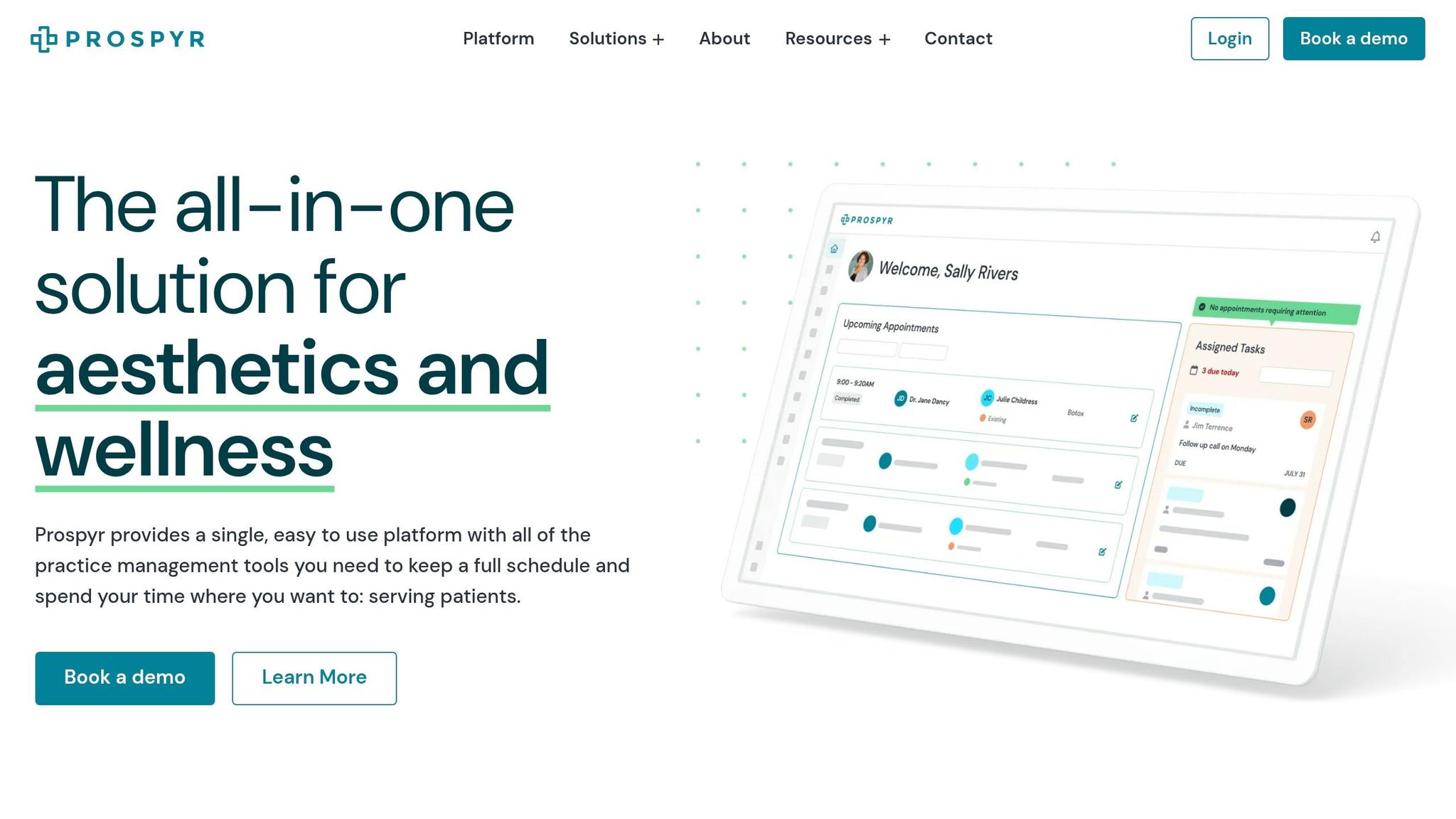
Once training is complete, maintaining workflow habits becomes critical to long-term success. An integrated platform can help ensure these workflows become a natural part of daily operations. Prospyr is specifically designed for aesthetics and wellness clinics, acting as a practical tool to support and sustain your team's trained habits. By embedding workflows directly into its design, Prospyr helps create the consistency needed for med spa growth.
How Prospyr Enhances Daily Workflow Execution
The common bottlenecks identified during training - like slow check-ins, missed reminders, or scheduling errors - are exactly what Prospyr is built to address. For instance, patients can complete digital intake and consent forms before arriving, which clears up front-desk congestion and lets staff focus on delivering a better patient experience.
Prospyr also automates room and device scheduling, ensuring double-bookings don’t disrupt your day. Automated appointment reminders and confirmations run quietly in the background, reducing no-shows without requiring staff to manually follow up. These features work seamlessly to reinforce trained workflows, bridging the gap between training and execution while promoting consistency.
Prospyr Features That Drive Workflow Efficiency
Prospyr integrates every aspect of the patient journey, from the initial lead capture to final checkout. Key features include:
- Lead capture and two-way SMS: Simplifies communication and keeps your pipeline organized.
- Charting, eRx, and lab ordering: Streamlines clinical workflows for smoother operations.
- Point-of-sale processing and payment links: Makes financial transactions faster and hassle-free.
For management, tools like practice analytics and inventory tracking provide real-time insights into workflow performance. Membership and package management are also automated, ensuring recurring revenue processes run smoothly without relying on manual follow-ups.
Training Staff to Use Prospyr Effectively
To get the most out of Prospyr, focused staff training is essential. The platform’s value depends on how well it’s used, so training should cover both the technical aspects of each feature and its role in your clinic’s established workflows. For instance, if front-desk staff understand how the patient portal reduces check-in delays, they’ll be more likely to encourage patients to complete forms ahead of time.
The ultimate goal is to make Prospyr the go-to platform for all trained workflows - whether it’s scheduling, charting, follow-ups, or reporting. This ensures that even during busy times, good habits remain intact and workflows continue to run smoothly.
Measuring How Staff Training Affects Workflow Performance
Key Metrics to Track
Tracking the right metrics is essential for improving workflow performance. Start by focusing on operational metrics like room utilization (target at least 70%) and no-show rates (aim for under 10–15%). These benchmarks provide a solid foundation for assessing efficiency. On the financial side, pay attention to your consultation conversion rate and revenue per treatment hour. For instance, a 10% boost in consultation bookings could translate to five extra new patients each month for every 50 inquiries.
Patient experience is another critical area. The return visit rate is a standout metric - top-performing practices often hit 70%, while the industry average hovers closer to 40%.
| Metric Category | KPI | Target |
|---|---|---|
| Operational | Room Utilization Rate | 70% or higher |
| Operational | No-Show Rate | Below 10–15% |
| Financial | Consultation Conversion | 10% improvement |
| Patient Experience | Return Visit Rate | 70% |
How to Evaluate Training Effectiveness
To gauge the impact of training, compare key metrics before and after implementation - at 30, 60, and 90-day intervals. Establish baseline numbers like slot fill rates, no-show occurrences, and how quickly cancellations are refilled. Effective scheduling training should result in faster refills for canceled slots and better adherence to appointment schedules.
It’s also important to measure both skill levels and confidence. As Tori Shireman from MINT Aesthetics explains:
"There is an often overlooked gap between technically trained and confidently proficient, and it's a gap through which your revenue will quietly leak if you let it."
For example, if a provider is trained on a specific treatment but lacks the confidence to recommend it, this gap could directly impact revenue. Use performance data to identify team members who may need additional coaching, rather than waiting for these issues to surface.
This type of ongoing evaluation naturally ties into the importance of continuous training to maintain workflow improvements.
Keeping Workflow Gains Through Continuous Training
Sustaining workflow gains requires more than a one-time training session. The most successful med spas treat training as an ongoing commitment. Regular reviews - such as weekly checks on room utilization and slot fill rates - can help spot scheduling issues early. If metrics start to decline, it’s a clear sign to revisit specific training modules rather than restarting the entire program.
"The most successful medspas don't just rely on hiring top providers; they invest in ongoing training and support to align their teams, sharpen execution, and sustain growth." - DermAesthetic Consulting
Listening to staff feedback is equally important. Front-desk teams and providers often notice workflow issues before they appear in the data. Monthly check-ins where staff can share concerns or highlight inefficiencies ensure the training program stays aligned with daily operations. This proactive approach keeps improvements on track and prevents small issues from turning into larger problems.
FAQs
What should I train first to fix workflow bottlenecks fast?
To tackle workflow bottlenecks effectively, begin by assessing your team’s strengths and pinpointing areas that need improvement - like pre-booking rates or treatment durations. Here are some practical steps to focus on:
- Streamline consultations and communication workflows: Ensure these are consistent to reduce missed opportunities and improve client interactions.
- Leverage Prospyr’s automation tools: Train your staff to use features like digital intake forms and appointment reminders to save time and enhance efficiency.
- Practice role-playing scenarios: This can help your team refine patient flow management skills and handle scheduling conflicts more smoothly.
By addressing these areas, you can create a more efficient and productive workflow.
Which KPIs show staff training is improving performance?
Tracking the right metrics can help you understand how well your staff training efforts are paying off. Here are some key performance indicators (KPIs) to keep an eye on:
- Consultation and Conversion Rates: Measure how effectively consultations lead to bookings and how often those bookings convert into actual treatments.
- Revenue and Productivity: Look at service and retail revenue, the average ticket size, and the revenue generated per hour worked. These numbers can show how training impacts overall profitability.
- Operational Efficiency: Assess factors like capacity utilization, treatment times, no-show rates, and task completion. These metrics reflect how smoothly your operations run after training.
- Client Retention: Check rebooking rates and patient satisfaction scores. These are clear indicators of whether training has improved the client experience.
- Employee Metrics: Monitor staff retention rates and engagement levels. Happy, well-trained employees are more likely to stick around and perform better.
By keeping tabs on these KPIs, you can pinpoint the areas where training is making a difference - and where there’s room for improvement.
How do I keep new workflows from slipping after training?
To keep new workflows running smoothly, it's important to do more than just a one-time training session. Start by creating detailed Standard Operating Procedures (SOPs) to standardize operations. Tools like Prospyr can help you keep an eye on processes, measure performance, and make adjustments when necessary.
Regular feedback is also key. Use team check-ins and performance reviews to spot and address any bottlenecks. Beyond that, reinforce the initial training with ongoing education and hands-on coaching. This approach ensures your team stays aligned and maintains consistency over the long haul.