Med Spa Peak Demand Planning Tips
Practical strategies for med spas to handle peak seasons: optimize staffing, JIT inventory, online booking, automated waitlists, yield-based scheduling and rebooking.

Med Spa Peak Demand Planning Tips
To thrive during high-demand seasons, med spas need smart strategies to manage staffing, inventory, and scheduling. Here's what you need to know:
- Q4 and Q1 are critical for revenue: Holiday gift card sales and New Year’s weight-loss goals drive demand for injectables and body contouring.
- Challenge: While schedules may be packed in Q1, cash flow often dips as prepaid packages are redeemed, adding financial strain.
- Key Solutions:
- Staffing: Use data to plan shifts, cross-train employees, and automate tasks to handle busy periods effectively.
- Inventory: Adopt just-in-time ordering to avoid overstocking and reduce waste, focusing on high-demand items like neurotoxins and fillers.
- Scheduling: Utilize online scheduling tools, prioritize high-revenue treatments during peak hours, and implement automated waitlists to fill cancellations.
- Revenue Maximization: Reserve prime slots for profitable services, extend hours strategically, and encourage rebooking at checkout.
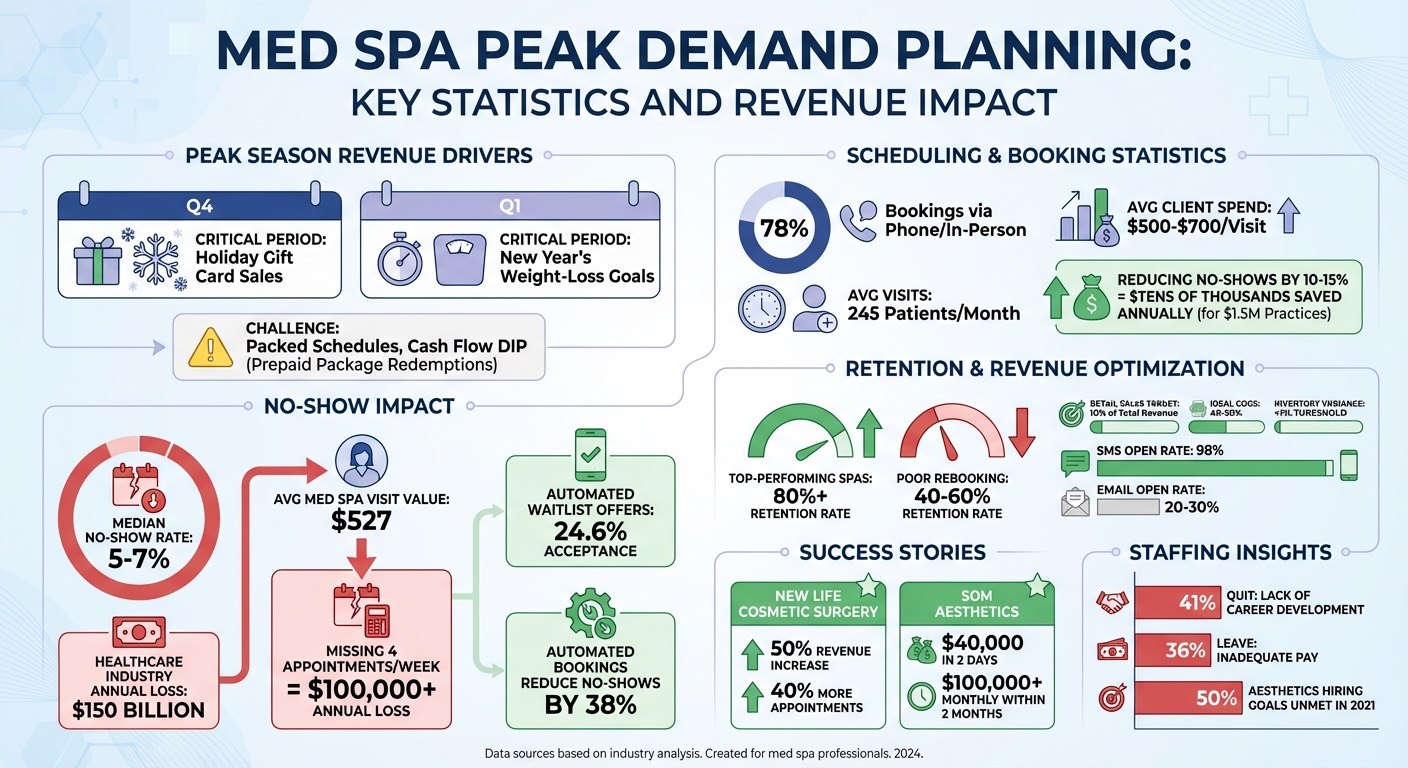
Med Spa Peak Demand Planning: Key Statistics and Revenue Impact
1. Use Smart Staff Scheduling and Cross-Training
Getting your staffing right during peak season can make or break your success. Start by analyzing past data to identify when demand tends to spike. For instance, the average medical spa sees about 245 patient visits per month, with the busiest times often falling in mid-mornings, lunch hours, early evenings, and weekends. This kind of insight helps you avoid overstaffing during slow periods while ensuring you have enough hands on deck when things get busy.
It’s also worth noting that fully booked schedules don’t always translate into higher revenue. Even though calendars may look packed in Q1 with holiday package redemptions, cash collections often dip. Andrew Miller, Sr. Financial Consultant at Maven Financial Partners, highlights this point:
"If we know that our appointment calendar isn't at the capacity where it makes sense to have all of our providers active; we like to see clients stagger provider shifts so our practice is running at an efficient capacity."
Flexibility is key, and cross-training your team can make a huge difference. For example, front desk staff can be trained to handle patient care coordination, or estheticians can assist with digital intake forms using your practice management software. Not only does this approach help fill scheduling gaps, but it also provides employees with opportunities to grow - a critical factor considering that 41% of workers who quit say the lack of career development drove their decision. Keeping your team agile ensures you can maintain service quality even during the busiest times.
Don’t forget to automate repetitive tasks. Tools like digital consent forms, appointment reminders, and AI-powered follow-ups can free up your team to focus on clients. Give staff digital access to SOPs, pair new hires with experienced team members, and share performance metrics like retention and conversion rates to encourage accountability. These strategies keep your team prepared and adaptable, so they can handle peak demand without sacrificing the quality of care your clients expect.
sbb-itb-02f5876
2. Use Just-In-Time Inventory Management
Stocking too much inventory can tie up your cash and limit your ability to adapt during busy times. Just-in-time (JIT) inventory management focuses on placing smaller, frequent orders, typically on a weekly or biweekly basis. As BeaconInside explains:
"Small, regular orders often work better than large bulk purchases."
The process starts with identifying your high-demand items - think neurotoxins, dermal fillers, and popular skincare products - and keeping a close eye on their stock levels. This approach ensures you're always ready for peak treatment hours while avoiding overstocking items that might expire during slower periods. For reference, retail sales should ideally make up at least 10% of your med spa's total revenue, with a cost of goods sold (COGS) falling between 40% and 50%. By ordering only what you need, you free up funds for other priorities like seasonal staffing or marketing.
Weekly reconciliation is a must. Counting inventory weekly is key to catching discrepancies early, especially for high-value items like injectables. If you notice a variance of more than 5% between your records and actual stock, it could indicate theft or processing errors that need immediate attention. Keeping a consistent eye on your inventory flow ensures it supports your bottom line.
To minimize waste, consider using a color-coded system for tracking expiration dates. For example, label products with green for safe, yellow for nearing expiration, and red for items that need immediate use or disposal. This visual system helps your team prioritize stock rotation, especially during busy periods. Combine this with dependable supplier relationships to guarantee timely restocking, and you'll maintain lean inventory levels without risking shortages when demand surges.
3. Improve Your Appointment Scheduling System
Your scheduling system plays a huge role in determining how many clients your med spa can handle. Did you know that about 78% of med spa bookings still happen over the phone or in person? That means clinics without online booking tools are missing out on a lot of after-hours leads. Considering that the average client spends $500–$700 per visit, those missed bookings can add up fast, cutting deep into your revenue. It’s clear: modernizing your booking process isn’t just helpful - it’s necessary.
Today’s scheduling platforms allow 24/7 online booking, which means clients can secure appointments even when your office is closed. These tools also offer real-time coordination, ensuring your providers, treatment rooms, and equipment (like lasers) are always in sync - no double bookings, no wasted resources. Features like automated SMS and email reminders, along with deposit requirements, help cut down on no-shows. In fact, reducing no-shows by just 10% to 15% could save a practice generating $1.5 million annually tens of thousands of dollars.
Take it from Dr. Daniel Lee, founder of New Life Cosmetic Surgery. After switching to the Prospyr integrated practice management platform in 2024, his clinic saw a 40% increase in booked appointments and a 50% revenue boost. Another example is Dr. Saami Khalifian, who used advanced scheduling tools to launch SOM Aesthetics. Within two days of opening, his clinic brought in $40,000, and within two months, it was generating over $100,000 monthly. As Dr. Khalifian shared:
"Prospyr has helped us launch SOM Aesthetics like a rocketship. Their powerful platform and helpful support have enabled us to exceed our financial targets while delivering an unmatched experience for our patients."
These examples show how integrated scheduling tools don’t just streamline operations - they can also drive significant revenue growth.
Beyond booking, analytics dashboards can pinpoint underutilized time slots, giving you the data you need to adjust staffing or launch targeted promotions to fill those gaps. For practices with multiple locations, enterprise scheduling tools offer a single view of capacity, making it easy to redirect clients to less busy locations during peak times. Plus, integrated payment links secure deposits upfront, increasing client commitment and safeguarding your revenue. When you combine optimized scheduling with smart staffing and inventory management, you create a solid foundation for handling peak demand successfully.
Reading about the problem? See how Prospyr solves it in one platform.
Book a Demo4. Schedule High-Value Treatments During Peak Hours
A $400 injectable brings in significantly more revenue than a $70 facial, even though both take up the same prime time slot. If your busiest hours - like mid-mornings, lunch breaks, early evenings, and weekends - are dominated by low-margin services, you're missing out on potential profits. To make the most of these peak hours, consider implementing yield management. This involves calculating the revenue each service generates per hour, factoring in provider time, room usage, and consumables. Use this data to prioritize high-revenue treatments such as injectables, fillers, and lasers. Reserve these prime slots for the most profitable services, and ensure your front desk focuses on bookings that maximize your bottom line.
Seasonal trends also play a big role in treatment demand. For instance, injectables and lasers are more popular in winter, while spring sees a rise in interest for body contouring and chemical peels as clients prepare for summer. During autumn, treatments like microneedling and sun damage repair are in higher demand as people get ready for holiday photos. A Forbes Health survey even found that 33.8% of respondents set New Year’s resolutions to lose weight, making January and February the perfect time to promote weight-loss and body contouring packages.
To capitalize on these trends, tools like Prospyr (https://prospyrmed.com) can help you track which treatments generate the most revenue. Real-time dashboards let you identify high-return services, allowing you to guide clients toward these options by using service-specific links in your online scheduling system. Instead of discounting peak hours, consider offering loyalty perks or membership benefits to encourage clients who prefer lower-margin treatments to book during off-peak times. This strategy ties seamlessly into your overall staffing and scheduling approach, ensuring you make the most of peak demand.
As Pabau wisely puts it:
"A slot is going to be booked either way - it's up to you to make it count for your revenue and bottom line".
5. Set Up a Waitlist Management System
An automated waitlist system can be a game-changer for filling last-minute cancellations or no-shows, which can significantly impact revenue. Consider this: the median no-show rate for clinic appointments ranges from 5% to 7%, and across the healthcare industry, these no-shows result in a staggering $150 billion in losses annually. For med spas, where the average visit is worth $527, even missing four appointments per week could lead to over $100,000 in lost revenue annually. A well-organized waitlist ensures those gaps are filled quickly, turning potential losses into opportunities.
The key is automation. Instead of relying on manual tracking, automated systems can notify clients immediately when a time slot opens up. A 2025 Mayo Clinic study involving 229,998 appointments found that 24.6% of patients accepted automated waitlist offers, moving their appointments up by an average of 22.6 days. Even better, automated bookings can reduce no-shows by 38%. Timing is everything - clients who receive notifications first are more likely to claim the available spot.
When creating a waitlist, collect detailed information upfront to streamline the process. Ask for specifics like the desired service, preferred provider, available time windows, and how quickly the client can arrive for a last-minute opening. To maximize efficiency, segment the waitlist by treatment type - whether it's injectables, facials, or body contouring - so the right clients are notified when a provider or room becomes available. Position your waitlist as an exclusive VIP perk, offering priority access to cancellations or rescheduled slots. Make it easy for clients to join by adding "Join Waitlist" buttons on your website or QR codes at the front desk.
For seamless execution, integrate your waitlist management into an advanced scheduling platform. For instance, Prospyr (https://prospyrmed.com) allows you to connect waitlist management with your scheduling and CRM/EMR systems. With instant SMS or email alerts, clients can confirm appointments through self-service links, eliminating the need for manual follow-ups. This not only saves your front desk staff time but also ensures they can focus on in-person interactions. Additionally, analyzing waitlist data can help identify peak demand times, enabling smarter staffing decisions during busy periods.
As Maja Muzhdeka aptly says:
"A waitlist keeps you ready for all of it. It shows clients you're organized and makes your operations feel effortless, even when things don't go as planned".
6. Extend Hours During Peak Seasons
Adjusting your operating hours during high-demand seasons - like the Q4 holiday rush or spring's "get beach-ready" period - can help you tap into extra revenue. The key is to plan these changes strategically.
Start by reviewing your historical scheduling data. Look for patterns: Which days consistently bring in the most revenue? When are appointment slots filling up fastest? Also, take a close look at your waitlist. High waitlist numbers often signal unmet demand. Seasonal peaks are prime opportunities - Q4 is ideal for holiday prep services, while spring and summer see increased interest in body contouring and laser hair removal. Extending hours into evenings or weekends during these times can make scheduling easier for clients and boost your bottom line.
However, longer hours shouldn't mean overworked staff. The aesthetics industry already struggles with staffing shortages - 50% of hiring goals went unmet in 2021 alone. To avoid burnout, stagger shifts based on appointment trends instead of having everyone work extended hours. Seasonal hires or cross-training existing staff can also help handle the increased volume. Using AI tools for lead management and scheduling can free up your front desk team to focus on in-person clients during these busy periods.
Keep an eye on the numbers. Make sure each additional hour of operation is financially worthwhile. Factor in rising costs for things like medical supplies and insurance premiums. Stock up on essential consumables in advance to avoid treatment delays. Tools like Prospyr can help streamline scheduling, staffing, and inventory management, making it easier to stay on top of your peak-season strategy.
Lastly, don’t overlook staff retention. With 36% of workers leaving jobs due to inadequate pay, offering competitive compensation during high-stress times can help keep your team motivated and committed when you need them most.
7. Add Rebooking to Your Checkout Process
Incorporating rebooking into your checkout process is a smart way to strengthen client retention. Med spas that excel in this area often maintain retention rates above 80%, compared to a lower range of 40–60% for those that skip this step.
Training your front desk team to use an assumptive close can make a big difference. For example, they might say: "Let’s schedule your next appointment while I have your chart open. Most clients see the best results with sessions every 4–6 weeks. Would Tuesday or Thursday afternoon work better for you?". By offering specific options instead of a yes-or-no question, you're making it easier for clients to commit.
Using an all-in-one platform like Prospyr (https://prospyrmed.com) can streamline this process. With scheduling, EMR, and payment processing integrated, your team can book follow-ups immediately after checkout without any extra hassle. For clients who aren’t ready to commit at the moment, an automated text sent three days after treatment - something like, "How are you feeling? Ready to book your next session?" - can help secure additional bookings. Practices with strong automated scheduling and reminder systems often report no-show rates below 5%, compared to the industry average of 15–30%.
For treatments requiring multiple sessions, such as laser hair removal or body contouring, scheduling the entire series during checkout ensures clients lock in their preferred time slots and eliminates the need for repeated follow-ups. Similarly, membership programs that automate recurring monthly appointments remove the pressure of rebooking at every visit. This approach ties neatly into peak demand strategies by securing appointments well in advance.
Conclusion
Managing peak demand in your med spa requires careful attention to staffing, inventory, scheduling, and client retention. By adjusting provider shifts during slower times, adopting just-in-time inventory practices, and focusing on high-value treatments during busy hours, you can keep operations running smoothly while boosting revenue. It’s also essential to plan for unearned revenue from Q4 gift cards and packages redeemed in Q1 - your schedule might appear packed, but cash flow can lag without proper preparation.
These strategies lay the groundwork for incorporating technology to further enhance your operations. The right technology can be transformative. For example, practices like New Life Cosmetic Surgery and SOM Aesthetics have seen impressive growth in revenue and appointments after streamlining their operations with Prospyr.
"We've seen a 50% increase in revenue and a 40% increase in appointments booked since switching away from using several different point solutions to running our practice on Prospyr." - Dr. Daniel Lee, Founder, New Life Cosmetic Surgery
Platforms like Prospyr (https://prospyrmed.com) offer a comprehensive solution, combining smart scheduling, digital intake forms, automated SMS reminders (boasting a 98% open rate compared to email’s 20-30%), membership management, and real-time analytics. This integration not only reduces software fatigue but also provides the visibility needed to make informed decisions about staffing, inventory, and appointment capacity during peak times.
With effective planning and the right tools, you can turn busy seasons into opportunities for sustained growth throughout the year.
FAQs
How can I avoid a Q1 cash-flow dip when Q4 packages are redeemed?
To prevent a cash-flow slowdown in Q1 caused by Q4 package redemptions, it's important to plan carefully. Here's how you can prepare:
- Set a budget: Anticipate slower cash flow in Q1 due to the impact of prepaid revenue.
- Save during peak months: Build up cash reserves during busier times to cover upcoming expenses.
- Track prepaid revenue: Keep an eye on prepaid revenue trends to adjust staffing and marketing efforts to meet demand.
Using tools like Prospyr can make it easier to monitor revenue and fine-tune your planning, ensuring a smoother start to the year.
What’s the simplest way to prioritize high-revenue services in peak hours?
During your busiest times, it’s smart to prioritize high-margin treatments like injectables. These services often bring in the most revenue, so scheduling them during peak hours makes sense. To make this work smoothly, you’ll need to fine-tune your appointment system and keep an eye on key metrics like utilization rates and rebooking percentages.
Using automated tools for appointment management and offering online booking can make the process even more seamless. These tools help ensure your peak hours are filled with your most profitable services, boosting both efficiency and revenue.
How do I set up an automated waitlist to fill last-minute cancellations?
To create an automated waitlist, use a tool like Prospyr that offers waitlist management features. This allows you to streamline the process and keep clients informed through automated SMS or email alerts whenever openings become available.
Here’s how to get started:
- Enable the waitlist feature: Make it simple for clients to sign up for the waitlist.
- Set up automated notifications: Configure the system to notify clients immediately when cancellations occur.
- Prioritize key clients: Give priority to your most valuable clients to maximize business impact.
- Track performance: Regularly review how the system is working to improve fill rates and minimize downtime.
This approach ensures efficiency while keeping your clients in the loop.