How to Plan Staffing for Clinic Expansion
Plan clinic growth with FTE calculations, hiring, scheduling, budgeting, and retention strategies to meet patient demand and control labor costs.


How to Plan Staffing for Clinic Expansion
Expanding your clinic requires careful staffing decisions to avoid overburdening your team or overspending. Here's what you need to know:
- Assess Current Staffing: Calculate your FTE (full-time equivalent) ratios and identify gaps. Signs of understaffing include long wait times and burnout, while overstaffing can inflate costs.
- Set Goals and Patient Targets: Align staffing plans with patient volume projections. For example, primary care providers typically see 20–29 patients daily.
- Calculate Staffing Needs: Use workload projections to determine FTEs for clinical and administrative roles. Consider factors like seasonal demand and staff leave.
- Hire and Train Effectively: Create clear job descriptions, use diverse recruitment channels, and implement structured onboarding programs.
- Retention Matters: Competitive pay, career growth opportunities, and flexible schedules are key to keeping staff.
- Optimize Scheduling: Use online scheduling tools to prevent overloading staff and reduce errors. Monitor performance metrics like wait times and turnover rates.
- Budget for Costs: Include salaries, benefits, and training in your financial plan. Keep payroll between 25–30% of revenue and plan for future growth with flexible compensation strategies.
Planning ahead ensures your team can handle increased demand while maintaining quality care and financial stability.
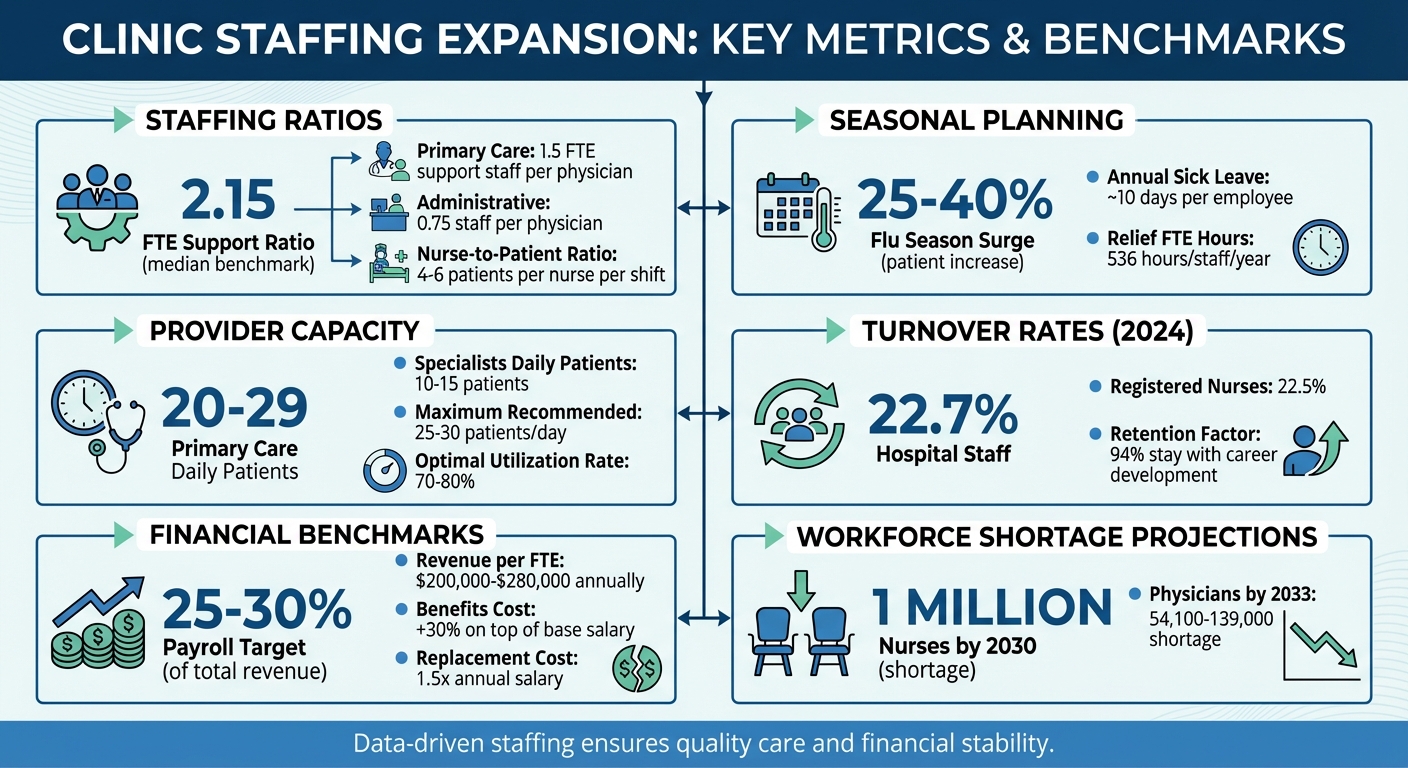
Key Staffing Metrics and Benchmarks for Clinic Expansion
Assess Current Staffing and Set Expansion Goals
Review Current Staff Levels and Skills
Start by calculating your FTE (full-time equivalent) support ratio: divide the total support staff FTE by provider FTE. If your ratio falls below the median of 2.15 or if provider utilization exceeds 70%, it might be time to grow your team. Another useful metric is revenue efficiency - divide your annual gross revenue by total FTE staff. This will help you determine if your staffing levels align with your income.
Signs of understaffing include long patient wait times, frequent overtime, billing delays, and staff burnout. On the flip side, overstaffing may show up as higher payroll costs without corresponding revenue growth or "task stretching", where simple tasks take unnecessarily long. Monica Ayre from Glenwood Systems highlights the risks of being overly reliant on a single resource:
"The most dangerous number in the business world is one. Having just one of anything can send your practice into a nosedive".
Set Clear Expansion Goals and Patient Volume Targets
Use the insights from your staffing review to create specific expansion goals. Establish patient volume targets based on your specialty. For example, primary care providers typically manage 20–29 patients daily, while specialists handling complex cases may see only 10–15 patients per day. Keep in mind that exceeding 25–30 daily patients could affect care quality.
Plan for seasonal fluctuations, like a 25% to 40% patient surge during flu season, to ensure you're adequately staffed. If you're introducing new services - such as in-house lab work, radiology, or other procedures - remember that these require higher staff-to-physician ratios compared to practices that outsource these services.
sbb-itb-02f5876
Calculate Staffing Needs for Growth
Determine Staff Requirements by Position
Start by calculating your full-time equivalent (FTE) count. An FTE represents 2,080 work hours annually - calculated as 8 hours a day, 5 days a week, for 52 weeks. To find your current FTEs, divide the total annual labor hours by 2,080.
Next, estimate staffing needs for specific roles using workload projections. Multiply your expected patient volume by the average time required for each task, then divide by available staff hours. For instance, if you anticipate 50 patients daily and registration takes 10 minutes per patient, that equates to 500 minutes (8.3 hours) of daily registration work. Plan for peak demand by using the busiest timeframes as your baseline.
Industry guidelines can also help refine your staffing decisions. Primary care practices generally require 1.5 FTE support staff per physician, while administrative roles average 0.75 staff members per physician. In aesthetics and wellness clinics, aim for injector utilization rates of 75–85% and 65–80% for aestheticians. Additionally, one medical biller can typically handle around 10,000 claims annually, and the recommended nurse-to-patient ratio in primary care is 4 to 6 patients per nurse per shift.
When calculating staffing needs, round up fractional FTEs to account for disruptions like sick leave (about 10 days annually), vacation time, and other unforeseen circumstances. As Carol Stryker notes:
"Staffing to the average time required to perform a specific task does not account for ancillary disruptions that are inevitable".
These calculations provide a framework for building a staffing plan that aligns with your clinic's revenue and service goals.
Build a Staffing Plan That Matches Business Objectives
Once you've determined your staffing needs, align them with your business objectives. Create a detailed staffing plan covering both clinical and administrative roles, using your FTE calculations and workload data as a guide. Monitor provider utilization closely; if it consistently exceeds 70–80%, it may signal the need to hire additional staff. Terri Ross, President of Aesthetics at Engage Technologies Group, advises:
"If your utilization number is more than 70%, then you may want to start considering hiring additional providers".
Optimize your staffing mix by focusing on revenue-per-hour benchmarks. For example, injectors should generate $600–$1,200 per hour, while aestheticians performing facials typically bring in $150–$350 per hour. Prioritize hiring for services with higher profit margins to maximize returns on staffing investments.
Build in buffers for turnover, training, and seasonal fluctuations. Cross-training employees can add flexibility to your team. For example, medical assistants might assist with front desk duties during busy periods, while administrative staff could help with clinical intake tasks. This adaptability can prevent bottlenecks without requiring additional hires.
Finally, evaluate your revenue per FTE by dividing total annual gross revenue by your total FTE count. Aim to keep payroll costs between 25% and 30% of your clinic's overall revenue to maintain healthy profit margins.
Reading about the problem? See how Prospyr solves it in one platform.
Book a DemoHire, Train, and Keep Quality Staff
Once you've assessed your staffing needs, the next step is recruiting, training, and retaining talented team members to support your clinic's growth.
Create a Hiring Plan
Before posting job openings, take time to define your clinic's mission, vision, and values. This ensures you're attracting candidates who align with your goals. Craft detailed job descriptions that include salary ranges, bonus structures, required skills, and any state-specific legal requirements. Keep in mind, the U.S. is facing a projected shortage of over one million nurses by 2030, and the Association of American Medical Colleges anticipates a physician shortfall of 54,100 to 139,000 by 2033. This makes thoughtful and strategic recruitment more critical than ever.
Use a variety of channels to find candidates. General job boards like Indeed, LinkedIn, ZipRecruiter, and Glassdoor are a good start, but also explore industry-specific platforms for aesthetics professionals. Partner with local medical schools, professional associations, and alumni networks to broaden your reach. Screening candidates thoroughly is key - consider phone interviews, role-specific skills tests, and personality assessments like DISC or Myers-Briggs. Keep in mind that up to 56% of candidates may stretch the truth on their resumes, so background checks are a must. This includes verifying criminal history, employment history, and licensing through tools like the National Practitioner Data Bank.
Involve your current team in interviews to gauge how well candidates might fit into the clinic's culture. Ask behavioral questions to uncover how they handle stress, challenging patient situations, and multitasking. As Stephanie Goss, Founder of VetMedLife, notes:
"It's not just about putting ourselves out there… we have to be transparent about what we're offering the candidate".
To attract top talent, offer competitive pay, flexible schedules to reduce burnout, comprehensive benefits, and clear paths for career advancement. Once you've secured the right candidates, a well-structured training program will help them hit the ground running.
Set Up Training and Onboarding Programs
A solid onboarding process can make all the difference. Create a roadmap with clear goals for the first 30, 60, and 90 days. Interestingly, only 12% of employees rate onboarding as effective, yet clinics with longer programs - three months or more - report much higher satisfaction and retention rates compared to rushed, one-week orientations. Make sure all paperwork, system logins, and workspaces are ready before a new hire’s first day.
Training should be tailored to roles. Clinical staff need to master patient care protocols and compliance standards like HIPAA and OSHA, while administrative staff should focus on scheduling, billing systems, and communication tools. If your clinic uses Prospyr or similar practice management software, include dedicated sessions to familiarize staff with features like digital intake forms and scheduling tools. Pairing new hires with experienced mentors can also ease the learning curve.
Incorporate scenario-based exercises using real patient cases or workflow challenges. Schedule regular check-ins at 30, 60, and 90 days to address issues early. Cross-training - where team members shadow each other - can improve communication and provide flexibility during busy periods. A strong onboarding program lays the groundwork for long-term retention and smoother operations.
Use Retention Strategies
Replacing an employee can cost up to 1.5 times their annual salary, so retention is not just about morale - it’s a financial necessity. Offer competitive wages, solid health insurance, paid time off, retirement matching, and performance-based bonuses or profit-sharing. Professional growth is another big factor, with 94% of employees saying they’d stay longer at a company that invests in their development.
Create clear career paths. For example, front desk staff might move into patient care coordinator roles, or providers could advance to lead injector positions. Tuition reimbursement and mentorship programs add further value. Flexible scheduling and encouraging staff to use their vacation time can also help prevent burnout. Automating repetitive tasks like appointment reminders with practice management software can reduce the strain on your team.
Recognition programs like "Employee of the Month" can boost morale, while fostering an environment where staff feel comfortable suggesting improvements strengthens team cohesion. Conduct exit interviews to use data analytics to identify recurring issues and hold quick daily huddles to address operational challenges. With hospital turnover rates at 22.7% and registered nurse turnover at 22.5%, focusing on retention strategies is essential to keeping your clinic running smoothly.
Improve Scheduling and Track Performance
Once you've built a strong team, the next hurdle is ensuring everyone's time is managed efficiently. Poor scheduling doesn’t just waste time - it can lead to burnout among staff and leave patients feeling frustrated. To keep operations running smoothly, it’s essential to streamline your scheduling system. Using technology can automate this process while also providing clear performance insights.
Apply Smart Scheduling Tools
Relying on manual scheduling, like spreadsheets, is risky - half of operational spreadsheets contain major errors. Automated scheduling tools solve this problem by aligning staff availability with patient needs in real time. For example, platforms like Prospyr prevent double bookings and help avoid overloading staff during busy periods.
Mobile scheduling is another game-changer. It allows employees to check schedules, swap shifts, or request time off straight from their phones, which supports a healthier work-life balance. Integrating scheduling tools with electronic medical records (EMR) and payroll systems also reduces manual data entry, saving time and cutting down on errors.
A great example comes from Prisma Health, where Dr. Nick Perkins, the Associate Chief Medical Informatics Officer, introduced optimized scheduling software for over 120 physicians in 2024. This change reduced payroll processing time by 90%, cutting it from 5–10 days to less than one day, while also eliminating the need for manual reviews. As Lightning Bolt puts it:
"A well-crafted physician schedule isn't just a calendar - it's the heartbeat of operational success".
Involving staff in scheduling decisions, such as preferred shifts, and setting clear rules for night, weekend, and holiday rotations can enhance fairness and satisfaction. To handle fluctuating demand, use strategies like float pools and staggered shifts, which reduce the need for excessive overtime. Predictive analytics can also help. By analyzing historical data, these tools can forecast peak times, letting you prepare your team before demand spikes. Balanced schedules are not just about efficiency - they’re also critical for safety. Nurses working over 12.5 consecutive hours are three times more likely to make medication errors. Smart scheduling tools provide the data needed to track and refine these efforts.
Monitor Key Performance Metrics
Once your scheduling system is running smoothly, tracking performance metrics ensures your team stays aligned with patient needs. Focus on staff-to-patient ratios, overtime hours, turnover rates, and missed appointments.
For instance, Grady Memorial Hospital introduced predictive analytics in 2024 to better manage patient demand. This led to a 33% reduction in average patient length of stay and a 70% drop in emergency department wait times by syncing staffing levels with anticipated surges. Similarly, a Tennessee health system launched the "Flexchoice" program to expand its internal resource pool. Within three months, they tripled their float pool size and eliminated thousands of hours of overtime and agency staffing costs each month.
Patient metrics like average wait times, satisfaction scores, and missed appointments reveal whether your team is meeting demand. On the financial side, tracking labor costs as a percentage of revenue and reliance on agency staff can highlight areas for improvement. To fine-tune operations, consider holding monthly meetings or using digital surveys to gather staff feedback on scheduling efficiency. Regular feedback loops not only help catch inefficiencies early but also ensure your team feels heard.
| Metric Category | Key Performance Indicators | Purpose |
|---|---|---|
| Staff-Related | Overtime hours, turnover rates, burnout survey scores | Measure roster sustainability and staff well-being |
| Patient-Related | Average wait times, satisfaction scores, missed appointments | Align staff availability with patient demand |
| Cost-Related | Labor cost as % of revenue, agency staff reliance | Monitor financial efficiency and control costs |
Budget for Staffing Costs and Future Growth
Misjudging staffing costs can throw a wrench into your plans for expansion. It’s not just about salaries - benefits, training, and unexpected expenses all add up. Plus, your staffing model needs to stay flexible as patient volumes ebb and flow. Striking the right balance between immediate needs and long-term planning is key to keeping your growth on track.
Calculate Staffing Expenses
Start by breaking down every piece of your compensation package. A base salary is only part of the equation. Benefits typically tack on an extra 30%, so a $50,000 salary actually costs closer to $65,000 annually. Then, there are sign-on bonuses, which average $32,636 for providers, and performance bonuses, which hover around $27,000 per year.
Looking ahead to 2026, 64% of medical groups plan to increase base pay by 1% to 3% for most roles. Meanwhile, 23% are budgeting for 4% to 6% raises in high-demand positions like registered nurses. With RN pay jumping 11.9% in 2024 and triage nurse pay rising 14.3%, it’s smart to prepare for several scenarios: conservative (1–3%), market-aligned (4–6%), and aggressive (7%+). This way, you’ll be ready to make mid-year adjustments for roles that are tough to fill.
To ensure profitability, calculate your revenue-to-staff ratio. A strong primary care practice typically generates $200,000 to $280,000 in annual revenue per non-physician full-time employee (FTE). If your revenue per FTE consistently falls below $180,000, it could signal overstaffing. As compensation expert Karmin Gentili explains:
"A 50% spread is appropriate in today's marketplace for salaried, professional-level jobs, and 40% is generally used for administrative or hourly functions".
Don’t forget to include "relief FTEs" in your staffing plan to cover vacation, sick leave, and other time off - roughly 536 hours per staff member each year. Without this buffer, you risk being understaffed when employees are out. Residency Advisor highlights the importance of this balance:
"One $50k FTE producing $84k in incremental revenue is obviously margin accretive. Flip it. If you add a nonproductive FTE who does not increase throughput or collections... your margin erodes directly".
Prepare for Long-Term Growth
Once you’ve nailed down staffing costs, it’s time to build flexibility into your approach. Instead of locking in permanent salary hikes, consider tiered compensation strategies. For example, one-time certification bonuses (usually under $3,000) or "micro-promotions" like MA-to-LPN apprenticeships can reward employees without inflating fixed costs. This keeps your pay competitive while helping you manage the budget as your practice grows.
Cross-training is another smart move to avoid unnecessary hiring during demand spikes. Outsourcing can also help. For instance, outsourced billing typically costs 4% to 7% of collections, turning a fixed expense into a variable one that scales with your revenue. For specialized tasks like revenue cycle management, outsourcing can be more cost-effective than hiring full-time staff.
Keep an eye on your staffing ratios as your practice expands. Solo practices often need 4.5 non-physician FTEs per physician, but this drops to 3.4 FTEs when you scale to three physicians, thanks to efficiencies in scheduling and billing. Yet, only 38% of small outpatient practices achieve staffing ratios that support above-median profit margins. Regularly benchmarking your numbers against data from MGMA or AAFP can help you stay on track.
To streamline all of this, consider using a practice management tool like Prospyr. Platforms like this offer real-time analytics on labor costs, utilization gaps, and historical patient volumes, helping you make informed decisions about hiring, training, and role optimization. By planning carefully, you can ensure your staffing model grows alongside your practice without sacrificing efficiency.
Conclusion
Staffing for clinic expansion goes beyond simply filling positions - it's about aligning your team with your growth objectives while ensuring patient care remains a top priority. Data-driven decisions are essential here. For instance, if providers regularly reach 80% capacity or utilization surpasses 70%, it’s a clear sign to consider hiring. Delaying too long risks staff burnout and patient dissatisfaction, while hiring too early can strain your budget unnecessarily.
To maintain financial health, aim to keep payroll costs between 25% and 30% of revenue. Cross-training your team to handle various roles and automating repetitive tasks, like appointment reminders, can improve efficiency - cutting no-show rates by as much as 36%. Additionally, outsourcing non-clinical tasks such as billing can help keep your team focused on delivering quality care.
Technology is another critical tool for scaling effectively. As Terri Ross from Engage Technologies Group says, "What gets measured gets managed!". Platforms like Prospyr offer real-time insights into key metrics such as provider productivity, labor costs, and scheduling inefficiencies. Features like automated scheduling, patient communication tools, and practice analytics allow your team to spend less time on administrative work and more time on what truly matters: providing exceptional care.
Before expanding to a second location, ensure your first clinic operates smoothly. Document your standard operating procedures (SOPs), stabilize your net profit at 15% to 20%, and confirm that your systems run efficiently without constant oversight. As WRTX MSO wisely notes, "If the first location isn't a well-oiled machine, the second will be a money pit".
FAQs
How do I forecast patient volume for a clinic expansion?
To predict patient volume, start by examining current patient data, appointment trends, and seasonal fluctuations. Determine your average daily patient count and the time typically spent with each patient to gauge the workload. Factor in your clinic's operating hours, and don't forget to account for potential growth or the addition of new services. Following these steps can help you make informed predictions about patient volume, ensuring your clinic has the right staffing and resources in place as you expand.
What roles should I hire first when adding providers or services?
When planning to expand your clinic, focus first on bringing in administrative and support staff to keep things running efficiently. Begin by hiring a receptionist or front desk staff member about six weeks before your launch. They’ll take care of scheduling, patient check-ins, and insurance verification - key tasks that ensure a seamless start.
Around four weeks before opening, consider adding a medical assistant or licensed practical nurse (LPN). They’ll assist with patient care, handle procedures, and record vital signs, giving your clinic the support it needs to deliver quality care. Finally, assess your providers’ workload to decide if hiring additional practitioners is necessary to meet demand.
How can I add staff without pushing payroll above 30% of revenue?
Keeping payroll within 30% of revenue can be a challenge, but it starts with a clear evaluation of your current staffing levels. Use industry benchmarks and productivity metrics to assess whether your team is optimized. Prioritize hiring for roles that have a direct impact on revenue or patient care - like providers and medical assistants. For tasks that don’t require in-house expertise, consider outsourcing or automating to reduce overhead.
Make sure to regularly track staffing efficiency. This allows you to adjust as needed, ensuring you maintain a healthy balance between operating costs and overall productivity.