
Adding new services to your aesthetic clinic can boost profits - but only if you carefully calculate the return on investment (ROI). ROI measures the financial gain relative to your costs and helps you decide if a service is worth pursuing. Here's what you need to know:
- Key Costs: Equipment (e.g., a CO₂ laser can cost $100,000+), staff wages (25–35% of revenue), consumables, and marketing (e.g., $30–$80 per PPC lead).
- Challenges: High upfront expenses, training disruptions, unpredictable demand, and competition with existing services.
- How to Maximize ROI:
- Calculate all costs and break-even points. For instance, a $100,000 device may need 500 sessions at $200 profit each to recover costs.
- Choose services with high demand and strong profit margins (e.g., injectables, microneedling).
- Use technology to cut costs and improve efficiency (e.g., automated booking, inventory tracking).
- Retention Strategies: Membership plans, service bundles, and automated marketing can improve patient loyalty and profitability.
- Track Results: Monitor metrics like appointment volume, consultation-to-treatment conversion rates, and revenue per hour to measure success.
Common Problems When Adding New Services
Expanding your service offerings can be an exciting way to grow your business, but it’s not without challenges. These hurdles can directly affect profitability, so identifying them early helps you decide if the investment is worth it. Below, we’ll break down some of the most common issues that can impact your return on investment (ROI).
High Initial Costs and Financial Risk
Adding new aesthetic services often comes with hefty upfront expenses. For example, acquiring a high-end device like a CO₂ laser or a body sculpting machine might set you back $100,000 or more. On top of that, consumable costs can eat into your profit margins. Take dermal fillers: a single syringe might cost your clinic $350, but to hit standard pricing, it needs to be marked up 3 to 5 times, reaching $1,050 to $1,750.
Staffing is another significant expense, typically accounting for 25–35% of revenue. New services often require specialized training or hiring additional professionals. And don’t forget marketing - SEO, social media campaigns, and pay-per-click (PPC) ads are crucial for creating awareness. A well-managed PPC campaign alone can cost $30–$80 per lead.
"A poorly planned addition can drain cash flow, create staffing challenges, and fail to generate the expected return on investment (ROI)." – Peak Financial Wellness
The financial strain doesn’t stop there. If your new service takes over a year to break even, you’ll need a solid cash flow to sustain operations during that time. For instance, a $100,000 device might require 500 sessions at $200 profit per session just to recover its cost. Misjudging demand or underestimating these figures can quickly turn your investment into a financial burden.
Workflow Disruptions and Training Requirements
Introducing a new service can disrupt your clinic’s daily operations. Without updated standard operating procedures (SOPs), tasks like scheduling, billing, and patient management can become bottlenecks.
Take Motykie Med Spa as an example. In December 2024, their manager, Ethan Reynolds, found himself spending 40 minutes every morning balancing transactions from the previous day. Scheduling tasks consumed up to three hours daily. It wasn’t until they adopted new administrative technology that the team could shift focus back to improving the patient experience.
Training is another significant challenge, and it’s not just about clinical staff. Administrative teams need to understand treatment details, risks, and aftercare to answer patient questions confidently. They also need to master consultation techniques and learn how to handle objections to turn inquiries into bookings. During this adjustment period, productivity often takes a hit. If staff turnover happens during this time, you’ll face additional training costs and operational delays while new hires get up to speed.
Unpredictable Demand and Competition with Existing Services
Even the most promising treatments can fall flat if there’s no local demand. Decisions should be based on solid market data, not just industry trends or buzzwords.
"Is it going to cannibalize another thing that I already have? Is it a marked improvement to what I already have?" – Nima Naghshineh, MD
Cannibalization is a real concern. If your new service addresses the same need as an existing treatment but doesn’t offer a clear advantage, you’re just redistributing revenue rather than increasing it. For example, introducing a new body contouring device could pull patients away from a current, profitable option instead of attracting new ones. Additionally, the rise of medical-grade services in non-medical settings, like salons, can dilute the perceived value of your clinic’s offerings.
Demand can also fluctuate due to seasonal trends, changes in referral patterns, or shifting demographics. Without tools like Google Trends, local SEO keyword research, or patient surveys, you’re essentially guessing whether there’s enough interest to make your investment worthwhile.
"If no one is searching for the service in your area, you may struggle to market it - even if it's a great treatment." – Peak Financial Wellness
How to Maximize ROI When Adding New Services
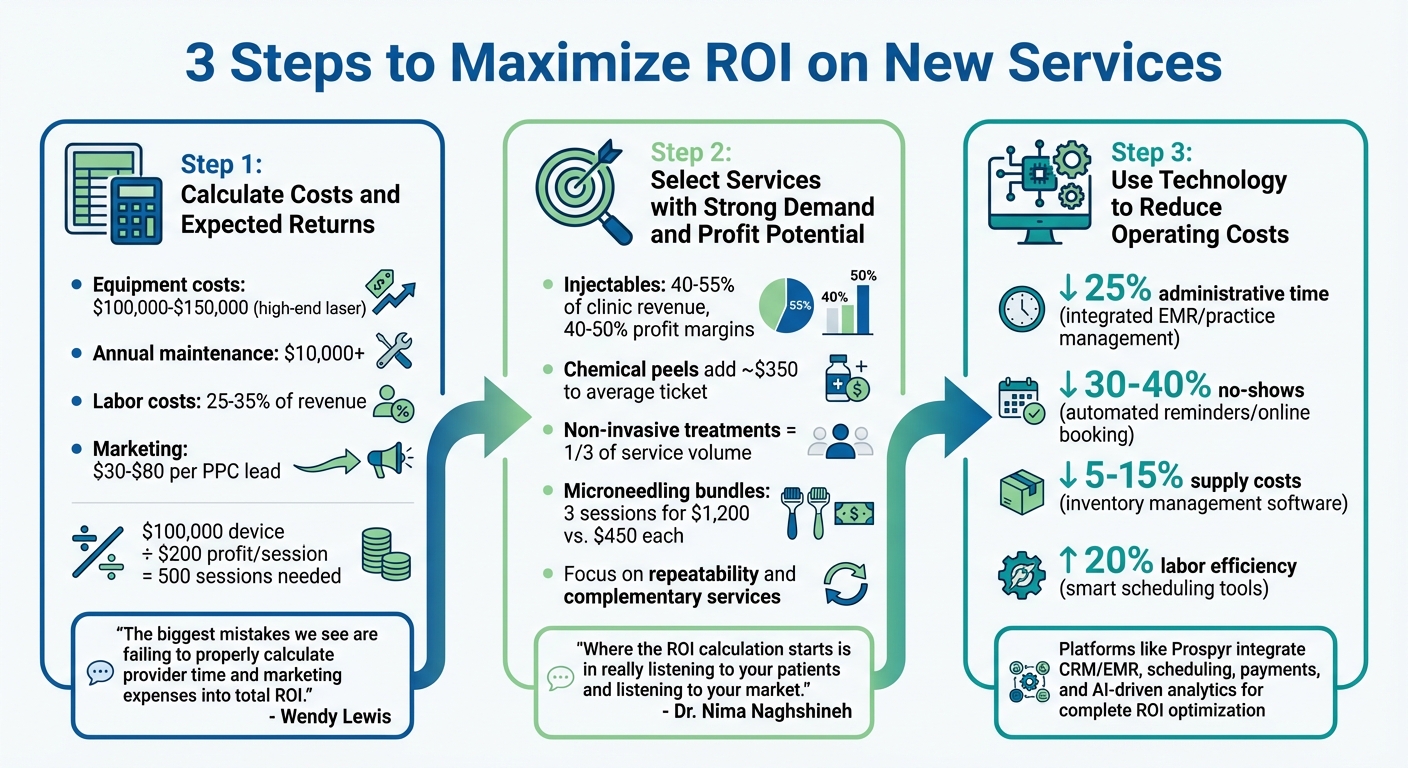
3-Step Process to Maximize ROI When Adding New Aesthetic Clinic Services
Once you've identified the challenges, the next step is to create a plan that ensures profitability. This involves crafting a solid financial and operational strategy to address those hurdles effectively.
Step 1: Calculate Costs and Expected Returns
Before diving into a new service, it's essential to understand the full scope of expenses and potential earnings. Start by listing all direct costs, such as equipment, consumables, and disposables. For instance, a high-end laser device might cost between $100,000 and $150,000, with annual maintenance fees adding another $10,000 or more.
Labor costs are another critical factor. Include the provider's salary or commission, as well as the time staff spend on preparation and follow-up care. Shorter procedures that require less labor often yield better returns.
"The biggest mistakes we see are failing to properly calculate provider time and marketing expenses into total ROI." – Wendy Lewis, Practice Management and Marketing Consultant
Marketing costs also play a significant role. Running PPC campaigns for a new service might cost anywhere from $30 to $80 per lead. To gauge profitability, perform a break-even analysis. For example, if a device costs $100,000 and generates $200 in profit per session, you'd need 500 sessions to recoup your investment.
Step 2: Select Services with Strong Demand and Profit Potential
The key to profitability lies in identifying services with high demand, repeatability, and strong profit margins. A good starting point is to analyze patient inquiries or consultation data to see what services are already being requested.
"Where the ROI calculation or consideration starts is not in the numbers. It's in really listening to your patients and listening to your market." – Nima Naghshineh, MD, Plastic Surgeon
Prioritize services that complement your existing offerings rather than competing with them. For instance, adding chemical peels to neurotoxin treatments can increase the average ticket by about $350 without adding significant time. Injectable treatments like neurotoxins and dermal fillers often account for 40% to 55% of a clinic's revenue, with gross profit margins of 40% to 50%. Meanwhile, simpler services like facials and microneedling tend to offer better ROI due to lower upfront costs, the ability to delegate them to licensed estheticians, and the likelihood of repeat visits. In fact, non-invasive treatments like these make up nearly one-third of the service volume in U.S. medical spas.
Also, think about services that can be bundled or sold as memberships. For example, offering three microneedling sessions for $1,200 can be more profitable than selling single sessions at $450 each, while also ensuring recurring revenue.
Step 3: Use Technology to Reduce Operating Costs
Operational inefficiencies can eat into your profits. Leveraging technology can streamline processes, reduce overhead, and ultimately boost ROI.
For example, integrated EMR and practice management systems can cut administrative time by up to 25%, allowing staff to focus on patient care and sales. Automated appointment reminders and online booking tools can reduce no-shows by 30% to 40%, resulting in fewer schedule gaps and steadier revenue. Inventory management software helps track consumables in real time, preventing overstocking and cutting supply costs by 5% to 15% annually. Additionally, scheduling tools that align provider hours with peak demand can improve labor efficiency by up to 20%.
Platforms like Prospyr offer an all-in-one solution by integrating CRM/EMR, scheduling, payment processing, automated marketing, and analytics. Prospyr's AI-driven tools manage patient inquiries 24/7, capture leads from your website and social media, and send automated reminders for recurring treatments. Its analytics dashboard provides insights into revenue per hour, service performance, and areas of financial loss - essential data for optimizing ROI on new services.
Marketing and Retention Methods to Improve ROI
Once your clinic is up and running, the next step is to focus on patient engagement to fuel your ROI. Effective marketing and retention strategies can make a world of difference. For example, increasing patient retention by just 5% can lead to a profitability boost of anywhere from 25% to 95%. Below are some practical ways to engage patients, structure enticing offers, and streamline processes to maximize your returns.
Promote to Current Patients Through Email, SMS, and Events
Your existing patients already trust your clinic, making them a great audience for targeted promotions. Start by segmenting your patient list based on their treatment history. Then, tailor email campaigns to highlight related services. For instance, if a patient regularly comes in for neurotoxin treatments, you could promote chemical peels as a way to improve skin texture and address sun damage - issues that neurotoxins alone may not cover.
SMS campaigns are another powerful tool, especially for urgent offers. Automated reminders and follow-ups can also reduce no-show rates by over 30%. Referral programs are another win-win strategy. Offering a $50 to $100 credit for each new client referred by an existing patient not only generates high-quality leads but also encourages loyalty. In fact, loyalty program members are over 70% more likely to recommend your clinic. Engaged patients mean more visits, higher revenue, and better profit margins.
Create Treatment Bundles and Membership Plans
Bundling services is an effective way to increase both patient commitment and revenue. A "Good, Better, Best" model works particularly well here. For example:
- Good: A basic neurotoxin treatment.
- Better: Neurotoxins combined with a chemical peel.
- Best: A comprehensive package that includes neurotoxins, a peel, and fillers.
This tiered approach can naturally increase the average ticket size by 20% to 30%.
Membership plans are another way to secure predictable revenue and enhance the lifetime value of your patients. On average, membership patients stay enrolled for 14 months, with a lifetime value of around $5,166 - far exceeding the $1,495 average for non-members. As David P., CEO of Rank & Rejuvenate, aptly puts it:
"The money isn't in the treatment room - it's in the relationship."
You can structure memberships in two ways:
- A "Bank" model, where patients pay a monthly fee (e.g., $99 to $199) to accumulate credit for services.
- A "Service" model, where patients receive a monthly treatment (like a facial) on a use-it-or-lose-it basis.
Additionally, offering series packages at a discount - such as three microneedling sessions for $1,200 instead of $450 each - encourages upfront commitment and delivers immediate returns. These strategies not only enhance short-term revenue but also build long-term loyalty.
Automate Marketing Tasks for Better Efficiency
Automation is key to maintaining a steady ROI without overloading your staff. Manual marketing can be time-consuming and prone to missed opportunities, but automation ensures consistent patient engagement. For example, automated email campaigns can nurture leads and send appointment reminders, reducing no-show rates by 30–40%.
Platforms like Prospyr make this process even smoother by integrating marketing automation with your CRM or EMR system. Prospyr’s tools include automated email and SMS campaigns to keep patients informed about new services, while its AI-powered agent handles inquiries 24/7. This ensures every lead from your website or social media is captured.
Prospyr also provides an analytics dashboard to track which campaigns are driving bookings and revenue. This data-driven insight allows you to refine your marketing efforts and get the most out of your budget. Automated rebooking reminders further ensure patients complete their treatment plans, which not only improves clinical outcomes but also strengthens your bottom line.
sbb-itb-02f5876
Track and Improve ROI After Launch
Launching a new service is just the beginning - the real work lies in consistently monitoring its performance. Without tracking, it’s impossible to know if your investment is paying off. As Terri Ross, Managing Partner of Lasky Aesthetics & Laser Center, explains:
"In order to maximize the profitability and success of your office, you need to take an accurate and realistic snapshot of where you are by the numbers."
Between 2015 and 2018, Ross grew her practice from $500,000 to $3.5 million by focusing on key financial metrics like ROI per procedure, lead retention rates, and revenue-per-hour targets. These numbers provided a clear picture of patient behavior and revenue trends, laying the groundwork for sustained success.
Monitor Appointment Volume and Patient Feedback
Keep a close eye on appointment volume and compare the number of consultations to completed treatments. This comparison helps you measure interest and pinpoint potential issues. An ideal consultation-to-treatment conversion rate is between 60% and 80%. If your rate falls short, the problem could be related to pricing, perceived value, or how your team presents the service during consultations.
Rebooking rates are another crucial metric. Successful clinics often see new patients book 3–4 follow-up appointments within their first 6–12 months. If patients aren’t returning, post-consultation feedback can help uncover whether the issue lies in the consultation process, pricing, or the treatment itself.
Compare Expected Results to Actual Performance
Before launching a new service, set SMART goals - targets that are specific, measurable, achievable, relevant, and time-bound. For example, you might aim to increase average revenue per appointment from $350 to $425. Once the service is live, compare your projections to actual results. Key metrics like revenue per hour (ideally between $600 and $1,000) can help you spot shortfalls quickly.
It's also important to track your Cost of Goods Sold (COGS). For injectables, aim to keep COGS under 30% of revenue. Similarly, labor costs should remain below 40% of total revenue. These benchmarks help ensure the service is both profitable and sustainable.
Use Analytics and Staff Input to Refine Operations
Leverage real-time analytics to make quick adjustments. Tools like Prospyr provide dashboards that track metrics such as appointment volume, revenue per provider, and marketing performance. This data reveals which services are driving bookings and which marketing channels deliver the best ROI. Businesses that use advanced analytics for operational tracking often see a 5% to 10% boost in productivity.
Don’t overlook the value of staff feedback. Regular input from your team can highlight workflow inefficiencies and training gaps. Schedule monthly reviews to evaluate key performance metrics and fine-tune strategies. If a service isn’t meeting expectations, consider bundling it with a more popular option, repositioning it in the market, or replacing it with something that better aligns with patient demand.
Conclusion
Adding new services can deliver impressive returns - if you start with solid planning. This means calculating your break-even point, choosing services that meet existing patient demand, and steering clear of trendy offerings without carefully analyzing their financial impact.
Once your groundwork is in place, technology becomes your greatest ally. Tools like Prospyr streamline operations by integrating CRM and EMR systems, which can lead to revenue increases of 27% to 50% through automated marketing and better patient retention.
The real game-changer, though, is ongoing evaluation. Keeping a close eye on metrics like consultation-to-treatment conversion rates, revenue per hour, and real-time patient feedback can set successful service expansions apart from costly missteps. Dr. Nima Naghshineh puts it best:
"Often, practices fail to track key metrics that could help them expand. They're just looking at what they're already doing".
Consistently reviewing performance allows you to pinpoint which services are thriving and which might need an overhaul. Even small changes in patient retention can have a huge financial impact - boosting it by just 5% can increase profitability by 25% to 95%. Tactics like automated follow-ups, treatment bundles, and membership programs can encourage patients to keep coming back.
The most successful clinics don’t just add services - they create systems that transform one-time treatments into lasting patient relationships.
FAQs
What should I consider when calculating the ROI of adding new services to my aesthetic clinic?
To figure out the ROI of adding new services to your aesthetic clinic, start by breaking down the initial investment costs. This includes things like buying equipment, training your staff, launching marketing campaigns, and covering other setup-related expenses. Be sure to also factor in ongoing operational costs - think supplies, staff hours, and maintenance - so you have a full understanding of your financial commitment.
Then, look at the revenue potential. How many treatments do you expect to perform? What’s the average price per service? Don’t overlook key considerations like patient retention and acquisition rates, as these can have a big impact on your long-term profits. It’s also a good idea to assess market demand and competition to ensure the service fits your patients' needs and aligns with what they’re willing to pay.
Lastly, using tools like practice management software can make a big difference. These platforms can streamline your operations, cut down on costs, and improve overall efficiency - helping to maximize your ROI. Taking the time to analyze these factors thoroughly will set you up to make smart, well-informed decisions about adding new services.
How can I find out if there’s enough demand for a new service in my clinic’s area?
To assess demand for a new service, begin by reviewing your clinic's current performance metrics. Look at factors like how many new clients you're attracting and trends in patient feedback. These can give you a clear picture of your clinic's strengths and areas for growth.
Next, dive into market research. Analyze local demographics, preferences, and any unmet needs specific to your area. This will help you understand what your community might be looking for.
Finally, take some time to evaluate competitor offerings. See what's working for them and identify any gaps they might have left unaddressed. Combining all this data will give you the foundation to decide whether launching a new service makes sense.
How can I boost patient loyalty and profitability after introducing a new service?
To strengthen patient loyalty and improve profitability after introducing a new service, focus on strategies that elevate the overall patient experience and encourage them to return. Start by keeping an eye on key metrics like patient retention rates, frequency of repeat visits, and client lifetime value. These numbers can highlight areas that need attention. Loyal patients not only spend more but are also more likely to refer others and choose premium treatments, making retention efforts a smart investment.
Streamlining operations through automation can make a big difference. Tools like appointment reminders, online booking systems, and follow-up messages simplify processes and enhance patient satisfaction. Another idea? Introduce membership programs. These programs encourage regular visits while providing a steady stream of income.
Lastly, keep track of patient feedback and treatment revenue per client. These insights can help you fine-tune your approach, ensuring your services remain appealing and your practice stays profitable over time.