Paid Ad ROI Benchmarks for Aesthetic Clinics
Benchmarks for paid ads in aesthetic clinics: CPL, CPC, CTR, conversion rates, patient acquisition cost and LTV, plus tracking and fast lead follow-up.

Running paid ads for aesthetic clinics is about maximizing returns, not just spending money. Clinics in 2026 are seeing an average return of $3.62 for every $1 spent, with top performers achieving 7x–7.6x ROI. Success hinges on tracking key metrics like Cost Per Lead (CPL), Click-Through Rate (CTR), and Conversion Rate (CVR) while focusing on high-value patients and efficient follow-ups.
Key Takeaways:
- CPL Benchmarks: High-performing campaigns range from $50–$100, while average campaigns can hit $75–$200.
- Google Ads ROI: High-intent keywords like "Botox near me" cost $12–$28 per click but yield higher patient conversions.
- Meta Ads ROI: Lower CPCs ($0.77–$3.06) but require strong follow-ups to drive conversions.
- Patient Acquisition Costs: Typically $200–$300 per patient, influenced by lead quality and follow-up speed.
- Lifetime Value (LTV): A patient can generate $4,775 over 18 months with repeat treatments and referrals.
Efficient ad spend requires clear attribution, fast lead follow-ups, and aligning costs with patient value. Clinics that track metrics and focus on ROI instead of just lead volume outperform competitors.
2026 Paid Ad ROI Benchmarks for Aesthetic Clinics
2026 Paid Ad ROI Benchmarks for Aesthetic Clinics
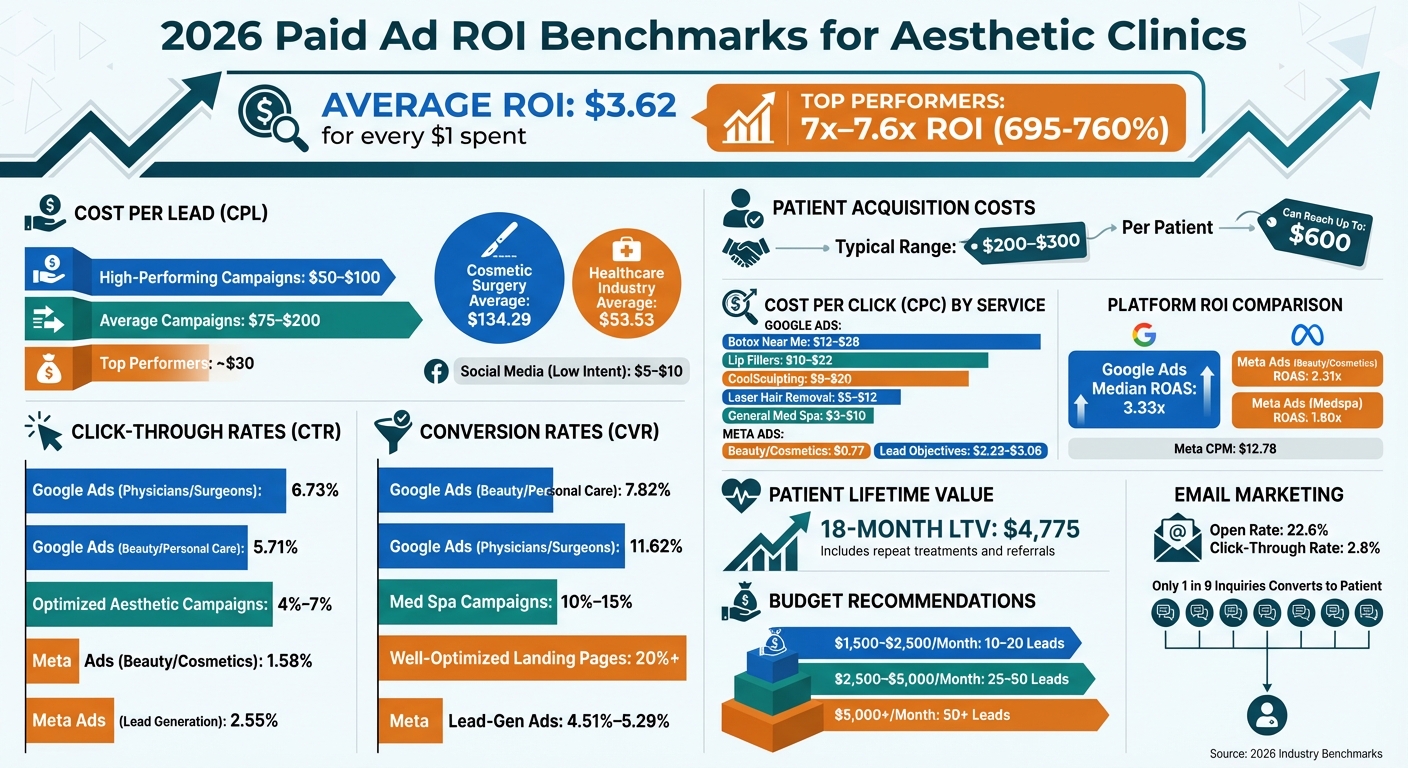
In 2026, healthcare providers are seeing an average return of $3.62 for every $1 spent on paid advertising. Yet, some aesthetic clinics are outperforming this standard by a wide margin. With well-structured campaigns targeting high-value patients, these clinics are achieving 695% to 760% ROI (roughly 7x–7.6x returns) over an 18-month span. This highlights the importance of tracking metrics with precision.
The key to such performance lies in focusing on lead quality, optimizing conversions, and understanding patient lifetime value. Chasing low-cost clicks alone can be shortsighted. For instance, a $28 click for "Botox near me" that results in a $4,775 lifetime patient is far more profitable than a $5 click that doesn’t convert into an appointment.
Marketing budgets in healthcare have tightened, shrinking from 9.6% of total revenue in 2023 to 7.2% in 2024. This shift forces aesthetic clinics to focus on efficiency. Campaigns now need clear attribution and an understanding of patient acquisition costs to stay profitable.
Knowing where your clinic stands compared to industry benchmarks is essential to identify weak spots before they drain your resources. Let’s break down key metrics to pinpoint which campaigns generate profit and which ones fall short.
Cost Per Lead (CPL) Benchmarks
The cost per lead (CPL) can vary significantly based on where a prospect is in their decision-making process. Social media campaigns targeting the top of the funnel - like offering free consultations or discounts - can generate leads for $5–$10. However, these leads often show less intent compared to search-based leads. High-intent Google Ads leads come at a higher price because they’re actively seeking solutions.
For high-performing med spa campaigns, CPL typically falls between $50 and $100. On the other hand, average campaigns can see CPLs climb to $75–$200. In the case of cosmetic surgery, the industry average CPL is $134.29.
Across the healthcare industry, the average CPL is $53.53, though top performers bring this down to around $30. Location and competition significantly influence these costs. Clinics in high-demand markets like Miami or Los Angeles often face CPCs 2–3 times higher than those in smaller towns. For example, a $50 lead in a rural area could cost $150 in a major city.
"A $5 lead doesn't mean a $5 patient. New patient acquisition usually ranges from $200–$300 when factoring in nurturing and conversion rates." - Beauty Brand Builders
Consider this: a $100 lead with a 50% conversion rate costs $200 per patient. Meanwhile, a $50 lead with a 10% conversion rate ends up costing $500 per patient. For most aesthetic clinics, patient acquisition costs typically range from $200 to $300, though they can reach up to $600 depending on follow-up effectiveness.
Click-Through Rate (CTR) and Conversion Rate (CVR) Benchmarks
After CPL, engagement metrics like click-through rates (CTR) and conversion rates (CVR) shed light on ad performance. CTR measures how well your ad grabs attention. For Google Ads, campaigns targeting physicians and surgeons average a 6.73% CTR, while beauty and personal care campaigns see about 5.71%. Optimized aesthetic campaigns typically achieve CTRs in the 4%–7% range. If your CTR falls below 3%, it’s a sign that your ad copy, targeting, or offer needs improvement.
Meta ads (Facebook and Instagram) tend to have lower CTRs since they interrupt users rather than meet active search intent. Beauty and cosmetics campaigns on Meta average a 1.58% CTR, while lead-generation campaigns reach 2.55%. To succeed here, your ad must grab attention amidst vacation photos and memes.
Conversion rates (CVR) measure how many clicks turn into actual leads. Google Ads for beauty and personal care convert at 7.82%, while physician and surgeon campaigns see a higher 11.62%. Med spa campaigns typically convert at 10%–15%, though well-optimized landing pages with clear calls-to-action and mobile-friendly designs can push CVR above 20%.
On Meta, lead-generation ads usually convert at 4.51%–5.29%. These lower rates reflect the lower intent of users who weren’t actively searching for your services. Meta’s "Instant Forms" feature can boost conversion rates by reducing friction, but these leads often lack the quality of those generated through website forms.
"Costs are rising, but so is performance - 65% of industries saw better conversion rates in 2025. The main takeaway here is that a smart strategy beats cheap clicks." - Cliff Sizemore, Senior Marketing Manager, LocaliQ
Here’s the math: a 7% CTR with a 10% CVR means only 0.7% of people who see your ad become leads. That’s why targeting and the post-click experience (like landing pages) are just as important as the ad itself. Search campaigns paired with strong landing pages can achieve 7–10% conversion rates, but these numbers drop below 4% if users land on poorly designed pages.
Cost Per Click (CPC) Trends
While CPL and CVR highlight performance, CPC trends reveal how efficiently your budget is being spent. CPCs for aesthetic services have risen sharply. Google Ads for beauty and personal care saw a 60.11% year-over-year increase as of late 2025. The current average CPC is $5.70, though specific treatment keywords cost much more.
High-intent keywords like "Botox near me" range from $12–$28 per click, while "Lip fillers" cost $10–$22. Other examples include "CoolSculpting" at $9–$20 and "Laser hair removal" at $5–$12. General terms like "med spa" are more affordable, falling between $3 and $10.
Meta ads, by comparison, offer significantly lower CPCs - $0.77 for beauty and cosmetics campaigns and $2.23–$3.06 for lead objectives. However, lower CPC doesn’t always mean higher ROI. Google users are actively searching for treatments, while Meta users are passively scrolling. If those clicks don’t convert into patients, the lower cost per click becomes irrelevant.
| Service Type | Google Ads CPC | Lead Intent |
|---|---|---|
| Botox | $12–$28 | High |
| Lip Fillers | $10–$22 | High |
| CoolSculpting | $9–$20 | High |
| Laser Hair Removal | $5–$12 | Moderate-High |
| General Med Spa | $3–$10 | Moderate |
CPC plays a critical role in how quickly your budget gets used. For example, a $5,000 budget delivers 500 clicks at $10 CPC but only 200 clicks at $25 CPC. To stay profitable, clinics need to calculate their maximum allowable CPC based on conversion rates and patient lifetime value. If your average patient generates $4,775 over 18 months and you convert 10% of clicks into patients, you can afford to pay up to $477 per click while breaking even.
Reading about the problem? See how Prospyr solves it in one platform.
Book a DemoROI Benchmarks by Advertising Platform
Different advertising platforms bring their own strengths when it comes to ROI. Google Ads excels at reaching high-intent patients, Meta platforms (Facebook and Instagram) shine with visual storytelling to build brand awareness, and email marketing helps nurture leads into loyal, long-term clients. Let’s break down how each platform contributes to your ROI.
Google Ads ROI
Google Ads is a go-to for capturing patients actively searching for treatments like "Botox near me" or "CoolSculpting". While it’s true that the cost per click can be on the higher side compared to other platforms, the payoff is often worth it because these clicks come from people closer to making a booking. By focusing on high-intent keywords, Google Ads ensures that every dollar spent is aimed at those most likely to convert. The cost-per-click and conversion data are key metrics that directly influence the ROI here.
Facebook and Instagram Advertising
Meta platforms offer a different ROI dynamic. For beauty and cosmetics campaigns, the return on ad spend (ROAS) averages 2.31x, significantly outperforming the 1.49x seen in the broader healthcare sector. Medspa-specific campaigns typically achieve a ROAS of around 1.80x. These platforms are particularly well-suited for visually driven content like before-and-after photos, treatment demos, and patient testimonials.
Cost metrics are another reason Meta is appealing. The cost per thousand impressions (CPM) for beauty and cosmetics campaigns is about $12.78, and click-through rates (CTR) for high-performing campaigns range from 1.58% to 3.8%. Traffic campaigns average a cost per click of just $0.74, while lead generation campaigns hover around $3.06. While these leads may require nurturing, the lower cost per click helps stretch your advertising budget further.
"The lower end of this range ($15-$25) is typically for broader, top-of-funnel offers... The higher end ($25-$50+) is more common for higher-intent, service-specific leads."
– Nikki Lindgren, Pennock
Meta’s Instant Forms feature also simplifies the lead generation process by keeping users on the platform, resulting in cost-per-lead figures between $15 and $50.
"A rapid and persistent follow-up strategy is critical to successfully convert these leads into booked appointments."
– Nikki Lindgren, Pennock
While Meta ads are great for generating leads, email nurturing campaigns are essential for turning those leads into actual patients.
Email Nurturing Campaigns
Email marketing is a powerhouse for converting inquiries into appointments. With an average open rate of 22.6% and a click-through rate of 2.8%, email campaigns consistently outperform cross-industry norms. Since only about one in nine inquiries results in a patient booking, automated email sequences triggered right after a lead submission are crucial. These emails keep your clinic top-of-mind and guide potential patients toward scheduling.
But email’s role doesn’t stop at conversion. It’s also a key tool for patient retention and encouraging repeat visits. Sending educational content, seasonal promotions, and information about complementary treatments keeps patients engaged with your clinic. Additionally, email lists can be used for retargeting campaigns, reaching people who are already familiar with your brand. Together, these strategies ensure that your advertising dollars continue to deliver value well beyond the initial click.
What Affects Paid Ad ROI in Aesthetic Practices
Several external factors play a crucial role in shaping the return on investment (ROI) of paid ad campaigns for aesthetic practices. By understanding these influences, you can make informed decisions about ad spend and campaign strategies to maximize results.
Budget Allocation and Revenue Contribution
Advertising efficiency often hinges on your budget, and smaller practices face unique challenges in this area. Independent clinics generally allocate $1,500 to $4,000 per month for digital ads, while mid-sized groups may spend anywhere from $4,000 to $10,000 or more. Your budget should reflect your growth objectives. Here's a breakdown of what different spending levels can achieve:
- $1,500–$2,500/month: Expect 10–20 leads and valuable insights into your local market.
- $2,500–$5,000/month: Generates 25–50 leads across 2–3 service lines, supporting steady growth.
- $5,000+/month: Brings in 50+ leads, enabling dominance in multiple treatment categories, especially in competitive metro areas.
The key is aligning your ad spend with your clinic’s goals - whether that’s steady growth or aggressive market expansion.
Sales Cycle Length and Lead Nurturing
The sales cycle for aesthetic treatments often spans 3–6 months, and slow follow-ups or complicated scheduling processes can significantly hurt conversion rates. Timing is everything: contacting leads within the first 5 minutes can boost conversion rates by up to 9 times compared to waiting 30 minutes.
High-performing clinics rely on a structured follow-up approach, typically including:
- 3 calls
- 2 SMS messages
- 2 emails
All within the first 72 hours. This strategy can drive conversion rates as high as 40%, compared to the industry average of 25–30%.
"Improving intake speed and follow up often has as much impact as optimizing ads or landing pages."
– Inner Spark Creative
Beyond the first treatment, the true ROI lies in the lifetime value of a patient. Over 18 months, a new patient can be worth up to $4,775 when factoring in maintenance treatments, additional services, and referrals. A more accurate ROI calculation considers this lifetime value:
(Lifetime Value – Patient Acquisition Cost) ÷ Patient Acquisition Cost × 100.
This approach provides a clearer understanding of long-term campaign success.
Local Market Competition
Your location heavily influences ad costs. For instance, high-intent keywords like "Botox near me" can range from $15–$25 per click in competitive markets like Los Angeles or Miami, compared to $8–$12 in smaller cities like Tulsa. Over the past three years, the average cost per booked consultation for injectables in major metro areas has surged, rising from $120–$210 in 2022 to $180–$320 today.
In competitive markets, patients often compare prices across 3–5 providers before making a decision. To stand out, many clinics are adopting hyperlocal targeting strategies, focusing on specific neighborhoods to connect with patients closer to booking. Understanding these cost differences is essential for refining your local marketing efforts and staying competitive.
sbb-itb-02f5876
How Prospyr Helps You Meet and Beat Paid Ad Benchmarks
Achieving and exceeding industry benchmarks takes more than effort - it requires the right tools. Aesthetic clinics often face a common hurdle: 42% of marketers report difficulty tracking ad ROI due to scattered data sources. When clicks happen on platforms like Google or Meta, but revenue shows up weeks later in your practice management system, it’s tough to figure out which campaigns are truly working.
Prospyr bridges this gap by integrating ad data directly with your CRM or EMR, offering clear attribution. Instead of guessing which campaigns are driving results, you can pinpoint the ads that bring in patients who show up and spend over $1,000 on treatments. This level of integration ensures every dollar spent is tracked and optimized with precision.
Track ROI with Practice Analytics
The first step to solving visibility issues is real-time analytics. Prospyr’s dashboard makes it easy to track crucial metrics like Cost Per Lead (CPL), Patient Acquisition Cost (PAC), and Patient Lifetime Value (PLV). With these insights, you can make smarter, data-driven decisions. For example, maintaining a 3:1 LTV-to-PAC ratio becomes much more manageable with this transparency. Clinics that connect their ad tools directly to their CRM report a 20% higher ROI compared to those relying only on platform data. Plus, automated tracking reduces manual errors, which can lower attribution accuracy by 15% and lead to mistakenly cutting campaigns that are actually profitable.
Automate Lead Nurturing and Follow-Ups
Quick follow-up is critical when it comes to converting leads. Prospyr’s automation tools ensure timely responses, keeping potential patients engaged while their interest is at its peak. The system triggers targeted emails and SMS messages as soon as leads are generated. This is especially vital for Meta Instant Form leads, which often have a lower CPL ($15–$50) but require fast and consistent follow-up to convert. For aesthetic clinics, where patients typically spend weeks or months researching before committing, this automation helps your practice remain top-of-mind without adding extra work for your team.
Connect Paid Ad Data with CRM and EMR
Breaking down data silos is key to understanding the full patient journey. By linking ad performance data with patient records, Prospyr reveals which campaigns attract patients who actually show up versus those who book but don’t follow through. This helps refine your targeting strategy to focus on higher-quality leads. You can also track the 18-month lifetime value of patients acquired through different campaigns, factoring in maintenance treatments, additional services, and even referrals. This long-term perspective ties marketing spend directly to patient revenue, justifying higher upfront acquisition costs. Without integrated tracking, clinics risk wasting up to 32% of their ad budgets by failing to identify which ads drive high-value bookings.
Conclusion
Hitting the 2026 paid ad ROI benchmarks isn’t about throwing more money at campaigns - it’s about refining every aspect of your strategy. For instance, Google Ads delivers a median ROAS of 3.33x in healthcare, while Meta Ads average around 1.80x. But these figures are meaningless if you’re not tracking the right metrics. Relying on shallow metrics could waste up to 32% of your ad spend. This highlights the importance of integrated tracking systems that connect metrics to actual revenue.
The focus is shifting from chasing lead volume to prioritizing revenue-based tracking. Aesthetic clinics are no longer just looking for cheaper clicks - they’re identifying campaigns that attract patients who spend $1,000 or more on treatments and return for maintenance services over an 18-month period. Prospyr bridges the gap by integrating ad performance data with patient revenue outcomes. This approach provides a clear view of the entire patient journey, from the first click to the final payment, empowering clinics to make smarter, data-driven marketing decisions.
As these benchmarks reveal, success in paid advertising isn’t about spending more - it’s about spending wisely. Clinics that consistently outperform their peers focus on aligning Patient Acquisition Costs with Lifetime Value, automating follow-ups to keep leads engaged, and optimizing campaigns based on real conversion data rather than surface-level metrics. With advertising costs climbing 12.88% year-over-year, precision and integration aren’t just helpful - they’re critical for ensuring sustainable growth.
FAQs
What are the best ways for aesthetic clinics to improve ROI on paid ads?
Aesthetic clinics can see better returns on investment (ROI) from paid ads by zeroing in on targeted, data-driven strategies. The healthcare industry averages a conversion rate of about 2.6% for paid search ads, making them a worthwhile investment - if campaigns are tailored to the right audience. Key metrics like cost per click (CPC) and cost per mille (CPM) play a big role in this. For med spas, CPCs typically range from $2.62 to over $10, depending on the competition and the keywords being targeted.
Incorporating tools such as marketing automation and practice management platforms can make a big difference. These tools help clinics track leads more effectively, streamline processes, and cut down on wasted ad spend. For instance, platforms like Prospyr provide features like lead capture, analytics, and automated patient engagement. These capabilities allow clinics to fine-tune their ad strategies and focus on campaigns that bring in the most value.
Consistently reviewing performance data, refining keyword choices, and tweaking audience targeting are essential steps to ensure your ad budget works as hard as possible in today’s competitive market.
What are the best ways to follow up with leads and turn them into patients?
To turn leads into patients, personalized communication plays a crucial role. Tools like CRM platforms and automated messaging systems allow you to send timely and relevant follow-ups tailored to each individual's needs. By keeping an eye on metrics like engagement and retention rates, you can pinpoint areas that need improvement and fine-tune your strategy.
Mixing educational content with special offers is another smart way to build trust and encourage bookings. Staying connected with leads through email, social media, and targeted campaigns ensures your clinic remains top-of-mind. Prompt follow-ups after consultations or treatments, along with appointment reminders and promotional updates, can make a big difference in conversion rates. Automation and data insights help streamline these processes, making them both efficient and effective.
Why is patient lifetime value important for advertising strategies in aesthetic clinics?
Patient lifetime value (LTV) is a key factor in designing advertising strategies for aesthetic clinics. It measures the total revenue a patient is likely to generate throughout their relationship with the clinic. By focusing on this metric, clinics can shift their attention from short-term gains to creating lasting relationships.
This mindset encourages clinics to invest in personalized, efficient marketing efforts aimed at fostering loyalty and repeat visits. When LTV increases, clinics gain more freedom to allocate ad budgets, as the return on investment improves with consistent patient satisfaction and engagement.