
A med spa employment contract should do more than list pay and a job title. If I’m reviewing one, I want it to lock down scope of practice, supervision, pay rules, policy compliance, confidentiality, and exit terms in plain English.
Here’s the short version:
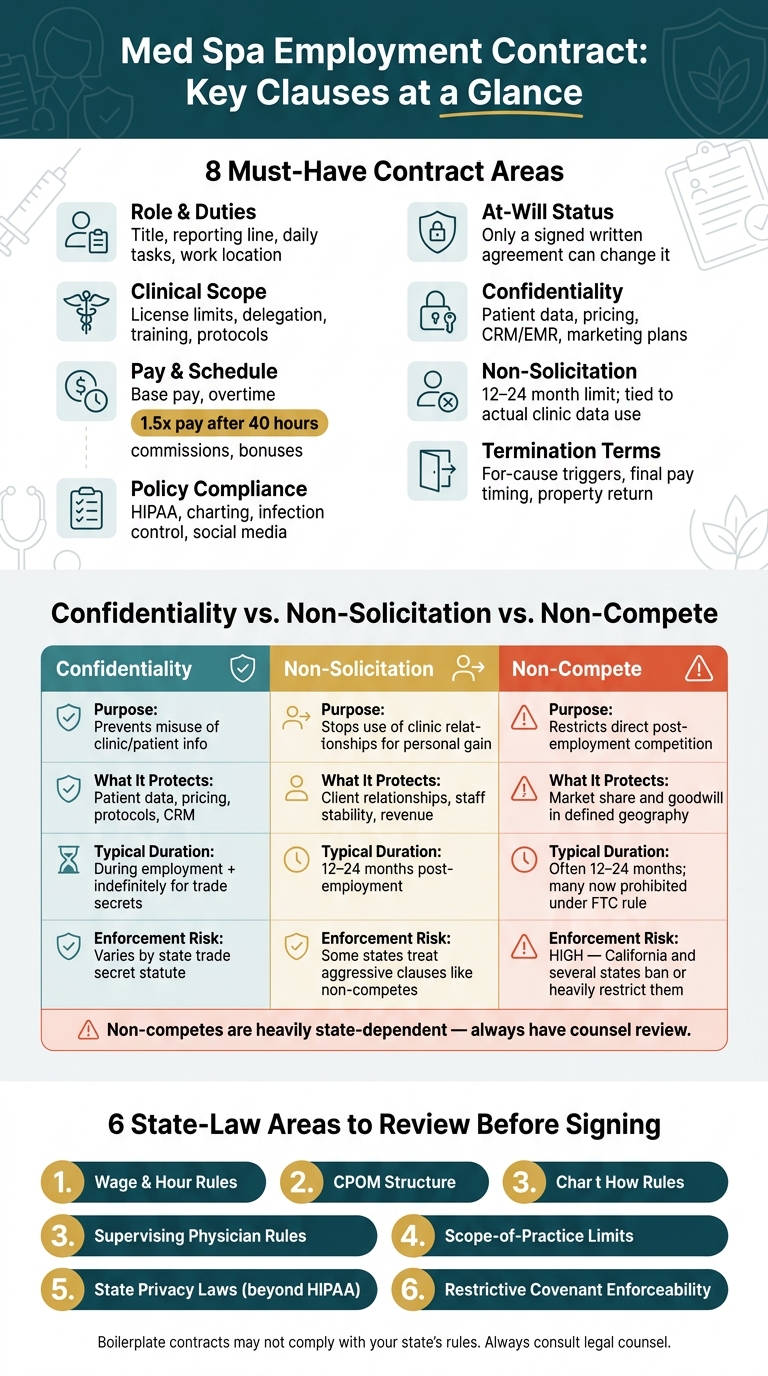
- I need the contract to state the exact role, reporting line, and daily duties.
- I need each clinical task tied to the worker’s license, training, and state law limits.
- I want pay terms to cover base pay, overtime, commission math, bonus rules, PTO, and schedule.
- I look for clear at-will wording and a line that says only a signed written agreement can change it.
- I expect clinic policies like HIPAA, charting, infection control, and social media rules to be pulled into the agreement.
- I want post-employment terms to separate confidentiality, non-solicitation, and non-compete because they do not carry the same legal risk.
- I check termination terms for for-cause triggers, final pay timing, property return, and what duties survive after the job ends.
- And I never assume boilerplate works, because state law controls wage rules, supervision, privacy, scope, and restrictive covenants.
A few numbers matter here. Under federal wage law, many non-exempt employees must get 1.5x pay after 40 hours in a workweek. And non-solicitation or non-compete clauses often try to use 12 to 24 months, even though state rules may limit or block enforcement.
Med Spa Employment Contract: Key Clauses, Risks & Restrictive Covenants Compared
Quick comparison
| Contract area | What I want in writing | Main risk if missing |
|---|---|---|
| Role and duties | Title, reporting line, tasks, work location | Scope fights, workflow gaps |
| Clinical scope | License limits, delegation, training, protocols | Out-of-scope treatment, board issues |
| Pay and schedule | Hourly or salary, overtime, commission trigger, bonus terms, shifts | Wage claims, payout disputes |
| Policies | HIPAA, consent, charting, infection control, conduct rules | Compliance failures |
| Restrictive terms | Confidentiality, non-solicit, non-compete split out clearly | Overbroad clause, weak enforcement |
| Termination | Resignation notice, cause, final pay, property return | Messy exits, unpaid wage claims |
If I had to sum it up in one line, it’s this: the best med spa employment contracts match how the clinic actually runs, not how a template says it runs.
sbb-itb-02f5876
Role, duties, and clinical scope
Once the contract confirms at-will status and pulls in the right policies, it needs to spell out the job itself. This part of a med spa employment contract sets the guardrails: what the employee does, who they report to, and where their limits are. Clear language here helps cut down on scope fights and coverage gaps.
Position title, reporting line, and daily responsibilities
Every contract should name the exact position title and say who the employee reports to. That reporting line matters because it sets both clinical direction and day-to-day oversight. For example, an RN injector may report clinically to the Medical Director and operationally to the Practice Manager.
Daily duties should be written out in plain terms. That includes treatments, charting, consent workflows, schedule expectations, staff meeting attendance, and following safety protocols. The contract should also require the employee to follow clinic protocols and SOPs.
Scope-of-practice limits, credentials, and training and protocol requirements
After the title and reporting structure, the contract should lay out the legal limits on what the employee can perform. Every clinical duty needs to fit within the employee’s active state license. It should also list the licenses, certifications, and training required before any clinical work starts.
An RN injector must work under physician delegation or standing orders and cannot independently prescribe the neurotoxins or fillers they administer. In a full-practice-authority state, an NP may have broader prescribing and treatment-planning rights, but the contract should still state those rights in clear terms. Estheticians should be limited to the services allowed under state law and practice protocols.
Duty comparison table for common med spa positions
| Role | Clinical Tasks | Documentation & Compliance | Required Supervision | Key Compliance Risks |
|---|---|---|---|---|
| RN Injector | Injectables and other services allowed by state law | Charting, consent forms, standing orders, safety workflows | Direct physician delegation and oversight | Independent prescribing, deviating from protocols |
| NP / PA | Diagnosis, prescribing, advanced injections | Chart review, protocol development, clinical oversight | Collaborative or supervisory agreement | Exceeding scope in restricted states |
| Esthetician | Facials, chemical peels, and other services allowed by state law | Treatment logs, adherence to medical protocols | General supervision by MD/NP | Performing medical-grade procedures outside scope |
| Front Desk Coordinator | Patient check-in, retail sales, scheduling | Patient intake, consent forms, scheduling | Practice Manager | Giving medical advice or "prescribing" treatments |
| Practice Manager | Operations, HR, marketing oversight | HR records, financial reporting, operational compliance | Owner or Medical Director | Misclassifying staff as 1099 contractors |
Once duties and scope are set, the contract should move to pay, bonuses, and schedule.
Compensation, bonuses, benefits, and work schedule
Once the role and scope are set, nail down how the employee is paid and when they’re expected to work. Put base pay, commissions, bonuses, benefits, and schedule terms in writing. That simple step can head off a lot of confusion later.
Base pay, overtime, and benefits language
State the pay type, exact rate, pay period, exempt status, and overtime rule. The contract should say whether the role is exempt or non-exempt under the FLSA and define the workweek used for overtime calculations. Most hourly clinical staff are non-exempt and must receive at least 1.5 times their regular rate for hours worked over 40 in a workweek. Clear classification language can help cut misclassification risk.
The agreement should also list PTO, sick leave, paid holidays, health benefits, and any CE allowance. If the clinic requires repayment of CE costs when an employee leaves within a set period, that repayment term should appear in the contract too.
Commission and bonus terms that reduce disputes
Commission terms should spell out exactly what triggers a payout and how the amount is figured. In most cases, the contract should tie commissions to collected revenue, not just booked or billed revenue, so refunds and chargebacks are already baked into the math. If a client gets a refund or a charge is reversed, the related commission should be offset in the next pay period. Membership incentives should also be clear about whether the payout applies to new sign-ups, monthly renewals, or both, and what happens if a member cancels early.
Bonus language needs one key distinction: a discretionary bonus does not create an obligation to pay each period, while a non-discretionary bonus tied to a set target is treated as earned compensation and may affect overtime calculations for non-exempt employees. The contract should also say whether the employee must still be employed on the payout date to receive a quarterly or annual bonus.
Pay structure and schedule comparison table
Schedule terms should live in the same section as pay because weekend shifts, holiday coverage, and multi-location work affect both clinic operations and employee compensation. Here’s a side-by-side look at common med spa pay structures and the tradeoffs.
| Compensation model | Common roles | Pros for clinic | Pros for employee | Key risks |
|---|---|---|---|---|
| Hourly + commission | Aestheticians, front desk, newer injectors | Predictable cost; performance upside | Stable floor; earning potential | Overtime tracking; precise timekeeping required |
| Salary + quarterly bonus | Clinical leads, experienced injectors, managers | Simpler budgeting; broader performance reward | Income stability; clear bonus targets | Vague bonus criteria; dispute risk |
| Commission-heavy / commission-only | High-producing injectors | Incentive alignment; lower fixed cost | High earning potential | Income volatility; refund and clawback disputes |
| Hourly only | Support staff, training-period roles | Simple to administer | Predictable pay | Less competitive for clinical roles |
The contract should directly state weekly hours, weekend shifts, holiday coverage, break periods, and any multi-location assignments.
After pay and scheduling, the contract should address at-will status, policy control, and restrictive covenants.
At-will language, policies, confidentiality, and restrictive covenants
After pay and schedule, the contract should protect the clinic’s data, patients, and team. These clauses help guard clinic data, client ties, and internal protocols. But here’s the catch: state law decides what will hold up.
At-will wording and handbook-linked policies
Add clear at-will language, and spell out that only a signed written agreement can change it. A common clause says employment is at-will and can end at any time, by either side, with or without reason or notice. It also says that only a signed written agreement can change that status.
If the contract mentions a notice preference, make it clear that the notice is only for scheduling. It should not weaken at-will status.
The contract should also bring in clinic policies by reference, including HIPAA, infection control, social media, and code of conduct rules. The employee should agree to follow those policies as they are updated from time to time. That gives the clinic room to change procedures without redoing the full contract. The handbook should also say plainly that it is not a contract.
From there, the contract needs to say what information stays confidential and what kinds of post-employment outreach are off-limits.
Confidentiality, non-solicitation, and non-compete clauses
A confidentiality clause should be specific about what it covers. That usually includes patient records, appointment histories, treatment protocols, membership pricing, vendor terms, CRM data, and marketing plans. It should apply to both paper and electronic records, require return or deletion of clinic information when employment ends, and stay in effect after separation.
At the same time, don’t make it so broad that it blocks someone from using general clinical skills or starts to read like a hidden non-compete. That’s where clinics get into trouble.
These limits should be narrower than a non-compete and tied to actual business interests. A non-solicitation clause should focus on active outreach that uses clinic data, like appointment lists or CRM exports, not casual contact with former patients. Staff non-solicitation clauses are meant to stop a departing employee from recruiting coworkers to a competing practice. A 12–24 month limit is common. If the language goes too far, it can start to function like a non-compete by making it hard for someone to work in the same field.
Non-competes are heavily state-dependent and are often limited in healthcare. Treat them as clauses for counsel review, not plug-and-play template language. If a clinic uses one at all, keep it short, limit the geography to the clinic’s actual service area, and tie it to a narrow competitive interest.
Restrictive covenant comparison table
Use the table below to match each clause to its purpose and legal risk. In med spa operations, these clauses often focus on patient lists, treatment pricing, and team stability.
| Confidentiality | Non-solicitation | Non-compete | |
|---|---|---|---|
| Purpose | Prevent misuse of sensitive clinic and patient information | Stop departing employees from using clinic relationships for their own gain | Restrict direct post-employment competition in a defined area |
| What it protects | Patient data, pricing, protocols, CRM/EMR data, marketing plans | Client/patient relationships, revenue, staff stability | Market share and goodwill in a defined geography |
| Typical time limits | During employment + afterward; trade secret obligations last as long as the information remains a trade secret | 12–24 months post-employment | Often 12–24 months; many are now prohibited under the FTC rule |
| Key drafting risks | Covering general skills or publicly known techniques; can be recharacterized as a non-compete if too broad | Banning all contact rather than targeted outreach; overbroad language can qualify as a non-compete | Vague scope, broad geography, long duration; many are now prohibited under the FTC rule |
| Enforcement risk | Varies by state trade secret statute; some require clear definitions of confidential information | Some states treat aggressive non-solicitation like a non-compete; patient-choice rules can limit enforcement | High - California and several other states ban or heavily restrict them; healthcare-specific statutes may cap duration at one year |
Owners should have counsel review restrictive covenants based on both state law and federal policy changes, especially for healthcare roles such as physicians, nurse practitioners, and physician assistants.
State law, termination terms, and day-to-day follow-through
State-law issues med spa owners should review before signing
Once pay, scope, and restrictive covenants are on the page, state law is what decides whether those terms hold up. A governing-law clause doesn't give you a free pass around mandatory rules in the state where the clinic operates. And if the contract leans on a more employer-friendly state's law, that approach may fall apart if it clashes with rules in the state where the clinician works.
Before signing, owners should review six areas:
- wage-and-hour rules
- corporate practice of medicine (CPOM) structure
- supervising physician rules
- scope-of-practice limits tied to each license
- state privacy laws that go beyond HIPAA
- restrictive covenant enforceability
Each of these affects how you write job duties, pay terms, and post-employment clauses. Small wording choices can matter a lot here.
Supervision rules are a good example. Rhode Island's Medical Spas Safety Act requires the medical director to keep written protocols on-site and oversee cosmetic procedures performed by physicians, PAs, APRNs, and RNs. If that's the rule, the contract should reflect it in reporting lines and scope language. Otherwise, the paper says one thing while the clinic runs another way.
State med spa rules differ a lot, so boilerplate contracts can be a problem.
Termination, final pay, and post-employment obligations
After enforceability, the next pressure point is how the relationship ends. The termination section should cover voluntary resignation, termination without cause, termination for cause, and any triggers for immediate suspension. For resignation, a contract can require notice - say, 30 days - to give the clinic time for patient handoffs and schedule changes. Termination without cause helps preserve at-will status, subject to any notice or severance term in the agreement.
State law also shapes what happens at the end of employment. For-cause grounds should match the clinic's actual risks, not some generic office template. That usually means license suspension, program exclusion, protocol violations, controlled-substance diversion, HIPAA breaches, fraud, criminal conduct, and credential misrepresentation. Healthcare risk is its own animal, so cause language should match the clinic's clinical and compliance exposure.
Final pay timing is also state-specific. Don't drop in a generic deadline if local wage law says something else. The contract should spell out when commissions are earned and how unpaid amounts are handled at separation. It should also require the employee to return clinic property on the last day, including devices, keys, ID badges, patient records, and confidential business documents. Continuing confidentiality and non-solicitation duties, where enforceable, should appear again in the termination section so everyone knows what still applies after separation.
Using Prospyr to support contract compliance in daily operations

A contract only works if daily operations line up with it. Prospyr can help connect the day-to-day side of the clinic with the contract through scheduling, CRM/EMR integration, digital intake, AI note creation, analytics, and task management - including offboarding checklists for property returns, access revocation, and final pay follow-through. It is HIPAA-compliant, but it does not replace legal counsel.
FAQs
What should be in a med spa employment contract?
A med spa employment contract should clearly spell out a few core terms: worker classification, job duties and scope of practice, pay, any bonus or commission terms, work schedule, training rules, pay policies, and confidentiality.
It should also include at-will language, any enforceable restrictive covenants, and links or references to clinic policies with signed acknowledgments. On top of that, the contract needs to line up with federal and state labor, wage-and-hour, and licensing rules.
How do state laws affect these contracts?
State laws play a big role in how medical spa employment contracts are written. They set the rules on ownership, scope of practice, and worker classification. In some states, CPOM laws also mean the agreement has to work within a PC/MSO setup, which separates clinical duties from administrative work.
On top of that, state rules on supervision, oversight, and classification can be stricter than federal standards. They also change based on where the employee works. That’s why these contracts need regular review to stay compliant.
Which post-employment clauses are most enforceable?
The post-employment clauses most likely to hold up are narrow, clearly drafted terms tied to a legitimate business interest and aligned with the laws of the state where the employee works.
In most cases, confidentiality clauses and trade-secret/NDAs are easier to enforce than non-competes. Non-solicitation terms also tend to stand on firmer ground than rules that, in practice, block someone from taking a new job. By contrast, non-competes face major state-by-state limits and growing scrutiny.