

Two patients with UnitedHealthcare can get different claim results for the same service. That’s the main point. If I run an aesthetics or wellness clinic, I need to check the patient’s plan, confirm if the service is cosmetic, reconstructive, or preventive, and make sure the claim matches both UHC coverage rules and payment rules before treatment.
Here’s the short version:
- Cosmetic services like Botox for wrinkles, fillers, and body contouring are usually excluded and should often be handled as self-pay.
- Reconstructive services may be covered if the chart shows a physical problem, loss of function, and that the procedure is expected to restore function.
- Preventive services like annual exams, vaccines, and screenings are often covered in-network when coded the right way.
- Medical policy answers whether UHC covers the service.
- Reimbursement policy answers how UHC pays the claim.
- Filing limits are often 90 or 180 calendar days, and missing that window can lead to a denial.
- Common denial paths include:
- CO-16: missing info or records
- CO-50 / CO-197: non-covered service
- PR-1: prior auth issue
A simple way to think about it: if the service is for appearance, expect self-pay; if it is for function or prevention, check plan rules, coding, prior auth, and chart support.
| Service type | Usual UHC result | What I should do |
|---|---|---|
| Cosmetic | Not covered in most cases | Collect self-pay and set expectations early |
| Reconstructive | May be covered | Verify benefits, get prior auth if needed, and send chart support |
| Preventive | Often covered in-network | Use the right preventive codes and avoid billing extras as part of the visit |
This guide is a plain-language map for intake, billing, and denial follow-up —often streamlined through digital intake tools— so my team can sort claims correctly from day one.
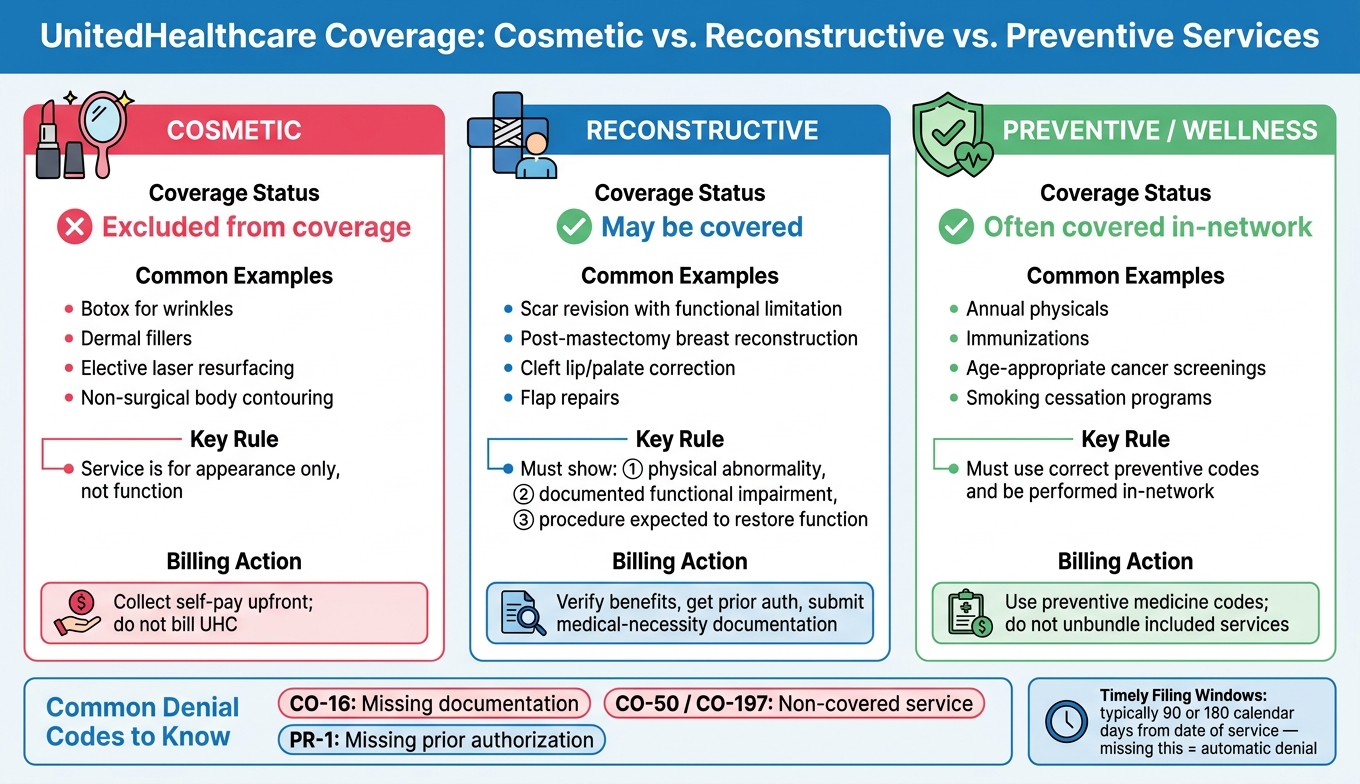
UnitedHealthcare Coverage: Cosmetic vs. Reconstructive vs. Preventive Services
UnitedHealthcare Policy Sources and Payment Rules
Once benefits are verified, the next step is matching the claim to the right UHC policy set. For aesthetics and wellness clinics, that starts with the member’s plan. UnitedHealthcare splits reimbursement rules by product line, so a rule that fits a Commercial plan may not fit a Medicare Advantage or Community Plan (Medicaid) member. UHC keeps separate reimbursement policy libraries for Commercial, Individual Exchange, Medicare Advantage, and Community Plan plans, and each policy spells out which plan types it covers. Individual Exchange plans usually follow Commercial rules unless the plan or contract says otherwise. Some Community Plan policies also note when they do not apply to Community Plan Medicare products and instead point providers to the Medicare Advantage library.
Contracts and state or federal law override reimbursement policies. Your contract and applicable law control.
Core Documents Your Team Should Review
The Care Provider Administrative Guide explains how reimbursement policies work across Commercial, Individual Exchange, and Medicare Advantage plans. That matters a lot for services that are often billed as cosmetic or reconstructive, like eyelid surgery and scar revision. It lays out timely filing rules, claim formats, and payment timeframes, and it directs staff to the online policy libraries where the current rules live.
From there, staff should review the reimbursement policy library that matches the patient’s exact product type before the claim is sent. That’s where they’ll find bundling rules, multiple procedure reductions, and code pair edits.
For services with a cosmetic or reconstructive angle, the Cosmetic and Reconstructive Procedures medical policy is a must-read. The Commercial and Individual Exchange version, Policy MP.007.29, effective January 1, 2025, says that cosmetic procedures are excluded from coverage and that reconstructive procedures must meet all listed criteria to qualify as medically necessary. If the patient is on Community Plan, staff should also check state-specific Community Plan manuals, since some policies point straight to state Medicaid criteria.
That line matters because coverage rules and payment rules are not the same.
Medical Policy vs. Reimbursement Policy
These two document types answer different questions, and mixing them up causes plenty of billing mistakes.
A medical policy answers: Is this service covered? It sets the clinical criteria, including what counts as reconstructive versus cosmetic and what functional impairment must be documented.
A reimbursement policy answers: How will this service be paid? It deals with payment mechanics such as bundling, multiple procedure payment reductions, place-of-service edits, and code pair rules.
Here’s where teams can get tripped up: a blepharoplasty may meet medical-policy criteria for coverage but still be reduced by reimbursement rules if it’s billed with another procedure on the same day. Both checks should happen before submission.
sbb-itb-02f5876
Coverage Rules for Cosmetic, Reconstructive, and Wellness Services
Once you find the right UHC policy, the next step is simple: figure out why the service is being done. Is it for appearance, function, or prevention? That purpose usually drives where the service lands: cosmetic, reconstructive, or preventive/wellness.
When Aesthetic Services Are Typically Not Covered
Across UnitedHealthcare plans, cosmetic procedures are usually excluded when the main goal is to improve appearance and not meaningfully improve function. In plain English, if the service is about looking different rather than fixing a physical problem, it will often be self-pay.
Common examples include Botox for wrinkles, dermal fillers for facial rejuvenation, laser resurfacing for fine lines, and non-surgical body contouring.
That should be addressed early, during intake and financial counseling. Patients need a clear expectation that these services are not usually covered and should be handled as self-pay. Just being upset or distressed about appearance does not turn a cosmetic service into a reconstructive one.
When Reconstructive or Preventive Services May Be Covered
A procedure may be covered when it treats a medical condition or restores function after injury, illness, or a congenital anomaly. UHC generally looks for three things: a physical abnormality, documented functional impairment, and proof that the procedure is expected to restore function.
Examples help here. Scar revision may be covered after trauma if a contracture limits joint movement or prevents eyelid closure. Orthognathic surgery may qualify when chewing or speech is impaired. Breast reconstruction after mastectomy may also be covered.
Breast reconstruction coverage goes further than many people expect. It includes surgery on the opposite breast for symmetry and nipple tattooing under the Women's Health and Cancer Rights Act. And when flap repairs or tissue transfer are involved, UnitedHealthcare requires InterQual CP: Procedures – Tissue Transfer (Flap) criteria to confirm reconstructive need.
Preventive services follow a different route than reconstructive care. In many UnitedHealthcare plans, annual physicals, immunizations, and age-appropriate screenings are covered as preventive benefits with no member cost share when they are billed the right way and done in-network. That means coding matters. Use the proper preventive medicine codes, and bill only what the preventive benefit includes.
Some services tied to smoking cessation or weight management may also be covered if they meet medical necessity rules and fit the member's plan benefits. On the other hand, non-medical spa services such as facials, relaxation massage, and body sculpting are not reimbursed.
Cosmetic vs. Reconstructive vs. Wellness Services: A Quick Comparison
Use the table below to sort services fast during intake and before claim submission.
| Service Category | Common Clinic Examples | Typical Coverage Status | Billing Implications |
|---|---|---|---|
| Cosmetic | Botox for wrinkles; dermal fillers for facial rejuvenation; elective laser resurfacing for fine lines; non-surgical body contouring | Excluded from coverage when done to improve appearance without functional benefit. | Collect self-pay upfront; do not bill as covered. |
| Reconstructive | Scar revision with functional limitation; post-mastectomy breast reconstruction; correction of congenital anomalies such as cleft lip/palate or midface hypoplasia; flap repairs | May be covered when documentation shows functional impairment and the procedure is expected to restore function. | Verify benefits and authorization; submit medical-necessity proof. |
| Preventive / Wellness | Annual physicals; immunizations; age-appropriate cancer screenings; smoking cessation or weight management programs, which can sometimes be facilitated via telehealth | Covered as preventive benefits in many plans when billed correctly and in-network. | Use preventive codes; don't unbundle included services. |
Claim Submission, Coding Checks, and Documentation Requirements
Once you've confirmed coverage, the next hurdle is claim setup. This is where a lot of payments get stuck. UnitedHealthcare uses automated edits to catch billing problems, so even small admin errors can slow payment or lead to a denial.
Claim Fields, Filing Basics, and Common Edits
Use CMS-1500/837P for professional claims and UB-04/837I for facility claims. Claims need to be clean and complete, with the right demographics, member IDs, codes, modifiers, units, service dates, and charges.
Timely filing is a hard cutoff. UnitedHealthcare filing windows depend on the plan and contract, and they are often 90 or 180 calendar days from the date of service. If you need to resubmit, mark the claim as corrected and follow the plan's rules for corrected claims. Miss the filing window, and you'll usually get an administrative denial.
Coding errors are another common problem. UnitedHealthcare applies NCCI edits and its own Smart Edits to spot bundling, mutually exclusive procedures, and invalid code pairings. In aesthetics and wellness settings, this often shows up when bundled injections are billed separately or when pre-op visits are denied under global surgery rules. Modifiers like 59, XE, XP, XS, and XU can support separate payment, but only when they are accurate and backed by the record. Use laterality or staging modifiers when the code set calls for them.
Diagnosis linkage matters just as much. Each procedure line should point to the right diagnosis code. For example, a reconstructive scar revision should link to trauma or functional impairment, not a cosmetic or vague diagnosis. If the diagnosis and procedure don't line up, UHC may deny the claim for lack of medical necessity.
Documentation That Supports Medical Necessity
UnitedHealthcare may ask for records to support medical necessity. Those records must be dated, signed, credentialed, and created at or near the time of service.
For reconstructive care or wellness-related services that could be mistaken for cosmetic work, the chart needs to tell a clear clinical story. That means showing:
- The condition history
- Objective exam findings, such as measurements, photos, or range-of-motion data
- Treatments that were tried and failed
- A direct explanation of how the planned procedure restores function, not appearance
Those same records can also carry a preauthorization request or an appeal. A strong appeal packet usually includes a medical necessity letter, chart notes, test results, photos when appropriate, and the matching UnitedHealthcare policy support.
Claim Element Checks and Documentation Checklist
Use the checklist below before you submit.
| Claim Element | Common UHC Edit/Issue | Prevention Tip |
|---|---|---|
| Member ID / subscriber info | Rejection if ID doesn't match UHC eligibility records | Verify eligibility on the date of service before submission |
| Patient name and date of birth | Rejection trigger before processing for demographic mismatch | Confirm demographics match UHC records at intake |
| Rendering and billing NPI / tax ID | Denial or edit if identifier is missing, invalid, or mismatched | Confirm the correct identifiers for each provider and location |
| CPT/HCPCS code | Edit for invalid, incompatible, or non-covered code | Use valid current codes and confirm the service is covered |
| ICD-10-CM diagnosis code | Denial if code lacks specificity or doesn't support the procedure | Use the most specific code available and confirm diagnosis-to-procedure links |
| Modifiers | Bundling denial if modifier is missing or incorrect | Apply NCCI-compliant modifiers only when services are genuinely distinct |
| Place of service | Edit or denial for POS mismatch with the rendered setting | Confirm the POS code matches where the service was actually performed |
| Units and dates of service | Rejection for inconsistent or missing data | Enter dates in MM/DD/YYYY format and verify units match documentation |
| Authorization number | Denial for missing or expired prior auth | Attach the authorization number when required and track timing carefully |
| Scenario | Required Documentation | When to Submit |
|---|---|---|
| Covered office visit | Signed, dated provider note; chief complaint; exam findings; diagnosis and plan | Retain in EMR; submit only if UHC requests records |
| Reconstructive procedure (preauthorization) | Detailed history; functional impairment description; exam findings with photos or measurements; prior failed treatments; operative plan; relevant diagnostic results | Submit with preauthorization request; retain full chart |
| Cosmetic denial appeal | Physician medical necessity letter; complete clinical notes; photos; prior treatment history; operative report; UHC policy citations supporting coverage | Submit with appeal; include denial notice and claim details |
Prospyr can automate claim creation, flag missing fields, and track filing deadlines.
Billing Terms, Denials, Appeals, and Next Steps for Your Clinic
Key Billing Terms Staff Should Know
After claim submission rules and documentation checks, staff need a shared set of billing terms. If one team member says a service is billable to UHC, another says it goes to patient balance, and a third calls it cosmetic, confusion starts fast. The same language keeps claim handling and patient cost conversations clear.
The main patient-payment terms staff should know are allowed amount, deductible, coinsurance, copayment, and out-of-pocket maximum. The allowed amount is the maximum UHC pays for a covered service under the contract or fee schedule. Once the out-of-pocket maximum is met, the plan will generally pay the allowed amount for covered in-network services.
A non-covered service is a service the plan excludes. In aesthetics and wellness, that often means purely cosmetic injections, elective skin rejuvenation, and other non-medical aesthetic or wellness-only services. Prior authorization (PA) is UnitedHealthcare's pre-approval for certain procedures. It can lower denial risk, but it does not guarantee payment. A corrected claim fixes a technical error on a claim that was already submitted. A reconsideration deals with processing or billing errors. An appeal challenges a clinical or coverage decision.
How to Read Denials and Respond Correctly
Once staff know the terms, the next job is simple in theory but easy to mess up in practice: match the denial to the right response. Here's the rule that matters most: the response must match the denial reason. If it doesn't, payment gets delayed and filing deadlines can slip away.
Common denial codes that help staff sort these issues include CO-16 for a claim that lacks required documentation, CO-50 for a service not covered, PR-1 for missing prior authorization, and CO-197 for a non-covered service.
| Denial Type | Common Codes | Right Response |
|---|---|---|
| Coding, billing, or documentation error | CO-16, modifier issues | Submit a reconsideration or corrected claim, depending on the error |
| Non-covered or excluded service | CO-50, CO-197 | Confirm plan exclusions; bill the patient per financial consent |
| Medical necessity or policy criteria | Medical-necessity denial or policy reference | Reconsideration first, then appeal with full clinical documentation |
| Missing prior authorization | PR-1 | Reconsideration if auth exists but wasn't linked; treat it as preventable if no auth was obtained |
Some denials are a sign to fix and resend. Others are a sign to stop resubmitting and bill the patient, if your consent forms allow it.
For cosmetic exclusions, the right response is usually patient billing, not sending the same claim again and again. A CO-197 denial often confirms the service is excluded under the plan, so the clinic should bill the patient when allowed by consent rules.
A CO-16 denial often means the claim was missing documentation or the documentation was not attached. In that case, the fix is pretty direct: add the chart notes and resubmit.
For medical-necessity denials, UnitedHealthcare will point to a policy number in the denial. Pull that policy, check whether your chart supports each criterion, and build the response around that policy. That's the part many teams skip, and it's often where the case is won or lost.
Conclusion: Key Rules Clinics Should Build Into Daily Workflow
The fastest way to cut UHC denials is to build this review into each visit, not wait until a claim comes back denied. Verify benefits and authorization, classify services the right way, submit clean claims, and route denials by type.
Staff should be fluent in the billing terms above so patient cost conversations stay clear and consistent. Prospyr can support task tracking, claim workflows, and patient communication so nothing falls through the cracks between visits.
FAQs
How do I tell if a service is cosmetic or reconstructive?
Reconstructive services restore body function or fix a deformity caused by injury, disease, trauma, congenital anomalies, infection, burns, or prior medical treatment. Cosmetic procedures are done on body parts that function normally and are meant only to improve appearance.
When classifying a service, focus on whether the record shows a functional problem. That can include pain, limited mobility, or conservative treatment that didn’t work. The documentation should clearly support medical need with specific clinical findings and a clear link between the diagnosis and the treatment plan.
What should I check before submitting a UHC claim?
Before you submit a UnitedHealthcare (UHC) claim, double-check the basics first. Make sure the payer and provider details are correct, including active enrollment, the right billing and rendering provider identifiers, and matching taxonomy or credentials.
You’ll also want to confirm the patient was eligible on the date of service. Check payer order and coordination of benefits (COB), and make sure any prior authorization or referral was in place if needed. On top of that, review the coding, modifiers, and documentation so they support medical necessity.
Then submit a clean claim by UHC’s timely filing deadline, and keep proof of submission.
What do common UHC denial codes mean?
UnitedHealthcare denial codes on your EOB or remittance advice tell you why a claim wasn’t paid and help you figure out the next move: request reconsideration or file a formal appeal.
Common reasons include eligibility issues, prior authorization failures, coding or modifier errors, and timely filing violations. It also helps to check adjustment group codes like PR (patient responsibility) and CO (contractual obligations). Those codes show whether amounts were adjusted for things like deductibles or fee schedules.