

If you run a med spa, the wrong entity setup can create legal and licensing problems fast. In most states, medical services must stay inside a clinician-owned PC or PLLC, while the MSO handles the business side. That split matters more than tax treatment alone.
With the U.S. med spa market above $17 billion and more than 11,000 locations, I’d look at three questions first:
- Who can own the clinical entity?
- Who controls medical decisions?
- What can the MSO do without crossing into medical practice?
Here’s the short version:
- PC: Clinical entity with corporate rules, usually used in stricter states
- PLLC: Clinical entity with LLC-style management, but only in states that allow it
- MSO: Non-clinical company for marketing, staffing, scheduling, tech, leases, and other business functions
The main point is simple: PCs and PLLCs treat patients; MSOs do not. If non-physicians want to join the business, they usually do that through the MSO, not the clinical entity.
What I’d keep in mind right away:
- State law decides whether you can use a PC, a PLLC, or both
- Many states limit clinical ownership to licensed professionals
- The MSA must keep medical control with the clinical entity
- A multi-state med spa often uses one MSO with separate state-level clinical entities
- In California, a PC is the clinical path because PLLCs are not allowed for healthcare services
Quick Comparison
| Entity | Main job | Who owns it | Who controls care | Main use |
|---|---|---|---|---|
| PC | Medical services | Usually licensed physicians or other allowed clinicians | Physician or other licensed owner | Clinical entity in stricter CPOM states |
| PLLC | Medical services | Licensed professionals, if state law allows | Licensed members or medical lead | Clinical entity with more flexible internal setup |
| MSO | Business services | Non-physicians, founders, investors | No clinical control | Non-clinical side of the med spa |
So if you want the plain answer: choose the clinical entity your state allows, keep medical control with licensed professionals, and use the MSO only for non-clinical work. That’s the core rule behind the full comparison below.
sbb-itb-02f5876
PC vs. PLLC: The two main clinical entity options
When a med spa needs a clinical entity, the choice usually comes down to a PC or a PLLC. The job of each is basically the same. The main difference is how state law allows the entity to be owned and run.
Professional Corporation (PC): physician ownership and corporate formalities
A PC is formed under a state's professional corporation statute. In states with strict corporate practice of medicine rules, it is often the required path. Non-physician investors and business partners usually can't own equity in the PC itself.
A PC follows a corporate setup. That means a board of directors, officers, formal bylaws, shareholder meetings, and written resolutions. Medical decisions must stay under physician control. It’s more rigid, yes, but it also makes professional control pretty easy to show on paper.
Taxes work a bit differently too. A PC usually defaults to C corporation status, which can lead to double taxation on profits. Because of that, many small med spa PCs choose S corporation status for pass-through treatment and some payroll tax planning room. In California, there’s even less choice: the state does not allow PLLCs for healthcare services, so a PC is the only compliant clinical entity option.
PLLCs take a looser approach in states that allow them.
Professional Limited Liability Company (PLLC): flexible internal management where permitted
A PLLC is not available everywhere. But where state law allows it, it can fill the same clinical role as a PC. It can hold the medical license, control treatment protocols, and employ providers. The main shift is internal setup: a PLLC runs under an operating agreement instead of corporate bylaws.
That agreement can spell out how decisions get made, how profits are divided, and how members come in or leave. And it does all that without the board structure and yearly meeting rules that come with a corporation. Its default tax treatment is pass-through.
State rules can look very different from one place to the next. For example:
- New York allows professional LLCs for med spa clinical entities, but it requires physician ownership and approval from the Education Department before filing.
- Washington allows physicians, ARNPs, and certain other licensed professionals to co-own a professional corporation or PLLC.
- California does not allow PLLCs for healthcare services at all.
PC vs. PLLC under med spa rules
For med spa compliance, the key point is simple: the difference is about structure, not medical power. No matter which entity you use, it must control medical decisions, set treatment protocols, manage supervision arrangements, and make sure each provider works within their licensed scope.
A PC leans toward formal corporate control. A PLLC gives more room on internal management where state law allows it.
Once the clinical entity is in place, the MSO stays outside medical decision-making and handles non-clinical support.
Where the MSO fits in a PC or PLLC model
MSO basics: non-clinical ownership, services, and limits
An MSO runs the business side of a med spa and does not step into patient care. It handles marketing, scheduling, HR, payroll, leases, equipment, and tech, while physicians or other licensed owners keep control over clinical care. That setup gives non-physicians a way to take part on the business side through the MSO without controlling medical treatment.
That line matters a lot. An MSO cannot set clinical protocols, overrule provider decisions, or direct how licensed staff practice medicine. The split only holds up when the clinical entity and the MSO are connected through a written management agreement.
How the PC/MSO or PLLC/MSO two-entity model works
The management agreement lays out the financial relationship without handing over clinical control. Patients pay the PC or PLLC for medical aesthetic services. The clinical entity then pays the MSO a management fee under a written Management Services Agreement, or MSA, for non-clinical services.
The MSA spells out the relationship, including:
- Which non-clinical services the MSO provides
- How management fees are set
- That the MSO has no power over clinical decisions
States look closely at MSA fees to make sure they reflect fair market value and do not let the MSO control medical decision-making in practice. If a fee drains too much money from the clinical entity, or gives the MSO de facto control, state rules can come into play. That’s why state-specific legal counsel, not a one-size-fits-all template, is the practical place to start when drafting an MSA.
Operations technology in the MSO layer
Tech is one of the clearest things to place in the MSO layer. These workflows are administrative by nature, so keeping them there can help keep day-to-day operations consistent across locations. A HIPAA-compliant platform like Prospyr can centralize scheduling, intake, payments, messaging, analytics, and memberships in the MSO layer, while clinicians keep control over clinical documentation and treatment protocols.
Role-based access should split administrative users from clinical users so the system matches that legal and operational divide.
PC vs. PLLC vs. MSO: side-by-side comparison
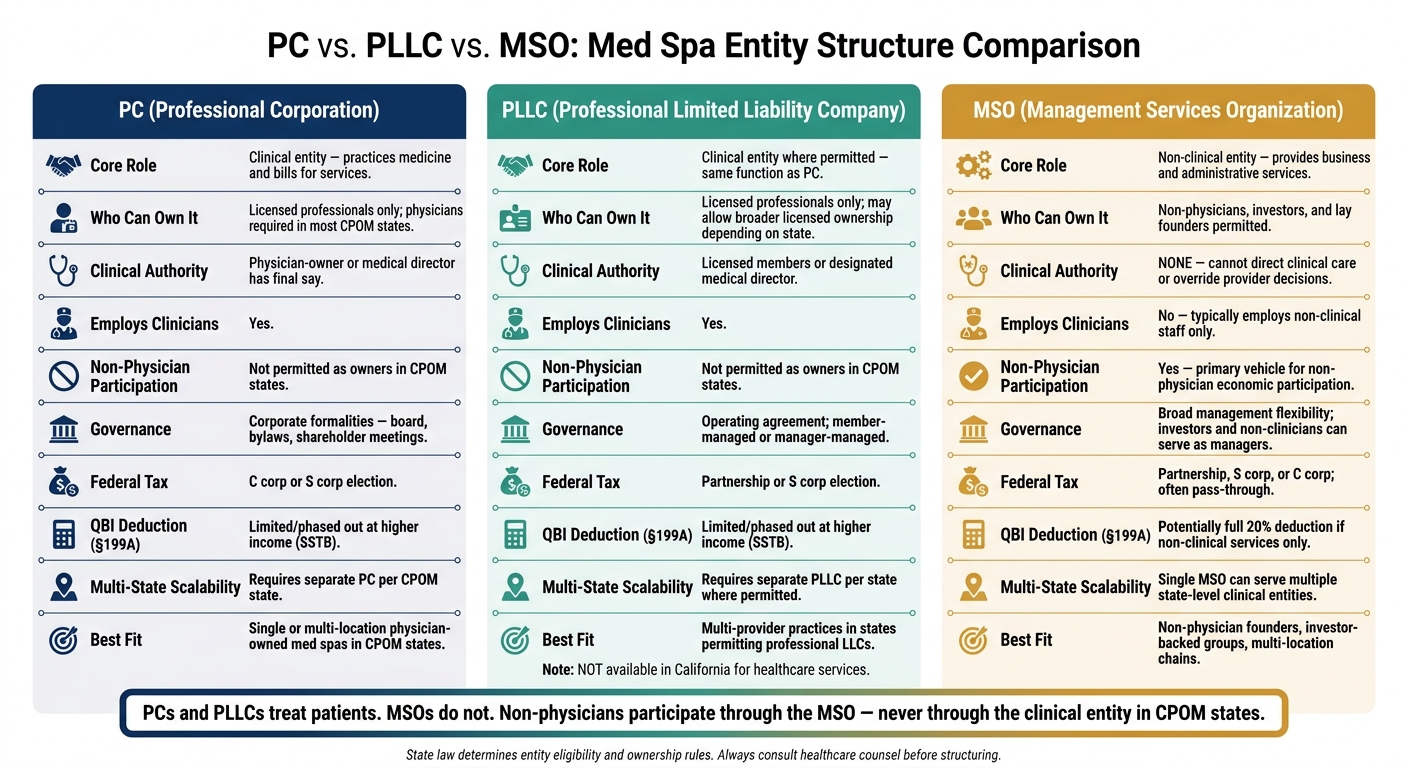
PC vs. PLLC vs. MSO: Med Spa Entity Structure Comparison
Ownership, control, and clinical authority
Once the clinical entity is in place, the next step is sorting out ownership, control, and tax treatment.
A PC or permitted PLLC is the clinical entity. An MSO sits on the non-clinical side of the business.
In states with strict corporate practice of medicine rules, the clinical entity has to be owned and controlled by licensed healthcare professionals, most often physicians. California shows this clearly: the clinical entity must be a physician-owned Professional Corporation, and PLLCs cannot deliver medical services there at all. An MSO is outside those ownership limits because it does not practice medicine.
| Feature | PC | PLLC | MSO |
|---|---|---|---|
| Core role | Clinical entity; practices medicine and bills for services | Clinical entity where permitted; same function as PC | Non-clinical entity; provides business and administrative services |
| Who can own it | Licensed professionals only; physicians required in most CPOM states | Licensed professionals only; may allow more licensed owners, depending on state law | Non-physicians, investors, and lay founders permitted |
| Clinical authority | Physician-owner or medical director has final clinical authority | Licensed members or designated medical director hold final clinical authority | None - cannot direct clinical care or override provider decisions |
| Employs clinicians? | Yes - typically employs or contracts with clinicians, subject to state law | Yes - typically employs or contracts with clinicians, subject to state law | No - should avoid directly employing clinicians; typically employs non-clinical staff |
| Non-physician participation | Not permitted as owners in CPOM states | Not permitted as owners in CPOM states | Yes - primary vehicle for non-physician economic participation |
The big line here is simple: PCs and PLLCs handle medicine; MSOs handle the business side. That split matters because non-physicians can take part in the MSO, but they can't control clinical care in a CPOM state.
Governance, tax treatment, and scalability
The next set of differences shows up in how each entity is run and taxed.
PCs follow standard corporate rules: board meetings, shareholder votes, bylaws, and minutes. If ownership changes, the process has to comply with professional corporation statutes. That can slow things down, but it also keeps clinical control easy to trace.
PLLCs work through an operating agreement instead. That gives licensed members more room in how they divide profits and set up day-to-day management. For a med spa with several licensed co-owners, that can be a better fit.
MSOs, usually set up as standard LLCs or corporations, give the business side much more room to operate. Investors and non-clinicians can serve as managers or directors. The entity can be built for regional growth, capital allocation, and more advanced business planning, so long as it does not cross into clinical decision-making.
PC and PLLC clinical income is often an SSTB under IRC §199A, which can limit the QBI deduction. An MSO limited to management services may avoid that limit.
| Feature | PC | PLLC | MSO |
|---|---|---|---|
| Governance style | Corporate formalities: board, bylaws, shareholder meetings | Operating agreement; member-managed or manager-managed | Broad management flexibility; investors and non-clinicians can serve as managers |
| Federal tax classification | C corp or S corp election | Partnership or S corp election | Partnership, S corp, or C corp; often a pass-through entity |
| QBI deduction (§199A) | Limited/phased out at higher income (SSTB) | Limited/phased out at higher income (SSTB) | Potentially full 20% deduction if non-clinical services only |
| Multi-state scalability | Requires separate PC per CPOM state | Requires separate PLLC per state where permitted | Single MSO can serve multiple state-level clinical entities |
| Best fit | Single or multi-location physician-owned med spas in CPOM states | Multi-provider practices in states permitting professional LLCs | Non-physician founders, investor-backed groups, multi-location chains |
For multi-state med spas, a central MSO can support separate state-level PCs or PLLCs.
That leads straight to the last issue: which setup matches your state rules and your growth plan?
Conclusion: Choosing the right structure for your state and growth plan
The main rule is simple: PCs and PLLCs are the clinical entities, while MSOs handle non-clinical operations under a management agreement. Get that split wrong, and you open the door to compliance risk.
What matters most isn't the label you pick. It's what your state allows. State law determines which entity types you can form and who may own or manage them.
Before you file anything, check:
- entity eligibility
- CPOM limits
- the scope of the management agreement
- tax treatment
- how the setup will scale across states
The same logic applies to technology. A HIPAA-compliant platform like Prospyr fits neatly into the MSO layer, where scheduling, intake, payments, and analytics usually sit. That keeps contracts, costs, and control with the MSO.
Pick the structure your state allows and your growth plan can support. Then have healthcare counsel and a tax advisor review it before launch or restructuring.
FAQs
How do I know if my state requires a PC or allows a PLLC?
Check your state’s Corporate Practice of Medicine rules before you set anything up. These rules change from state to state, so it’s smart to confirm the right entity type for clinical ownership with your state medical board or a qualified healthcare attorney.
In stricter states, a medical practice may need to be formed as a PC or PLLC with physician-only ownership. In other states, the rules may allow different structures. An MSO is a separate entity that manages non-clinical operations.
Can a non-physician own part of a med spa through an MSO?
Yes. In states with Corporate Practice of Medicine rules, a non-physician can own a Management Services Organization (MSO) that runs the non-clinical side of the business, like marketing, billing, payroll, and facility management.
The separate clinical entity - usually a PC or PLLC - must be owned by a licensed physician. That physician keeps full, independent control over clinical decisions and patient care.
What should an MSO management agreement include?
An MSO management agreement should draw a clear line between non-clinical administrative services and clinical authority. That split helps support compliance with state rules and cuts down on confusion about who controls what.
Include:
- The scope of services the MSO will provide
- The PC or PLLC’s exclusive control over medical decisions and clinical staff
- Fair-market-value financial terms, rather than percentage-based revenue sharing
- A structure where patient revenue is paid to the PC first
- Compliance and governance provisions