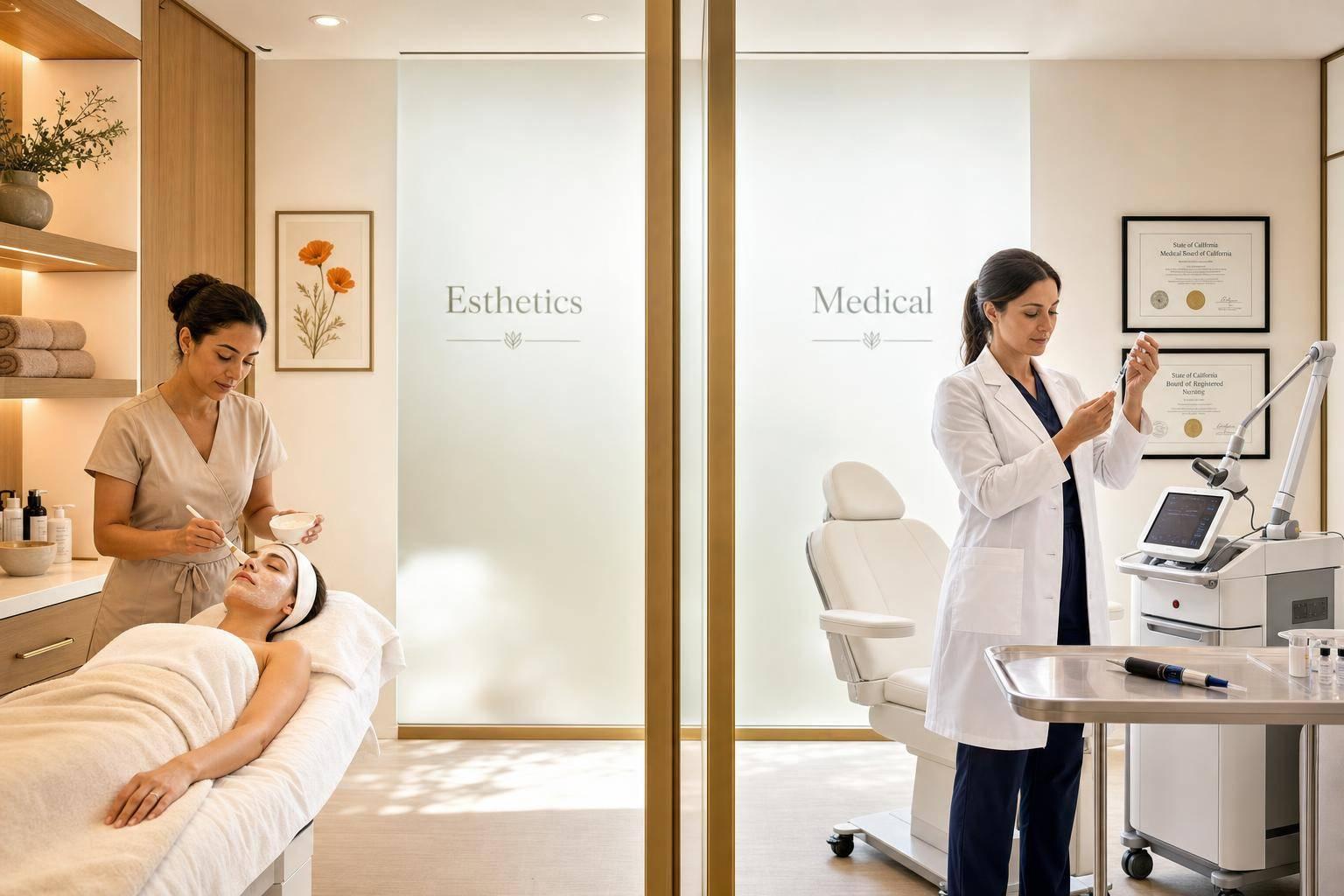

If you run a med spa in California, the short answer is this: estheticians can do only surface-level cosmetic services, not medical treatments.
I’d boil the rule down to four points:
- Estheticians may do facials, waxing, makeup, dermaplaning, and superficial peels limited to the epidermis.
- Estheticians may not do Botox, fillers, lasers, IPL, RF treatments, medical microneedling, or medium/deep peels.
- Medical services need a good-faith exam first by a physician, NP, or PA before first treatment.
- Written orders, protocols, and scheduling controls matter because bad delegation can lead to board complaints, discipline, and patient harm.
One number from the article stands out: 87 California med spa businesses were cited in a statewide inspection effort for possible violations, including unlawful practice of medicine. That tells me this is not a small paperwork issue. It’s a staffing, safety, and compliance issue.
Here’s the simplest way to think about it: if a treatment goes past the epidermis, uses medical judgment, involves prescription products, or uses devices like lasers or injectables, it should not be on an esthetician’s calendar. Internal training, job titles, and standing orders do not change that line.
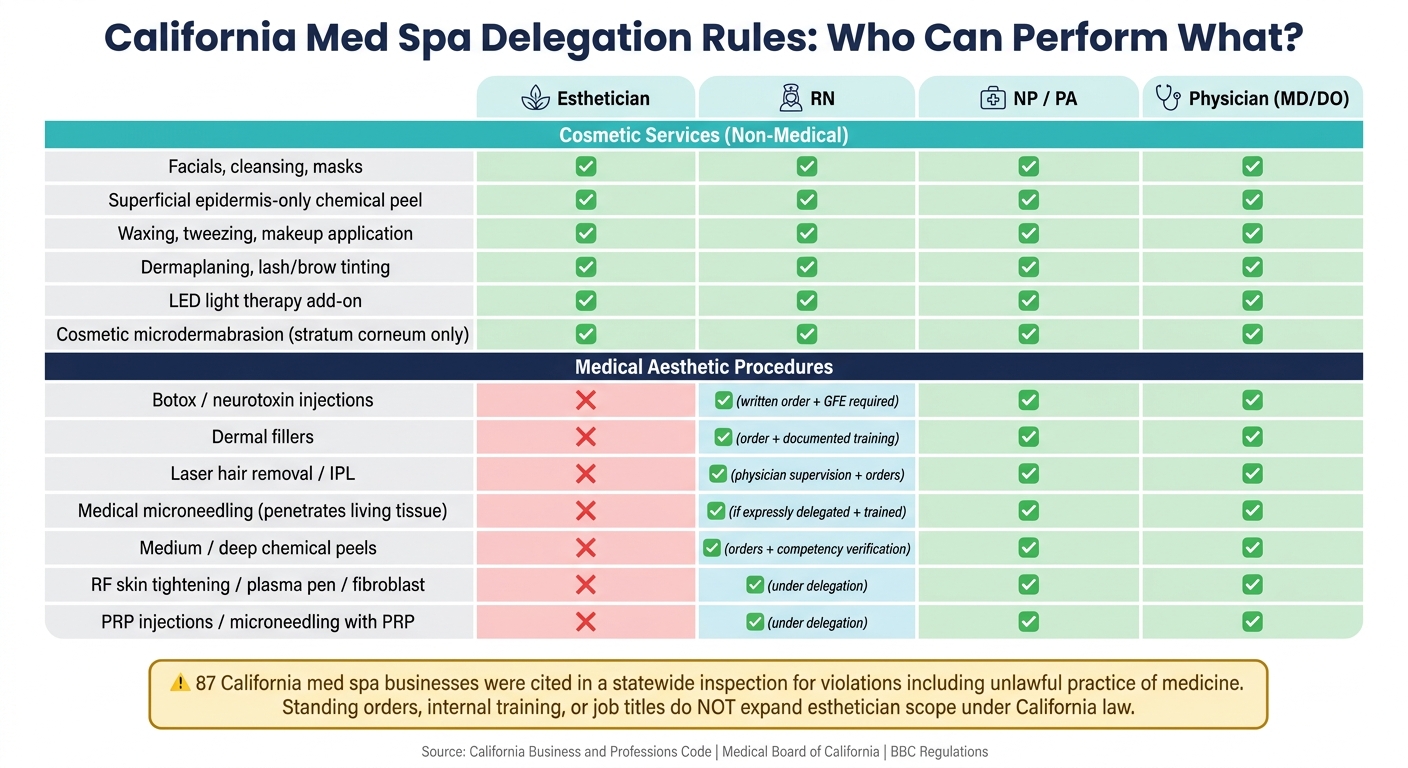
California Med Spa: Who Can Perform What? Esthetician vs. Medical Staff Scope Guide
Quick comparison
| Service type | Esthetician | RN | NP/PA | Physician |
|---|---|---|---|---|
| Facial, waxing, makeup | Yes | Yes | Yes | Yes |
| Superficial epidermis-only peel | Yes | Yes | Yes | Yes |
| Botox or filler | No | Yes, with order/protocol | Yes | Yes |
| Laser or IPL | No | Yes, with supervision/orders | Yes | Yes |
| Medical microneedling | No | Yes, if delegated and trained | Yes | Yes |
| Medium or deep peel | No | Yes, with orders | Yes | Yes |
If I were reviewing a California med spa today, the first things I’d check would be the service menu, staff roles, booking rules, and charting for medical exams and patient-specific orders. Those four areas usually show where delegation problems start.
sbb-itb-02f5876
California Esthetician Scope of Practice and Where It Ends
Services that fall within esthetician scope
In California, esthetics is limited to superficial services on the epidermis. That line matters. It decides whether a med spa can give a task to an esthetician in the first place.
Services that stay within scope include facials, cleansing, manual extractions of comedones, waxing, tweezing, makeup application, and superficial chemical peels that remain within the epidermis. Cosmetic microdermabrasion is allowed only when it stays within the stratum corneum. California has also expanded esthetics scope to include facial dermaplaning and lash and brow tinting and perming, as long as those services stay superficial and non-invasive.
| Esthetician-scope cosmetic services | Medical aesthetic procedures |
|---|---|
| Facial (cleansing, superficial exfoliation, mask, moisturizer) | Microneedling that punctures skin |
| Superficial chemical peel that stays within the epidermis | Medium-depth TCA peel or phenol peel reaching the dermis |
| Cosmetic microdermabrasion limited to the stratum corneum | Laser resurfacing or medical-grade dermabrasion |
| Waxing and tweezing for hair removal | Laser or IPL hair removal |
| Makeup application, LED facials, lash/brow tinting | Botox, dermal fillers, RF skin tightening, or PRP injections |
Services outside esthetician scope in California
Microneedling, derma rolling, and any service that pierces, removes, destroys, or incises tissue beyond the epidermis fall outside esthetician scope. In plain English: the board looks at what the service does to tissue, not what someone calls it on a treatment menu.
Out-of-scope services include microneedling, lasers and IPL, injectables, medium and deep peels, radiofrequency, fibroblast/plasma pen, and lesion removal. That shift matters because once a service is no longer superficial, a different board takes over.
Why board jurisdiction matters
Once a service moves into medical territory, the issue is no longer just scope. The next question is who can legally perform it. California splits oversight between two agencies: the BBC regulates estheticians and cosmetologists, while the Medical Board of California oversees anything that counts as the practice of medicine. That split controls who may perform each service.
Physician ownership, in-house training, or internal job titles do not expand esthetician scope. California also does not recognize a higher esthetician tier with broader scope.
If a service falls under the Medical Board, it belongs in physician, NP, or PA workflows, not esthetician workflows. That line is what drives the delegation rules for physicians, NPs, and PAs.
Who Can Perform Medical Aesthetic Services in a California Med Spa
Physician, NP, and PA roles in treatment decisions
Once a service goes past esthetician scope, the staffing rules change fast. If it’s no longer superficial, it’s no longer part of the esthetician workflow. For medical aesthetic services, the physician still carries responsibility for diagnosis, treatment planning, and patient safety, even if another licensed clinician does the procedure.
NPs and PAs are often the first clinical contact for patients. NPs may perform good-faith exams, prescribe or furnish aesthetic drugs and devices, and build treatment plans within their scope. PAs may also conduct exams, order or prescribe treatments, and perform aesthetic procedures under a written practice agreement.
Physicians may direct RNs or PAs to inject Botox with supervision. Estheticians and medical assistants may not do that work.
How delegation works for medical services
Delegation in a California med spa isn’t casual. It begins before the patient ever gets to the treatment chair.
Every new medical aesthetic patient must receive a good-faith exam (GFE) from an authorized prescriber - a physician, NP, or PA - before the first treatment. That exam covers medical history, medications, allergies, contraindications, and whether the patient is a fit for the service. RNs and estheticians cannot perform GFEs or set treatment plans on their own.
After the exam, the prescriber must issue a written patient-specific order. That order should spell out the procedure, product, dose, treatment area, and frequency. For RNs, California also requires written standardized procedures that define what they may do, when they may do it, and when they must escalate the case to the prescriber. Competency should be documented through training logs or privileging files. It should never be assumed just because someone holds a license.
Written protocols should also lay out what happens if something goes wrong, including escalation steps for issues like vascular occlusion or laser burns.
Which provider types may perform common procedures
Use the chart below as the default staffing map for medical aesthetic services.
| Procedure | Physician (MD/DO) | NP | PA | RN | Esthetician |
|---|---|---|---|---|---|
| Botox / neurotoxin injections | Yes | Yes | Yes | Yes, under written patient-specific order or standardized procedures after GFE | No |
| Dermal fillers | Yes | Yes | Yes | Yes, under order with documented training | No |
| Laser hair removal / IPL | Yes | Yes | Yes | Yes, under physician supervision and appropriate orders | No |
| Medical microneedling that penetrates living tissue | Yes | Yes | Yes | Yes, when expressly delegated and trained | No |
| Medium/deep chemical peels | Yes | Yes | Yes | Yes, under orders with competency verification | No |
| Superficial cosmetic peels / basic facials | Yes | Yes | Yes | Yes | Yes, within esthetician scope only |
The pattern here is pretty clear: estheticians may only perform services that stay inside their non-medical, epidermal-level scope. If a med spa delegates lasers, injectables, or medium or deep chemical peels to an esthetician, it creates unlicensed-practice risk.
Those role limits need to show up in standing orders, service menus, and written job rules.
Standing Orders, Service Menus, and Written Role Rules
How to use standing orders and protocols correctly
Once you assign each service to the right provider, put that line in writing through standing orders and protocols. That matters because standing orders and protocols govern medical staff only. They do not expand an esthetician’s scope. A standing order sets what an RN, NP, or PA may do within that person’s own scope, under the right supervision or standardized procedure.
For a California med spa, every compliant protocol needs a few core parts. It should spell out:
- Indications for treatment
- Contraindications, such as pregnancy, anticoagulant use, active infection, or recent isotretinoin use
- Documentation rules, including informed consent and lot numbers for injectables
- An emergency response plan for events like anaphylaxis, lidocaine toxicity, vascular occlusion with fillers, or burns from energy devices
Each protocol also needs to name the provider types allowed to perform the service - physician, NP, PA, or RN under supervision - and make clear that estheticians are limited to non-medical tasks. Periodic physician review helps keep those protocols in line with California rules.
How to build a compliant California service menu
Your service menu isn’t just a marketing page. It’s a compliance document and a booking control. It should label each service as medical or cosmetic, name the allowed provider, and state the exam or protocol needed before the patient is ever booked.
A simple way to do this is to split the menu into two sections. One section covers Esthetician Services, such as facials, superficial peels on the epidermis, dermaplaning, waxing, and non-medical LED add-ons. The other covers Medical Aesthetic Services, such as injectables, lasers, IPL, medium or deep chemical peels, and microneedling. Also, don’t let brand names blur the line. If you use a brand name, pair it with a plain-language technical descriptor so the actual procedure is always clear.
| Service | Medical vs. Cosmetic | Authorized Providers | Required Exam or Protocol |
|---|---|---|---|
| Hydrating facial | Cosmetic | Esthetician | No medical exam; standard spa protocol |
| Superficial enzyme peel | Cosmetic | Esthetician | Skin analysis by esthetician; cosmetic peel protocol |
| Medium-depth TCA chemical peel | Medical | Physician, NP, PA, RN (under supervision) | Pre-treatment medical exam; chemical peel protocol with indications, contraindications, and emergency plan |
| Botulinum toxin injections | Medical | Physician, NP, PA, RN (per delegation rules) | Provider exam and treatment plan; neuromodulator standing order; informed consent |
| Hyaluronic acid filler – lips | Medical | Physician, NP, PA, RN (under supervision) | Focused exam; filler protocol including vascular occlusion response; consent and photo documentation |
| IPL for photorejuvenation | Medical | Physician, NP, PA, RN (under supervision) | Medical assessment of skin type and lesions; IPL protocol; emergency response instructions |
| LED light therapy add-on | Cosmetic | Esthetician | Cosmetic protocol; no medical diagnosis implied |
| Microneedling with PRP | Medical | Physician, NP, PA, RN | Medical exam; microneedling/PRP protocol; infection control procedures |
| Post-procedure soothing facial | Cosmetic | Esthetician (after medical clearance) | Medical provider determines timing; cosmetic protocol only |
Your scheduling system should mirror that setup. Prospyr lets clinics tag each service as medical or cosmetic, connect it to the right protocol, and limit booking to the right provider types. That means front desk staff can’t accidentally drop a laser treatment onto an esthetician’s calendar.
Once the menu draws the line, written role descriptions help make sure staff don’t step over it.
Written role descriptions that prevent scope drift
Scope drift usually doesn’t happen with one big decision. It slips in through small habits - an esthetician who starts by helping set up for a laser case, or a medical assistant who begins giving clinical advice. Written role descriptions help stop that slide early.
Each role description should state three things: what the person may do, what the person may not do, and what level of supervision the role requires. For estheticians, allowed support tasks include room setup, stocking nonprescription products, non-medical skin cleansing, comfort support, and non-medical home-care instructions.
A delegation matrix can make those lines much easier to train on and review. Think of it as a simple table: roles across the top, common tasks down the side, and each box showing whether that role may perform the task, may assist, or is not allowed to do it. Use that matrix during onboarding, annual training, and performance reviews so scheduling and task assignment stay in step. Those written rules then need to show up in day-to-day practice through scheduling controls, staff training, and audits.
Steps to Reduce Delegation Risk in California Med Spas
Fix common problem areas before they trigger complaints
A lot of complaints start with a simple labeling mistake.
When a medical service is listed or scheduled as a facial, the risk goes up fast. Menu names like “collagen induction facial” or “skin renewal treatment” can blur what the service actually is. And when the medical part is hidden, that can lead to complaints about unlicensed practice and misleading advertising.
A statewide inspection campaign cited 87 med spa businesses for potential violations, including unlawful practice of medicine. One case involved a licensed esthetician providing cosmetic injections that led to MRSA infection, sepsis, and hospitalization, followed by license revocations and emergency enforcement action.
In many clinics, the root issue is pretty plain: unclear menus, staff who were not trained on scope, and scheduling setups with no guardrails. Here are some of the most common weak spots and how to fix them.
| Problem | Fix |
|---|---|
| Estheticians booked for microneedling | Classify microneedling as a medical procedure in writing; revise the menu to place it under medical aesthetic services; restrict booking to physicians, NPs, and PAs; retrain front desk and estheticians on scope |
| Estheticians assigned to laser, IPL, or RF services | Remove lasers, IPL, and RF from any facial category; label services so the authorized provider type is clear; add hard stops in the scheduling system |
| Hybrid names that hide medical components | Use plain-language descriptions that identify the procedure and the required provider, such as "Microneedling with PRP - NP/PA only"; update marketing materials to match |
| No written scope policy | Adopt a written policy stating that estheticians are limited to the non-invasive cosmetic scope allowed under California law |
| Infrequent retraining | Hold quarterly scope reviews with competency checklists; document attendance |
Once the menu and role chart are clear, the next pressure point is day-to-day scheduling and treatment assignment.
Use systems to enforce provider-specific workflows
Written policies matter. But on their own, they’re not enough.
If the booking system lets the wrong person get assigned to the wrong service, the policy won’t stop much. That’s why role-based scheduling works so well. Each staff member gets a role, and each service is tied to the roles allowed to perform it.
In practice, that means medical services should only be bookable for the licensed medical providers who are allowed to do them. Hard stops should block staff from saving an appointment when the selected provider is not authorized. Regular audits of appointment data can then show whether the rules are working and help spot scope drift early.
This is where workflow controls do the heavy lifting. Prospyr can enforce role-based scheduling, intake routing, and protocol-linked documentation for aesthetics and wellness clinics.
Conclusion: Clear boundaries protect patients and the business
Under California law, microneedling, laser and IPL treatments, injectables, and medium or deep chemical peels are medical procedures. Standing orders or internal policies do not change that. The Medical Board of California also makes clear that unlicensed personnel, including estheticians, may not legally perform these services.
The path forward is straightforward: keep service menus accurate, define roles in writing, set role-based scheduling rules, and tie documentation workflows to EMR-linked protocols. Those guardrails help protect patients and help the business avoid complaints, investigations, and enforcement actions.
FAQs
Can estheticians ever perform microneedling in California?
No. In California, estheticians are limited to superficial, non-medical skin services, such as facials and microdermabrasion. They can't legally perform microneedling.
Microneedling is considered a medical practice. It must be performed under a signed order from a physician (MD or DO), or from an NP or PA working under delegation rules.
Who must complete the good-faith exam before treatment?
In California, the Good Faith Exam has to be done by a physician, nurse practitioner, or physician assistant before a patient gets their first treatment.
That also means registered nurses and estheticians can't handle this first assessment.
How can a med spa prevent illegal delegation?
Assign each task only to staff who hold the proper California license. For example, estheticians should handle superficial services only. On top of that, require written, procedure-specific physician authorization that spells out the allowed tasks, supervision rules, and when the case must be escalated.
You’ll also want patient-specific prescriber orders whenever California law calls for them. Before any delegated care takes place, a qualified prescriber should complete a good-faith exam. And the paper trail matters just as much as the care itself: keep clear, auditable records of staff credentials, procedures performed, and license or authorization renewals.