
Navigating state licensing for aesthetic clinics can feel complex, but it boils down to understanding three key areas: state-specific regulations, practitioner credentials, and facility requirements. Each state has unique rules for medical aesthetics, which impact ownership structures, permitted treatments, and supervision protocols. Here's what you need to know:
- Identify the Right Licensing Board: Depending on your services, you may need to comply with medical, nursing, or cosmetology boards. For example, Botox and laser treatments fall under medical board oversight, while facials and waxing are regulated by cosmetology boards.
- Understand Licensing for Services: Advanced procedures like injectables and lasers require medical oversight, while basic skincare can be performed with an esthetician license. Some states enforce strict ownership laws, allowing only physicians to own medical spas.
- Verify Practitioner Credentials: Ensure every team member is trained and licensed for their role. RNs, NPs, and PAs often need documented training for injectables and lasers, while estheticians are limited to non-medical procedures.
- Meet Business and Facility Standards: Clinics must comply with zoning laws, medical waste disposal, and facility-specific permits. States like Texas and California require additional steps, such as appointing a Laser Safety Officer or meeting Corporate Practice of Medicine (CPOM) rules.
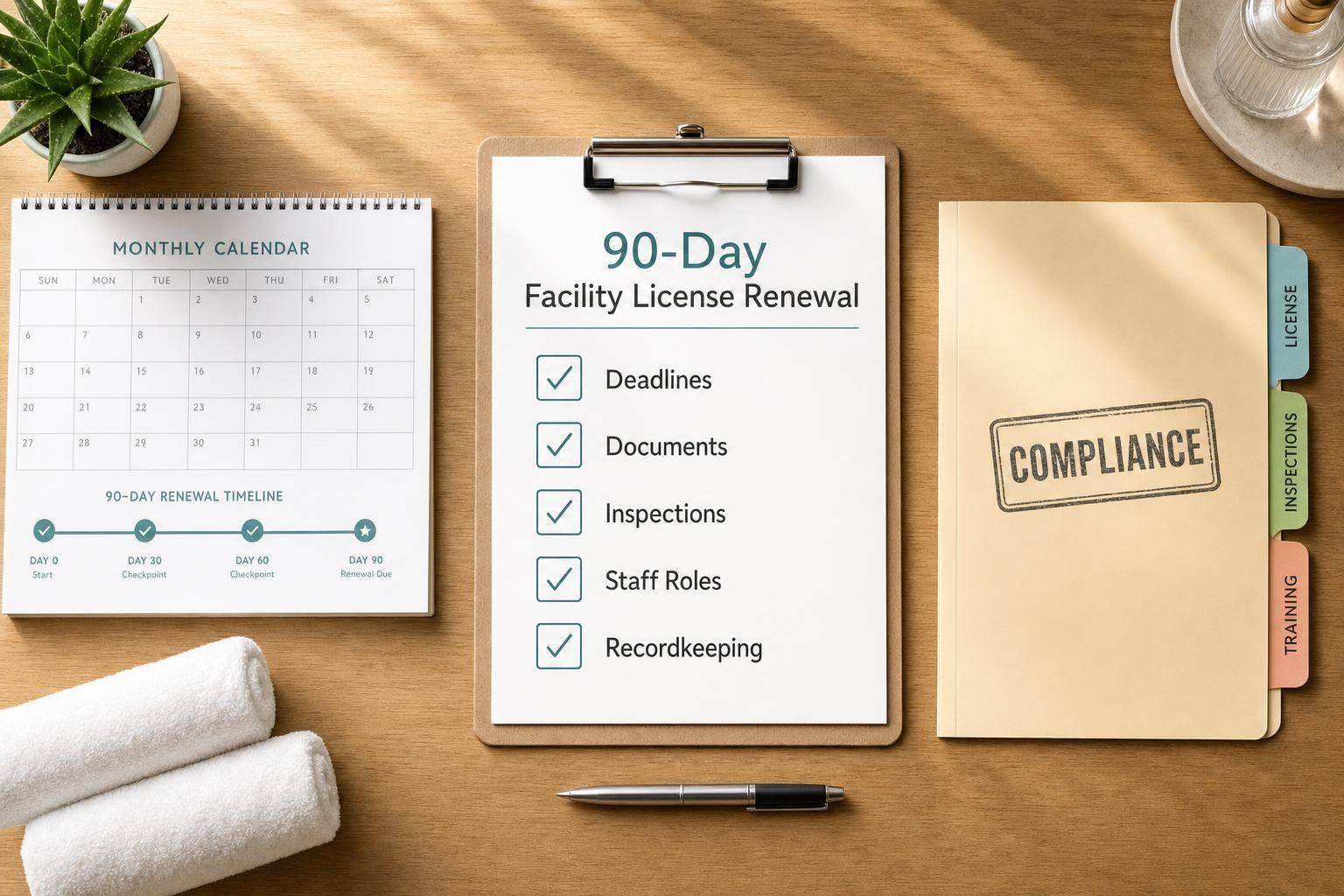
- Stay on Top of Renewals: Licenses, DEA registrations, and permits have varying renewal schedules, often requiring annual or biennial updates.
Pro Tip: Noncompliance can result in fines, license revocation, or even clinic closures. Use tools like compliance software to track deadlines and organize records.
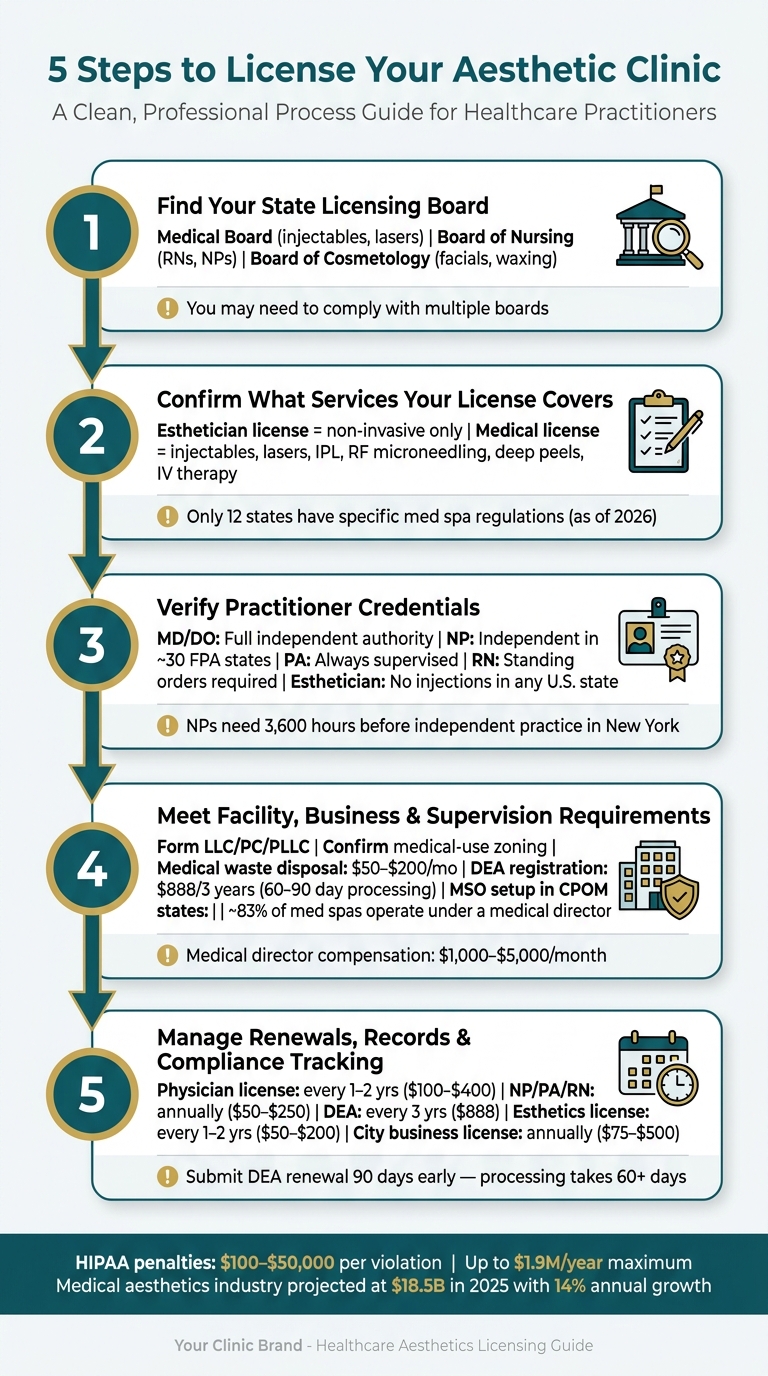
5-Step State Licensing Guide for Aesthetic Clinics
Step 1: Find the State Board That Governs Aesthetic Licensing
Many new clinic owners assume that a single agency oversees all aesthetic licensing. However, in most states, licensing responsibilities are split among several boards depending on the treatments you plan to offer.
How to Find Your State Licensing Board
The type of services your clinic provides will determine which board regulates your operations. For example:
- State Medical Boards handle medical procedures like injectables and Class IV laser treatments.
- Boards of Nursing oversee the scope of practice for registered nurses (RNs) and nurse practitioners (NPs).
- Boards of Cosmetology govern non-invasive services such as facials and waxing.
If your med spa offers a mix of these services, you may need to comply with the rules of multiple boards.
To locate the appropriate board, visit your state's official .gov website and search for terms like "Board of Medicine" or "Board of Cosmetology." For esthetician-specific licensing, the Associated Skin Care Professionals (ASCP) State Board Directory is a great resource, providing contact details and links for all 50 states. If your business will operate in more than one state, the National-Interstate Council of State Boards of Cosmetology can help you navigate multi-state regulations.
| State | Medical Board | Cosmetology Board |
|---|---|---|
| California | CA Medical Board | CA Board of Barbering & Cosmetology (barbercosmo.ca.gov) |
| Texas | TX Medical Board | TX Dept. of Licensing & Regulation (tdlr.texas.gov) |
| Florida | FL Board of Medicine | FL Board of Cosmetology (myfloridalicense.com) |
| New York | NY Office of the Professions | NY Dept. of State (dos.ny.gov) |
| Georgia | GA Composite Medical Board | GA State Board of Cosmetologists (sos.ga.gov) |
Finding the right board is a crucial first step toward ensuring your clinic operates within legal and regulatory guidelines.
"Regulations change frequently. Verify current requirements with your state's medical board and board of nursing before making compliance decisions." - Med Spa Standards
Once you’ve identified the appropriate board, the next step is determining the specific license your clinic will need.
What Type of License You Need
The license required for your clinic depends entirely on the services you plan to offer. For basic skincare treatments like facials, waxing, or simple chemical peels, a cosmetology or esthetician license will usually suffice. Some states, such as Washington, Utah, and Virginia, even offer a "Master Esthetician" license, which allows for more advanced procedures under supervision.
For medical treatments like injectables or laser therapies, a license regulated by the medical board is necessary. In addition, the ownership structure of your business can play a big role. As of 2026, only 12 states have specific regulations for medical spas. In other states, rules are governed by existing medical, nursing, and cosmetology laws.
Also, don’t overlook your state’s Corporate Practice of Medicine (CPOM) doctrine. In strict CPOM states like New York and California, only physicians can own medical entities, which must be structured as a Professional Corporation (PC) or Professional Limited Liability Company (PLLC). In less restrictive states like Arizona, ownership can be more flexible, as long as licensed providers retain control over clinical decisions. Be sure to confirm your state’s CPOM rules before filing any business paperwork.
sbb-itb-02f5876
Step 2: Confirm What Services Your License Covers
Once you’ve identified the board that governs your clinic, the next step is to align your planned services with your existing licenses. Making assumptions about what your license permits can put your practice at risk. Let’s break down the specific limitations tied to each type of license.
Services Allowed Under an Esthetician License
An esthetician license typically permits non-invasive treatments that don’t require physician involvement. Knowing these boundaries is essential to avoid stepping outside the law.
For example, using an FDA-classified prescription device, like a Class IV laser, requires physician supervision. Many states provide resources like Treatment Delegation Tables or scope-of-practice trees to outline what’s legally allowed. The American Med Spa Association (AmSpa) also tracks 21 procedures across six professional titles, offering a helpful guide to confirm what your license covers.
If you plan to offer services beyond what your esthetician license allows, you’ll need to implement additional safety measures and ensure oversight by licensed professionals.
Medical Procedures That Require Supervision
Certain medical procedures demand direct clinical oversight due to their classification as medical practices. These include:
- Neuromodulators (e.g., Botox)
- Dermal fillers
- Laser hair removal
- IPL (Intense Pulsed Light)
- RF microneedling
- Deep chemical peels
- IV therapy
- Body contouring
Each of these treatments requires documented supervision. Below is a summary of key requirements for performing aesthetic procedures in some major states:
| State | Who Can Inject (Botox/Fillers) | Laser Oversight Requirements |
|---|---|---|
| California | MD, DO, NP, PA; RN under physician order | Physician oversight; Cal/OSHA safety program required |
| Texas | MD, DO, NP, PA; RN/LVN under delegation | Laser Safety Officer required; Class IV facility registration with DSHS |
| Florida | MD, DO, ARNP, PA; RN under standing orders | Medical supervision and laser safety training required |
| New York | MD, DO, NP, PA; RN under written orders | Physician oversight required for all energy-based procedures |
| Arizona | MD, DO, NP, PA; RN under protocol | OSHA standards apply; NPs can practice independently |
In most states, a physician, nurse practitioner (NP), or physician assistant (PA) must conduct an initial Good Faith Exam before delegating procedures. Clinics often use digital intake forms to streamline this documentation and ensure all legal requirements are met. Additionally, the Medical Director is responsible for issuing standing orders and reviewing 10–20% of patient charts periodically.
"Allowing a person to exceed their legal scope of practice could result in disciplinary action against the medical director, the supervisor, and the individual performing a task they are not licensed to perform." - Washington State Department of Health
Between 2024 and 2026, state boards in California, Texas, and New York notably increased disciplinary actions against clinics with "ghost" medical directors - those who sign off on paperwork but fail to provide actual oversight. Active, documented supervision isn’t just a legal box to check - it protects both the clinic and its patients.
Step 3: Check Practitioner Credentials and Training Requirements
After determining your board and service coverage, the next step is to confirm that every team member has the necessary credentials for their treatments. Proper qualifications are not just about compliance with state licensing laws - they're also essential for ensuring patient safety.
Education and Exam Requirements by Role
Licensing requirements vary depending on the role within an aesthetic clinic, and understanding these distinctions is key.
Physicians (MD/DO) have full authority to prescribe and administer treatments. They often act as the medical director, overseeing clinical protocols and staff training. In some states, like Rhode Island, medical directors must document additional training in cosmetic procedures beyond their general medical education.
Nurse Practitioners (NPs) can prescribe and administer injectables independently in approximately 30 states and Washington, D.C., where they have full practice authority. However, in states such as Florida, Texas, and Georgia, NPs must work under a collaborative agreement with a physician. In New York, NPs must complete 3,600 hours of qualifying practice before they can practice independently. Some states, including Michigan, Alabama, Louisiana, South Carolina, and Wisconsin, recently expanded NP practice authority, so it’s important to stay updated on current regulations.
Registered Nurses (RNs) are permitted to administer injectables like Botox, but they must operate under physician standing orders or delegation. For example, North Dakota requires RNs to demonstrate evidence of comprehensive, specialized, and accredited training before performing aesthetic injections.
"An RN, with evidence of comprehensive, specialized, and accredited training; certification and competencies may inject FDA-approved aesthetic agents." - North Dakota Board of Nursing
"Estheticians and medical assistants cannot legally inject Botox® in any U.S. state." - IAPAM
Although some states, such as Nevada, recognize "Advanced Estheticians" who can perform treatments like microneedling under specific conditions, injecting prescription drugs remains prohibited across the board.
| Role | Injection Authority | Supervision Required |
|---|---|---|
| MD / DO | Full, independent | None |
| NP | Independent (~30 FPA states) | Varies by state |
| PA | Delegated authority | Always (direct or general) |
| RN | Authorized via standing orders | Always |
| Esthetician | Prohibited | N/A for medical procedures |
These foundational requirements often serve as the baseline for further specialized certifications.
Advanced Certifications for Specific Treatments
In addition to basic licensure, advanced training is often necessary for certain aesthetic procedures. This can be a legal requirement or a stipulation from malpractice insurance providers.
For laser procedures, the operation of Class IV lasers typically requires at least RN-level licensure along with device-specific training. Texas mandates that clinics using Class IV lasers designate a Laser Safety Officer (LSO) and register the facility with the Department of State Health Services (DSHS). Rhode Island's Medical Spas Safety Act takes it a step further, prohibiting the delegation of ablative laser procedures, which must be performed solely by a physician, PA, or certified nurse practitioner.
"Procedures involving ablative lasers or ablative energy devices must be performed exclusively by a physician, PA, or certified nurse practitioner and cannot be delegated." - Rhode Island Medical Spas Safety Act
For injectables, training courses often provide between 8 and 20 CME/CE credits. While not always required by law, hands-on training with live patients is considered the industry standard and is often necessary for malpractice insurance coverage. Nurses can also pursue specialized credentials, such as the Certified Aesthetic Nurse Specialist (CANS) designation, which some state boards recognize as evidence of accredited training.
To stay compliant, maintain a training portfolio for each practitioner. This should include copies of CME/CE certificates, records of supervised clinical hours, and competency assessments. Proper documentation is critical for addressing any inquiries from state boards or auditors.
Step 4: Meet Facility, Business, and Supervision Requirements
Setting up your clinic isn’t just about hiring the right staff - it’s about ensuring your business structure, facility, and supervision practices align with legal standards. Licensing your team is only part of the process; your clinic must also meet specific registration, permit, and oversight requirements.
How to Get Your Business and Facility Licenses
Start by forming your legal entity, such as an LLC, Corporation, or PC/PLLC, through your state’s Secretary of State. Next, obtain a general business license from your local city or county. Fees for these licenses typically range from $50 to $500 annually. It’s also crucial to confirm that your chosen location is zoned for "medical use" rather than "personal services." Why does this matter? Some retail leases exclude medical tenants, and reclassifying a Certificate of Occupancy after construction can be far more expensive than securing pre-lease approval.
In addition to basic registration, you may need specialized permits. For example:
- Clinics generating regulated medical waste (like sharps or blood-soaked materials) must register with state environmental or health agencies and arrange for disposal through licensed providers like Stericycle. Expect monthly costs between $50 and $200.
- If you plan to use Class IV lasers, states such as Texas require facility registration with the Department of State Health Services (DSHS) and the appointment of a Laser Safety Officer (LSO).
- Clinics handling controlled substances, such as testosterone or ketamine, must secure a DEA registration, which costs $888 for a three-year term and takes 60–90 days to process. In stricter CPOM (Corporate Practice of Medicine) states, you’ll also need to establish an MSO (Management Services Organization) structure, which can cost $5,000–$20,000.
For CPOM states like California, New York, and Texas, non-physicians cannot directly own a medical practice. Instead, a physician-owned Professional Corporation must handle clinical services, while the MSO manages operations. In less restrictive states like Arizona, a standard LLC or PLLC may suffice. Setting up your clinic incorrectly could lead to severe consequences, including closure.
Once your facility is properly licensed, you’ll need to implement a compliant supervision model to ensure ongoing legal and clinical adherence.
When You Need a Medical Director or Physician Oversight
In addition to facility permits, proper clinical oversight is critical for safe operations. Procedures like Botox, dermal fillers, and medical-grade laser treatments are considered medical practices in nearly all states. Because of this, around 83% of U.S. med spas operate under a medical director. Operating without appropriate oversight is one of the most common reasons state medical boards take enforcement action against med spas.
Having a medical director isn’t just about listing a physician’s name on paperwork. The role involves active participation, including:
- Developing and signing written treatment protocols (SOPs) for every procedure
- Issuing standing orders that allow clinical staff to treat patients in the director’s absence
- Being available - either on-site or by phone - during operating hours, as required by state law
Ongoing compliance also involves periodic chart reviews. Compensation for medical directors typically ranges from $1,000 to $5,000 per month, depending on their level of involvement and the state.
"The medical director is not a figurehead: the physician must be in good standing with the state medical board, carry medical malpractice insurance, establish and sign standing orders and clinical protocols, and be reachable for emergencies during operating hours." - Pulse RevOps
State medical boards are cracking down on "ghost director" arrangements, where a physician is paid but provides no real oversight or chart reviews. Recent investigations in states like Florida, California, and New York (2025–2026) led to dozens of clinic closures due to improper medical director setups. To avoid these issues, ensure you have a detailed written agreement outlining responsibilities, chart review schedules, and on-call requirements. This step is essential for staying compliant and protecting your practice.
Step 5: Manage License Renewals, Records, and Compliance Tracking
Once your clinic is licensed and operational, staying on top of renewals and records is crucial to avoid compliance issues. Letting a license lapse could lead to inspections or, worse, a temporary shutdown. The key is to keep everything current, organized, and ready for audits.
License Renewal Schedules and Fees
Renewal schedules can be tricky because different licenses follow different timelines. For instance:
- Physician licenses: Renew every 1–2 years, costing $100–$400 annually.
- NP, PA, and RN licenses: Typically require renewal every year, ranging from $50–$250.
- DEA registrations: Renew every three years at $888 per renewal. Since processing can take over 60 days, it's best to submit your renewal at least 90 days before it expires.
- Esthetics establishment licenses: Renew every 1–2 years, with costs between $50–$200.
- City business licenses: Usually renewed annually, costing anywhere from $75–$500.
And don’t forget about federal requirements. These don’t align with state renewal calendars. For example, OSHA Bloodborne Pathogens training and HIPAA security risk assessments are required annually, regardless of your state’s schedule. To stay ahead, plan time for both reviews and payments.
Recordkeeping Best Practices
Strong recordkeeping is essential for compliance and audit readiness. Without organized documentation, your clinic could face unnecessary risks. Keep critical documents like the OSHA Exposure Control Plan, HIPAA Notice of Privacy Practices, and Business Associate Agreements (BAAs) stored separately and updated regularly.
"If you're running a med spa without standard operating procedures, you're running on borrowed time." - MedSpa Standards
Here are a few recordkeeping tips to make life easier:
- Photo release forms: Always keep these separate from general treatment consent forms. Specify exactly how and where images will be used.
- Standard Operating Procedures (SOPs): Ensure these are reviewed and signed by your medical director. Keep them accessible for staff.
- License verifications: Use official state board portals to verify practitioner licenses. A physical certificate may not reveal restrictions or other important details.
These habits help protect your clinic and keep you prepared for any compliance checks.
Tools to Help You Track Compliance
Managing renewals and records manually can get overwhelming, so consider using automated tools to streamline the process. For example, Prospyr centralizes compliance tasks, automates reminders, and organizes license tracking. It even lets you assign renewal deadlines to specific team members, so everyone knows their responsibilities.
The most effective systems combine automated reminders at 90, 60, and 30 days before deadlines with a centralized database. This database should include license numbers, expiration dates, portal URLs, and uploaded confirmation documents. Whether you use a dedicated tool or integrate this into your existing practice management software, the goal is to have full visibility before any inspection knocks on your door.
Conclusion: Keep Your Clinic Compliant and Ready to Grow
State licensing isn’t just a box to check - it’s an ongoing responsibility that safeguards your clinic, your team, and your patients. From identifying the correct state board in Step 1 to staying on top of renewals and keeping records organized in Step 5, every step plays a role in maintaining compliance.
Consider this: HIPAA penalties alone can range from $100 to $50,000 per violation, with a maximum of $1.9 million per year. On top of that, state boards in New York, Texas, and California have significantly increased disciplinary actions against medical directors and clinic owners between 2024 and 2026. With shifting regulations around GLP-1 prescribing, telehealth exams, and nurse practitioner authority, staying informed isn’t optional - it’s essential to keep your clinic running smoothly.
"Maintaining thorough medical and business records as well as conducting regular practice audits can further safeguard the MedSpa from regulatory risk and supports consistent, high-quality patient experiences." - Sheppard, Mullin, Richter & Hampton LLP
But compliance isn’t just about avoiding penalties - it’s also about setting the stage for growth. The medical aesthetics industry is thriving, with revenue projected to hit $18.5 billion in 2025 and an annual growth rate of 14%. A clinic with a solid compliance framework is better positioned to scale. Tools like Prospyr can help streamline your compliance efforts by centralizing records, automating reminders, and ensuring HIPAA standards are met, allowing your practice to focus on growth.
Compliance isn’t just a requirement - it’s the foundation for building a thriving, scalable practice.
FAQs
Do I need a medical director to open a med spa in my state?
In many states, a physician medical director must legally oversee a med spa. This is because treatments like Botox and laser procedures are considered medical practices. The medical director is responsible for supervising treatment protocols, overseeing delegated procedures, and ensuring the business follows all applicable regulations. Since supervision and ownership rules differ from state to state, it's important to check with your state medical board to understand the specific requirements for your practice.
Can an esthetician legally perform microneedling or laser treatments here?
Medical spa regulations differ from state to state, and it's crucial to understand the specific rules where you operate. For instance, some states, like Illinois, do not allow estheticians to perform microneedling, as it falls outside their permitted scope. Illinois also restricts estheticians from working on living skin layers. Similarly, laser treatments are often classified as medical procedures, requiring either a licensed physician to perform them or limited delegation under their supervision. Always check your state’s medical practice laws and med spa regulations to ensure compliance before providing these services.
What’s the fastest way to track renewals and stay audit-ready?
To keep renewals on track and maintain compliance, use a centralized, automated system. This allows you to monitor licenses individually and establish a notification schedule - for example, alerts at 90, 60, 30, and 7 days before deadlines (or 120 days for licenses with higher continuing education requirements). Make sure to keep a thorough audit trail that includes timestamped submissions, verifications, and all relevant policy documents. Tools like Prospyr’s integrated platform can simplify this process by managing data, scheduling, and maintaining HIPAA-compliant records, ensuring your practice stays organized and ready for audits.