

If I want a med spa franchise to grow without losing control, I need a system before I need another lease.
Here’s the short answer: I scale new locations by making sure the first clinic has 12–18 months of steady growth, positive EBITDA, clean clinical processes, and a team that can run the site without me every day. Then I use that location as the model for staffing, training, site screening, systems, and launch marketing.
Before I open a new unit, I focus on five things:
- Proven base: steady patient volume, strong margins, and at least six straight months of positive cash flow
- Clear rules: written SOPs for intake, consent, treatment flow, checkout, follow-up, and issue handling
- Market fit: income, age mix, access, and local demand for injectables and memberships
- Team setup: medical director hired 90–120 days out, manager 60–90 days out, providers 45–60 days out, front desk 30–45 days out
- Shared systems: one setup for scheduling, EMR, payments, reporting and analytics, and lead follow-up
- First-90-day checks: leads, consults, show rate, conversion, utilization, memberships, reviews, and revenue vs. plan
A new location usually does not fail because the idea is bad. It fails because the model was not written down, the market was weak, the team was late, or the launch was not tracked closely enough.
That’s the full play: prove the first site, document it, screen the market, staff early, centralize systems, and measure the first 90 days hard.
Franchise model setup
Turn your flagship location into a repeatable playbook
Start by turning what your flagship already does well into a playbook another owner-operator can actually follow.
That means documenting every workflow the location has already solved - consultations, intake, consent, treatment handoffs, checkout, memberships, retail, and issue escalation - as a clear, step-by-step SOP before you hand it off to anyone else. Get specific. Include front desk scripts, timing between staff handoffs, how consent forms are collected and stored, when follow-up messages go out, and what staff should do when a patient has a complaint or adverse reaction. The more concrete the SOPs are, the less guesswork a new location has at launch.
Software matters here too. If each location uses a different process, things get messy fast. Prospyr can standardize intake, consent, notes, and scheduling so every location follows the same workflow from day one.
The playbook should also spell out brand standards - visual identity, facility layout, and the tone used in patient interactions - so each site stays on-brand. Keep the manual digital, searchable, and version-controlled. That way, updated protocols can be pushed to every location right away instead of getting stuck in a binder nobody opens.
Once the model is written down, the next question is simple: can a new market support it?
Set minimum requirements before opening a new location
Before opening another unit, require six consecutive months of positive cash flow after royalties, rent, payroll, cost of goods, and owner salary.
Cash flow alone isn't enough. The flagship should also show healthy margins, steady provider utilization, and a service mix backed by proven patient demand in actual data. Medical oversight has to be in place too. Chart review processes, standing orders, and scope-of-practice rules should already be running before the model is copied anywhere else.
Only after the model is financially and operationally ready should you move to the next test: opening a med spa.
sbb-itb-02f5876
Site selection and market validation
Once the model is repeatable, site selection becomes the thing that decides if it can grow. A known brand helps, but it won't fill a new location's calendar on its own. And a bad ZIP code can drag down even a well-run franchise. So don't treat territory approval like a hunch. Treat it like a screen you can run the same way every time.
Evaluate demographics, access, and competition in the area
Start by defining the trade area by drive time, not miles. That's the better way to look at it because traffic, commute habits, and highway access shape how far patients will actually travel.
After that, set your income and age thresholds before you look at any lease. For markets that depend on recurring injectable visits and membership spend, household income above $70,000 is a useful benchmark. Then layer in age mix and population density to make sure there are enough discretionary-spending consumers inside that drive-time area to hit your revenue goals.
Access matters more than people think. Look for easy turn-in, clear signage, and co-tenancy with businesses that fit the same customer base, such as upscale fitness studios, salons, dermatology offices, and medical offices. Nearby daytime employers can help fill weekday appointments. Dense residential areas can support evening and weekend demand.
You also need to map direct competitors in the trade area and compare their service mix, pricing, reviews, and visibility. A market with fewer competitors isn't always better. The better signal is unmet demand and a clear way to stand apart.
Confirm that local demand supports your service mix
Demographics tell you who lives in the area. Demand signals tell you what they're willing to spend money on. Before you sign a lease, check whether the market can support your specific services, not just aesthetics as a broad category.
Injectables make up about 45–55% of revenue at the average med spa, so demand for injectables has to be checked up front. Strong local search interest for injectables, paired with a limited number of high-quality providers nearby, is a good sign. On the other hand, a market with a lot of providers but weak consultation conversion can point to price sensitivity or a service mix that doesn't fit the local audience very well.
That first screen helps you find the right neighborhood. Demand data helps you pick the right menu. Test memberships and energy-based services against local discretionary spending. If the area leans younger or more budget-conscious, start with a narrower, lower-ticket service mix.
Use a simple scoring framework before approving any site:
| Screening Factor | What to Confirm |
|---|---|
| Household income | Median above $70,000 within the drive-time trade area |
| Age and density | Enough consumers in your target age range to support recurring visits |
| Access and visibility | Easy parking, visible from the road, complementary co-tenants |
| Competitive gap | Unmet demand or a clear differentiation opportunity |
| Service-mix fit | Local search interest and pricing match local purchasing power |
If any row comes in weak, adjust the service mix, renegotiate the lease, or redraw the territory.
Staffing, training, and operational control for opening day
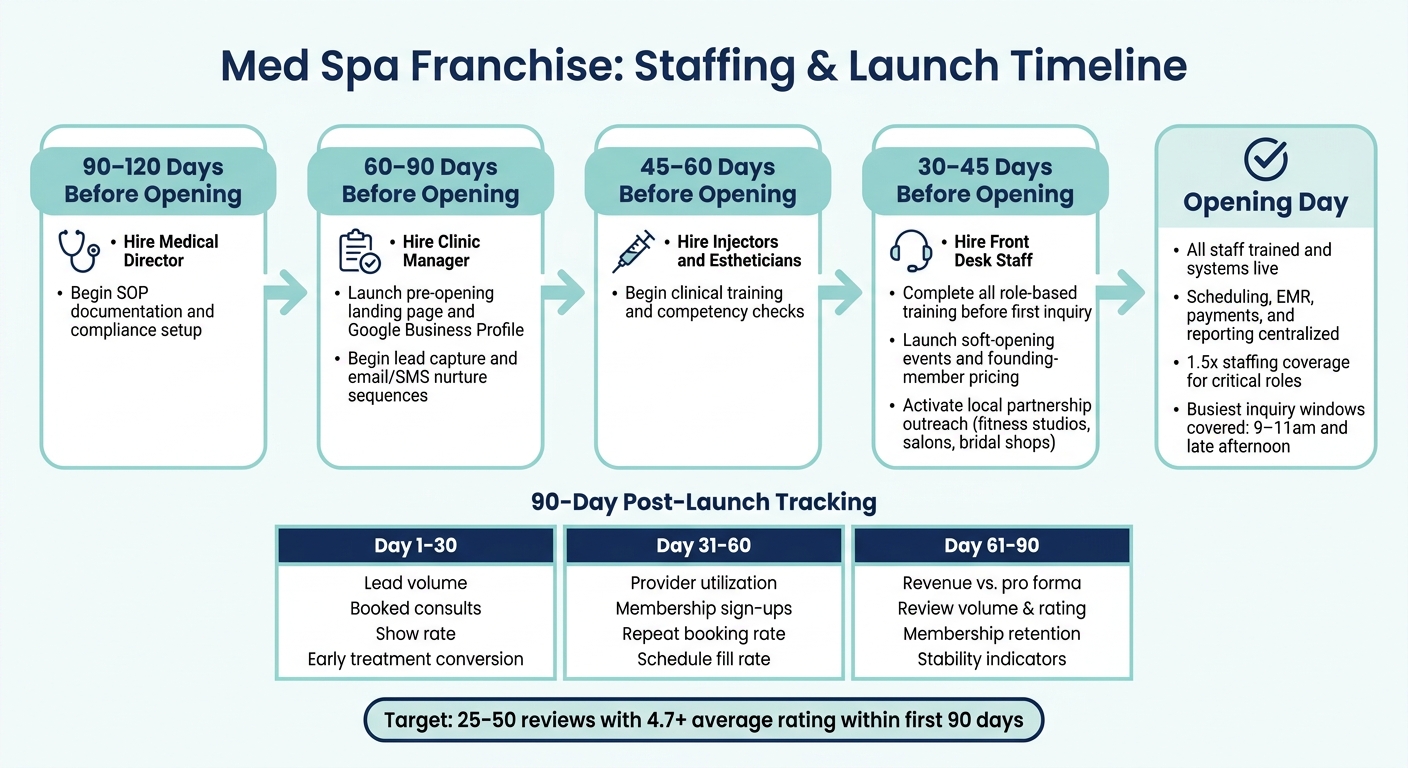
Med Spa Franchise Scaling Roadmap: Staffing Timeline & Launch Checklist
Once the site gets the green light, opening day comes down to three things: people, training, and control. A location may look ready on paper, but if the team isn’t in place and the day-to-day systems aren’t set up, the founder ends up getting pulled into every small issue. And that’s exactly what you want to avoid.
Build a staffing plan by role and hire date before opening
Start with the service mix approved during market validation, then build staffing around it. The simplest way to do this is to work backward from opening day.
- Secure the medical director 90 to 120 days out
- Hire the clinic manager 60 to 90 days out
- Add injectors and estheticians 45 to 60 days out
- Bring on front desk staff 30 to 45 days before launch
Front desk training needs to be done before pre-opening inquiries begin. If calls and messages start coming in and the team isn’t ready, that first impression can fall apart fast.
It also helps to plan 1.5x staffing coverage for critical roles and write down backup coverage in advance. Stagger shifts so the busiest inquiry windows are always covered, especially 9:00 a.m. to 11:00 a.m. and the late-afternoon rush.
Once those roles are filled, the next step is making sure everyone is trained the same way.
Use standardized training to protect consistency and compliance
Training should be role-based, checked off, and completed before anyone works without supervision. That’s the baseline.
For clinical staff, this includes documented procedure manuals, supervised practice, and competency checks for protocols, charting, consent, and emergency procedures. For front desk staff and coordinators, it means using scripted flows for consultations, payments, membership conversations, and service recovery.
Cross-training matters more than many operators expect. One callout can throw off the whole day if only one person knows how to handle a key task. Patient coordinators who can jump on phones and adjust schedules, and front desk staff who can handle basic intake and chart prep, give the location breathing room without adding extra headcount. Train at least two people on every critical task.
Those standards are much easier to keep in place when scheduling, records, and payments all run through one shared setup.
Centralize scheduling, records, payments, and reporting across locations
Separate systems make it harder to spot trouble. One platform for scheduling, clinical records (EMR), payments, and reporting gives you a single view across the network.
With shared systems, you can check provider utilization, no-show rates, and booking lead times by site without digging through different tools. Problems also stand out sooner, like a location with high refund rates or low consult-to-treatment conversion, before they cut into revenue. Prospyr supports this visibility with CRM/EMR integration, scheduling, digital intake, payments, communication, lead capture, automation, AI tools, task management, membership management, and analytics in one HIPAA-compliant platform.
That shared view sets the benchmark for the first 90 days.
Launch marketing and the first 90 days
With the playbook, staffing, and systems in place, the next job is filling the schedule. That takes a phased rollout, not just a social post on opening day.
Run pre-opening outreach and get the front desk ready to book
The pre-opening window should begin 60 to 90 days before opening. In this stage, the main job is setting up the basics that drive bookings later: build a location-specific landing page for the new site, claim and tune the Google Business Profile, set up lead capture forms that tag each inquiry by source, and launch email and SMS nurture sequences so leads are warmed up before the schedule opens.
At 30 days out, the focus shifts from setup to conversion. Soft-opening events, private previews, founding-member pricing, and local partnership outreach usually make the biggest difference. Fitness studios, salons, and bridal shops are common cross-promotion partners because they reach a similar audience. Use the franchise event template, but pick partners that fit the neighborhood.
Use brand templates, but tailor the offer and message to the local market. A higher-income area may respond better to messaging around injectable artistry and concierge memberships. A suburban location may book more appointments with package pricing for laser hair removal or body contouring. Prospyr supports this setup with lead capture, email/SMS automation, booking, and social management, so the corporate team can send brand-aligned templates while each location adjusts the details.
Before any campaign goes live, train the front desk on phone, SMS, and web chat scripts so inquiries turn into bookings fast. Staff should know when to escalate clinical questions, and the booking flow should move a lead from inquiry to confirmed appointment in as few steps as possible.
Then comes the part that tells you what’s working: measuring booked demand.
Track launch metrics against your pro forma at 30, 60, and 90 days
Once launch campaigns are live, track results at 30, 60, and 90 days against the pro forma. The first 90 days should be treated like a structured review period, not just a revenue ramp. What matters most changes at each stage.
| Timeframe | Primary Focus | Key Metrics |
|---|---|---|
| Day 1–30 | Awareness and early demand | Lead volume, booked consults, show rate, early treatment conversion |
| Day 31–60 | Schedule fill and recurring revenue | Provider utilization, membership sign-ups, repeat booking rate |
| Day 61–90 | Stability and retention | Revenue vs. pro forma, review volume and average rating, membership retention |
If show rates are below the flagship benchmark, the fix is often operational. That can mean tighter SMS confirmation sequences, deposit rules for high-demand slots, or appointment times that line up better with local work schedules.
If treatment conversion is weak even when consult volume looks strong, the problem is more likely inside the consult itself. Maybe recommendations aren’t clear. Maybe financing options aren’t being offered. Maybe the flow feels rushed.
Low membership sign-ups can point to a pricing or tier mismatch with local income levels. In that case, test an alternate founding-member rate before making a permanent pricing change.
The goal is to treat early gaps as data, not as failure. Centralized analytics in Prospyr let corporate and local managers see whether a gap is isolated to one site and respond before it snowballs. Review volume should be tracked alongside booking metrics from day one. Reaching 25 to 50 reviews with an average rating of 4.7 or higher within the first 90 days is a useful early benchmark for local search visibility and patient trust.
Conclusion: What it takes to scale a med spa franchise to new locations
Scaling a med spa franchise is usually less about reinventing the business and more about doing the basics the same way, again and again, without letting standards slip.
It starts with a flagship location that has already proved itself. That means steady revenue, strong patient retention, and clean compliance over at least 12 to 18 months. From there, the job is to turn what worked into a clear playbook for service mix, staffing, KPIs, and SOPs. If that playbook doesn't exist, each new location ends up making things up as it goes. And that tends to lead to uneven patient experiences, more compliance risk, and weaker margins.
That playbook matters. But it doesn't replace careful market screening.
Site selection and market validation are the make-or-break step. Franchise templates can set minimum thresholds, but local data is what tells you whether those thresholds mean anything in that market. A site that performs well in one city can struggle in another if demand is weaker or competition is too crowded. National benchmarks help you get started. They are not automatic approval. Once a site passes that test, the next bottleneck is usually staffing.
As locations increase, operations get harder to manage. That's why staffing needs to start early, not at the last minute. In practice, that means:
- Hiring a clinic manager and front desk team 60 to 90 days before opening
- Bringing in core providers 30 to 60 days before launch
- Finishing standardized training before the first patient visit
Those steps often mark the line between a smooth opening and a rough first month.
After launch, shared systems for med spas help keep that model steady across locations. Prospyr can support that setup in one HIPAA-compliant platform for scheduling, CRM/EMR, payments, analytics, and marketing automation. Then the focus shifts to the new location's first 90 days, because that's where the model gets tested under pressure.
Franchise systems can reduce variation, but local judgment still carries a lot of weight. The playbook gets a location to opening day. Local data and day-to-day execution decide whether it can grow from there. The teams that expand well tend to treat early gaps as signals, not failures, and fix them before small issues turn into bigger ones.
FAQs
How do I know when my first med spa is ready to scale?
Your first med spa is usually ready to scale once it reaches steady profitability. For most owners, that happens around 12 to 24 months in.
Before you expand, the first location should hit its revenue targets on a consistent basis. During the ramp-up phase, that often means bringing in about $15,000 to $30,000 per month. Once the business is established, the bar is much higher: $120,000+ per month.
It’s not just about top-line revenue, though. You also want the business to run in a repeatable way. That means having standardized operating procedures, a centralized practice management system like Prospyr, and enough cash on hand to cover 6 to 12 months of operating expenses for the new site.
What should I prioritize before signing a lease for a new location?
Before you sign a lease for a new med spa location, make sure the site works legally and day to day.
Start with the local planning department. You need to confirm that medical aesthetic services are allowed at the exact address, not just somewhere in the same shopping center or general area. Then check the Certificate of Occupancy to make sure it covers medical use.
That’s only part of the picture. You also want proof that the location makes sense from a business and build-out standpoint, and that you have a way out if zoning or permitting falls apart.
Look for:
- At least 50,000 women ages 25 to 65 within a 15-minute drive
- Median household income above $100,000
- Adequate electrical capacity
- Private consult rooms
- HIPAA-compliant data security
It’s also smart to think through your exit path before committing. If zoning or permitting fails, you don’t want to be stuck holding a lease on a space you can’t use as planned.
How much should local market data change the franchise playbook?
Local market data should sharpen a standard franchise playbook, not take its place. The main system keeps the brand consistent, while local data shows whether demand in a given area lines up with the business model.
That data should shape key decisions like site selection, service menu changes, and local marketing. Looking at zoning rules, competitor density, and search trends helps you apply the playbook where it has the best shot at turning a profit.
