If your clinic misses just one wage rule, payroll errors can turn into overtime claims, tip-credit issues, or recordkeeping problems. In Florida, the first numbers to check are simple: the state minimum wage is $14.00 per hour through 09/29/2026, then $15.00 per hour starting 09/30/2026, and most nonexempt staff must get 1.5x pay after 40 hours in one workweek.
Here’s the short version of what I’d check before every payroll run:
- Pay rates: Make sure each nonexempt employee is at or above Florida minimum wage.
- Classification: Confirm exempt roles meet the salary and duties tests. A title alone does not decide it.
- Overtime: Pay overtime after 40 hours in a fixed 168-hour workweek. Do not average hours across weeks.
- Regular rate: Include nondiscretionary bonuses, commissions, and shift differentials when overtime is figured.
- Tips: If you use a tip credit, keep the notice on file and make sure cash wages plus tips hit minimum wage.
- Breaks: Rest breaks under 20 minutes are paid. Meal periods are unpaid only if the employee is fully off duty.
- Time records: Track actual daily hours, missed punches, meal periods, and all edits.
- Audits and manager controls: Review payroll analytics before each pay date and train managers to record and pay all time worked.
A few clinic trouble spots stand out. Front desk staff, medical assistants, and patient coordinators are often nonexempt. Auto-deducted lunches can create pay errors if staff work through them. And tipped spa roles need extra review because Florida uses a $3.02 tip credit.
Use this checklist as a pay-period review tool: check rates, hours, tips, breaks, records, and corrections before payroll is approved.
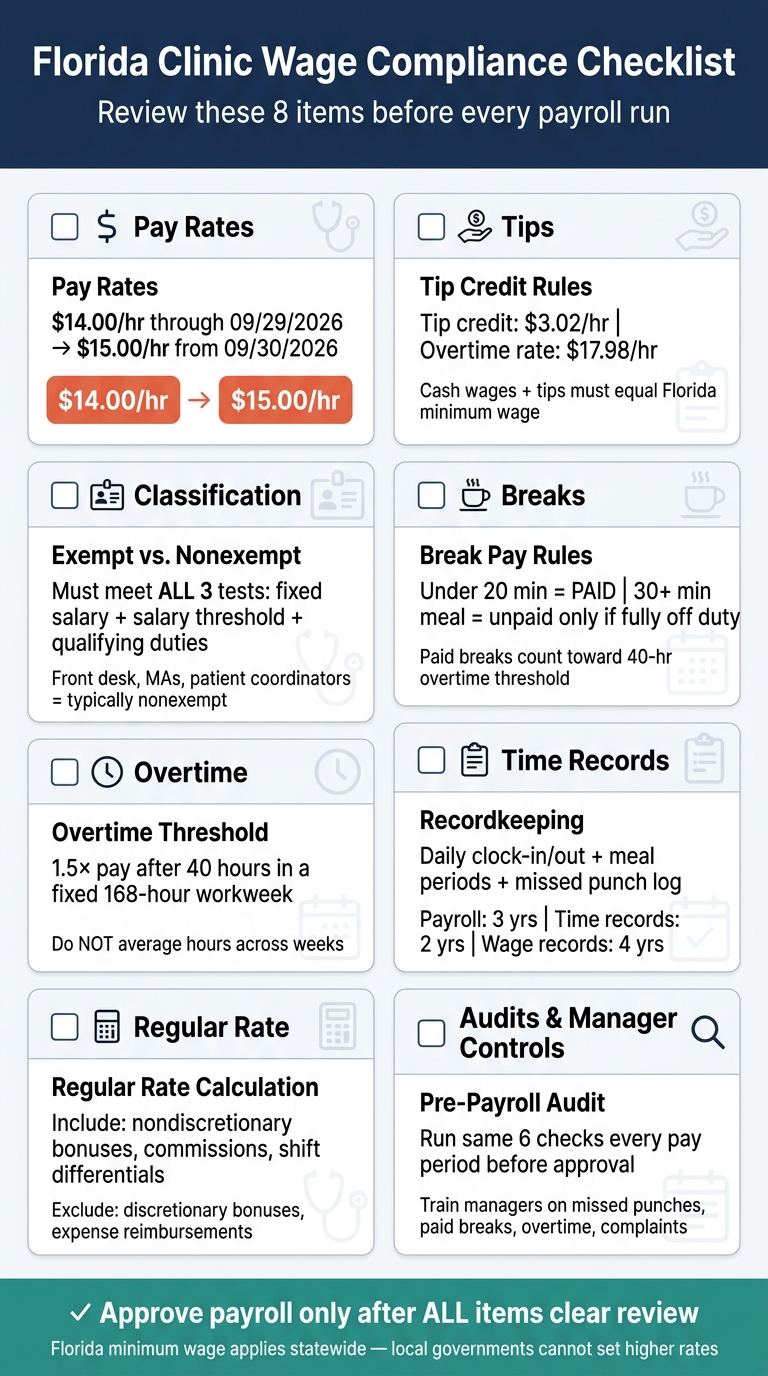
Florida Clinic Wage Compliance Checklist: Key Rules Every Pay Period
Florida wage rates and employee classification
Check the current Florida minimum wage and pay rates
Before each payroll run, make sure every nonexempt employee’s base rate meets the current Florida minimum wage. In Florida, the minimum wage is $14.00 per hour through September 29, 2026, and then moves to $15.00 per hour on September 30, 2026. This rule applies to all employers in the state, and local governments can’t set a higher minimum wage.
One point that trips people up: shift differentials don’t fix a base rate that falls below minimum wage.
After you confirm base pay, the next step is role classification. That’s what determines how minimum wage and overtime rules apply.
Review exempt vs. nonexempt status for clinic roles
Pay rate comes first. Exempt status answers a different question: does overtime apply? A salary by itself does not make someone exempt. The role has to meet all three tests.
- Fixed salary: The employee is paid a set salary that isn’t reduced based on hours worked or quality of work
- Meets threshold: The employee meets the current federal salary threshold in effect at the time of classification
- Qualifying duties: The employee’s main duties fall under the executive, administrative, or professional categories
Use the federal salary threshold that is in effect at the time you classify the employee.
In most clinics, roles like front desk staff, medical assistants, and patient coordinators are nonexempt by default. That’s usually true no matter how the title sounds or how the employee is paid. The biggest trouble spot tends to be mixed-duty roles. For example, a patient coordinator who mainly handles scheduling and check-ins is usually still nonexempt, even if the title sounds like a leadership role.
For managers and administrative staff, look at what the person actually does day to day, not just the label on the org chart. A “practice manager” who spends most of the workweek on routine digital intake or clerical work may not meet the executive or administrative duties test. Write down which exemption test you used, and review that classification any time the job duties change.
Once you’ve set status, the next payroll check is overtime, which turns on the hours worked by nonexempt employees.
sbb-itb-02f5876
Overtime pay, tips, and break rules
With classifications set, move to the time-based checks that most often lead to wage claims: overtime, tips, and breaks.
Set overtime to trigger after 40 hours in a workweek
Once pay rates and classifications are in place, review hours, tips, and breaks before payroll closes. Overtime starts after 40 hours in a fixed workweek, not per day. So if a medical assistant works four 12-hour days in one week, that employee is not owed overtime unless total hours go past 40.
Set a fixed 168-hour workweek in your payroll system, such as Sunday 12:00 a.m. through Saturday 11:59 p.m. Do not average hours across weeks. Each workweek stands on its own.
The overtime rate is 1.5× the regular rate. That regular rate includes nondiscretionary bonuses, commissions, and shift differentials. It does not include discretionary bonuses or expense reimbursements. Here’s how that works in practice:
If a medical assistant earns $18/hour, works 45 hours, and receives a $90 nondiscretionary productivity bonus that week, add straight-time pay and the bonus, divide by 45 hours, then pay 1.5× the resulting regular rate for the five overtime hours.
After overtime, check whether any tipped role still meets Florida’s minimum wage for the pay period.
Apply tip credit rules carefully for tipped staff
Most clinic jobs are not tipped. But if you have tipped spa or wellness roles, tip-credit rules apply. If your clinic takes a tip credit, give the employee written notice that covers:
- The cash wage
- The tip credit amount
- The fact that tips belong to the employee
- Your duty to make up any shortfall
Keep that notice on file and update it when the minimum wage changes.
Cash wages plus tips must equal at least Florida’s minimum wage. If tips come up short, you make up the gap in cash. For overtime, use this formula: full minimum wage × 1.5 − tip credit. Using Florida’s $14.00/hour minimum wage and a $3.02/hour tip credit, the overtime rate for tipped employees is $17.98 per overtime hour.
Then turn to breaks, because paid breaks and interrupted meal periods can change the weekly hour total.
Pay short breaks and track unpaid meal periods correctly
Florida does not require meal or rest breaks for adult employees. But if your clinic offers them, federal rules decide whether that time is paid. Short breaks under 20 minutes are paid time, and they count toward the 40-hour overtime threshold. In plain terms, a few short breaks during the week can push an employee over 40 hours.
Meal periods of 30 minutes or more are unpaid only if the employee is fully relieved of duties. If someone answers phones or keeps an eye on a patient during lunch, that time must be paid and counted toward overtime. This is where clinics get tripped up, so manager training matters. If the break is unpaid, work needs to stop.
For healthcare facilities with more than 50 employees, Florida Statute § 450.087 adds another rule: the employee must get at least a 30-minute unpaid meal break when working six or more consecutive hours, and that break must happen no later than the end of the fifth hour. If your clinic is over that threshold, check this rule on its own rather than folding it into your general break policy.
Time records, payroll audits, and manager controls
Once pay rules are in place, the next step is simple: make sure the time records, payroll review, and supervisor controls behind each paycheck are solid. Most wage problems don’t start in payroll. They start earlier, with bad time data, missed approvals, or loose manager habits.
Require complete daily time records for nonexempt staff
Every nonexempt employee - front desk staff, treatment coordinators, medical assistants, and anyone else whose schedule shifts with patient volume - needs a daily time record showing the actual hours worked. That means actual clock-in and clock-out times, unpaid meal-period start and end times, plus a log for missed punches or corrections.
When someone needs to fix a time entry, don’t let it happen quietly in the background. Require both the employee and the supervisor to sign off, and include a short written note that explains what happened. Keep the original timestamp and the corrected entry in the record.
Record retention matters too. Keep payroll records for three years, supporting time records for two years, and hold onto all wage records for four years to cover Florida claims.
If your system auto-deducts 30-minute lunches, set a clear rule: managers must override the deduction when an employee works through the break, and each override needs documentation. If records are incomplete, a court can accept the employee’s reasonable estimate of hours worked.
Run payroll audits before every pay date
Run a pre-payroll audit before every pay date. Use the same checks each pay period so mistakes show up before payroll is processed.
| Audit check | What to verify |
|---|---|
| Minimum wage | Flag any nonexempt rate below the current Florida minimum wage |
| Overtime accuracy | Confirm all hours over 40 were paid at 1.5× the regular rate |
| Regular-rate validation | Include nondiscretionary bonuses, commissions, and shift differentials |
| Tip-credit review | Confirm cash wages plus tips meet the minimum wage and notices are current |
| Time record reconciliation | Match timekeeping entries to payroll and flag missing days or sudden drops |
| Manual adjustments | Attach a documented reason and manager approval to every override |
Clinics using Prospyr can catch overtime spikes, missed breaks, and other payroll risks before payroll closes.
Train managers to enforce wage policies consistently
Payroll fixes won’t stick if supervisors handle timekeeping differently from one department to the next. Managers are the ones who make wage policy work - or let it slip. If a nonexempt employee performs work, that time must be recorded and paid, even when the work was not preapproved.
Train managers on the basics that tend to cause trouble:
- Missed punches
- Paid breaks
- Overtime response
- Retaliation-free complaint handling
When a payroll error shows up, move fast. Pay the shortage right away, fix the root cause, retrain the supervisor, and audit that department more often for the next few pay periods.
Conclusion: The core wage compliance checks Florida clinics should review every pay period
Wage compliance isn't a one-time task. It's a payroll habit.
By this stage, the checklist should be built into every payroll run. Before payroll closes each pay period, review wage rates, worker classification, overtime, tips, breaks, and time records. The logic is simple: repeated checks help stop avoidable pay errors. They also keep small mistakes from turning into wage claims.
A pre-payroll audit and manager training can help catch problems early. Clinics using Prospyr can pull from scheduling and time data to make payroll reconciliation faster. Run the same checks every pay period, document any corrections, and approve payroll only after each item clears review.
FAQs
How do I classify clinic staff correctly?
Classify workers as W-2 employees or independent contractors (1099) based on how much control your clinic has over their work.
If you decide when, where, and how the work gets done, and you supply the tools or equipment, that worker is usually an employee.
The main factors to look at are:
- Behavioral control: Who directs how the work is done?
- Financial control: Who controls payment, expenses, and business-related costs?
- The overall relationship: Is the role built into the clinic’s day-to-day work, and how is the arrangement set up?
Roles that sit at the heart of your clinic, such as aesthetic treatments, are often treated as employee work. That makes sense. If someone is doing the thing patients come to your clinic for, the line starts to look a lot more like W-2 than 1099.
Document each classification with care. If anyone ever asks why a worker was labeled one way or the other, you’ll want a clear paper trail that shows your reasoning.
What counts toward the regular rate for overtime?
The regular rate includes the employee’s hourly wage, plus nondiscretionary bonuses and commissions. Employers use this rate to calculate overtime pay at 1.5 times the regular rate for any hours worked over 40 in a 168-hour workweek.
That means overtime isn’t based only on the base hourly wage. If an employee earns extra pay through bonuses or commissions that must be counted, those amounts need to be part of the math too.
Track these payments carefully and include them the right way. Small payroll mistakes can turn into back pay claims and legal penalties fast.
What records should a clinic keep for wage compliance?
Clinics should keep payroll and employment records for at least three years, although some states or local rules may require more time.
That means holding on to core employee details such as names, Social Security numbers, addresses, occupations, daily and weekly hours worked, pay rates, wages paid, and any commissions, bonuses, or deductions.
It also helps to keep the records that explain how pay and work status were handled, including:
- Employment contracts
- Work schedules
- Time cards
- Tax forms
- Worker-classification documentation
- Records of leave
- Records of pay disputes
This paperwork creates a clear trail if questions come up later about hours, pay, leave, or job status.