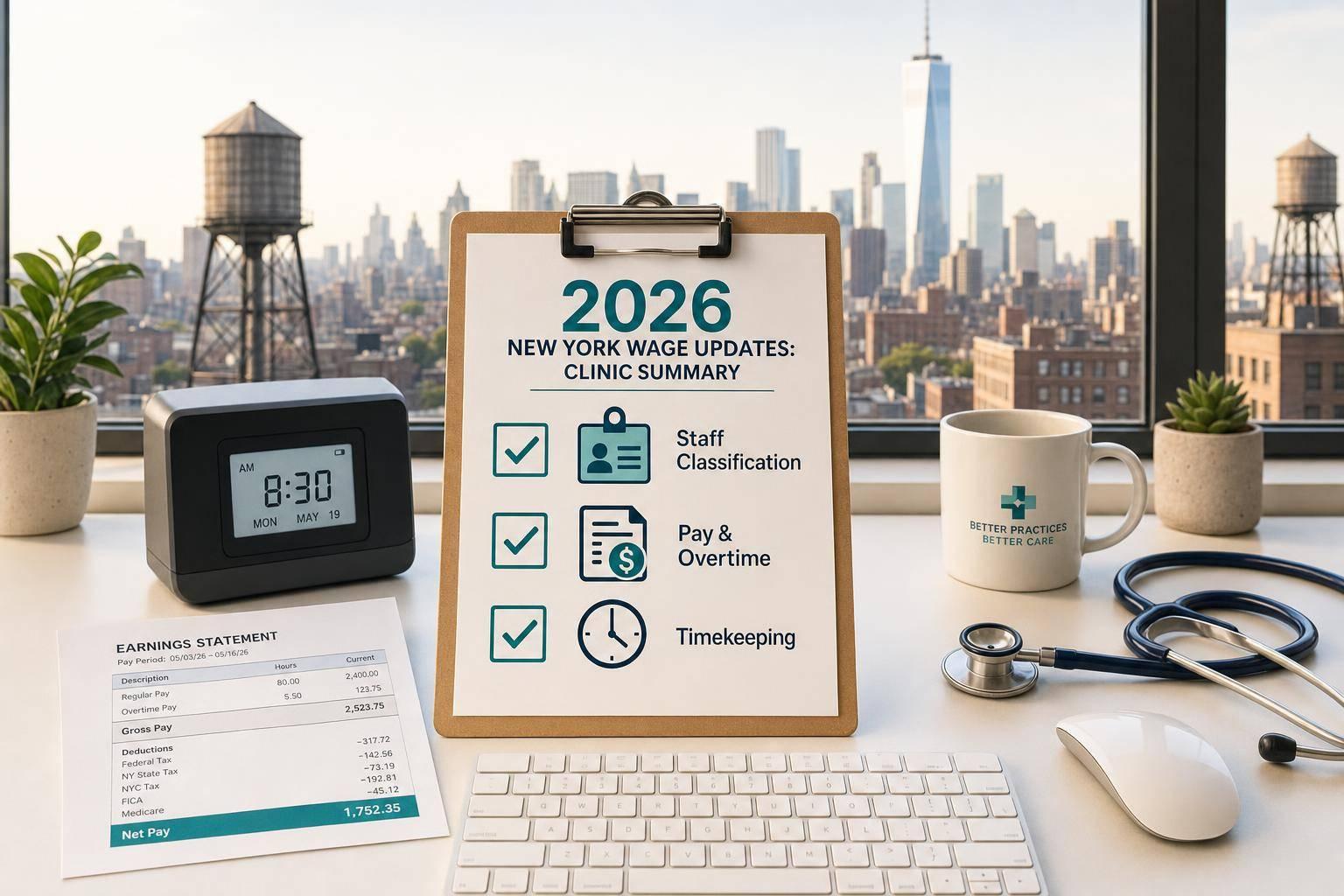

If I run a New York clinic, I’d review pay rates, overtime rules, and exempt status before the first January 2026 payroll. The big numbers are simple: $17.00/hour in New York City, Long Island, and Westchester, $16.00/hour in the rest of the state, plus new weekly exempt salary floors of $1,275.00 downstate and $1,199.10 elsewhere.
Here’s the short version:
- Minimum wage changes by location
- Overtime stays at 1.5x the worker’s regular rate
- Exempt status is not about title alone
- Managers under the new salary floor may need reclassification
- Employee vs. contractor status should be checked first
- Time records should cover all hours worked
- Payroll records should be kept for 6 years
One point I would not miss: New York uses one regional split for minimum wage and a slightly different one for exempt salary thresholds. That can lead to payroll mistakes if I lump all New York worksites together.
A few clinic roles need close review: practice managers, assistant managers, front-desk leads, office managers, marketing coordinators, estheticians, and nurse injectors. The main question is simple: who is hourly, who is salaried, and who still passes both the pay test and duties test?
| Item | Downstate | Rest of New York |
|---|---|---|
| Minimum wage | $17.00/hour | $16.00/hour |
| Minimum overtime floor | $25.50/hour | $24.00/hour |
| Exempt salary threshold | $1,275.00/week | $1,199.10/week |
If I were summarizing this article in one line, it would be this: check classification first, then update pay, overtime, schedules, and time tracking for January 1, 2026.
2026 New York minimum wage and overtime rates

2026 New York Wage & Exempt Salary Thresholds by Region
New York sets minimum wage by region, so the first step is simple: figure out whether your clinic is downstate or in the rest of New York State before you change payroll.
Downstate vs. rest-of-state minimum wage
New York uses a two-tier system. If your clinic is in New York City, Long Island, or Westchester County, the minimum wage for 2026 is $17.00 per hour. If your clinic is anywhere else in the state, the minimum wage is $16.00 per hour.
That split matters more than it may seem at first glance. A clinic in Brooklyn and a clinic upstate are both in New York, but they do not follow the same wage floor.
Overtime pay benchmarks based on the new wage floor
Overtime must be paid at 1.5 times the employee's regular rate. Using the 2026 minimum wage as the starting point, the minimum overtime rates come to $25.50 per hour downstate and $24.00 per hour in the rest of the state.
| Region | 2026 Minimum Wage | 2026 Overtime Rate (1.5x) |
|---|---|---|
| New York City | $17.00 / hour | $25.50 / hour |
| Long Island | $17.00 / hour | $25.50 / hour |
| Westchester County | $17.00 / hour | $25.50 / hour |
| Rest of New York State | $16.00 / hour | $24.00 / hour |
One detail is easy to miss: overtime is based on the employee's regular rate, not just the legal floor. So if someone earns more than the minimum wage, you should calculate overtime from that higher hourly rate.
These hourly figures also serve as the starting point for exempt-salary checks in the next section.
sbb-itb-02f5876
Exempt salary thresholds for managers and administrators
New York also applies a weekly salary test to exempt managers and administrators.
Starting January 1, 2026, the minimum weekly salary is $1,275.00 in New York City, Nassau, Suffolk, and Westchester counties and $1,199.10 in the rest of New York State. On an annual basis, that comes to $66,300.00 per year downstate and $62,353.20 per year in the rest of the state.
| Region | Weekly Threshold | Annual Equivalent |
|---|---|---|
| New York City, Nassau, Suffolk, and Westchester counties | $1,275.00 / week | $66,300.00 / year |
| Rest of New York State | $1,199.10 / week | $62,353.20 / year |
One detail can trip people up: New York uses a different county grouping for the salary test than it does for the minimum wage. For clinics, the practical issue is simple. Which current managers and administrators now sit below the new exempt pay floor? Use the New York salary thresholds when deciding exempt status.
Who may lose exempt status in 2026
A job title by itself doesn't lock in exempt status. For example, a practice manager paid $60,000 per year is below the $1,275.00 weekly threshold that applies in New York City, Nassau, Suffolk, and Westchester counties as of January 1, 2026. In that case, the employee would be eligible for overtime under state law unless the clinic increases pay or reclassifies the role.
To qualify as exempt, an employee has to pass both tests:
- The salary level test
- The duties test
The duties test means the employee's main work must be managerial or administrative in day-to-day practice, not mostly clerical or routine tasks.
Clinic roles most likely affected by the salary test
In aesthetic and wellness clinics, the roles most likely to be affected include practice managers, assistant managers, front-desk leads, and operations coordinators. These titles can sound administrative on paper, but some employees in those roles may still fall under the 2026 cutoff.
Owners should review both pay and actual job duties for each role. Focus on what the person does each day, not just the title. A coordinator handling routine clerical work may not qualify as exempt, while a supervisor with real hiring or staffing authority may.
That kind of review helps clinics spot which roles may need reclassification, pay adjustments, or tighter time tracking.
How these changes affect roles in med spas and aesthetic clinics
Once new pay floors are in place, clinics should split hourly and salaried roles for review.
Hourly non-exempt roles
Licensed estheticians and nurse injectors (RNs) usually work as employees when the clinic controls how the job gets done, so they should generally be treated as non-exempt unless legal counsel says otherwise. When the practice sets schedules, supplies equipment like lasers and injectables, and requires staff to follow set treatment protocols, that level of control points to employee status.
Get this wrong, and the cost can add up fast. Misclassification can lead to penalties and back-pay exposure.
After that, the same review should move to salaried roles that may no longer pass the exemption test.
Salaried roles that need status review
The big 2026 checkpoint is simple: do salaried team members still meet the test for exemption? Office managers, assistant managers, and marketing coordinators all need a close look, because a job title by itself does not decide classification.
Here’s how common clinic roles usually line up:
| Role | Likely Status | Classification Cue |
|---|---|---|
| Nurse Injectors (RN) | Employee | Supervised clinical role |
| Licensed Estheticians / Techs | Employee | Work is part of the clinic's core business |
| Marketing Coordinators | Employee | Employee; clinic control |
| Office Managers | Employee | Employee; clinic control |
That role-by-role review should flow straight into payroll, scheduling, and recordkeeping changes.
Action items for clinic owners before 2026
After role reviews, update payroll, timekeeping, and records for the January 1, 2026 rules. Then make sure payroll and timekeeping match those job classifications.
Payroll, scheduling, and recordkeeping updates
Start with a worksite pay audit. If your clinic operates in more than one location, you may need different payroll settings for downstate and upstate worksites. Before you run the first payroll of 2026, check each non-exempt pay rate and confirm the overtime calculation.
Review every exempt salary against the 2026 weekly threshold: $1,275.00 in NYC, Long Island, and Westchester; $1,199.10 in the rest of New York State. Then compare the cost of a salary increase with the cost of reclassifying the role before that first 2026 payroll. In plain terms, it’s a simple tradeoff: do you lift pay to keep the exemption, or move the role to non-exempt and track hours?
Payroll settings only work if time records are complete. That means tracking all hours worked, not just scheduled time. Include prep work, cleanup, meal breaks, training, schedule changes, and after-hours charting or client communication. If someone does work off the clock, record it. Keep payroll records for at least six years.
Here’s a practical pre-2026 checklist:
| Step | What to Verify |
|---|---|
| Pay rate audit | Correct 2026 minimum wage by work location |
| Exempt salary review | Weekly salary meets the applicable regional threshold |
| Duties test check | Exempt employees also satisfy the executive or administrative duties test |
| Timekeeping review | All hours captured, including prep, cleanup, and off-schedule work |
| Payroll settings update | Regional rates, overtime multiplier, and bonus/commission rules configured |
| Recordkeeping | Six-year retention policy in place for hours, rates, and pay adjustments |
Using Prospyr to support schedule and task tracking

Prospyr's scheduling and task tools keep schedules, task assignments, and staff communications in one place. That makes it easier to compare scheduled hours with hours worked during payroll review.
FAQs
How do I know which New York rate applies to my clinic?
Pinpoint the exact place where your clinic operates. In New York, state law, regional rules, and local ordinances can all set different wage rates.
Check with your state tax agency to confirm which city or county rules apply. Then make sure your clinic follows the highest rate that applies in that location.
Should I raise a manager’s salary or reclassify the role?
It depends on whether the role still qualifies as exempt under federal and state law. Check both the salary threshold - $684 per week ($35,568 per year) - and the employee’s day-to-day duties.
If the manager no longer passes the salary test or duties test, you may need to reclassify the role from exempt to nonexempt. Write down the reasons behind the change and keep a record of your classification decision for compliance and audit purposes.
What hours do I need to track for non-exempt staff?
Track all hours worked for non-exempt staff so you stay in line with federal and state wage-and-hour laws. That means more than just time spent on a shift.
You also need to record time spent on required training, onboarding, paperwork, and software setup.
Here’s the simple rule: if a task is mandatory, tied to the job, or completed during regular work hours, it counts as paid time and should be tracked that way.
Prospyr can help bring work hours, commissions, and tips into payroll.